• العربية
  • فارسی
Brand
  • Iran Insight
  • Politics
  • Economy
  • Analysis
  • Special Report
  • Opinion
  • Podcast
  • Iran Insight
  • Politics
  • Economy
  • Analysis
  • Special Report
  • Opinion
  • Podcast
  • Theme
  • Language
    • العربية
    • فارسی
  • Iran Insight
  • Politics
  • Economy
  • Analysis
  • Special Report
  • Opinion
  • Podcast
All rights reserved for Volant Media UK Limited
volant media logo

Hardliner 'New York Gang' fueling Iran's isolation, centrist daily says

Behrouz Turani
Behrouz Turani

Iran International

Dec 19, 2024, 11:00 GMT+0Updated: 15:17 GMT+0
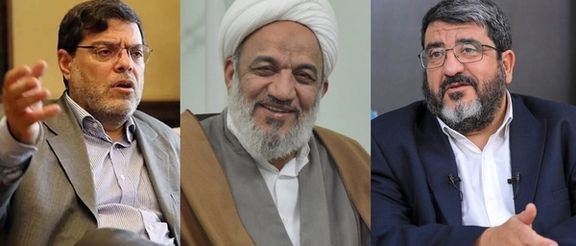
Iranian hardline politicians, (L-R) Marandi, Aqa Tehrani and Izadi

Iranian hardliners who ironically spent time in the United States are responsible for pushing policies which deepen Iran's isolation and weakness, a leading centrist news outlet fulminated this week.

A few of these hardliners, who were born or lived in the United States, have become a particular focus of criticism.

Entekhab wore on Tuesday that several hardliners with US ties—whether born, raised or having resided there—are promoting radical ideas in foreign policy. The paper regarded this as a strange phenomenon that people who benefited from education or experience in the United States are now promoting policies that could increase Iran's isolation.

The website featured images of several individuals with similar backgrounds, including political commentators Foad Izadi and Mohammad Marandi, as well as former Paydari Party leader Morteza Aqa-Tehrani. It further alleged that "all of these hardline figures support ultraconservative former nuclear negotiator Saeed Jalili."

Entekhab quoted Heshmatollah Falahatpisheh, the former head of the Iranian parliament's Foreign Relations and National Security Committee, criticizing Iranian ultraconservative academic Foad Izadi. Falahatpisheh remarked, "Izadi grew up, attended school, and lived in the United States for several decades. Yet, upon returning to Iran, he was appointed as a university faculty member and introduced on state television as a political expert on the United States. In all the programs he has participated in, he has done nothing but promote international tensions. Isn't there something wrong here?"

According to Entekhab, Izadi is a member of the ultraconservative Paydari Party. "Yet, he is not the only Iranian hardliner who grew up in the United States and lived there for some time."

Just last week, Mohammad Marandi, a vocal critic of Iran's nuclear agreement with the United States and other world powers, sparked controversy by suggesting that Iran might target Qatar, and a major US military base located there. Marandi, who frequently appears on Iranian state television and international channels to voice his anti-US rhetoric, raised the threat in an X post about a potential US attack on Iran’s nuclear facilities. He wrote: “Slight problem. The US Al Udeid air base is in tiny Qatar. In case of aggression, the natural gas facilities and infrastructure in Qatar will be totally destroyed. Hence, there will be no natural gas from Doha. Hence, there will be no Qatar. Things won’t end there either…”

According to Rouydad24 news website in Tehran, Mohammad Marandi was born in the US in 1966 form an Iranian father and an American mother. He is the son of Alireza Marandi who is Supreme Leader Ali Khamenei's family doctor. When he first came to Iran after his father was appointed health minister, he was only 13. He was part of Iran’s nuclear negotiating team in Vienna in 2021-2022.

Hardline cleric Morteza Aqa-Tehrani, who has denied holding US citizenship, acknowledged to the press that he possesses a green card, having lived in the United States for many years while serving as the Imam of an Iranian mosque in New York. Notably, Iran's parliament did not address his US residency status when enacting a law that prohibits US citizens and permanent residence permit holders from holding key positions in Iran.

Nonetheless, Mohammad Mohajeri, a former editor of hardline daily Kayhan pointed out that it was because of his US citizenship that Aqa-Tehrani was forced to step down from his position as the leader of the ultraconservative Paydari Party.

Entekhab wrote: "While the hardliners label former Foreign Minister Zarif and his aides as 'the New York Gang,' it seems these ultraconservative figures are the true members of that gang." The website also criticized Mohammad Marandi for his unrealistic claims that Europe would capitulate to Iran's demands during the "hard winter" of 2022 due to a need for Iranian natural gas. In reality, not only did Iran lack gas to supply Europe, but it was forced to purchase gas from Turkmenistan and struggled to pay for it. Marandi used the argument to persuade others that there was no need to make a nuclear deal in mid-2022 and Tehran could wait for the West to capitulate.

The website also charged that "Marandi and his hard winter theory were the main reason why Iran was not able to conclude successful negotiations with the West over its nuclear program."

Most Viewed

Ghalibaf defends Iran-US talks amid hardline backlash
1
INSIGHT

Ghalibaf defends Iran-US talks amid hardline backlash

2
INSIGHT

A nation in limbo: 100 days after the massacre, has the world moved on?

3
ANALYSIS

From instability to influence: Pakistan’s pivotal role in US-Iran diplomacy

4
ANALYSIS

100 days on: why Iran’s January protests spread across social classes

5

War-hit homeowners feel abandoned as Iran’s reconstruction aid fades

Banner
Banner

Spotlight

  • War-hit homeowners feel abandoned as Iran’s reconstruction aid fades

    War-hit homeowners feel abandoned as Iran’s reconstruction aid fades

  • 100 days on: the anatomy of Iran’s January crackdown
    INSIGHT

    100 days on: the anatomy of Iran’s January crackdown

  • Ghalibaf defends Iran-US talks amid hardline backlash
    INSIGHT

    Ghalibaf defends Iran-US talks amid hardline backlash

  • 100 days on: why Iran’s January protests spread across social classes
    ANALYSIS

    100 days on: why Iran’s January protests spread across social classes

  • From instability to influence: Pakistan’s pivotal role in US-Iran diplomacy
    ANALYSIS

    From instability to influence: Pakistan’s pivotal role in US-Iran diplomacy

  • A nation in limbo: 100 days after the massacre, has the world moved on?
    INSIGHT

    A nation in limbo: 100 days after the massacre, has the world moved on?

•
•
•

More Stories

Iran’s Central Bank to inject cash into market as rial hits record lows

Dec 19, 2024, 10:49 GMT+0

Iran’s Central Bank plans to sell foreign currencies next week in an effort to stabilize the rial, which has been losing value against the US dollar and other major currencies.

According to the Tasnim news website, affiliated with the Revolutionary Guard, the bank will inject 1.5 billion UAE dirhams and 300 million US dollars in cash into Tehran’s free exchange market.

The rial has depreciated by over 25% since September, driven by regional conflicts and Iran’s setbacks in Syria and Lebanon. On Thursday, the rial traded at nearly 770,000 per US dollar, a sharp drop from around 600,000 in September.

Since the establishment of the Islamic government in 1979, the Iranian currency has experienced an 11,000-fold decline in value.

Iran's economy minister summoned over currency slump, MP says

Dec 19, 2024, 08:32 GMT+0

Iran's minister of economy has been summoned to parliament for questioning due to currency fluctuations and their negative impact on the economy and people’s livelihoods, MP Abbas Goudarzi said Thursday.

“The representatives of the nation have summoned the minister of economy to parliament with questions, and if necessary, they will initiate impeachment proceedings,” Goudarzi said.

The Iranian rial plummeted to a historic low against the US dollar on Wednesday, trading at over 780,000 rials per dollar. The Iranian currency has lost about 50% of its value in less than a year.

A notable shock to the currency market occurred on November 6, when the dollar surged past 700,000 rials following news of Donald Trump’s victory in the US presidential election. However, the currency’s decline had already begun in September, triggered by severe setbacks inflicted by Israel on Iran's key regional proxy, Hezbollah, and an Israeli airstrike that destroyed much of Iran's air defenses.

Has Khamenei backtracked from strict hijab enforcement?

Dec 19, 2024, 07:15 GMT+0
•
Maryam Sinaiee

Iran's Supreme National Security (SNSC) may have shelved the controversial new hijab law, some lawmakers and the media outlets in Tehran say, most likely with the consent of Supreme Leader Ali Khamenei.

For months, the law imposing heavy fines and even prison sentences on women violating hijab regulations has sparked division among the public and even Islamic government politicians. During his election campaign, President Masoud Pezeshkian pledged to prevent the harsh treatment of women for hijab.

In response to a question from the semi-official Mehr News Agency Wednesday regarding the government’s actions concerning the Hijab and Chastity Law, which has been referred to the Supreme National Security Council (SNSC), Pezeshkian’s parliamentary deputy, Shahram Dabiri, told reporters that the government has so far requested the law “not to be promulgated, allowing for a decision to be made on it in the future.”

Dabiri added that Parliament Speaker Mohammad-Bagher Ghalibaf has urged the administration to propose an amendment bill, but whether such a bill will be submitted to the Parliament has yet to be decided.

The President heads the Security Council, but all its decisions require the Supreme Leader’s signature to come into effect.

Khamenei delivered a speech to a group of women Tuesday on the occasion of the birthday of the Prophet Mohammed’s daughter, Fatima, but quite uncharacteristically he did not make any reference to the new hijab law or the issue of hijab in general.

In a speech in April 2023, Khamenei asserted that flouting hijab was “religiously and politically haram (forbidden)”. He claimed that foreign intelligence services were encouraging Iranian women to disobey the mandatory hijab.

He also claimed that “the enemy” was working according to “a plan and plot” and urged authorities to have their own plan for dealing with the issue of women’s unveiling.

His statement at the time was widely interpreted as a directive to authorities to take whatever measures necessary to reassert control over women's appearance in public, a control that had diminished in the wake of the Woman, Life, Freedom protests.

A day after the speech, Ghalibaf said Khamenei's order was clear and promised to give precedence to any hijab-related motion or bill, and the police and other authorities including Tehran Metro security increased their pressure on women and businesses such as shops, restaurants, cafes to enforce hijab rules.

In recent days, several lawmakers, including Deputy Speaker Ali Nikzad, have confirmed that the Supreme National Security Council (SNSC) has decided to put the hijab law on hold for now. Speaking to the Khabar Online news website on Saturday, Nikzad admitted he was unsure how long the suspension of the law’s implementation would last.

Akbar Rajbarzadeh, another lawmaker, told Khabar Online that the SNSC's decision had to be obeyed because the Council is the highest decision-making body in national security matters.

“The Supreme National Security Council’s preclusion of the promulgation of a controversial law is almost unprecedented, or at least [such an incident] had never been given wide coverage by the media,” the conservative Khabar Online wrote Sunday.

It seems that with the SNSC’s interference, the public and the media will no longer be preoccupied with the controversial law, the conservative Tabnak on Sunday wrote. The step taken by the SNSC would help “the country’s stability and security given the extraordinary sensitivity of the regional and international situations.”

The SNSC consists of two representatives of the Supreme Leader, the heads of the three forces of the government, ministers of interior, intelligence, and foreign affairs, the chief of armed forces’ staff, the Revolutionary Guards (IRGC), and the regular Army commanders, and the head of the Planning and Budget Organization.

ECBA urges action after arrest of Iranian activist Reza Khandan

Dec 18, 2024, 13:55 GMT+0

The European Criminal Bar Association (ECBA) has issued an urgent request for international intervention on behalf of Iranian human rights activist Reza Khandan, the husband of prominent human rights lawyer Nasrin Sotoudeh.

Khandan was arrested on Friday after Iranian security forces raided his home. His daughter, Mehraveh Khandan, revealed in an Instagram post that her father was detained at his residence. The reason for his arrest has not been disclosed.

In its statement, the ECBA said Wednesday, “We call for an end to the judicial harassment of Reza Khandan and Nasrin Sotoudeh, in line with the UN Declaration on Human Rights Defenders and the UN Basic Principles on the Role of Lawyers.”

Khandan has been arrested in the past for his activism and his support of his wife’s campaign against Iran’s mandatory hijab laws.

Former Iranian President Rouhani: Hijab law neither just, Islamic, nor constitutional

Dec 18, 2024, 13:13 GMT+0

Former Iranian President Hassan Rouhani has criticized the newly approved hijab law, saying that it "aligns neither with the Constitution, nor with justice, nor with the Quran and Islamic culture."

"The Quran regards hijab as a means to ensure the safety of women, but unfortunately, some people view the issue of hijab as a tool for coercion," Rouhani said on Wednesday.

This comes as the Islamic Republic has officially postponed the implementation of the controversial hijab law, which imposes severe penalties on women and girls who defy veiling requirements, following significant backlash from both the public and the international community.

Iran's Supreme National Security Council, in a letter to the parliament on Saturday, requested that the process of implementing the Hijab and Chastity law be halted. A member of the Parliament's presiding board stated that the government intends to submit an amended bill to the parliament for further consideration.