• العربية
  • فارسی
Brand
  • Iran Insight
  • Politics
  • Economy
  • Analysis
  • Special Report
  • Opinion
  • Podcast
  • Iran Insight
  • Politics
  • Economy
  • Analysis
  • Special Report
  • Opinion
  • Podcast
  • Theme
  • Language
    • العربية
    • فارسی
  • Iran Insight
  • Politics
  • Economy
  • Analysis
  • Special Report
  • Opinion
  • Podcast
All rights reserved for Volant Media UK Limited
volant media logo

Iran preparing to respond to Israel's Oct. 26 attack - Khamenei's aide

Nov 24, 2024, 15:18 GMT+0Updated: 19:14 GMT+0
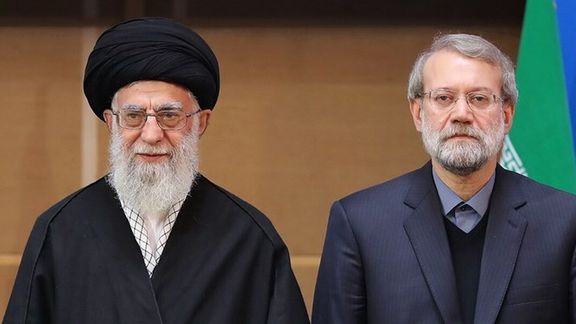
Iran's Supreme Leader Ali Khamenei and his advisor Ali Larijani

Iranian authorities are preparing to respond to Israel's October 26 attack on the Islamic Republic's military sites, an advisor to Iran's Supreme Leader Ali Khamenei said on Sunday.

"Military officials are planning various strategies to respond to Israel," Ali Larijani said in an interview with the IRGC-affiliated Tasnim News.

Iran has been threatening to retaliate against Israel over the air strikes, which according to Israeli and US officials, knocked out Iran's last three Russian-provided S-300 air defense missile systems and left the country "naked".

Larijani's remarks came shortly after the body of an Israeli rabbi was found in the United Arab Emirates following his abduction by an allegedly Iran-linked cell, giving rise to suspicions that his assassination may be related to Tehran's plan to avenge the Israeli attacks.

Washington's 'shadow war' against Iran

In his Sunday interview, Larijani accused the United States of orchestrating the Israeli actions in the Middle East, including its operations against Iran.

"Israel was counting on the United States' support when planning its operation against Iran, with many US resources and aircraft operating in the region to assist them," he said.

"It can be said with certainty that the Americans are orchestrating events here. But why are they doing this? Because they prefer to engage in a "shadow war," staying out of sight while pushing others into the forefront," the senior advisor to Khamenei said.

He also called on the incoming administration of Donald Trump to stop its support for Israel and prevent what he called the tarnishing of the US image in the region.

"It seems that the United States and its current leadership, which has undergone changes, need to gain a proper understanding of the situation. The officials of the Zionist regime (Israel) are drowning themselves and dragging the Americans down with them, tarnishing the US's reputation in the region," he said.

Trump’s incoming administration plans to revive its “maximum pressure” policy to “bankrupt” Iran’s capacity to support its so-called Axis of Resistance and pursue nuclear development, The Financial Times reported last week.

Trump’s team is preparing executive orders for his first day in office that would tighten existing sanctions and introduce new ones on Iran’s oil exports, the FT report said citing unnamed sources.

Most Viewed

Ghalibaf defends Iran-US talks amid hardline backlash
1
INSIGHT

Ghalibaf defends Iran-US talks amid hardline backlash

2
VOICES FROM IRAN

Bread shortages, soaring prices strain households in Iran, residents say

3
ANALYSIS

From instability to influence: Pakistan’s pivotal role in US-Iran diplomacy

4
ANALYSIS

100 days on: why Iran’s January protests spread across social classes

5

War-hit homeowners feel abandoned as Iran’s reconstruction aid fades

Banner
Banner

Spotlight

  • Is Iran entering its Gorbachev moment?
    INSIGHT

    Is Iran entering its Gorbachev moment?

  • Iran crackdown reaches cemeteries as graves of slain protesters defaced
    EXCLUSIVE

    Iran crackdown reaches cemeteries as graves of slain protesters defaced

  • Iran diplomacy wobbles as factions compete to avoid looking soft on US
    INSIGHT

    Iran diplomacy wobbles as factions compete to avoid looking soft on US

  • The politics of pink: how Iran uses cuteness to rebrand violence
    ANALYSIS

    The politics of pink: how Iran uses cuteness to rebrand violence

  • Bread shortages, soaring prices strain households in Iran, residents say
    VOICES FROM IRAN

    Bread shortages, soaring prices strain households in Iran, residents say

  • Ghalibaf defends Iran-US talks amid hardline backlash
    INSIGHT

    Ghalibaf defends Iran-US talks amid hardline backlash

•
•
•

More Stories

Rent in Iran soars by 42% over past year, joined by rising car and energy costs

Nov 24, 2024, 13:20 GMT+0

Recent statistics have shown sharp increases in housing rents and other essential costs as inflation soars amid Iran's worst economic crisis since the founding of the Islamic Republic.

Iran’s Statistics Center revealed that rental rates in urban areas rose by approximately 42% in the last 12 months compared to the same period last year. This rate significantly outpaced general inflation by 8.6 percentage points, despite a government-imposed cap of 25% on rent hikes announced in July.

Since July, following the implementation of a cap on rent increases, annual inflation in this sector, as reported by the Statistics Center, has been recorded at 41.4% in August, 41.7% in September, 41.8% in October, and now 41.7% in November.

Throughout these four months, rent inflation has exceeded general inflation. From September to November, rent inflation compared to general inflation has been reported to be higher by 6.6, 7.5, 8.2, and 8.6 percentage points, respectively.

The cost of renting has faced a significant surge since 2020, a combination of housing prices rising and the country's inflation rising since 2019. The government’s strategy of command pricing is not addressing the root causes of inflation, reported the financial newspaper Donya-e-Eqtesad.

A view from the capital Tehran (Undated)
100%
A view from the capital Tehran

Rental price inflation is part of a wider trend of rising costs in Iran, with recent moves by the government signaling potential price increases in gasoline and automobiles. It comes alongside rising energy costs and insufficient incomes.

The government recently authorized controversial measures to burn mazut in power plants to address the energy crisis, exacerbating environmental and public health concerns. Meanwhile, a resolution by the Economic Council mandates higher gas tariffs to curb overconsumption, further burdening households.

Simultaneously, domestic carmakers Iran Khodro and SAIPA announced price increases of up to 30% for their products, citing financial losses and heavy debts. Critics have called the car market one-sided, accusing the government of supporting monopolistic practices by banning imports.

The situation is reminiscent of the 2019 fuel price protests which saw widespread unrest and the deaths of hundreds of protesters. Economists warn that any rise in fuel prices could trigger inflationary shocks across the economy.

Hossein Raghfar, an economist at Al-Zahra University told Jamaran News: “Raising fuel prices without addressing systemic economic issues will harm everyone and increase tensions."

As the Iranian government struggles to manage rising costs and budget deficits, the consequences of inflation are felt acutely by ordinary citizens with one third of Iranians now living below the poverty line and basic goods like food becoming ever harder to afford.

Iran deploys advanced centrifuges in defiance of IAEA resolution

Nov 24, 2024, 12:21 GMT+0

Iran has begun deploying advanced centrifuges which enrich uranium for the country’s nuclear program in response to a resolution by the International Atomic Energy Agency (IAEA) calling for greater transparency into Iran's nuclear activities.

Speaking during an open session of parliament on Sunday, Mohammad Bagher Ghalibaf criticized the resolution, accusing the United States and European nations of using Iran's nuclear program as a pretext for unjustified actions.

He said, "The Islamic Republic of Iran's reciprocal response to this political misuse of the Board of Governors was immediately put into action, and the deployment of a set of new and advanced centrifuges has begun".

The IAEA resolution, backed by major Western powers, expresses concerns over Iran’s lack of cooperation in addressing undeclared nuclear sites and calls for full compliance with its obligations under the Nuclear Non-Proliferation Treaty. Tehran, however, has dismissed these concerns and accused the agency of undermining trust through such decisions.

In a statement, France, Germany, the US and the UK criticized Iran’s response on Saturday, emphasizing the lack of credible peaceful rationale for expanding its nuclear program.

They warned that Tehran’s actions could deepen mistrust and further destabilize diplomatic efforts to address its nuclear ambitions.

“[We] note with serious concern Iran’s announcement that, instead of responding to the IAEA resolution with cooperation, it plans to respond with further expansion of its nuclear program in ways that have no credible peaceful rationale."

They also added that with this resolution, the IAEA Board emphasizes the essential and urgent need for Iran to resolve outstanding issues.

The western nations raised hope that Iran will use the time leading up to this report to provide the necessary information and cooperation to address these concerns. Last year, Iran banned a third of the IAEA's inspectors throwing relations between the two into a crisis.

Centrifuges in Natanz, Iran (Undated)
100%
Centrifuges in Natanz, Iran

“[This way,] the Agency is able to provide assurance that Iran’s program remains exclusively peaceful, and the Board can close consideration of this matter. If it does not, it will be important that the Board remain engaged to meet the challenge that Iran’s continued refusal to meet its NPT-related nuclear verification obligations would present, including to the credibility of the global IAEA safeguards regime.”

The development comes amid the prolonged deadlock over reviving the 2015 nuclear deal, which Iran claims the resolution jeopardizes.

The IAEA’s calls for compliance and Iran’s defiance highlight the growing divide between Tehran and Western nations. As both sides dig in, the possibility of a diplomatic resolution to the nuclear standoff appears increasingly tenuous.

Iran says it will hold nuclear talks with UK, EU before Trump takes office

Nov 24, 2024, 10:14 GMT+0

Iranian foreign ministry spokesperson Esmail Baghaei confirmed Sunday that Tehran is set to hold nuclear talks with Britain, France, Germany, and the European Union on November 29th in Geneva.

Earlier in the day, Japan's Kyodo News Agency reported the meeting, citing several Iranian diplomatic sources.

The report indicated that Iranian President Masoud Pezeshkian's administration aims to resolve the nuclear impasse before the inauguration of the next US president, Donald Trump.

According to Baghaei, the upcoming talks with the three European countries are seen as a follow-up to meetings held with them on the sidelines of the United Nations General Assembly in New York.

“In this round of talks, which were planned in New York, a range of regional and international issues, including Palestine and Lebanon, as well as nuclear issues, will be discussed.”

Iranian Deputy Foreign Minister for Political Affairs Majid Takht Ravanchi, who previously served as Iran’s ambassador to the United Nations and was a member of the Iranian nuclear negotiating team for the JCPOA nuclear accord is said to be leading the negotiations.

There is no direct confirmation of scheduled talks from the European sides.

Earlier on Sunday, Iran's state-run ISNA news agency quoted the EU's lead spokesperson for foreign affairs, Peter Stano, as saying that the bloc is in contact with Iran regarding the prospect of resuming the talks. However, there is no independent source confirming Stano's statement.

The outgoing High Representative of the EU Josep Borrell and his team are in contact with Iran, other parties of the Joint Comprehensive Plan of Action (JCPOA), and also the United States to keep all communication channels open and maintain the possibility of meaningful nuclear negotiations, he said according to ISNA.

Stano also expressed hope for a swift resumption of nuclear diplomacy with Tehran, according to these reports.

"We hope that nuclear diplomacy can resume soon since a solution to the Iran nuclear issue cannot wait any longer. It will also be conducive to the stabilization of the region," he told the semi-official ISNA. "Diplomacy is the way to find solutions on sensitive issues and we have already reached out to the new President Pezeshkian and Foreign Minister Araghchi." However, this statement, if correct, is not a confirmation of any immediate talks.

Criticizing Tehran’s lack of transparency over its nuclear program, Stano noted, "The EU fully relies on the International Atomic Energy Agency (IAEA), and the agency's report regarding Iran's nuclear trajectory and lack of cooperation is very concerning.” "The EU is committed to a comprehensive political approach based on mutual respect," he added.

On November 21, 2024, the IAEA Board of Governors passed a resolution against Iran over its perceived non-cooperation with international inspections, saying it is not convinced that Iran’s nuclear program is peaceful. It has been asking questions and seeking clarification on several issues for years. But many remain unresolved.

The IAEA is calling on Iran to urgently improve its cooperation with the agency and provide a comprehensive report on its nuclear activities.

The resolution against Iran may prove a crucial step in building a case for more binding measures. It provides a basis for the parties to the JCPOA to claim Iran is violating its commitments and potentially initiate what is known as the Trigger Mechanism.

Trigger Mechanism is an informal term for a provision under the 2015 deal that allows signatories to reimpose Iran sanctions that were lifted under the agreement.

In 2018, the Trump administration withdrew the United States from the JCPOA and reimposed harsh sanctions on Iran. In response, Iran began violating the deal's nuclear limits, including stockpiling enriched uranium, enriching it to higher purity levels, and installing advanced centrifuges.

Indirect talks between the Biden administration and Iran to revive the deal have been unsuccessful. Despite this, Trump stated during his election campaign in September that a nuclear deal with Iran is necessary to avoid adverse consequences. "We have to make a deal, because the consequences are impossible. We have to make a deal".
Israelis warned to avoid UAE after killing of Moldovan-Israeli rabbi

Nov 24, 2024, 08:56 GMT+0

A young rabbi residing in the United Arab Emirates was confirmed dead on Sunday in what appears to be a targeted killing. If confirmed as a political assassination, it could signal a broader threat of attacks against Israelis abroad.

A statement by the Israeli foreign ministry and Prime Minster’s office, said: “The UAE intelligence and security authorities have located the body of Zvi Kogan, who has been missing since Thursday, November 21.

"The Israeli mission in Abu Dhabi has been in contact with the family from the start of the event and is continuing to assist it at this difficult time; his family in Israel has also been updated.“

The statement called the incident "an abhorrent act of antisemitic terrorism".

"The State of Israel will use all means and will deal with the criminals responsible for his death to the fullest extent of the law," the statement added.

Kogan, a young rabbi who once served in Israel's Givati Brigade, an elite unit of the army, worked in Dubai at the kosher supermarket which has since been closed temporarily. It was one part of the growing Jewish life which has been a byproduct of the 2020 US-brokered Abraham Accords facilitating diplomatic ties between Israel and countries including the UAE.

The community, which is now hundreds strong including Israelis and Jews from around the diaspora, is in shock after the event which comes amid already heightened security in the wake of the Gaza war.

Israel had listed the UAE as a level three, or medium threat, reiterating the warnings in the wake of the killing, advising it is a destination for essential travel only.

“This also serves as a reminder that for a while, per the recommendations of the National Security Council (NSC), there has been a level 3 – moderate travel warning issued for the UAE, with a recommendation to avoid any non-essential travel to the country, and for those who are in the country – take extra precautions,” a statement said Sunday from Israel’s Prime Minister’s office.

While there has so far been no official mention of Iran, Israeli media reported it is a suspected Iran-backed attack, similar to those of 2020 and 2014.

German-Iranian Jamshid Sharmahd was abducted by Iranian agents from his hotel in Dubai while on a layover in 2020. He was later transferred to Iran and sentenced to death. On November 5, a spokesman for the Iranian judiciary said Sharmahd died in custody on October 28 before he could be executed.

Israel’s Channel 12 reported that Israeli and Emirati security agencies suspect the young rabbi was murdered by three Uzbek citizens. who kidnapped and murdered him, and then fled the country.

In announcements regarding the search for the missing resident, the UAE did not announce that Kogan was Israeli, only mentioning his Moldovan nationality.

Planned attacks on Israelis and Jews around the world have been stepping up over the last year amid the war, with multiple plots inside and outside Israel foiled, including against high level targets such as the Prime Minister, Benjamin Netanyahu.

Since 2020, Reuters reported that there have been at least 33 assassination or abduction attempts in the West in which local or Israeli authorities allege an Iran link, according to court documents and public statements by government officials.

Among recent alleged targets was a Chabad center in Athens, the same organization Kogen was affiliated with as a rabbi, which has hundreds of centers around the world.

Israeli President Isaac Herzog said on Sunday: "I mourn with sorrow and outrage the murder of Rabbi Zvi Kogan. This vile antisemitic attack is a reminder of the inhumanity of the enemies of the Jewish people.”

It comes amid the ongoing war in Gaza in which Iran’s allies around the region have joined Iran-backed Hamas and fired on Israel from Yemen, Lebanon, Syria and Iraq. Iran has also launched two attacks on Israel. The latest retaliation by Israel took out swathes of Iran’s air defenses.

Enough on our plates: Iranians with no tears for Palestine

Nov 24, 2024, 07:13 GMT+0
•
Tehran Insider

Iranian perspectives on the conflicts in the Middle East are mostly dominated by the prevailing resentment toward their own rulers.

“The enemy of my enemy is my friend” is a prevailing logic vis-a-vis the Israeli-Palestinian conflict, overshadowing political, even humanitarian, sentiments.

Across Tehran, banners urging support for Palestinian and Lebanese war victims have become a common sight. One banner calls on citizens to sponsor displaced Lebanese families. On state TV, women are featured donating their gold and jewelry for Gaza and Lebanon. But this is not the whole story—far from it, in fact.

“These campaigns to support Gaza and Lebanon are sickening. They target people who can’t even afford bread. Money that could help Iranians escape poverty is funneled into Gaza and Lebanon.” This is my friend Safoora, a 38-year-old graphic designer. She jumps in when I ask our rideshare driver what he thinks about the pro-Palestinian billboards. The driver nods in agreement, half-glancing at Safoora in the rear-mirror.

“I agree with every word,” he joins in. “The government pours oil revenues into Gaza and Lebanon while our own people suffer. They wanted a Shiite crescent in the region, but look at what happened to the IRGC commanders and the leaders of Hamas and Hezbollah. They spent our money for nothing.”

No reliable data exists on Iranians’ view of regional politics. But anecdotal evidence suggests the views shared by Safoora and Kamran the driver are typical.

Iran’s strategy of backing armed groups against Israel and the United States has not sat well with much of the Iranian population. The discontent is evident in everyday conversations. And it’s cried out in almost every collective act of protest in recent years: “No to Gaza, no to Lebanon, (I give) my life for Iran”.

The laws of the Islamic Republic criminalize travel to Israel or expressing support for it. Iranian athletes are barred from competing against Israelis in international events.

Until recently, even using the word “Israel” in publications (instead of the “Zionist regime”) could mean serious trouble. Then there's the annual, state-sponsored Quds Day rally in solidarity with the Palestinian cause.

This one-sided approach has alienated many Iranians, who increasingly link the country’s economic woes to its regional policies.

Apathy and resentment are prevalent. Those feeling differently—those sympathetic to Palestinians and critical of Israel— often keep quiet to avoid “pro-regime” and “apologist” labels.

“The regime has monopolized and corrupted the Palestinian issue,” says Roya, a 34-year old activist from Iran’s Kurdish region. “It’s almost impossible to express support for Palestinians when the public is so hostile or indifferent at best."

"People who oppose Israel’s killing of civilians feel trapped. We want to protest these atrocities, but we don’t want to be associated with the regime and its propaganda,” she added.

Last month, more than 400 Iranian academics, writers, and activists inside and outside Iran signed a letter condemning Israel’s actions in Gaza.

The letter sparked backlash on social media. The signatories were called hypocrites for not criticizing the Islamic Republic equally. They responded that Iran’s stance was irrelevant to their concern about what they called genocide.

“Why do they condemn Israel but not Hamas? Why are they not so vocal when the regime executes protesters?” said Alireza, 29, works in a tech-support company. He believes it’s “stupid at best” to be concerned about Palestinians. “We have enough injustice to deal with at home,” he added.

His coworker, Babak, snaps at him. “So I’m stupid if I’m mad about kids being killed by Israel?” He turns to me, “I often think we’re blinded by our hatred for the Islamic Republic. We happily ignore or condone any crime if we think it’s somehow against our government.”

The debate surrounding Israel and Palestine is a microcosm of Iran’s internal struggles. For many Iranians, animus toward the Islamic Republic overshadows everything, including humanitarian sentiments. Life is tough here—too tough, often, for empathy to get the better of cynicism.