• العربية
  • فارسی
Brand
  • Iran Insight
  • Politics
  • Economy
  • Analysis
  • Special Report
  • Opinion
  • Podcast
  • Iran Insight
  • Politics
  • Economy
  • Analysis
  • Special Report
  • Opinion
  • Podcast
  • Theme
  • Language
    • العربية
    • فارسی
  • Iran Insight
  • Politics
  • Economy
  • Analysis
  • Special Report
  • Opinion
  • Podcast
All rights reserved for Volant Media UK Limited
volant media logo

Israel targets Hezbollah in Beirut air strikes, Nasrallah fate unknown

Sep 27, 2024, 21:56 GMT+1Updated: 15:47 GMT+0
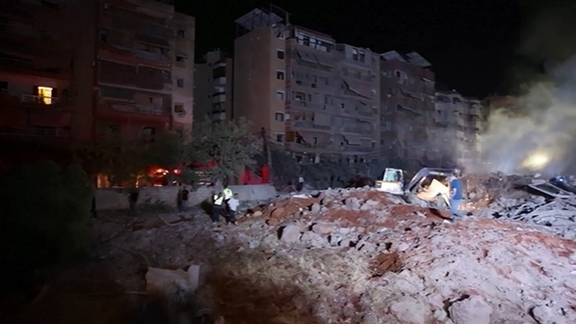
People inspect damage at the site of an Israeli strike, amid ongoing hostilities between Hezbollah and Israeli forces, in Beirut's southern suburbs, Lebanon September 27, 2024.

Israel said huge air strikes it unleashed on Beirut on Friday targeted Hezbollah's headquarters in an attack security sources told multiple media outlets aimed at the Iran-backed group's leader Hassan Nasrallah, though his status remained unknown.

The attack was Israel's largest of the vast suburb from which the Iran-backed Shia militant group draws its support in nearly a year of fighting.

The New York Times on Friday evening cited five Israeli officials saying intelligence agencies' initial assessment was that Hezbollah leader Hassan Nasrallah had been killed.

The indications were preliminary and might change, the officials added.

Hezbollah, which has yet to comment on Nasrallah's fate, said it fired missiles at the northern Israeli city of Safed in response.

Iran condemned the bombings without clearly pledging to retaliate directly.

"There is no doubt that this reprehensible crime and reckless behavior represent a serious escalation that changes the rules of the game and brings upon its perpetrator appropriate punishment and discipline," Tehran's embassy in Beirut said on X.

The attack leveled residential buildings in the Haret Hreik neighborhood and preliminary estimates by the Lebanese health ministry reported that two people were killed and 76 injured.

Middle East analyst Ghassan Ashour said Israel's ramped-up attacks have been met with little to no response from Tehran, in a trend which is likely to embolden Israel fruther.

“In case the Islamic Republic decides to retaliate against Israel, it would inevitably draw in the United States and other countries into the war, which is undesirable for Iran," Ashour told Iran International. "Even if Hassan Nasrallah were killed, Tehran would refrain from retaliation.”

"Long arm" of Israel

Further Israeli air strikes in the early hours of Saturday pounded the same south Beirut area after the country's military warned residents to flee certain areas there.

Residents fled the area in droves, according to imagery posted on social media.

Early on Friday, Israeli Prime Minister Benjamin Netanyahu told the United Nations General Assembly that Israel was winning in a multi-front war with Iran.

"There is no place in Iran that the long arm of Israel cannot reach. And that's true of the entire Middle East ... We are winning", Netanyahu said.

The United States said it had no foreknowledge or hand in the attack, President Joe Biden told reporters on Friday.

"We’re still gathering information; I can tell you — the United States had no knowledge of or participation in the IDF action," Biden said, referring to the Israeli military.

The top defense officials of both countries were speaking together on the phone at the time of the attack, Pentagon spokesperson Sabrina Singh told reporters, who declined to elaborate on the contents of their discussion.

Asked about whether Washington approved of Israeli actions or targeted killings, Secretary of State Anthony Blinken said the United States was still examining the intent and effects of the attack.

"What's necessary is to create the conditions, including moving forces back, such that people in both northern Israel and southern Lebanon have the confidence to return home," Blinken said, noting that efforts for a ceasefire and deal to withdraw Hezbollah forces northward were ongoing.

Beginning last week, bombing attacks widely attributed to Israel and air strikes across Lebanon targeting Hezbollah killed over 600 people, ramping up tensions between the Jewish state and an array of Islamist groups Iran arms and funds in the region.

Netanyahu on Thursday appeared to brush off an initiative by the US and other world powers for a 21-day ceasefire between the Jewish state and Iran-backed Hezbollah, saying military operations would continue with "full force".
Most Viewed

100 days after carnage: Iran economy reels from war, inflation, unemployment
1
INSIGHT

100 days after carnage: Iran economy reels from war, inflation, unemployment

2
INSIGHT

Ghalibaf defends Iran-US talks amid hardline backlash

3
INSIGHT

A nation in limbo: 100 days after the massacre, has the world moved on?

4
ANALYSIS

From instability to influence: Pakistan’s pivotal role in US-Iran diplomacy

5
ANALYSIS

100 days on: why Iran’s January protests spread across social classes

Banner
Banner

Spotlight

  • War-hit homeowners feel abandoned as Iran’s reconstruction aid fades

    War-hit homeowners feel abandoned as Iran’s reconstruction aid fades

  • 100 days on: the anatomy of Iran’s January crackdown
    INSIGHT

    100 days on: the anatomy of Iran’s January crackdown

  • Ghalibaf defends Iran-US talks amid hardline backlash
    INSIGHT

    Ghalibaf defends Iran-US talks amid hardline backlash

  • 100 days on: why Iran’s January protests spread across social classes
    ANALYSIS

    100 days on: why Iran’s January protests spread across social classes

  • From instability to influence: Pakistan’s pivotal role in US-Iran diplomacy
    ANALYSIS

    From instability to influence: Pakistan’s pivotal role in US-Iran diplomacy

  • A nation in limbo: 100 days after the massacre, has the world moved on?
    INSIGHT

    A nation in limbo: 100 days after the massacre, has the world moved on?

•
•
•

More Stories

Iranian support transformed Houthis into military power, UN report finds

Sep 27, 2024, 14:11 GMT+1

Yemen's Houthi group has grown into a "powerful military organization" due to significant support from Iran's Revolutionary Guards, Hezbollah, and Iraqi experts, according to a confidential UN report seen by Reuters.

The report indicates that foreign military aid has significantly enhanced the Houthis' capabilities, allowing them to play a more prominent role in regional conflicts.

Independent UN experts, who report annually to the UN Security Council, observed that Houthi fighters have received advanced tactical and technical training outside of Yemen.

Houthi operatives, using fake passports, have traveled to Iran, Lebanon, and Iraq to hone their military skills. These efforts have enabled the group to execute more complex operations, such as drone and missile strikes in key areas like the Red Sea.

On Tuesday, Reuters also reported that Iran has been assisting in organizing secret talks between Russia and Yemen’s Houthi militia. The aim is for Russia to supply the group with advanced anti-ship missiles. Two regional officials confirmed that representatives of the Houthis and Russia have met in Tehran at least twice this year to discuss these missile deliveries.

Despite a UN arms embargo on the Houthis since 2015, the report emphasized the significant amount of foreign assistance they continue to receive.

"Multiple testimonies from military experts, Yemeni officials, and individuals close to the Houthis indicate they lack the capability to develop and produce complex weapon systems independently," the UN experts wrote.

"The scale, nature, and extent of the military equipment and technology being transferred to the Houthis from outside sources, along with financial support and training, is unprecedented."

The report also noted that the weapons used by the Houthis resemble those produced by Iran or members of the so-called Axis of Resistance, a coalition of Tehran-backed organizations opposed to Israeli and US influence in the Middle East.

This transformation is largely attributed to the support of the IRGC-QF (Quds Force), Hezbollah, and Iraqi experts, who have provided the Houthis with training and material assistance.

The conflict in Yemen has become a central issue in the broader regional crisis. As the war in Gaza continues, the Houthis have intensified their blockade of the Red Sea, targeting commercial vessels under orders from Iran's Supreme Leader Ali Khamenei.

What began in the Red Sea has now spread to the Arabian Sea. These attacks have severely disrupted global shipping and led to the capture of several foreign sailors uninvolved in the Israel conflict.

In response, a US-led coalition of over 20 nations has mobilized to protect global trade routes and ensure the safety of maritime traffic in these crucial areas.

Iran’s influence in the region extends beyond Yemen. In early September, the Houthis launched a missile into central Israel for the first time, striking an area near Ben Gurion International Airport.

The attack, which the Houthis claimed involved a hypersonic missile, caused no injuries but marked a serious escalation. Israeli Prime Minister Benjamin Netanyahu warned that Israel would impose a "heavy price" on the Houthis.

Meanwhile, Iranian President Masoud Pezeshkian, in his first press conference since his election, denied that Tehran has supplied hypersonic missiles to the Houthis or short-range ballistic missiles to Russia, reiterating Iran’s position that it does not provide direct military support to the group.

Prince Pahlavi says fall of Islamic Republic will bring peace to region

Sep 27, 2024, 07:30 GMT+1

Exiled Iranian Prince Reza Pahlavi has stated that peace in the Middle East is achievable only without the Islamic Republic of Iran and urged the West to end its policy of making deals with Tehran.

In an interview with Iran International, Pahlavi addressed the Hezbollah-Israel conflict, saying, "The Islamic Republic’s adventurism and provocations have destabilized the Middle East and are the primary cause of the current situation."

Speaking on the sidelines of the National Union for Democracy in Iran (NUFDI) conference, Pahlavi emphasized that Iran’s interference in neighboring countries and its support for proxy groups have forced regional powers like Israel and Saudi Arabia into direct confrontation with Iran's rulers.

The conflict escalated in October 2023 when Israel launched a large-scale military operation in the Gaza Strip following a surprise Hamas invasion of its territory that killed over 1,000 civilians. In response, Iran-backed groups, including Hezbollah in Lebanon and the Houthis in Yemen, joined the fight in support of Hamas. These ongoing clashes have further destabilized the region.

Pahlavi urged the international community to stop "investing in negotiations with a bankrupt regime" and instead support the Iranian people’s push for freedom. This call echoes demands from the "Woman, Life, Freedom" movement, which gained momentum after the mass protests in 2022.

He argued that the fall of the Islamic Republic would eliminate the nuclear and terrorism threats in the Middle East, leading to fundamental change across the region.

Recent reports from the International Atomic Energy Agency (IAEA) confirm that Iran continues its high-enrichment uranium program, which could lead to the production of nuclear weapons. Iran’s stockpile of 60% enriched uranium now stands at 164.7 kilograms, a critical threshold since it can quickly be further enriched to 90%, the level required for nuclear arms.

At the NUFDI conference, Pahlavi unveiled the "Iran Prosperity Project," a plan designed by experts to guide Iran’s future after the fall of the Islamic Republic. He highlighted the stark economic contrast between Iran and South Korea, noting that before the 1979 revolution, Iran's per capita GDP was double that of South Korea, but it has since plummeted to one-seventh of South Korea's. "Iran should have become the South Korea of the Middle East, but instead, it has turned into the North Korea of the region," he said.

Prince Reza Pahlavi also warned that Iran is falling behind in the digital and AI revolutions, putting the country’s future at risk. He outlined the first phase of the "Iran Prosperity Project," which focuses on "financial and social stabilization" during the first 100 days after the fall of the Islamic Republic. The second phase will address political and legal stabilization, while the third phase will focus on long-term economic reconstruction and creating investment opportunities.

He called for the full participation of all citizens in the post-Islamic Republic economy, stressing the need to remove barriers to women’s participation in the workforce.

Israel denies talk of ceasefire amid escalation with Hezbollah

Sep 26, 2024, 14:20 GMT+1

While the US and other world powers have pushed for a 21-day ceasefire between Israel and Iran-backed Hezbollah, Israel's prime minister said operations continue with "full force".

A statement by Prime Minister Benjamin Netanyahu's office said the reports about a ceasefire were "incorrect", publicly pushing back on US pressure.

"This is an American-French proposal that the prime minister has not even responded to. The report about the purported directive to ease up on the fighting in the north is the opposite of the truth. The Prime Minister has directed the IDF to continue fighting with full force, according to the plan that was presented to him."

He said the fighting in Gaza will also continue until all the objectives of the war have been achieved, meaning the dismantling of Iran-backed militia Hamas, and the return of the 101 hostages still in captivity.

On Wednesday night, the United States, France and allies released a joint statement calling for an immediate 21-day ceasefire across the Israel-Lebanon border while also expressing support for a ceasefire in Gaza.

"The situation between Lebanon and Israel since October 8th, 2023 is intolerable and presents an unacceptable risk of a broader regional escalation," the joint statement said.

Israel's foreign minister, Israel Katz, also denied the ceasefire claims. Writing on X, he said: "There will be no ceasefire in the north. We will continue to fight against the terrorist organization Hezbollah with all our might until victory and the safe return of the residents of the north to their homes," as 63,000 Israelis remain displaced.

On Wednesday, Israel's chief of staff mobilized two more reserve units, believed to be as many as 4,000 troops talking of a possible ground invasion.

“You hear the jets overhead; we have been striking all day. This is both to prepare the ground for your possible entry and to continue degrading Hezbollah, Gen Herzi Halevi told troops Wednesday.

“The sense is that your military boots, your manoeuvre boots, will enter enemy territory,” he said. “Your entry there with force... will show (Hezbollah) what it is like to meet a professional combat force."

The public pushback from Israel comes after a tense year with the US which has constantly pushed the Jewish state towards a ceasefire with Hamas in Gaza and threatened to withhold arms sales.

It has made relations between old friends Netanyahu and outgoing US President Joe Biden increasingly tense as the pair came to blows on the war goals in the wake of October 7 when Hamas killed 1,100 mostly civilians and took over 250 hostages.

Iran's most powerful proxy, Hezbollah, began an almost daily bombardment of Israel in allegiance with Hamas and has since sent over 8,000 projectiles towards Israel's north, displacing tens of thousands.

Retaliatory strikes have seen over 100,000 displaced in south Lebanon and since last week, as many as 100,000 more have fled as Israel stepped up its military offensive against Hezbollah.

Around 1,500 operatives have been left out of action after two days of attacks in which pagers and walkie-talkies belonging to the militia exploded. Israel has neither confirmed or denied the incident which sent shockwaves through the group.

On Friday, a mass assassination of the group's commanders also left the designated group devastated at its highest ranks.

Israeli strikes as deep as Beirut have since left hundreds more dead while Hezbollah continues to barrage Israel's north. On Tuesday, Hezbollah fired its first surface-to-surface missile to Tel Aviv which Israel's military says it intercepted.

Iran's president faces political landmine after remarks in NY

Sep 26, 2024, 07:30 GMT+1

While some of President Massoud Pezeshkian's aides and supporters praised him for everything—even the smooth landing of his plane in New York—others have sharply criticized him for several of his comments during the visit.

Iranian social media users compared Pezeshkian’s call for mutual disarmament between Iran and Israel to former Soviet leader Mikhail Gorbachev, suggesting that Pezeshkian is attempting to trigger the decline of the Islamic Republic, much like Gorbachev did with the Soviet Union.

Others, mostly loyalist hardliners in Tehran, have gone as far as calling for Pezeshkian’s impeachment and removal upon his return to Tehran. On Wednesday, thousands of Iranian social media users trended the hashtag #Pezeshkian's_Impeachment in Persian.

The hardline newspaper Kayhan which is close to Supreme Leader Ali Khamenei's office used strong words in condemning Pezeshkian and Foreign Minister Abbas Araghchi for their remarks in New York. In a commentary headlined "Pezeshkian's uncalculated remarks, who is advising the President," the Kayhan wrote that Pezeshkian's comments were surprising and played into the hands of international and regional media.

After arriving in New York, Pezeshkian held a closed-door meeting with American reporters and columnists. Following the meeting, reports surfaced claiming he had suggested mutual disarmament if Israel agreed to do the same. While his foreign minister quickly denied these claims, Iran International obtained an audio file of the meeting, confirming that the Iranian president had indeed made those remarks.

Pezeshkian said, "We are prepared to give up all our weapons, provided Israel also disarms, and an international organization steps in to ensure security in the region. We don't even need them—we know how to secure our own safety."

Kayhan criticized Pezeshkian's remarks as a "slip of the tongue" and faulted him for his inability to deliver effective speeches. Kayhan argued that these comments could be interpreted as Iran recognizing Israel, contradicting the principles of the Islamic Republic’s founder, Ruhollah Khomeini, and Supreme Leader Ali Khamenei.

The daily went on to advise Pezeshkian to dismiss his current advisers, particularly those behind the 2015 nuclear deal—presumably Vice President Mohammad Javad Zarif, Foreign Minister Abbas Araghchi, and Deputy Foreign Minister Majid Takht Ravanchi. Kayhan accused these individuals of lacking a proper understanding of international relations.

Meanwhile, the IRGC's daily newspaper Javan also harshly criticized Pezeshkian and called him a poor speaker and repeated Kayhan's accusations about his advisers. "Those who brokered the nuclear deal are saying that they will remain in New York for a few days after Pezeshkian leaves on Wednesday and try to pretend that they can have some achievements during those few days."

Javan quoted Pezeshkian's statement and sharply criticized both him and his advisers. The hardline newspaper condemned the idea of disarmament, taking aim at the presidential team for suggesting that after Iran and Israel lay down their arms, “an international organization can restore security in the region, although even that is not necessary." The paper directly blamed his advisers, holding them responsible for what it labeled a "shambolic statement."

Meanwhile, another hardline daily, Hamshahri, published by the Tehran Municipality, praised Pezeshkian as "The Voice of the Oppressed Palestinians" and commended the Iranian delegation's diplomatic efforts to build a consensus against Israel in New York. However, the paper did not specify which countries were aligned with the Islamic Republic in this so-called "consensus."

Ironically, the reformist daily Etemad, whose managing editor Elias Hazrati, acting as the government's News Dissemination Chief, had denied Pezeshkian's comments on Tuesday, ran a commentary titled "We are prepared for negotiations." The piece largely contradicted Hazrati’s stance as a state official. Critics had already flagged a potential conflict of interest when Hazrati was appointed to the post earlier in the month.

Ali Khamenei, the ultimate decider in Tehran, has remained silent on Pezeshkian’s visit to New York, likely giving him some leeway to portray the Islamic Republic as a reasonable regional power. Pezeshkian’s presidential campaign and post-election statements have consistently emphasized that lifting US economic sanctions is a top priority for a state facing both a serious economic crisis and the threat of war with Israel.

US seeks de-escalation as Israel moots Lebanon ground invasion

Sep 25, 2024, 22:00 GMT+1

The United States distanced itself from Israel’s stepped-up attacks in Lebanon on Wednesday shortly after the Israeli army chief hinted at a ground invasion against Hezbollah.

"When it comes to Lebanon, the U.S. military has no involvement in Israel's operations," Pentagon spokesperson Sabrina Singh told reporters, adding that an Israeli incursion did not appear imminent.

Israel has been targeting Hezbollah positions inside Lebanon since Monday, killing hundreds and injuring thousands.

"We keep striking and hitting them everywhere," Israel’s military commander Herzi Halevi told troops on Wednesday. "Your military boots ... will enter enemy territory, enter villages that Hezbollah has prepared as large military outposts, with underground infrastructure, staging points, and launchpads into our territory and carry out attacks on Israeli civilians", he added.

Tensions in the region have escalated sharply, with Israeli air strikes targeting Hezbollah leaders and hitting hundreds of sites across Lebanon, forcing hundreds of thousands of people to flee from the border area.

Hezbollah in turn has launched rockets and missiles towards Israel.

A missile reached Tel Aviv for the first time, according to a spokesperson for the Israeli government, who said that the missile was intercepted by Israel’s aerial defense system.

Hezbollah said the target was Israel's vaunted intelligence agency, Mossad.

President Joe Biden acknowledged on Wednesday the risk of an all-out war in the Middle East but also expressed hope for a possible settlement to the escalating conflicts in Gaza and with Hezbollah.

Singh, the Pentagon spokesperson, described the administration’s diplomatic push as a “full-court press”.

The Biden administration has been trying to avoid a full-scale war for nearly a year since October 7.

“Escalating this to an all-out war seems counterproductive to the stated objectives [of the Israeli government] which is peace and security along that line,” White House spokesperson John Kirby said, referring to Israel's border with Lebanon.

Iran’s Supreme Leader Ali Khamenei on Wednesday accused the U.S. of backing Israel's ramp up of bombings and air strikes in Lebanon, rejecting Washington’s repeated assertions that it had no prior knowledge of attacks against Iran and its regional allies.

“In this battle, the (Israeli) enemy is equipped with the most advanced resources, and the United States stands behind it,” Khamenei said Wednesday, in his first substantive reaction since Israel began days of crushing attacks against Hezbollah that have killed hundreds and injured thousands.