• العربية
  • فارسی
Brand
  • Iran Insight
  • Politics
  • Economy
  • Analysis
  • Special Report
  • Opinion
  • Podcast
  • Iran Insight
  • Politics
  • Economy
  • Analysis
  • Special Report
  • Opinion
  • Podcast
  • Theme
  • Language
    • العربية
    • فارسی
  • Iran Insight
  • Politics
  • Economy
  • Analysis
  • Special Report
  • Opinion
  • Podcast
All rights reserved for Volant Media UK Limited
volant media logo

Iran's president faces political landmine after remarks in NY

Sep 26, 2024, 07:30 GMT+1Updated: 13:30 GMT+1
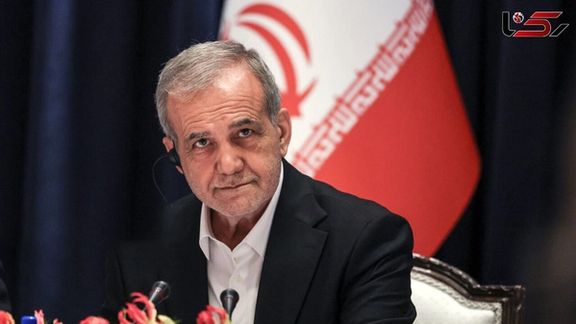
Iran president Masoud Pezeshkian in New York.

While some of President Massoud Pezeshkian's aides and supporters praised him for everything—even the smooth landing of his plane in New York—others have sharply criticized him for several of his comments during the visit.

Iranian social media users compared Pezeshkian’s call for mutual disarmament between Iran and Israel to former Soviet leader Mikhail Gorbachev, suggesting that Pezeshkian is attempting to trigger the decline of the Islamic Republic, much like Gorbachev did with the Soviet Union.

Others, mostly loyalist hardliners in Tehran, have gone as far as calling for Pezeshkian’s impeachment and removal upon his return to Tehran. On Wednesday, thousands of Iranian social media users trended the hashtag #Pezeshkian's_Impeachment in Persian.

The hardline newspaper Kayhan which is close to Supreme Leader Ali Khamenei's office used strong words in condemning Pezeshkian and Foreign Minister Abbas Araghchi for their remarks in New York. In a commentary headlined "Pezeshkian's uncalculated remarks, who is advising the President," the Kayhan wrote that Pezeshkian's comments were surprising and played into the hands of international and regional media.

After arriving in New York, Pezeshkian held a closed-door meeting with American reporters and columnists. Following the meeting, reports surfaced claiming he had suggested mutual disarmament if Israel agreed to do the same. While his foreign minister quickly denied these claims, Iran International obtained an audio file of the meeting, confirming that the Iranian president had indeed made those remarks.

Pezeshkian said, "We are prepared to give up all our weapons, provided Israel also disarms, and an international organization steps in to ensure security in the region. We don't even need them—we know how to secure our own safety."

Kayhan criticized Pezeshkian's remarks as a "slip of the tongue" and faulted him for his inability to deliver effective speeches. Kayhan argued that these comments could be interpreted as Iran recognizing Israel, contradicting the principles of the Islamic Republic’s founder, Ruhollah Khomeini, and Supreme Leader Ali Khamenei.

The daily went on to advise Pezeshkian to dismiss his current advisers, particularly those behind the 2015 nuclear deal—presumably Vice President Mohammad Javad Zarif, Foreign Minister Abbas Araghchi, and Deputy Foreign Minister Majid Takht Ravanchi. Kayhan accused these individuals of lacking a proper understanding of international relations.

Meanwhile, the IRGC's daily newspaper Javan also harshly criticized Pezeshkian and called him a poor speaker and repeated Kayhan's accusations about his advisers. "Those who brokered the nuclear deal are saying that they will remain in New York for a few days after Pezeshkian leaves on Wednesday and try to pretend that they can have some achievements during those few days."

Javan quoted Pezeshkian's statement and sharply criticized both him and his advisers. The hardline newspaper condemned the idea of disarmament, taking aim at the presidential team for suggesting that after Iran and Israel lay down their arms, “an international organization can restore security in the region, although even that is not necessary." The paper directly blamed his advisers, holding them responsible for what it labeled a "shambolic statement."

Meanwhile, another hardline daily, Hamshahri, published by the Tehran Municipality, praised Pezeshkian as "The Voice of the Oppressed Palestinians" and commended the Iranian delegation's diplomatic efforts to build a consensus against Israel in New York. However, the paper did not specify which countries were aligned with the Islamic Republic in this so-called "consensus."

Ironically, the reformist daily Etemad, whose managing editor Elias Hazrati, acting as the government's News Dissemination Chief, had denied Pezeshkian's comments on Tuesday, ran a commentary titled "We are prepared for negotiations." The piece largely contradicted Hazrati’s stance as a state official. Critics had already flagged a potential conflict of interest when Hazrati was appointed to the post earlier in the month.

Ali Khamenei, the ultimate decider in Tehran, has remained silent on Pezeshkian’s visit to New York, likely giving him some leeway to portray the Islamic Republic as a reasonable regional power. Pezeshkian’s presidential campaign and post-election statements have consistently emphasized that lifting US economic sanctions is a top priority for a state facing both a serious economic crisis and the threat of war with Israel.

Most Viewed

Ghalibaf defends Iran-US talks amid hardline backlash
1
INSIGHT

Ghalibaf defends Iran-US talks amid hardline backlash

2
INSIGHT

A nation in limbo: 100 days after the massacre, has the world moved on?

3
ANALYSIS

From instability to influence: Pakistan’s pivotal role in US-Iran diplomacy

4
ANALYSIS

100 days on: why Iran’s January protests spread across social classes

5

War-hit homeowners feel abandoned as Iran’s reconstruction aid fades

Banner
Banner

Spotlight

  • War-hit homeowners feel abandoned as Iran’s reconstruction aid fades

    War-hit homeowners feel abandoned as Iran’s reconstruction aid fades

  • 100 days on: the anatomy of Iran’s January crackdown
    INSIGHT

    100 days on: the anatomy of Iran’s January crackdown

  • Ghalibaf defends Iran-US talks amid hardline backlash
    INSIGHT

    Ghalibaf defends Iran-US talks amid hardline backlash

  • 100 days on: why Iran’s January protests spread across social classes
    ANALYSIS

    100 days on: why Iran’s January protests spread across social classes

  • From instability to influence: Pakistan’s pivotal role in US-Iran diplomacy
    ANALYSIS

    From instability to influence: Pakistan’s pivotal role in US-Iran diplomacy

  • A nation in limbo: 100 days after the massacre, has the world moved on?
    INSIGHT

    A nation in limbo: 100 days after the massacre, has the world moved on?

•
•
•

More Stories

Land subsidence in Iran intensifies as groundwater is depleted - report

Sep 26, 2024, 06:01 GMT+1

Groundwater depletion in Iran is approaching a critical threshold, a detailed new study has found, leading to the subsidence of broad swaths of land across the country.

Satellite imagery highlights cracks and sinkholes emerging in various regions, with parts of Iran sinking at a rate of over 10 centimeters per year due to the excessive tapping of groundwater.

According to researchers cited by the Guardian on Wednesday, it could take hundreds if not thousands of years for the water resources to be naturally replenished.

Mahmud Haghighi and Mahdi Motagh from Leibniz University in Germany analyzed satellite data collected between 2014 and 2020 to assess the impact of groundwater extraction in Iran.

The findings, published in Science Advances, indicate that 3.5% of Iran’s land area is experiencing significant subsidence primarily due to the overuse of groundwater for irrigation. This subsidence is not only affecting agricultural regions but also infrastructure, including airports, roads, and railways.

Among the hardest-hit areas is Kerman province, located in southeastern Iran, which is known for its pistachio production. In this region, subsidence rates exceed 35 centimeters annually, posing a threat to both the local economy and the safety of the area’s infrastructure.

Depletion of groundwater has far-reaching consequences, contributing to the increasing number of sinkholes and land cracks that have begun to impact cities across the country.

A view of the effects of land subsidence in the capital Tehran (Undated)
100%
A view of the effects of land subsidence in the capital Tehran

In the city of Gorgan in northern of Iran, ground subsidence caused a sinkhole to open up, swallowing two vehicles. Witnesses described how the ground suddenly gave way, creating panic among those nearby but no injuries.

A similar incident occurred at another location in the city only days earlier.

The Guardian reports that Iran’s rate of land subsidence ranks among the highest in the world, with experts warning that the damage in some regions may be irreversible due to the complete collapse of aquifers. The extraction of groundwater is pushing the country, home to nearly 90 million people, towards an escalating water crisis.

“There is an urgent need for immediate action and a coherent groundwater policy,” said Motagh, stressing the importance of finding solutions before the problem becomes completely unmanageable.

Last year, reports emerged indicating that the Iranian government had withheld information regarding the worsening subsidence issue.

In March, Iranian experts described the land subsidence situation as "critical," warning that it endangers the lives of over 39 million people.

Contributing factors include dam construction, climate change, inefficient water usage in agriculture and industry, and the over-extraction of underground aquifers through illegal agricultural wells. These issues now pose a significant risk to millions across the country.

US seeks de-escalation as Israel moots Lebanon ground invasion

Sep 25, 2024, 22:00 GMT+1

The United States distanced itself from Israel’s stepped-up attacks in Lebanon on Wednesday shortly after the Israeli army chief hinted at a ground invasion against Hezbollah.

"When it comes to Lebanon, the U.S. military has no involvement in Israel's operations," Pentagon spokesperson Sabrina Singh told reporters, adding that an Israeli incursion did not appear imminent.

Israel has been targeting Hezbollah positions inside Lebanon since Monday, killing hundreds and injuring thousands.

"We keep striking and hitting them everywhere," Israel’s military commander Herzi Halevi told troops on Wednesday. "Your military boots ... will enter enemy territory, enter villages that Hezbollah has prepared as large military outposts, with underground infrastructure, staging points, and launchpads into our territory and carry out attacks on Israeli civilians", he added.

Tensions in the region have escalated sharply, with Israeli air strikes targeting Hezbollah leaders and hitting hundreds of sites across Lebanon, forcing hundreds of thousands of people to flee from the border area.

Hezbollah in turn has launched rockets and missiles towards Israel.

A missile reached Tel Aviv for the first time, according to a spokesperson for the Israeli government, who said that the missile was intercepted by Israel’s aerial defense system.

Hezbollah said the target was Israel's vaunted intelligence agency, Mossad.

President Joe Biden acknowledged on Wednesday the risk of an all-out war in the Middle East but also expressed hope for a possible settlement to the escalating conflicts in Gaza and with Hezbollah.

Singh, the Pentagon spokesperson, described the administration’s diplomatic push as a “full-court press”.

The Biden administration has been trying to avoid a full-scale war for nearly a year since October 7.

“Escalating this to an all-out war seems counterproductive to the stated objectives [of the Israeli government] which is peace and security along that line,” White House spokesperson John Kirby said, referring to Israel's border with Lebanon.

Iran’s Supreme Leader Ali Khamenei on Wednesday accused the U.S. of backing Israel's ramp up of bombings and air strikes in Lebanon, rejecting Washington’s repeated assertions that it had no prior knowledge of attacks against Iran and its regional allies.

“In this battle, the (Israeli) enemy is equipped with the most advanced resources, and the United States stands behind it,” Khamenei said Wednesday, in his first substantive reaction since Israel began days of crushing attacks against Hezbollah that have killed hundreds and injured thousands.

Canada to release review on security failures allowing terror suspects in

Sep 25, 2024, 20:17 GMT+1

Canada is set to release its internal critical review on how two men with reported ties to ISIS were allowed to enter the country despite serious security concerns.

The report, scheduled for release in two weeks, follows the arrests of 62-year-old Ahmed Fouad Mostafa Eldidi and his 26-year-old son, Mostafa Eldidi, in Richmond Hill, Ontario. They face terrorism charges, including conspiracy to commit murder on behalf of ISIS.

The case has sparked significant controversy and concern, particularly among the official opposition party, who have questioned how a man with alleged ties to ISIS managed to enter Canada and evade detection during two separate national security screenings.

The elder Eldidi, who is now facing charges of aggravated assault linked to a 2015 incident outside Canada, allegedly participated in a promotional video for ISIS, where he was seen committing a violent act that experts have said likely constitutes a war crime.

The fact that he was granted Canadian citizenship and allowed to enter the country has raised serious questions about the effectiveness of Canada's immigration and security vetting processes.

Immigration Minister Marc Miller addressed these concerns, stating that the federal government is actively investigating whether Eldidi’s citizenship should be revoked.

"I'm as disgusted as any Canadian. But I have a responsibility to get to the bottom of it, and I will," Miller said during a morning news conference.

According to reports the RCMP's investigation and subsequent arrests of the Eldidis were triggered by a tip-off from French intelligence authorities – further increasing criticism of Canada’s intelligence services.

The RCMP has stated that the father and son were in the "advanced stages of planning a serious, violent attack in Toronto," with a machete and axe found in their possession at the time of their arrest.

The case has intensified scrutiny over Canada’s ability to prevent individuals with ties to terrorist organizations from entering the country. Just this month, another incident further compounded these concerns when 20-year-old Muhammad Shahzeb Khan was arrested near the US border in Quebec, allegedly planning a terrorist attack targeting Jews in New York City.

These events have sparked a growing debate over the issuance of visas and the overall security measures in place to screen individuals suspected of involvement in terrorist activities.

Opposition House Leader Andrew Scheer has called the situation a “colossal failure,” demanding that a parliamentary committee investigate how Eldidi gained entry into Canada. The federal New Democrats have echoed this call, with MP Alistair MacGregor requesting that the ministers responsible for immigration and public safety appear before the committee.

Canada’s handling of Iranian regime officials

As it pertains to Iran, the Canadian government has identified Tehran as a regime that engages in terrorism and systematic or gross human rights violations. In response, Ottawa has taken steps to block senior regime officials from entering the country. Initially, in November 2022, Canada made officials who served in the Iranian regime from November 15, 2019, onward inadmissible.

This measure was later expanded to include officials dating back to June 23, 2003, the day Iranian-Canadian photojournalist Zahra Kazemi was detained, tortured, and killed by state forces.

Last year, the Canadian Border Services Agency (CBSA) reported denying entry to numerous senior officials from the Iranian government. Since the implementation of these measures, the CBSA has been investigating approximately 100 individuals with status in Canada for potential connections to Tehran.

While dozens of individuals have been denied entry to Canada, there have been concerns raised by the Iranian diaspora that the deportations of individuals already in Canada, with ties to the regime, are not moving quickly enough.

In an interview with Iran International, Pierre Poilievre, the leader of Canada’s Conservative Party, stressed that Canada should not become a haven for the terrorist activities of the IRGC or the Islamic Republic’s proxy forces. He further stated that those who act as saboteurs for the Islamic Republic have no place in Canada.

While it remains unclear whether the forthcoming review will also address concerns related to Iranian regime officials on Canadian soil, the expanded scrutiny reflects Canada’s broader efforts to prevent potential threats from entering the country.
Khamenei says US behind Israeli military escalation

Sep 25, 2024, 18:41 GMT+1

Iran’s Supreme Leader Ali Khamenei accused the United States of backing Israel's ramp up of bombings and air strikes in Lebanon, rejecting Washington’s repeated assertions that it had no prior knowledge of attacks against Iran and its regional allies.

“In this battle, the (Israeli) enemy is equipped with the most advanced resources, and the United States stands behind it,” Khamenei said Wednesday, in his first substantive reaction since Israel began days of crushing attacks against Hezbollah that have killed hundreds and injured thousands.

“The US claim that it’s unaware of Israel's actions and not involved in the matter is untrue.”

The US government has sought to distance itself from several unclaimed attacks against Iran and its allied armed groups in recent months which were almost certainly Israeli operations.

It did so after Hamas leader Ismail Haniyeh was assassinated in Tehran on 31 July, and when Hezbollah’s pagers and other communication devices exploded last week, maiming and blinding hundreds of Hezbollah members and many civilians.

Khamenei’s accusation against the Joe Biden administration comes as Iran’s president Masoud Pezeshkian ends his three-day US trip following his debut address to the UN General Assembly, in which he tried to strike a less hostile tone towards the West.

On Wednesday, Pezeshkian said in an interview with Al Jazeera that his administration is open to talks with those involved in the 2015 nuclear deal, but added that the US was not showing sufficient good will to restart talks.

“We have no issue with dialogue with the United States, but it has not fulfilled its commitments," Al Jazeera quoted Pezeshkian saying Wednesday.

Israel's ambassador to the United Nations Danny Danon accused Iran’s new president of deceiving the world with his UN speech. “(Pezeshkian) is lying and unfortunately some people are buying it," he told Iran International on Wednesday.

Under Iran's theocratic system, Khamenei has the final say over matters of foreign policy, especially over relations with the United States. The Supreme Leader, who has ruled over Iran for 35 years, has championed confronting the American “Great Satan” and has led Iran toward ever-closer ties with Russia.

In his speech Wednesday, Khamenei dismissed critics inside the country who claim Iran under his leadership has become isolated from the world, emphasizing its connections with countries representing half of the global population.

“Some from within say that the Islamic Republic is at odds with the world, that it’s not on speaking terms with the world. This is untrue. Today, we are in contact and interact with countries where half of the world's population lives,” Khamenei said, in what appears to be a reference to Iran’s good relations with China and Russia.

But in a sign of persistent Western objections to Iranian policy, EU Foreign Policy Chief Josep Borrell on Tuesday condemned the recent transfer of Iranian-made ballistic missiles to Russia, calling it a substantial escalation following the provision of Iranian drones used in Ukraine.

US should threaten to blow Iran 'to smithereens' for threats - Trump

Sep 25, 2024, 18:38 GMT+1

Republican presidential candidate Donald Trump said on Wednesday that the United States should threaten to bomb countries which seek the assassination of US leaders in the wake of an alleged Iranian plot on his life.

"If I were president, I'd inform the threatening country, in this case Iran, that if you do anything to harm this person, we're going to blow your largest cities and the country itself to smithereens, and there'd be no more threats," Trump told supporters at a rally in in North Carolina.

"But right now we don't have that leadership or necessary leaders," the former president added.

Trump earlier said that the Islamic Republic was seeking to kill him and that his security detail had been increased as his campaign said it was briefed on the threats by US security officials.

“Big threats on my life by Iran. The entire U.S. Military is watching and waiting. Moves were already made by Iran that didn’t work out, but they will try again," the former President said on X.

"I am surrounded by more men, guns, and weapons than I have ever seen before," he added. "An attack on a former President is a Death Wish for the attacker!"

A spokesperson from the US Office of the Director of National Intelligence acknowledged the briefing on Tuesday but declined to address any specifics.

Authorities in Iran did not immediately comment on the situation.

Trump's campaign said the Iranian threats were part of an effort to undermine the United States, Iran's main antagonist since its Islamic Revolution in 1979.

"President Trump was briefed earlier today by the Office of the Director of National Intelligence regarding real and specific threats from Iran to assassinate him in an effort to destabilize and sow chaos in the United States," it said in a statement.

The campaign said intelligence officials conveyed that Iranian threats have "heightened in the past few months", without elaborating.

Iran has issued repeated threats of retribution against those who were involved in the 2020 targeted killing of Qasem Soleimani, Iran's top military and intelligence operative in the Middle East.

Earlier this month, a Pakistani man with alleged ties to Iran pleaded not guilty to charges stemming from an alleged plot to assassinate an unnamed American politician in retaliation for Soleimani's killing.

The defendant named Trump as a potential target but had not conceived the scheme as a plan to assassinate the former president, according to a person familiar with the matter.

Federal authorities are separately investigating an apparent assassination attempt on Trump at his Florida golf course in mid-September and a July 13 shooting of the Republican presidential candidate at a rally in Pennsylvania. There has been no indication of Iranian involvement in either of the alleged attempts.

US government agencies said last week Iranian hackers sent emails containing stolen material from the Republican former president's campaign to people involved in Democratic President Joe Biden's then re-election campaign, as part of an alleged broader effort by Tehran to influence the US election.

Biden stepped aside as a candidate in late July and was replaced by Democratic Vice President Kamala Harris, who faces Trump in a tight race for the Nov. 5 US elections.

In August, the United States accused Iran of launching cyber operations against the campaigns of both US presidential candidates. Iran denied the allegations.







