• العربية
  • فارسی
Brand
  • Iran Insight
  • Politics
  • Economy
  • Analysis
  • Special Report
  • Opinion
  • Podcast
  • Iran Insight
  • Politics
  • Economy
  • Analysis
  • Special Report
  • Opinion
  • Podcast
  • Theme
  • Language
    • العربية
    • فارسی
  • Iran Insight
  • Politics
  • Economy
  • Analysis
  • Special Report
  • Opinion
  • Podcast
All rights reserved for Volant Media UK Limited
volant media logo

Prince Pahlavi says fall of Islamic Republic will bring peace to region

Sep 27, 2024, 07:30 GMT+1Updated: 15:48 GMT+0
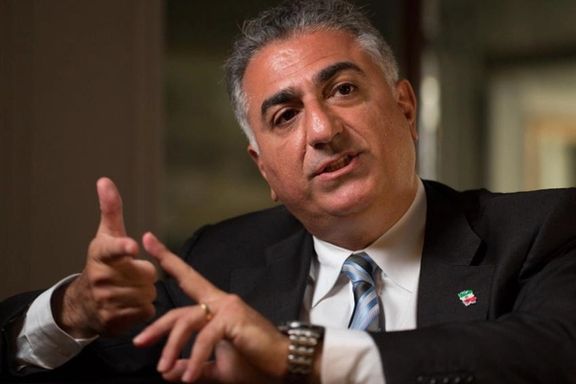
Iran's exiled Crown Prince Reza Pahlavi - File photo

Exiled Iranian Prince Reza Pahlavi has stated that peace in the Middle East is achievable only without the Islamic Republic of Iran and urged the West to end its policy of making deals with Tehran.

In an interview with Iran International, Pahlavi addressed the Hezbollah-Israel conflict, saying, "The Islamic Republic’s adventurism and provocations have destabilized the Middle East and are the primary cause of the current situation."

Speaking on the sidelines of the National Union for Democracy in Iran (NUFDI) conference, Pahlavi emphasized that Iran’s interference in neighboring countries and its support for proxy groups have forced regional powers like Israel and Saudi Arabia into direct confrontation with Iran's rulers.

The conflict escalated in October 2023 when Israel launched a large-scale military operation in the Gaza Strip following a surprise Hamas invasion of its territory that killed over 1,000 civilians. In response, Iran-backed groups, including Hezbollah in Lebanon and the Houthis in Yemen, joined the fight in support of Hamas. These ongoing clashes have further destabilized the region.

Pahlavi urged the international community to stop "investing in negotiations with a bankrupt regime" and instead support the Iranian people’s push for freedom. This call echoes demands from the "Woman, Life, Freedom" movement, which gained momentum after the mass protests in 2022.

He argued that the fall of the Islamic Republic would eliminate the nuclear and terrorism threats in the Middle East, leading to fundamental change across the region.

Recent reports from the International Atomic Energy Agency (IAEA) confirm that Iran continues its high-enrichment uranium program, which could lead to the production of nuclear weapons. Iran’s stockpile of 60% enriched uranium now stands at 164.7 kilograms, a critical threshold since it can quickly be further enriched to 90%, the level required for nuclear arms.

At the NUFDI conference, Pahlavi unveiled the "Iran Prosperity Project," a plan designed by experts to guide Iran’s future after the fall of the Islamic Republic. He highlighted the stark economic contrast between Iran and South Korea, noting that before the 1979 revolution, Iran's per capita GDP was double that of South Korea, but it has since plummeted to one-seventh of South Korea's. "Iran should have become the South Korea of the Middle East, but instead, it has turned into the North Korea of the region," he said.

Prince Reza Pahlavi also warned that Iran is falling behind in the digital and AI revolutions, putting the country’s future at risk. He outlined the first phase of the "Iran Prosperity Project," which focuses on "financial and social stabilization" during the first 100 days after the fall of the Islamic Republic. The second phase will address political and legal stabilization, while the third phase will focus on long-term economic reconstruction and creating investment opportunities.

He called for the full participation of all citizens in the post-Islamic Republic economy, stressing the need to remove barriers to women’s participation in the workforce.

Most Viewed

100 days after carnage: Iran economy reels from war, inflation, unemployment
1
INSIGHT

100 days after carnage: Iran economy reels from war, inflation, unemployment

2
INSIGHT

Ghalibaf defends Iran-US talks amid hardline backlash

3
INSIGHT

A nation in limbo: 100 days after the massacre, has the world moved on?

4
ANALYSIS

From instability to influence: Pakistan’s pivotal role in US-Iran diplomacy

5
ANALYSIS

100 days on: why Iran’s January protests spread across social classes

Banner
Banner

Spotlight

  • War-hit homeowners feel abandoned as Iran’s reconstruction aid fades

    War-hit homeowners feel abandoned as Iran’s reconstruction aid fades

  • 100 days on: the anatomy of Iran’s January crackdown
    INSIGHT

    100 days on: the anatomy of Iran’s January crackdown

  • Ghalibaf defends Iran-US talks amid hardline backlash
    INSIGHT

    Ghalibaf defends Iran-US talks amid hardline backlash

  • 100 days on: why Iran’s January protests spread across social classes
    ANALYSIS

    100 days on: why Iran’s January protests spread across social classes

  • From instability to influence: Pakistan’s pivotal role in US-Iran diplomacy
    ANALYSIS

    From instability to influence: Pakistan’s pivotal role in US-Iran diplomacy

  • A nation in limbo: 100 days after the massacre, has the world moved on?
    INSIGHT

    A nation in limbo: 100 days after the massacre, has the world moved on?

•
•
•

More Stories

US says ready to engage with Iran if it changes behavior

Sep 26, 2024, 21:15 GMT+1

The United States will judge Iran’s new president by actions not words, a senior state department official told Iran International on Thursday, in the first US reaction to Masoud Pezeshkian’s debut address at the United Nations.

"While Iran speaks of change and diplomacy, its actions on the ground—especially its military support for proxies—remain unchanged," US Assistant Deputy Secretary for Iran and Iraq Victoria Taylor said in an interview.

"We are prepared to engage, but Iran has to show it is serious by changing its behavior," she added. "We will continue to use all available tools to hold Iran accountable."

Pezeshkian has been seeking to ease Western sanctions which have hamstrung Iran's economy by presenting a message of reconciliation despite escalating violence between Tehran's armed Islamist allies in the Middle East and Israel.

At his first major event under the global spotlight, Iran's new president told the UN General Assembly on Tuesday that Tehran could work with world powers on a deal over its nuclear program if other parties renewed their obligations to the lapsed agreement.

But Iran's Supreme Leader Ali Khamenei holds the last word on policy and has for decades championed confronting the West and Israel by backing armed Islamist groups like Hezbollah, Palestinian militants and the Houthis in Yemen.

The US government opposes Iran's role in regional conflicts, including its alleged transfer of ballistic missiles to Russia, which Washington and Western allies say could give Moscow greater advantage against Ukraine.

"If Iran truly wants to improve its relationships with the international community including the United States, it needs to take meaningful steps," Taylor added in the interview on the sidelines of the UNGA in New York on Thursday.

As Israel and Iran-backed Hezbollah traded heavier blows this week, the US is working with European and Arab allies to de-escalate the conflict.

Washington has called for a 21-day ceasefire, urging all parties to prevent further escalation into a broader regional war.

"Our efforts are focused on promoting a ceasefire and preventing further destabilization," Taylor added. "Iran can play a constructive role by using its influence with Hezbollah and halting its support for the group."

Zarif’s visa

Asked about concerns raised by US lawmakers about the granting of a visa to Javad Zarif, Iran’s vice-president, to enter the US as part of the country’s delegation to the UN, Taylor said it was a US duty.

"As the host country for the United Nations, we must abide by our legal obligations under the UN Host Country Agreement," she said.

Some Republican members of congress have called on the administration of Joe Biden to refuse entry permits to Iranian officials, some of whom are affiliated with the Islamic Revolutionary Guard Corps or are individually sanctioned like Zarif.

Zarif played a central role in negotiations over the 2015 nuclear deal and was also a key figure in Masoud Pezeshkian’s successful campaign to become president.

Appointed as a Vice President for Strategic Affairs, US-educated Zarif has for years been a main advocate for detente between Iran and the West and conducted several interviews with American media whilst in New York.

US sets $20 million reward for IRGC suspect in Bolton assassination plot

Sep 26, 2024, 19:28 GMT+1

The US State Department on Thursday offered a reward of up to 20 million dollars for information on Shahram Poursafi, accusing him of seeking to former US national security adviser John Bolton on behalf of Iran.

"From October 2021 to April 2022, Iran-based Poursafi attempted to hire criminal elements within the United States to murder Mr. Bolton in Washington DC or Maryland in exchange for $300,000," the state department said.

The statement described Poursafi as a uniformed member of the Islamic Revolutionary Guard Corps, Tehran's transnational paramilitary organization dedicated to confronting Israel and the United States.

"Poursafi allegedly provided material support and resources to facilitate the attempted killing. Poursafi told the potential assassin – who actually became a confidential source for U.S. investigators – that once he completed the Bolton murder he would have a second assassination job for him."

The US treasury designated Poursafi a "specially designated global terrorist" in 2023 after the justice department unsealed aspects of the allegations against him the previous year.

The announcement comes days after Donald Trump's campaign said US security agencies had briefed him on threats to the former president's life.

Trump said on Wednesday that the United States should threaten to bomb countries "to smithereens" which seek the assassination of US leaders in the wake of the alleged Iranian plot.

Under fire at home, Pezeshkian misses own VIP dinner send-off at UN

Sep 26, 2024, 15:58 GMT+1

Iranian president Masoud Pezeshkian capped off a tricky week at the United Nations navigating between hardliners at home and a gambit to ease sanctions by engaging the West with a gala dinner he abruptly left, attendees said.

The gathering of approximately 100 Iranians at the Millennium Hilton Hotel in New York on Wednesday included professionals in the diaspora community advocating for normalization with the Islamic Republic.

Pezeshkian delivered a brief speech before departing the hotel with his delegation for the airport. Although due to host the dinner, the president did not dine with the attendees and the reason for his departure was not immediately clear.

Underscoring the pressure the new president faces on hot-button issues, at least one attendee invited to speak pressed the president on the harshness of hijab enforcement in the country.

Pezeshkian attempted to parry the subject by citing alleged Western hypocrisy at highlighting the issue while downplaying Israel's actions in the region.

"Why do they not react to the massacre of 45,000 Palestinians in Gaza?" the president said, according to news outlet Iranwire.

Javad Zarif, typically affable with guests, entered the dinner alongside security personnel but left immediately after without engaging with attendees, the outlet added.

Also attending an evening meeting ahead of the dinner were several advocates of the now voided Iran nuclear deal which had lifted some sanctions in exchange for curbs on Tehran's enrichment activities.

These included Ali Vaez, head of the Iran program at the International Crisis Group; Hooman Majd, Iranian-American journalist; Trita Parsi, founder of the National Iranian American Council; Negar Mortazavi, Iranian-American journalist; and Mohsen Milani, University of Florida professor, who generally departed before the dinner.

According to Iran International reporters at the scene, many guests of the evening events hosted by the Iranian delegation shielded their faces upon entering the hotel.

Farewell to arms

Central to the president's dilemma were comments he made in a closed door meeting with media professionals on Monday in which he said the Islamic Republic was willing to lay down its arms if its Israeli foe did the same.

"We are prepared to give up all our weapons, provided Israel also disarms, and an international organization steps in to ensure security in the region. We don't even need them—we know how to secure our own safety," Pezeshkian said.

A press conference due to follow was abruptly cancelled without any reason provided.

Aides denied the reported comments but a recording obtained by Iran International confirmed them, earning blistering criticism in Iran.

The hardline Kayhan newspaper, widely seen as a reflection of Supreme Leader Ali Khamenei's thinking on key issues, lambasted the remarks as violations of the Islamic Republic's founding principles.

In another major embarrassment which earned the ire of conservatives, Lior Sternfeld, a professor at Pennsylvania State University who holds Israeli nationality, said he met and spoke personally to the president at an interfaith meeting early in the week.

Israel denies talk of ceasefire amid escalation with Hezbollah

Sep 26, 2024, 14:20 GMT+1

While the US and other world powers have pushed for a 21-day ceasefire between Israel and Iran-backed Hezbollah, Israel's prime minister said operations continue with "full force".

A statement by Prime Minister Benjamin Netanyahu's office said the reports about a ceasefire were "incorrect", publicly pushing back on US pressure.

"This is an American-French proposal that the prime minister has not even responded to. The report about the purported directive to ease up on the fighting in the north is the opposite of the truth. The Prime Minister has directed the IDF to continue fighting with full force, according to the plan that was presented to him."

He said the fighting in Gaza will also continue until all the objectives of the war have been achieved, meaning the dismantling of Iran-backed militia Hamas, and the return of the 101 hostages still in captivity.

On Wednesday night, the United States, France and allies released a joint statement calling for an immediate 21-day ceasefire across the Israel-Lebanon border while also expressing support for a ceasefire in Gaza.

"The situation between Lebanon and Israel since October 8th, 2023 is intolerable and presents an unacceptable risk of a broader regional escalation," the joint statement said.

Israel's foreign minister, Israel Katz, also denied the ceasefire claims. Writing on X, he said: "There will be no ceasefire in the north. We will continue to fight against the terrorist organization Hezbollah with all our might until victory and the safe return of the residents of the north to their homes," as 63,000 Israelis remain displaced.

On Wednesday, Israel's chief of staff mobilized two more reserve units, believed to be as many as 4,000 troops talking of a possible ground invasion.

“You hear the jets overhead; we have been striking all day. This is both to prepare the ground for your possible entry and to continue degrading Hezbollah, Gen Herzi Halevi told troops Wednesday.

“The sense is that your military boots, your manoeuvre boots, will enter enemy territory,” he said. “Your entry there with force... will show (Hezbollah) what it is like to meet a professional combat force."

The public pushback from Israel comes after a tense year with the US which has constantly pushed the Jewish state towards a ceasefire with Hamas in Gaza and threatened to withhold arms sales.

It has made relations between old friends Netanyahu and outgoing US President Joe Biden increasingly tense as the pair came to blows on the war goals in the wake of October 7 when Hamas killed 1,100 mostly civilians and took over 250 hostages.

Iran's most powerful proxy, Hezbollah, began an almost daily bombardment of Israel in allegiance with Hamas and has since sent over 8,000 projectiles towards Israel's north, displacing tens of thousands.

Retaliatory strikes have seen over 100,000 displaced in south Lebanon and since last week, as many as 100,000 more have fled as Israel stepped up its military offensive against Hezbollah.

Around 1,500 operatives have been left out of action after two days of attacks in which pagers and walkie-talkies belonging to the militia exploded. Israel has neither confirmed or denied the incident which sent shockwaves through the group.

On Friday, a mass assassination of the group's commanders also left the designated group devastated at its highest ranks.

Israeli strikes as deep as Beirut have since left hundreds more dead while Hezbollah continues to barrage Israel's north. On Tuesday, Hezbollah fired its first surface-to-surface missile to Tel Aviv which Israel's military says it intercepted.
'Ship has sailed' for barred UN inspectors’ readmission to Iran - UN nuclear chief

Sep 26, 2024, 13:21 GMT+1

While the United Nations’ nuclear watchdog continues to urge Iran to readmit inspectors barred from the country, its nuclear chief says the chances are now unlikely.

Speaking in New York on the sidelines of the UN’s General Assembly, Rafael Grossi said: ”Unfortunately this ship has sailed.”

The head of the International Atomic Energy Agency has long warned of Iran’s proximity to nuclear weapons, earlier this year saying it was “weeks, not months” away.

One year ago, Iran banned what Grossi said comprised one third of the team dedicated to monitoring the country’s nuclear program, branding them “extremists”.

At the time, the head of the Atomic Energy Organization of Iran (AEOI), Mohammad Eslami, said that those expelled had a history of "extremist political behavior”, contradicting Grossi’s statements and saying only an "insignificant" number had been barred.

The IAEA called the move "unprecedented" and a "very serious blow" to its work.

In June, the IAEA's 35-nation Board of Governors passed a resolution calling on Iran to step up cooperation with the agency and reverse the barring of those inspectors, technically known as 'de-designation'.

This week, Grossi told Reuters, ”Until a few months ago they said they were considering and now they say they are not going to reincorporate these inspectors to the list, so unfortunately this ship has sailed.”

An IAEA report in August said that Iran had told the agency in June that its position "with regard to the de-designation of those inspectors is unchanged and this position will remain as it is”.

Grossi is now pushing to meet Iran's new president Masoud Pezeshkian next month to appeal to the new premier who is seeking to elevate Iran’s place on the world stage.

Taking a more moderate approach than his predecessors, during his his first speech at the UN, Pezeshkian, who took office in July, said: “I aim to lay a strong foundation for my country’s entry into a new era, positioning it to play an effective and constructive role in the evolving global order”.

Today, Iran is enriching uranium to up to 60 percent purity, close to the roughly 90 percent needed to be weapons-grade. It has enough uranium enriched to that level, which if enriched further could produce almost four nuclear bombs, according to the IAEA's August report.

Unprecedented, the IAEA says no other country has enriched uranium to that level without producing a bomb.