• العربية
  • فارسی
Brand
  • Iran Insight
  • Politics
  • Economy
  • Analysis
  • Special Report
  • Opinion
  • Podcast
  • Iran Insight
  • Politics
  • Economy
  • Analysis
  • Special Report
  • Opinion
  • Podcast
  • Theme
  • Language
    • العربية
    • فارسی
  • Iran Insight
  • Politics
  • Economy
  • Analysis
  • Special Report
  • Opinion
  • Podcast
All rights reserved for Volant Media UK Limited
volant media logo

Argentina to promote law to try Iranian leaders blamed for 1994 bombing

Jul 18, 2024, 09:30 GMT+1Updated: 10:54 GMT+1
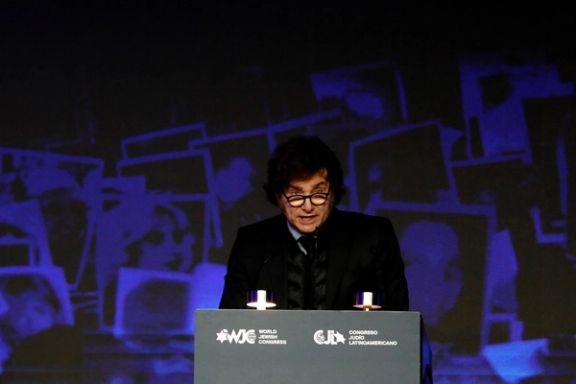
Argentina President Javier Milei attends a commemoration event ahead of the anniversary of 1994 bombing attack on the Argentine Israeli Mutual Association (AMIA) community centre, marking the 30th anniversary of the attack, in Buenos Aires, Argentina July 17, 2024.

Argentina's president said Wednesday that his government will promote a law that will allow accused persons to be tried in absentia for grave crimes, paving the way for the prosecution of Iranian leaders for an attack against a Jewish center 30 years ago.

"Today we chose to speak out, not stay silent," Milei said in an address on Wednesday evening. "We're raising our voice, not folding our arms. We choose life, because anything else is making a game out of death."

In April, Argentina's top criminal court blamed Iran for the attack, saying it was carried out by Hezbollah militants responding to "a political and strategic design" by Iran.

Javier Milei said in his Wednesday speech that the law will make it possible "to try the leaders of the Iranian regime involved in the bombing."

"While they may never be able to serve a sentence, they will not be able to escape the eternal condemnation of a free court proving their guilt to the entire world."

On the morning of July 18, 1994, an explosives-laden truck exploded outside the Argentine Israeli Mutual Association (AMIA) building in Buenos Aires.

Eighty-five people were killed in the deadliest attack ever in Argentina's history which came two years after the 1992 bombing of the Israeli Embassy in Buenos Aires that killed 29.

"Undoubtedly, the fanatical government of Iran is behind these atrocities (bombing at the Jewish center) as they have been behind so many other atrocities against humanity. To be clear, the terrorism of that tragic Oct. 7 is exactly the same terrorism that attacked us 30 years ago," Milei said.

Argentine courts have blamed the attack on Iran but no one has been brought to trial in either that case. Iran denies playing a role in either attack.

Milei questioned on Wednesday the actions of the judiciary and previous governments in Argentina for negligence, cover-up, and manipulation of evidence on the bombing attack during an commemoration event organized in Buenos Aires by the World Jewish Congress and the Latin American Jewish Congress.

Milei's government, which has expressed its alignment with Israel in the Middle East conflict, declared Hamas a "terrorist organization" last Friday, and said that "in recent years, a link with the Islamic Republic of Iran has been revealed."

In his Wednesday speech, Milei linked the attack perpetrated by Hamas against Israel last October to the AMIA bombing and demanded the release of all hostages, among whom there are still eight Argentines.


(Report by Reuters)

Most Viewed

US blockade enters murky phase as tankers spoof signals and buyers hesitate
1
ANALYSIS

US blockade enters murky phase as tankers spoof signals and buyers hesitate

2

US tightens financial squeeze on Iran, warns banks over oil money flows

3
INSIGHT

Ideology may be fading in Iran, but not in Kashmir's ‘Mini Iran'

4
INSIGHT

Hardliners push Hormuz ‘red line’ as US blockade tests Iran’s leverage

5
VOICES FROM IRAN

Hope and anger in Iran as fragile ceasefire persists

Banner
Banner

Spotlight

  • Hardliners push Hormuz ‘red line’ as US blockade tests Iran’s leverage
    INSIGHT

    Hardliners push Hormuz ‘red line’ as US blockade tests Iran’s leverage

  • Ideology may be fading in Iran, but not in Kashmir's ‘Mini Iran'
    INSIGHT

    Ideology may be fading in Iran, but not in Kashmir's ‘Mini Iran'

  • War damage amounts to $3,000 per Iranian, with blockade set to add to losses
    INSIGHT

    War damage amounts to $3,000 per Iranian, with blockade set to add to losses

  • Why the $100 billion Hormuz toll revenue is a myth
    ANALYSIS

    Why the $100 billion Hormuz toll revenue is a myth

  • US blockade targets Iran oil boom amid regional disruption
    ANALYSIS

    US blockade targets Iran oil boom amid regional disruption

  • Iran's digital economy battered by prolonged blackout
    INSIGHT

    Iran's digital economy battered by prolonged blackout

•
•
•

More Stories

A look at threats against Trump by Iranian officials

Jul 18, 2024, 07:33 GMT+1

Iran’s acting foreign minister categorically rejected the idea that his country could have had a plan to assassinate Donald Trump, contradicting several statements by high-ranking officials who have threatened the former US president in the past few years.

In an interview with CNN’s Fareed Zakaria, Iranian foreign minister Ali Bagheri-Kani confirmed Iran’s will to “bring to justice” those who killed the country’s most prominent military figure Qasem Soleimani, in 2020, but insisted that all efforts to that end would be “legal and judicial”.

General Soleimani was killed in a ‘targeted assassination’ ordered by the then US president Trump. The killing shocked Iran’s Supreme Leader Ali Khamenei, who mourned the loss of his top general and vowed to punish the perpetrators with a “harsh revenge.”

Politico reported this week that the US intelligence community has received an increasing amount of evidence to suggest that Iran is actively working on plots to kill former President Donald Trump.

That promise was taken up by several Iranian officials who translated Khamenei’s words to issue direct threats against Trump. There’s no evidence, of course, to suggest that Trump’s shooter, Thomas Matthew Crooks, had any links to Iran, but the threats have been clear and well-documented, contrary to what Iran’s acting foreign minister told CNN.

Below comes a number of instances where prominent Iranian figures spoke of the regime’s intention to target Donald Trump.

January 2021, Supreme Leader Khamenei

Following Khamenei’s proclamation of a “harsh revenge”, his official account on X (then Twitter) published an image of Trump on a golf course under the shadow of a drone, hinting at his targeting. That post has since been deleted.

Khamenei’s official website also released an animation with the same theme, showing IRGC forces killing Trump using a robot.

Screenshot of Khamenei's website where on the left side there a screengrab of the video showong Trump on crosshairs.
100%
Screenshot of Khamenei's website where on the left side there a screengrab of the video showong Trump on crosshairs

December 2020, Qaani, Commander of IRGC Quds Force

On the anniversary of Soleimani’s assassination, his successor, Ismail Qaani, hinted at the intention to target Trump in an address to Iran’s parliament. “American agents involved in the assassination of martyr Soleimani should learn the secretive life of Salman Rushdie because the Islamic Republic will avenge his unjustly-spilled blood.”

January 2021, Qaani, Commander of IRGC Quds Force

Qaani reiterated his threat in yet another occasion to commemorate his predecessor. This time more directly: “Trump and others who were with him are all known to us. From [Mike] Pompeo, who no one humiliated as much as martyr Soleimani, to the US president and all those involved in this crime, [they] are all under the microscope (not only of Muslims but) of all free people of the world.”

January 2022, President Raisi

"If Trump and (former Secretary of State Mike) Pompeo are not tried in a fair court for the criminal act of assassinating General Soleimani, Muslims will take our martyr's revenge.”

July 2022, Foreign Minister Amir-Abdollahian

Two years before dying in a helicopter crash, Iran’s foreign minister Hossein Amir-Abdollahian said what had happened to Soleimani would “never be forgotten.” He did explain Iran’s legal and diplomatic efforts, including appeals to the International Law Commission.

In an interview with Iran’s state TV, he said: “One action we have taken has been to place the perpetrators and instigators of this crime on the terrorist blacklist, and those who have been listed do not sleep easily… They wanted to resolve this through intermediaries, but we rejected their offer.”

February 2023, Hajizadeh, Commander of IRGC Air Force

Amir Ali Hajizadeh, the IRGC Aerospace Commander, appeared on a TV program to explain Iran’s actions to avenge Soleimani. He said, “We did not intend to kill [US soldiers]. God willing, we will kill Trump, Pompeo, [Frank] McKenzie, and the military commanders who ordered [Soleimani’s assassination].”

Can Trump-Vance be both Iran hawk and Russia dove?

Jul 17, 2024, 14:09 GMT+1
•
Iran International Newsroom

With J.D. Vance as his vice-presidential pick, former President Donald Trump aims to solidify his core base while extending his reach – but the prospect of the duo in the White House raises questions about the future of US foreign policy.

Vance, who went from an Ohio Senator to Trump's running mate, has undergone a self-admitted significant shift—from a "never-Trumper" to a staunch ally. With their squabbles now seemingly behind them, Vance, by some called a "real Donald Trump junior," will serve as a perfect complement on the presidential ticket.

Given the current global landscape and their publicly stated positions, the reality of Russia, Iran, China, and North Korea forming a powerful bloc challenging the existing world order presents a serious challenge.

Will the Trump of 2016 reemerge in his next term, or will his approach adapt to the new set of today’s complexities?

Trump, who is widely believed to become the 47th president, will have to navigate a new reality: the ongoing war in Ukraine, China's growing influence, and conflicts in the Middle East.

While Trump became known for his “maximum pressure” policy on Iran and the assassination of the notorious Islamic Revolutionary Guard Corps Quds Force Commander Qasem Soleimani, it is unclear how he will approach Tehran during another term.

Vance has previously outlined his views on Iran on several occasions. Speaking before he was chosen as the VP candidate, Vance stated that he doesn’t see the use of force on the Iranian mainland as an option "right now."

He has criticized President Joe Biden’s handling of Iran and its proxy forces, advocating for a de-escalatory approach with Tehran - or strong retaliation in the event of any attacks on US interests. He has also critiqued the Obama-era Iran nuclear deal as a “disastrous” foreign policy decision, praising Trump’s move to withdraw from it as the best course of action.

Tehran, meanwhile, is relentlessly pursuing its destabilizing agenda in the Middle East. The Iranian state has also been implicated in assassination plots against opponents on American soil, including reported plots to kill Trump himself. Escalating its nuclear program, Tehran is violating international agreements and provoking global concern.

Tehran’s agenda, which is likely to persist under the country’s newly elected president, underscores the regime's determination to exert its influence and destabilize the region.

This not only heightens regional tensions but also pressures Trump to address a rapidly escalating geopolitical threat – that may require him to redefine his foreign policy strategy.

In a stark illustration of the wide array of national security threats posed by Iran, Russia, and China to the US, state-sponsored hackers from these nations have also targeted the country’s water utilities. These cyberattacks aimed to exploit vulnerabilities, creating strategic disruptions and sowing widespread panic.

Vance has also argued for more aid to Israel, stressing that Washington and the American taxpayers should not be funding both sides of the conflict, ensuring aid does not end up in Iran-backed Hamas' hands instead of the Palestinian people.

Arguing that Israelis and Sunni Muslims should manage their own region, Vance’s view of the world sees Europeans handling their region, and that Washington is then able to concentrate more on East Asia.

Yet, the challenges posed by Tehran have become increasingly complex for the US, as Iran has strengthened its position within the "axis of upheaval," also dubbed by some as the "Axis of Evil 2.0."

As a staunch ally to Russia in its war on Ukraine, Tehran has significantly bolstered Moscow's efforts by supplying destructive drones and other military aid. This support has been instrumental in Russia's continued aggression, further solidifying the strategic alliance between Tehran and Moscow.

Both Vance and Trump have expressed a strong desire for the war in Ukraine to end swiftly, hinting at a willingness to make concessions to Moscow. Vance's perceived indifference toward Ukraine's fate and Trump's interest in resetting relations with Russia raise alarm among European nations, who fear the message it sends to Putin.

If Trump and Vance push Ukraine to make peace with Putin through concessions, it could be seen as a victory by the members of the "axis of upheaval"—including Iran, encouraging it to continue its behavior.

This move might be perceived as a significant win by Russia and embolden China, which is already eyeing Taiwan, to take bolder actions.

Vance has also been forceful in arguing that aid to Ukraine should instead go to Taiwan, which has feared an invasion by Beijing for years. Trump recently argued that Taiwan should pay the US to defend it, likening the US to an insurance company and stating that Taiwan "doesn't give us anything."

In Vance's worldview, China is the paramount threat to the US, a position he made clear in one of his first interviews as Trump’s vice-presidential candidate. However, both Vance and Trump's approach to China appears to be largely trade-focused, with the possibility of high tariffs on imports potentially launching a more intense trade war between the nations.

In short, there are apparent contradictions in the Trump-Vance foreign policy, which seems to miss the point that Russia-China-Iran are one block when it comes to challenging US interests.

The threat of the "axis of upheaval" is not solely the US's problem. Recently, Lord Robertson, the former UK Labour defense secretary and ex-NATO chief, issued a stark warning that Britain's armed forces must be prepared to confront a "deadly quartet" consisting of China, Russia, Iran, and North Korea.

The major question remains: Can a Trump-Vance administration signal to Russia that its behavior is accepted while trying to contain China, which they have identified as the biggest threat?

Furthermore, can the US appear lenient toward Russia, one of Iran's biggest allies, while simultaneously deterring Tehran’s nefarious behavior?

Will their isolationist and seemingly incoherent approach, which involves withdrawing from certain conflicts, reinforce US power internationally or weaken it overall – and ultimately fail in making the US strong again on the global stage?
Iranian hacking group steps up global cyber war

Jul 17, 2024, 13:06 GMT+1

Iranian hacker group MuddyWater has expanded its operations to countries such as Azerbaijan, Portugal, Turkey, Saudi Arabia, and India, using newly developed malware.

According to a detailed report by cybersecurity firm Check Point, MuddyWater has employed BugSleep malware to allow hackers to execute remote commands and transfer files between infected systems and their servers with targets including government organizations, media outlets, and travel agencies.

International organizations, including the US Cybersecurity and Infrastructure Security Agency, have attributed MuddyWater to Iran's ministry of intelligence. MuddyWater, also known as APT34 and OilRig, has been active for several years, focusing on cyber-espionage against private and governmental organizations in the Middle East and Western countries.

Their activities are characterized by a mix of strategic intelligence gathering and disruptive cyberattacks, aiming to further Iran's geopolitical interests.

The primary and most successful method of the new malware so far, also targeting countries such as Israel and Saudi Arabia, has been through phishing emails.

Since February 2024, over 50 such emails have been distributed to hundreds of recipients, crafted to deceive recipients into clicking malicious links or downloading infected attachments.

Cybersecurity company Sekoia has also highlighted a surge in MuddyWater's activities. One of the significant findings from Sequoia's investigation is a shift in the hackers' tactics.

Instead of embedding infected links directly in the text of phishing emails, MuddyWater now places these malicious links in PDF files attached to the emails, an attempt to bypass security filters that scrutinize email contents for suspicious links.

Iran has a long history of using cyberattacks, not least on its archenemy, Israel, targeting entities like the Israel Electric Corporation.

These attacks have stepped up since the outbreak of the Gaza war. In November, just weeks after the war began, a group going by the name of “Cyber Toufan” targeted Israeli companies and organizations and dumped huge troves of data online that it claims to have stolen.

Israel's National Institute for Security Studies says Iran was one of the first countries to develop a national cyber strategy. It has developed the institutions and infrastructure to ensure its proxy war could disrupt, sabotage and even destroy civil and commercial targets, critical national infrastructure and military capabilities.

Iran denies alleged plot to assassinate Trump

Jul 17, 2024, 10:52 GMT+1

Iran's acting Foreign Minister has denied allegations of an Iranian plan to assassinate former US President Donald Trump just days after an assassin shot him during a campaign rally.

Recent human source intelligence obtained by US authorities indicated a potential threat from Iran against Trump. However, there is no evidence linking Thomas Matthew Crooks, who attempted to assassinate the former president on Saturday, to the alleged plot.

Ali Bagheri-Kani admitted that Iran is still seeking justice for the assassination of IRGC Commander Qasem Soleimani, killed in a drone strike in Iraq ordered by Trump in 2020, through legal channels.

"I told you explicitly that we would resort to legal and judicial procedures and frameworks at the domestic level and international level in order to bring the perpetrators and military advisers of General Soleimani’s assassination to justice," he told CNN’s Fareed Zakaria.

Iranian authorities, both political and military, have continued to issue threats against Trump and his administration to avenge the death of Soleimani, responsible for Iran's proxies across the region. For example, in February 2023, Amirali Hajizadeh, the head of the Revolutionary Guards aerospace force directly stated that the Islamic Republic intends to kill Trump.

In January 2022, Iran's former President Ebrahim Raisi vowed revenge for Soleimani's killing unless former US President Donald Trump was put on trial.

"If Trump and (former Secretary of State Mike) Pompeo are not tried in a fair court for the criminal act of assassinating General Soleimani, Muslims will take our martyr's revenge," Raisi said in a televised speech.

Spokesperson for Iran's Foreign Ministry, Nasser Kanaani, also refuted the claims of Iran’s involvement in any recent armed attack on Trump. “Iran strongly rejects any involvement in the recent armed attack on Trump or claims about Iran's intention for such an action, considering such allegations to have malicious political motives and objectives," Kanaani stated.

The Permanent Mission of Iran to the United Nations echoed the denials.

“These accusations are unsubstantiated and malicious. From the perspective of the Islamic Republic of Iran, Trump is a criminal who must be prosecuted and punished in a court of law for ordering the assassination of General Soleimani. Iran has chosen the legal path to bring him to justice,” a spokesperson for the mission told CNN.

In 2022, the US Justice Department announced charges against an IRGC member for allegedly plotting to assassinate John Bolton, Trump's former national security adviser, likely in retaliation for Soleimani's death.

Similar threats have been made against other former Trump administration officials, including Mike Pompeo and Robert O'Brien, who have maintained security details due to ongoing risks.

Soleimani was instrumental in Iran's external military and intelligence operations involved in hostilities against US forces in the region.

Despite Iran's denials, the security concerns for those involved in the decision to kill Soleimani remain significant, with ongoing protection measures in place.

Drone attack reported on US base in Iraq

Jul 17, 2024, 07:57 GMT+1

Two armed drones on Tuesday targeted Iraq's Ain al-Asad airbase, which hosts US forces and other international forces in western Iraq, two Iraqi military sources told Reuters.

It was the second attack against US forces in Iraq since early February when Iranian-backed groups in Iraq stopped their attacks against US troops. In January, the United States launched retaliatory air strikes against Iran-backed militias who were targeting its forces in Iraq and Syria. Since then, only a few incidents had been reported.

An Iraqi military official said defense systems downed one drone near the base perimeter.

In April, two drones were shot down near Ain al-Asad base, according to a US official.

No casualties have been reported, said the sources.

The latest reported attack comes after Masoud Pezeshkian, who is presented as a “moderate” won the presidential election in Iran, raising some expectations in the West that he might restart nuclear talks. However, the United States has dismissed such suggestions, giving little credence to major changes under the new president.

Iraqi army stepped up patrolling the areas around the base to prevent possible further attacks, said an Iraqi army official.

The attack came less than a week before an expected visit by a high-level Iraqi military delegation to Washington to continue talks on ending the US -led military coalition in the country.

Washington and Baghdad in January initiated talks to reassess the draw-down of the US-led coalition in Iraq, formed in 2014 to help fight Islamic State after the extremist Sunni Muslim militant group overran large parts of the country.

A US official, speaking on condition of anonymity, said a projectile appears to have targeted the base, but without causing casualties.