• العربية
  • فارسی
Brand
  • Iran Insight
  • Politics
  • Economy
  • Analysis
  • Special Report
  • Opinion
  • Podcast
  • Iran Insight
  • Politics
  • Economy
  • Analysis
  • Special Report
  • Opinion
  • Podcast
  • Theme
  • Language
    • العربية
    • فارسی
  • Iran Insight
  • Politics
  • Economy
  • Analysis
  • Special Report
  • Opinion
  • Podcast
All rights reserved for Volant Media UK Limited
volant media logo

A look at threats against Trump by Iranian officials

Jul 18, 2024, 07:33 GMT+1Updated: 15:16 GMT+1

Iran’s acting foreign minister categorically rejected the idea that his country could have had a plan to assassinate Donald Trump, contradicting several statements by high-ranking officials who have threatened the former US president in the past few years.

In an interview with CNN’s Fareed Zakaria, Iranian foreign minister Ali Bagheri-Kani confirmed Iran’s will to “bring to justice” those who killed the country’s most prominent military figure Qasem Soleimani, in 2020, but insisted that all efforts to that end would be “legal and judicial”.

General Soleimani was killed in a ‘targeted assassination’ ordered by the then US president Trump. The killing shocked Iran’s Supreme Leader Ali Khamenei, who mourned the loss of his top general and vowed to punish the perpetrators with a “harsh revenge.”

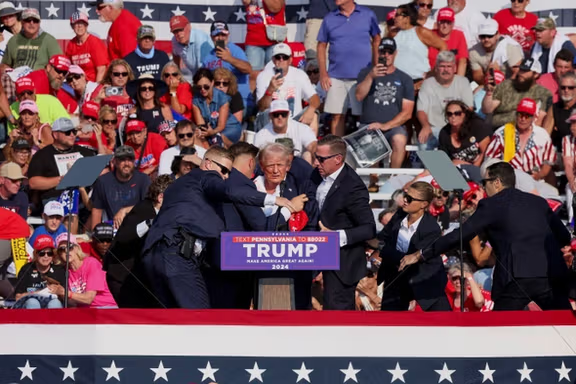
Politico reported this week that the US intelligence community has received an increasing amount of evidence to suggest that Iran is actively working on plots to kill former President Donald Trump.

That promise was taken up by several Iranian officials who translated Khamenei’s words to issue direct threats against Trump. There’s no evidence, of course, to suggest that Trump’s shooter, Thomas Matthew Crooks, had any links to Iran, but the threats have been clear and well-documented, contrary to what Iran’s acting foreign minister told CNN.

Below comes a number of instances where prominent Iranian figures spoke of the regime’s intention to target Donald Trump.

January 2021, Supreme Leader Khamenei

Following Khamenei’s proclamation of a “harsh revenge”, his official account on X (then Twitter) published an image of Trump on a golf course under the shadow of a drone, hinting at his targeting. That post has since been deleted.

Khamenei’s official website also released an animation with the same theme, showing IRGC forces killing Trump using a robot.

Screenshot of Khamenei's website where on the left side there a screengrab of the video showong Trump on crosshairs.
100%
Screenshot of Khamenei's website where on the left side there a screengrab of the video showong Trump on crosshairs

December 2020, Qaani, Commander of IRGC Quds Force

On the anniversary of Soleimani’s assassination, his successor, Ismail Qaani, hinted at the intention to target Trump in an address to Iran’s parliament. “American agents involved in the assassination of martyr Soleimani should learn the secretive life of Salman Rushdie because the Islamic Republic will avenge his unjustly-spilled blood.”

January 2021, Qaani, Commander of IRGC Quds Force

Qaani reiterated his threat in yet another occasion to commemorate his predecessor. This time more directly: “Trump and others who were with him are all known to us. From [Mike] Pompeo, who no one humiliated as much as martyr Soleimani, to the US president and all those involved in this crime, [they] are all under the microscope (not only of Muslims but) of all free people of the world.”

January 2022, President Raisi

"If Trump and (former Secretary of State Mike) Pompeo are not tried in a fair court for the criminal act of assassinating General Soleimani, Muslims will take our martyr's revenge.”

July 2022, Foreign Minister Amir-Abdollahian

Two years before dying in a helicopter crash, Iran’s foreign minister Hossein Amir-Abdollahian said what had happened to Soleimani would “never be forgotten.” He did explain Iran’s legal and diplomatic efforts, including appeals to the International Law Commission.

In an interview with Iran’s state TV, he said: “One action we have taken has been to place the perpetrators and instigators of this crime on the terrorist blacklist, and those who have been listed do not sleep easily… They wanted to resolve this through intermediaries, but we rejected their offer.”

February 2023, Hajizadeh, Commander of IRGC Air Force

Amir Ali Hajizadeh, the IRGC Aerospace Commander, appeared on a TV program to explain Iran’s actions to avenge Soleimani. He said, “We did not intend to kill [US soldiers]. God willing, we will kill Trump, Pompeo, [Frank] McKenzie, and the military commanders who ordered [Soleimani’s assassination].”

Most Viewed

Worst outcome is Islamic Republic’s survival, ex-CIA official says
1
PODCAST

Worst outcome is Islamic Republic’s survival, ex-CIA official says

2
ANALYSIS

Iran brings unusually broad team to US talks to blunt future blame

3
INSIGHT

Tehran sends tough message but keeps diplomacy door open

4

Zoroastrian religious figure arrested in Iran

Banner
Banner

Spotlight

  • What the US naval blockade would mean for Iran’s economy
    INSIGHT

    What the US naval blockade would mean for Iran’s economy

  • Tehran sends tough message but keeps diplomacy door open
    INSIGHT

    Tehran sends tough message but keeps diplomacy door open

  • Worst outcome is Islamic Republic’s survival, ex-CIA official says
    PODCAST

    Worst outcome is Islamic Republic’s survival, ex-CIA official says

  • Why the Iran-US truce is more likely to buy time than peace
    ANALYSIS

    Why the Iran-US truce is more likely to buy time than peace

  • Engaged but uncommitted: China watches Iran and US fight and talk
    ANALYSIS

    Engaged but uncommitted: China watches Iran and US fight and talk

  • A truce for the world, a reckoning for Iran’s economy
    ANALYSIS

    A truce for the world, a reckoning for Iran’s economy

•
•
•

More Stories

US privately warned Iran over 'suspicious' nuclear activities: Report

Jul 17, 2024, 22:03 GMT+1

The Biden administration warned Iran privately over the country’s nuclear program last month, after the US and Israel detected suspicious activities by Iranian scientists “under an academic umbrella” that could be relevant to the production of weapons.

In an exclusive report Wednesday, Axios quoted three American and Israeli officials as saying their intelligence communities have been trying to ascertain if there is a change of policy by Iran's Supreme Leader Ali Khamenei, believing that he may have refrained from publicly approving the activity “to leave room for plausible deniability.”

Iran maintains that its nuclear program is peaceful, and all accusations otherwise are politically motivated. The UN nuclear watchdog, however, has repeatedly said that Iran’s enrichment program, and its stockpiling of near-weapons-grade uranium is hard to explain outside a weapons program.

The US officials speaking to Axios have expressed concern about Iran's nuclear “escalation”, while suggesting that there are no current indications of Iran undertaking the activities necessary to produce a testable nuclear device.

Last week, Iran’s president-elect Masoud Pezeshkian claimed in an open letter written in English that his country had been treated “unfairly” by the US and its western allies, accusing them of “abusing” the NPT and “fabricating” a crisis over Iran’s nuclear activity.

“The US and its Western allies not only missed a historic opportunity to reduce and manage tensions in the region and the world, but also seriously undermined the Non-Proliferation Treaty (NPT) by showing that the costs of adhering to the tenets of the non-proliferation regime could outweigh the benefits it may offer,” Pezeshkian wrote.

Pezeshkian, elected on a ‘reformist’ ticket, is viewed by many inside and outside Iran as “powerless” when it comes to issues of foreign policy, defense and the nuclear program.

The Axios report Wednesday seems to suggest that backchannel communications have been ongoing and that the Biden administration has been trying to dissuade Iranians from further escalation of their nuclear activities.

The recent meeting of the US-Israel Strategic Consultative Group marked the first high-level discussion about Iran's nuclear program since March 2023. The assessments were aligned, according to reports, indicating no “top-down directive from Khamenei” to proceed with nuclear weapon production.

All US administrations in the past two decades have warned Iran that weaponization is a red line, and the US would consider all options to stop it.

After Iran’s election some ultraconservatives come under pressure

Jul 17, 2024, 16:53 GMT+1

Some hardliner candidates from Iran’s recent presidential election, along with a key commentator who aided their parliamentary victory, are facing pressure from fellow conservatives to exit the political scene.

The main reason for the pressures is yet to be known, although those who exert these pressures have offered enough arguments to back their initiative.

Presidential candidate Alireza Zakani, the mayor of Tehran has come under attack by the city councilors for leaving the city at the mercy of profiteers. They accuse him of allowing high municipal positions to be sold to those willing to pay hefty bribes for lucrative jobs in local councils around Tehran.

His main critic enjoys a special position that cannot be ignored. She is Narjess Soleimani, the daughter of former IRGC Qods Force Commander Qasem Soleimani who has left his legacy of reverence and influence to his children within the Islamic Republic’s political establishment. However, Ms. Soleimani is not alone in her campaign against Zakani. Some seven of Tehran's councilors are said to be backing a motion to unseat Zakani.

Another former candidate under fire is ultraconservative Saeed Jalili who appears to be losing his influence among Iran's conservatives after his defeat by President-elect Masoud Pezeshkian. The main argument brought against him is about his lack of transparency about the funding of his self-declared shadow government and the hefty sums his campaign spent.

Several politicians, including former President Hassan Rouhani and former Justice Minister Mostafa Pourmohammadi, who was also a presidential candidate, have recently disclosed that Saeed Jalili obstructed Iran's negotiations with the United States and blocked the country's joining the FATF conventions for personal political gain. Jalili did this in his role as the secretary of the influential Supreme Council of National Security.

Both Rouhani and Pourmohammadi have said that everyone else at the Security Council was in favor of the negotiations that were close to be finalized in a bid to reduce the pressure of sanctions on Iran. Pourmohammadi added that Jalili told him he would have endorsed the FATF membership motion if someone other than Rouhani was the President at the time.

The FATF is an international financial watchdog that spearheads efforts to combat money laundering, terrorist financing, and the financing of weapons proliferation. In recent years, Iran has been placed on the financial watchdog’s “blacklist” due to its failure to adhere to transparency standards and international conventions against money laundering and terrorism financing.

Saeed Jalili's resistance to adopting the Financial Action Task Force (FATF) recommendations had emerged as a pivotal topic in the sudden presidential election debates in Iran.

For more than a decade, the debate over FATF compliance, intertwined with the persistent challenge of international sanctions, has dominated Iran's foreign relations discourse.

In an interview with Khabar Online, conservative politician Mahmoud Naqavi Hosseini called on Jalili to make transparent the budget of his shadow government and its source of income. He said that the shadow government's name has not been mentioned anywhere in the country's annual budget bill.Naqavi Hosseini said that Jalili should begin to move out of the shadow and come under the spotlight.

During the election, Jalili claimed his campaign was funded by the people but provided no evidence to support this. Other politicians, including former Tehran Mayor Gholamhossein Karbaschi and conservative Hossein Mozaffar, questioned Jalili's integrity, accusing him and the "shadow government" of undermining previous administrations.

Additionally, conservatives released a video in which Supreme Leader Ali Khamenei seemingly opposed the formation of a parallel body to the seated government. Former MP Gholamali Jafarzadeh Imanabadi warned that Jalili's shadow government could create problems for Iran's new administration under Pezeshkian, describing Jalili as a rude individual who persists in his shadow government activities despite Khamenei's remarks.

Ideological propagandist Ali Akbar Raefipour who leads the ultraconservative group Masaf [Combat] and groomed several hardliners, as well as helped win the parliamentary election in March has also been in trouble during recent weeks over lack transparency about hefty donations he claims to have received. Reports in Tehran say he has disbanded the group.

As the weakest link in the ultraconservative circle, he is facing dangerous allegations about portraying the Shiites's first imam, Imam Ali, in a bad light in a video that has gone viral on social media. He is said to be also facing a travel ban and probably an indictment.

Rumors have it that Majles Speaker Mohammad Bagher Ghalibaf is at least behind the attacks on Raefipour. However, a higher authority, such as Khamenei's office or the Judiciary, might have decided that the trio have gone too far in their slogans and ambitions and that they need to be stopped before they put themselves and others in more trouble.

Iran's acting FM champions Pezeshkian's 'new' foreign policy at UN

Jul 17, 2024, 14:56 GMT+1
•
Niloufar Goudarzi

Iran's Acting Foreign Minister, Ali Bagheri-Kani, has lauded the purported new foreign policy direction under President-elect Masoud Pezeshkian, while steadfastly defending Tehran's support for regional proxy groups.

In a statement addressing Tuesday's United Nations Security Council meeting in New York, Bagheri-Kani stated, “His Excellency, Dr. Pezeshkian, the elected President, has recently outlined his primary foreign policy strategy, which aims to open new horizons and foster friendly relations with other nations based on dialogue, cooperation, equality, and mutual respect.”

In his speech, Kani also underscored the "legitimacy" of Iran's support for "Resistance” groups in the region, portraying it as a countermeasure to the “unilateralism” of the US and Israel.

"I wish to emphasize that Iran's support and solidarity with resistance groups in the region is legitimate under international law and aims to end aggression and occupation," Kani said.

"Resistance Forces" encompasses a network of proxy entities, including Palestinian militant groups such as Hamas, the Syrian regime, the Lebanese militant organization Hezbollah, and various other factions in Yemen, Iraq and elsewhere.

Meanwhile, the cornerstones of Iran's current foreign policy—funding and supporting militia groups and advancing its nuclear program—are seen by many countries as contradicting the principles of dialogue and cooperation. This approach has led to crippling Western sanctions.

Thus, it remains to be seen how President-elect Masoud Pezeshkian's foreign policy will reconcile the paradox of advocating a "new approach" while maintaining the existing strategy.

Additionally, Pezeshkian has vowed to follow strategies and goals proclaimed by Iran's Supreme Leader Ali Khamenei, who has so far advocated defying the West. Any minor adjustments could indicate Khamenei's desire to adopt a more flexible approach, similar to how Khamenei allowed nuclear talks a decade ago.

These negotiations resulted in the JCPOA nuclear deal in 2015, between Iran and major global powers, including the five permanent members of the United Nations Security Council. As part of the agreement, Iran agreed to curtail its nuclear capabilities in return for reducing UN economic sanctions. Nevertheless, the US withdrawal from the deal in 2018 by President Donald Trump, coupled with the reimposition of stringent sanctions, severely strained diplomatic ties and debilitated Iran's economy.

Meanwhile, the current US administration has declared reluctance to resume nuclear negotiations with Tehran under the new president precisely for Iran's ongoing "support for terrorist organizations Hamas and Hezbollah".

Additionally, even in the event of an administration change in the US in November, Iran will face possibly even more pressure regarding its funding of proxy groups and its nuclear deal program.

Nikki Haley, former US Ambassador to the UN under Donald Trump, asserted on Tuesday that she attributes the instability in the Middle East to Iran. She also praised Trump's decision to withdraw from the JCPOA.

"Every problem in the Middle East can be laid at the feet of Iran. The dictators who chant Death to America are the bankrollers and weapons suppliers for Hamas and Hezbollah. They're behind barbaric massacres and the hostage-taking," the former South Carolina Governor said in her Republican National Convention speech.

Can Trump-Vance be both Iran hawk and Russia dove?

Jul 17, 2024, 14:09 GMT+1
•
Iran International Newsroom

With J.D. Vance as his vice-presidential pick, former President Donald Trump aims to solidify his core base while extending his reach – but the prospect of the duo in the White House raises questions about the future of US foreign policy.

Vance, who went from an Ohio Senator to Trump's running mate, has undergone a self-admitted significant shift—from a "never-Trumper" to a staunch ally. With their squabbles now seemingly behind them, Vance, by some called a "real Donald Trump junior," will serve as a perfect complement on the presidential ticket.

Given the current global landscape and their publicly stated positions, the reality of Russia, Iran, China, and North Korea forming a powerful bloc challenging the existing world order presents a serious challenge.

Will the Trump of 2016 reemerge in his next term, or will his approach adapt to the new set of today’s complexities?

Trump, who is widely believed to become the 47th president, will have to navigate a new reality: the ongoing war in Ukraine, China's growing influence, and conflicts in the Middle East.

While Trump became known for his “maximum pressure” policy on Iran and the assassination of the notorious Islamic Revolutionary Guard Corps Quds Force Commander Qasem Soleimani, it is unclear how he will approach Tehran during another term.

Vance has previously outlined his views on Iran on several occasions. Speaking before he was chosen as the VP candidate, Vance stated that he doesn’t see the use of force on the Iranian mainland as an option "right now."

He has criticized President Joe Biden’s handling of Iran and its proxy forces, advocating for a de-escalatory approach with Tehran - or strong retaliation in the event of any attacks on US interests. He has also critiqued the Obama-era Iran nuclear deal as a “disastrous” foreign policy decision, praising Trump’s move to withdraw from it as the best course of action.

Tehran, meanwhile, is relentlessly pursuing its destabilizing agenda in the Middle East. The Iranian state has also been implicated in assassination plots against opponents on American soil, including reported plots to kill Trump himself. Escalating its nuclear program, Tehran is violating international agreements and provoking global concern.

Tehran’s agenda, which is likely to persist under the country’s newly elected president, underscores the regime's determination to exert its influence and destabilize the region.

This not only heightens regional tensions but also pressures Trump to address a rapidly escalating geopolitical threat – that may require him to redefine his foreign policy strategy.

In a stark illustration of the wide array of national security threats posed by Iran, Russia, and China to the US, state-sponsored hackers from these nations have also targeted the country’s water utilities. These cyberattacks aimed to exploit vulnerabilities, creating strategic disruptions and sowing widespread panic.

Vance has also argued for more aid to Israel, stressing that Washington and the American taxpayers should not be funding both sides of the conflict, ensuring aid does not end up in Iran-backed Hamas' hands instead of the Palestinian people.

Arguing that Israelis and Sunni Muslims should manage their own region, Vance’s view of the world sees Europeans handling their region, and that Washington is then able to concentrate more on East Asia.

Yet, the challenges posed by Tehran have become increasingly complex for the US, as Iran has strengthened its position within the "axis of upheaval," also dubbed by some as the "Axis of Evil 2.0."

As a staunch ally to Russia in its war on Ukraine, Tehran has significantly bolstered Moscow's efforts by supplying destructive drones and other military aid. This support has been instrumental in Russia's continued aggression, further solidifying the strategic alliance between Tehran and Moscow.

Both Vance and Trump have expressed a strong desire for the war in Ukraine to end swiftly, hinting at a willingness to make concessions to Moscow. Vance's perceived indifference toward Ukraine's fate and Trump's interest in resetting relations with Russia raise alarm among European nations, who fear the message it sends to Putin.

If Trump and Vance push Ukraine to make peace with Putin through concessions, it could be seen as a victory by the members of the "axis of upheaval"—including Iran, encouraging it to continue its behavior.

This move might be perceived as a significant win by Russia and embolden China, which is already eyeing Taiwan, to take bolder actions.

Vance has also been forceful in arguing that aid to Ukraine should instead go to Taiwan, which has feared an invasion by Beijing for years. Trump recently argued that Taiwan should pay the US to defend it, likening the US to an insurance company and stating that Taiwan "doesn't give us anything."

In Vance's worldview, China is the paramount threat to the US, a position he made clear in one of his first interviews as Trump’s vice-presidential candidate. However, both Vance and Trump's approach to China appears to be largely trade-focused, with the possibility of high tariffs on imports potentially launching a more intense trade war between the nations.

In short, there are apparent contradictions in the Trump-Vance foreign policy, which seems to miss the point that Russia-China-Iran are one block when it comes to challenging US interests.

The threat of the "axis of upheaval" is not solely the US's problem. Recently, Lord Robertson, the former UK Labour defense secretary and ex-NATO chief, issued a stark warning that Britain's armed forces must be prepared to confront a "deadly quartet" consisting of China, Russia, Iran, and North Korea.

The major question remains: Can a Trump-Vance administration signal to Russia that its behavior is accepted while trying to contain China, which they have identified as the biggest threat?

Furthermore, can the US appear lenient toward Russia, one of Iran's biggest allies, while simultaneously deterring Tehran’s nefarious behavior?

Will their isolationist and seemingly incoherent approach, which involves withdrawing from certain conflicts, reinforce US power internationally or weaken it overall – and ultimately fail in making the US strong again on the global stage?
Iranian hacking group steps up global cyber war

Jul 17, 2024, 13:06 GMT+1

Iranian hacker group MuddyWater has expanded its operations to countries such as Azerbaijan, Portugal, Turkey, Saudi Arabia, and India, using newly developed malware.

According to a detailed report by cybersecurity firm Check Point, MuddyWater has employed BugSleep malware to allow hackers to execute remote commands and transfer files between infected systems and their servers with targets including government organizations, media outlets, and travel agencies.

International organizations, including the US Cybersecurity and Infrastructure Security Agency, have attributed MuddyWater to Iran's ministry of intelligence. MuddyWater, also known as APT34 and OilRig, has been active for several years, focusing on cyber-espionage against private and governmental organizations in the Middle East and Western countries.

Their activities are characterized by a mix of strategic intelligence gathering and disruptive cyberattacks, aiming to further Iran's geopolitical interests.

The primary and most successful method of the new malware so far, also targeting countries such as Israel and Saudi Arabia, has been through phishing emails.

Since February 2024, over 50 such emails have been distributed to hundreds of recipients, crafted to deceive recipients into clicking malicious links or downloading infected attachments.

Cybersecurity company Sekoia has also highlighted a surge in MuddyWater's activities. One of the significant findings from Sequoia's investigation is a shift in the hackers' tactics.

Instead of embedding infected links directly in the text of phishing emails, MuddyWater now places these malicious links in PDF files attached to the emails, an attempt to bypass security filters that scrutinize email contents for suspicious links.

Iran has a long history of using cyberattacks, not least on its archenemy, Israel, targeting entities like the Israel Electric Corporation.

These attacks have stepped up since the outbreak of the Gaza war. In November, just weeks after the war began, a group going by the name of “Cyber Toufan” targeted Israeli companies and organizations and dumped huge troves of data online that it claims to have stolen.

Israel's National Institute for Security Studies says Iran was one of the first countries to develop a national cyber strategy. It has developed the institutions and infrastructure to ensure its proxy war could disrupt, sabotage and even destroy civil and commercial targets, critical national infrastructure and military capabilities.