• العربية
  • فارسی
Brand
  • Iran Insight
  • Politics
  • Economy
  • Analysis
  • Special Report
  • Opinion
  • Podcast
  • Iran Insight
  • Politics
  • Economy
  • Analysis
  • Special Report
  • Opinion
  • Podcast
  • Theme
  • Language
    • العربية
    • فارسی
  • Iran Insight
  • Politics
  • Economy
  • Analysis
  • Special Report
  • Opinion
  • Podcast
All rights reserved for Volant Media UK Limited
volant media logo

US and Britain Launch Airstrikes on Houthi Targets
Jun 18, 2024, 07:16 GMT+1Updated: 16:34 GMT+0
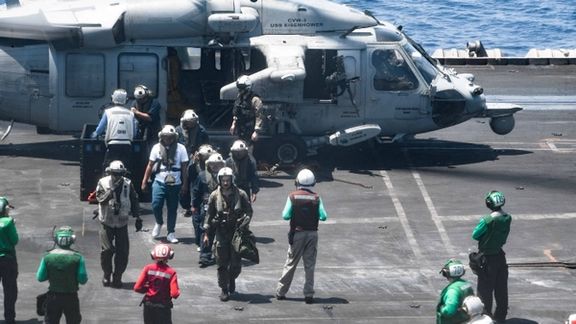
Sailors from the Dwight D. Eisenhower Carrier Strike Group assist distressed mariners rescued from the Liberian-flagged, Greek-owned bulk carrier M/V Tutor that was attacked by Houthis, in the Red Sea, June 15, 2024.

US and British forces launched at least six airstrikes on Yemeni Houthi targets on Monday in retaliation for repeated attacks on commercial vessels in the Red Sea area, Houthi media reported.

The attacks targeted Yemen's Hodeidah International Airport and four strikes on Kamaran Island near the port of Salif off the Red Sea, Al-Masirah TV, the main television news outlet run by Yemen's Houthi movement, said on Monday.

The strikes on Kamaran mark the first time US-led coalition forces have targeted the island since airstrikes on Houthi targets began early this year.

They follow the Iran-backed Houthis' first successful armed maritime drone strike and other missile assaults that damaged the Tutor and Verbena cargo ships last week. Both vessels are abandoned and adrift - with Tutor at risk of sinking, military and security experts said.

Meanwhile the Pentagon said that Russian, Chinese and Iranian naval vessels in the vicinity of Tutor did not respond to emergency calls for assistance. The Houthis have reportedly given assurances to Russia and China of not attacking their commercial ships.

“Among the ships that were in response distance and did nothing to assist the M/V Tutor were Iranian, Russian and Chinese naval vessels. The Tutor remains in the Red Sea and is slowly taking on water while waiting for salvage vessels to help with recovery,” Deputy Pentagon Press Secretary Sabrina Singh said during her press briefing on Monday.

The Houthis, who control Yemen's capital and most populous areas, have attacked international shipping in the Red Sea since November in solidarity with Palestiniansin Gaza. In that time, they have sunk one ship, seized another vessel and killed three sailors in separate attacks. The attacks began after Iran’s Supreme Leader Ali Khamenei called on Muslim Nations in early November to blockade Israeli trade.

Yemen's internationally recognized government believes Houthi fighters in the past have used Kamaran Island and Port Salif as a site to launch their Red Sea attacks as well as hide stockpiles of missiles and drones in its salt mines, two military sources within the government told Reuters.

The 10-kilometers of water that stretch from the port of Salif to Kamaran Island are also part of the route that ships must transit through to reach their next port of call.

Military and security officials said the Liberian-flagged Tutor has been taking on water since the Houthis hit it with an armed boat drone and air missiles on Wednesday in the Red Sea. That attack damaged the Tutor's engine room and caused severe flooding.

Rescuers from the U.S. Dwight D. Eisenhower Carrier Strike Group aircraft carrier have airlifted the Tutor's crew to safety. One sailor remains missing.

U.S. Central Command separately said crewmembers from the Palau-flagged Verbena issued a distress call this weekend due to uncontrolled fires sparked by two Houthi missile strikes in the Gulf of Aden on Thursday.

The Cayman Islands-flagged Anna-Meta wheat carrier rescued Verbena's crew and is transporting them to safety, CENTCOM said.

Despite reprisals from the U.S.-British coalition and other navies, the Houthis have escalated their campaign against commercial vessels in one of the world's busiest shipping lanes.

Their missile and drone attacks have forced ship owners to reroute vessels away from the vital Suez Canal shortcut - sending costs and delays cascading through the vital ocean shipping industry that transports about 80% of international trade.


Most Viewed

Ghalibaf defends Iran-US talks amid hardline backlash
1
INSIGHT

Ghalibaf defends Iran-US talks amid hardline backlash

2
ANALYSIS

From instability to influence: Pakistan’s pivotal role in US-Iran diplomacy

3
ANALYSIS

100 days on: why Iran’s January protests spread across social classes

4

War-hit homeowners feel abandoned as Iran’s reconstruction aid fades

5

Iran says no decision yet on talks as Pakistan prepares to host US team

Banner
Banner

Spotlight

  • The politics of pink: how Iran uses cuteness to rebrand violence
    ANALYSIS

    The politics of pink: how Iran uses cuteness to rebrand violence

  • Bread shortages, soaring prices strain households in Iran, residents say
    VOICES FROM IRAN

    Bread shortages, soaring prices strain households in Iran, residents say

  • War-hit homeowners feel abandoned as Iran’s reconstruction aid fades

    War-hit homeowners feel abandoned as Iran’s reconstruction aid fades

  • 100 days on: the anatomy of Iran’s January crackdown
    INSIGHT

    100 days on: the anatomy of Iran’s January crackdown

  • Ghalibaf defends Iran-US talks amid hardline backlash
    INSIGHT

    Ghalibaf defends Iran-US talks amid hardline backlash

  • From instability to influence: Pakistan’s pivotal role in US-Iran diplomacy
    ANALYSIS

    From instability to influence: Pakistan’s pivotal role in US-Iran diplomacy

•
•
•

More Stories

Israel Warns Iran-Backed Hezbollah Over Cross-Border Escalation

Jun 17, 2024, 07:21 GMT+1

Intensified cross-border fire from Iran-backed Hezbollah militias from Lebanon into Israel could trigger serious escalation, the Israeli military said on Sunday, repeating recent warnings by other officials.

"Hezbollah’s increasing aggression is bringing us to the brink of what could be a wider escalation, one that could have devastating consequences for Lebanon and the entire region," Israeli military spokesperson Rear Admiral Daniel Hagari said in a video statement in English.

Hezbollah, which has been in a cross-border confrontation with Israel since the October 7 Hamas attack, intensified its bombardment of northern Israel last week, triggering strong responses by the Israeli air force. Concerns about a wider war grew, as many in Israel spoke about a decisive confrontation with the Lebanese Shiite group armed and supported by Iran.

The Israeli strike in south Lebanon village of Jouaiyya late on Tuesday killed three Hezbollah fighters alongside the senior field commander identified by Hezbollah as Taleb Abdallah, also known as Abu Taleb.

He was the most senior Hezbollah commander killed during eight months of hostilities; a source told Reuters. Old photos emerged on social media showing Abdallah with Hezbollah leader Hassan Nasrallah.

Hagari stated that Hezbollah “has been escalating its attacks against Israel. Since deciding to join the war that Hamas started on October 7th, Hezbollah has fired over 5,000 rockets; anti-tank missiles, and explosive UAVs from Lebanon at Israeli families, homes, and communities.”

After the relatively heavy exchanges over the past week, Sunday saw a marked drop in Hezbollah fire, while the Israeli military said that it had carried out several air strikes against the group in southern Lebanon. However, Hagari warned that “Israel will take the necessary measures to protect its civilians, until security along our border with Lebanon is restored.”

The US and France are working on a negotiated settlement to the hostilities along Lebanon's southern border. Hezbollah says it will not halt fire unless Israel stops its military offensive on Gaza.

A senior Biden adviser will travel to Israel on Monday for meetings to avoid further escalation between Israel and Lebanon, the White House said.

Amos Hochstein will advance efforts to avoid further escalation along the "Blue Line" between Israel and Lebanon, said the official, who did not wish to be identified.

Hagari said that Hezbollah is endangering the future and security of Lebanon by playing the role of a “shield for Hamas terrorists who murdered the elderly, raped women, burned children, and kidnapped Jews, Muslims, and Christians, during their massacre on October 7th.”

Hagari warned that “Iran’s terror proxies continue to drag the region to destruction. Israel will continue fighting against Iran’s axis of evil on all fronts — in Gaza, in Lebanon — as we work towards a more secure future for the Middle East.”

“October 7th cannot happen again, on any one of Israel’s borders. Israel has a duty to defend the people of Israel. We will fulfill that duty, at all costs,” he added.

Around 400 Hezbollah and allied fighters have been killed in eight months of skirmishes with Israel, with dozens of Israeli soldiers and civilians dead and wounded in Hezbollah shelling of northern Israel.

US Navy Rescues Crew from Ship Hit by Houthis in Red Sea

Jun 16, 2024, 10:34 GMT+1

The US Naval Forces Central Command (NAVCENT) said on Sunday that it had rescued the crew from the Liberian-flagged, Greek-owned bulk carrier M/V Tutor that was attacked by Yemen's Iran-backed Houthis on 12 June in the Red Sea.

Sailors assigned to the Dwight D. Eisenhower Carrier Strike Group airlifted the crew out on Saturday, NAVCENT said, adding that one civilian sailor remained missing.

The attack, which occurred near the Yemeni port of Hodeidah, caused severe flooding and damage to the engine room and left the Tutor unable to maneuver.

On Saturday, the United Kingdom Maritime Trade Operations (UKMTO) said the ship's crew was evacuated and that the abandoned vessel was drifting in the Red Sea.

The Houthis claimed responsibility for the small sea craft and missile attacks it used to target the ship as part of their ongoing campaign which they say is in support of the Palestinians and is focused on ships bound for Israel.

Iran supplies weapons to and supports Houthi forces in Yemen, which have been attacking international commercial vessels since November, disrupting a vital maritime route linking Asia with Europe.

The attacks began after Iran's Supreme Leader Ali Khamenei called on Muslim nations in early November to blockade Israeli trade.

Ship Evacuated and Ablaze After Attack by Iran-Backed Houthis

Jun 15, 2024, 17:30 GMT+1

The United Kingdom Maritime Trade Operations (UKMTO) said on Saturday the crew of a Palau-flagged cargo ship had been evacuated and the ship was on fire and sinking, referring to an incident that happened 98 nautical miles east of Yemen's Aden on June 13.

Missiles fired by Yemen's Houthi militants struck the Verbena in the Gulf of Aden on Thursday, sparking a fire and severely injuring one of its crew, U.S. Central Command said.

The Iran-allied Houthis have launched dozens of attacks on international shipping in the Red Sea region since November for what they say is solidarity with Palestinians in the war between Israel and Hamas.

The attacks began after Iran's Supreme Leader Ali Khamenei urged Muslim nations to blockade Israel's trade routes. The United States and Britain have launched air strikes against Houthi military targets since January, but the militant group receiving arms and support from Iran has continued its campaign.

The Houthi campaign in the Red Sea region has disrupted global shipping, cascading delays and costs through supply chains. The militants have sunk one ship, seized another vessel and killed three seafarers in separate attacks.

US Navy Fighting Its 'Most Intense' Battle Since WWII Against Iran-Backed Houthis

Jun 14, 2024, 22:30 GMT+1

The US-led campaign against Iran-backed Houthi militants "has turned into the most intense running sea battle the US Navy has faced since World War II," its leaders and experts told AP.

“I don’t think people really understand just kind of how deadly serious it is what we’re doing and how under threat the ships continue to be,” Cmdr. Eric Blomberg with the USS Laboon told the AP on a visit to his warship on the Red Sea.

“We only have to get it wrong once,” he said. “The Houthis just have to get one through.”

Capt. David Wroe, the commodore overseeing the guided missile destroyers, says “it is every single day, every single watch, and some of our ships have been out here for seven-plus months doing that."

The US Navy prepared for decades to potentially fight the Soviet Union, then later Russia and China, on the world’s waterways. However, instead of a global power, it finds itself locked in combat with a shadowy, Iran-backed rebel group based in Yemen, the AP's report said.

The Houthis, an Iranian proxy group, began targeting maritime commercial traffic in mid-November following a call by Iran’s Supreme Leader Ali Khamenei for Muslim countries to blockade Israel. Initially confined to the Red Sea, these attacks have since extended to other crucial waterways, including the Indian Ocean.

The United States and Britain have bombed Houthi military installations several times since January, but the Iran-backed group has accelerated attacks in the past two weeks, as Israel continues operations in Gaza and attacks Iran-backed Hezbollah targets in Lebanon.

The Houthi campaign has disrupted global shipping, forcing firms to re-route to longer and more expensive journeys around southern Africa. It has also stoked fears that the Gaza war - in which the local health ministry says over 37,000 have been killed - could spread and destabilize the wider Middle East.

G7 Warns Iran Against Giving Russia Ballistic Missiles

Jun 14, 2024, 17:07 GMT+1

The Group of Seven leaders warned Iran Friday not to give Russia ballistic missiles, only a day after the two countries’ much-publicized strategic agreement was confirmed to have been halted due to “issues” on the Iranian part.

Iran and Russia have grown closer due to the war in Ukraine, which has resulted in sweeping sanctions on Russia from the US and the EU. Iran has supplied Russia with hundreds of kamikaze drones, and unofficial reports suggest that Tehran may be considering enhancing its assistance with missiles.

"We call on Iran to stop assisting Russia’s war in Ukraine and not to transfer ballistic missiles and related technology, as this would represent a substantive material escalation and a direct threat to European security," the G7 stated.

In February, Reuters reported that Iran had provided Russia with “a large number of powerful surface-to-surface ballistic missiles”. The claim was later repeated by UK defense secretary Grant Shapps, who indicated that he had such information but refused to offer details..

Iran and Russia have been working on a long-term agreement for a few years now, hoping to set in stone a trend that has seen Tehran and Moscow expand and deepen ties.

The new comprehensive cooperation agreement was conceived under former President Hassan Rouhani and officially announced by his late successor, Ebrahim Raisi. “Documents of strategic cooperation can outline the horizons of the [two countries’] relations over 20 years,” Raisi said after he met Putin and presented the draft in 2022.

The agreement was expected to be signed this year, but the Russian side announced Wednesday that the process was halted due to “issues faced by our Iranian partners.” Russia's TASS news agency then quoted foreign minister Sergei Lavrov as saying that several "procedural legislative actions" must be completed before the agreement can be signed.

It is unclear what the “actions” are and if it is related to the unexpected, upcoming presidential elections in Iran, which were announced after Raisi died in a helicopter crash last month.

Earlier on Friday, it was announced that Russian President Vladimir Putin and Iran’s acting president, Mohammad Mokhber, had talked on the phone Thursday evening, in what seems to be the latest attempt to counter rumors surrounding the ‘halt’ of the two countries’ comprehensive agreement.

“Both sides expressed their interest in further development of Russian-Iranian cooperation,” according to the Kremlin, “including in implementing promising joint projects in energy and transport.”

Reza Talebi, Iran International's political correspondent, believes the ‘halt could be a strategic move by Putin to exert more pressure on an isolated Iran.

"It's a message from Vladimir Putin to Tehran, warning them not to alter their policies, particularly concerning Ukraine and the Gaza conflict. Additionally, it aims to pressure the incoming Iranian government into negotiations to secure more favorable terms," he stated.

Under severe international sanctions, Russia and Iran have expanded their economic ties, with mutual trade standing at $4 billion, which even Iranian officials admit is far below the target of $40 billion.

The two countries reached an agreement in December to eliminate the use of the US dollar in bilateral trade, a development heralded by Iran's central bank governor as a "new chapter." However, the move has more of a symbolic significance than a real economic act.





