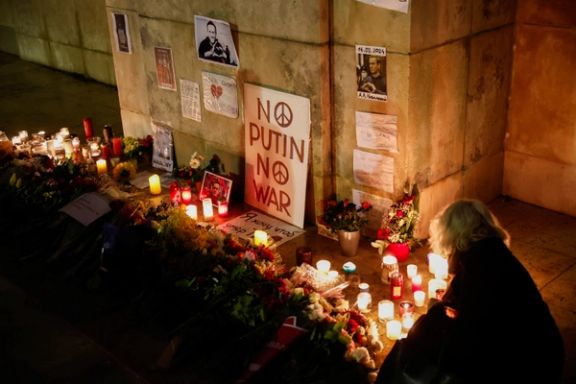
People attend a vigil following the death of Russian opposition leader Alexei Navalny, at the Trocadero near the Eiffel Tower in Paris, France, February 19, 2024.
In the annals of Russian history, few figures stand as tall as Alexei Navalny. His name has become synonymous with courage, resilience, and unwavering commitment to justice in the face of oppression.
From surviving a poisoning attempt orchestrated by the Kremlin, to boldly returning to Russia despite the risks, Navalny's journey embodies the spirit of defiance against tyranny.
Navalny's activism began long before his poisoning in August 2020. As a prominent anti-corruption crusader and political opposition leader, he had long been a thorn in the side of Vladimir Putin's regime. His relentless investigations into corruption at the highest levels of government exposed the rot at the core of Putin's rule, earning him both admiration and ire from supporters and adversaries alike.
But it was the brazen attempt on Navalny's life that catapulted him onto the international stage and transformed him into a symbol of resistance against Putin's authoritarian regime. Despite suffering near-fatal poisoning with Novichok, a deadly nerve agent, Navalny defied the odds and survived. His recovery, against all odds, was a testament to his resilience and determination to continue the fight for justice.
Navalny's return to Russia in January 2021, just months after his poisoning, further underscored his unwavering commitment to his cause. Despite the genuine threat to his life, he chose to confront his would-be assassins head-on, declaring, "I'm not afraid." His defiance in the face of danger inspired millions of Russians who yearned for change and galvanized a new wave of opposition to Putin's regime.
A woman holds flowers in front of a makeshift memorial to Russian opposition leader Alexei Navalny in Milan, Italy, February 19, 2024.
Navalny’s life and death has undoubtedly left a deep impression on activists facing tyrannical regimes around the world, including in Iran, where hundreds of dissidents suffer isolation and often torture in prisons. Many Iranians voiced outrage upon hearing the news of his passing in a Gulag prison, flooding social media with messages of support.
In his powerful courtroom speech during his trial, Navalny minced no words in condemning Putin and his cronies for their corruption and oppression. He spoke not just for himself but for the millions of Russians who have suffered under Putin's rule. His words were a rallying cry for those who refuse to be silenced by fear, a call to action for all who believe in democracy and human rights.
Navalny's court defense succinctly highlights his defiance against Putin's regime and his unwavering commitment to justice. He accuses Putin of orchestrating his assassination attempt, asserting that his persecution stems from Putin's fear and hatred towards him for surviving the attempt. Condemning Putin as a cowardly "little man in a bunker," Navalny accuses him of resorting to murder to maintain power and brands him as "Vladimir the Underpants Poisoner." He challenges the trial's intimidation tactics, asserting that locking up one man cannot instill fear in millions. Navalny pledges to continue fighting despite facing imprisonment and urges others to do the same, demanding proper justice and fundamental rights such as participation in elections and equitable distribution of national wealth.
A man watches portraits of Russian opposition leader Alexei Navalny at the Russian embassy as people attend a protest and vigil held following the death of Navalny, in Kappara, Malta, February 19, 2024.
Navalny's activism, however, did not go unchallenged. Putin's regime, notorious for its brutal crackdowns on dissent, spared no effort in trying to silence Navalny and his supporters. From arbitrary arrests and politically motivated prosecutions to the use of state-sponsored violence, the regime sought to crush any opposition to its rule.
But Navalny remained undeterred. His courage in the face of adversity inspired countless Russians to join the fight for freedom and justice. His message resonated with those who had long suffered under Putin's repressive regime, giving voice to their aspirations for a better future.
As we mourn Navalny's passing, we must also celebrate his life and legacy. His death in prison is a tragic reminder of the lengths to which Putin's regime will go to cling to power. But it is also a testament to Navalny's unwavering commitment to his principles and willingness to sacrifice everything for the cause of justice.
As we honor Navalny's memory, let us renew our commitment to the values for which he fought so tirelessly. Let us demand justice for Navalny and all those whom Putin's regime has silenced. And let us continue to pressure Putin and his chain of corruption until justice prevails and freedom triumphs.
Let us call for the free world to recognize the severity of the situation in Russia under Putin's rule, rejecting the notion that continued dialogue will lead to meaningful change and instead urging decisive action, including the non-recognition of the upcoming Russian election. International solidarity is needed in addressing the crisis in Russia. It is time for the free world to stand up to Putin's tyranny and demand justice for the people of Russia.
As Navalny famously stated in an Oscar-winning 2022 documentary about his life by Canadian director Daniel Roher, "If they decide to kill me, You're not allowed to give up. If they decide to kill me, it means that we are incredibly strong. We need to utilize this power not to give up, to remember we are a huge power that these bad dudes are oppressing."
As he asked, we can't lose hope and must continue the fight. Dictators never rest, and neither can we. Let us join together, wiping away our tears, and pick up where he left off, standing firmly for justice and freedom.
A protest rally by Iranian retirees and pensioners in June 2022
While Iran funds billions of dollars into its regional proxies, retirees have been given a minimal new year bonus which falls far short of covering even the most essential expenses amidst the country's economic disaster.
Maryam Shokrani, an economic reporter, vocalized the frustration felt by many, stating, "They have deposited 25 million rials (less than 50 dollars) as pensioners' Eid gift; the money is equivalent to four pizzas and side dishes. Aren't they ashamed?!"
In Iran, the anticipation of the Muslim holiday of Eid which follows the Holy Month of Ramadan which begins next month, or the Iranian New Year, beginning on March 21, is often accompanied by the hope of receiving a bonus from employers.
The amount allocated for Eid or New Year bonuses has dwindled to such an extent that it no longer holds the purchasing power it once did. For countless families, the bonuses have become mere tokens, scarcely enough to cover basic necessities, let alone indulge in the customary tradition of purchasing new clothes for the occasion.
In a bid to appease a disillusioned public on the eve of upcoming elections, Iranian workers are set to receive a government approved average salary increase of 20 percent starting in March, amid an annual inflation rate of around 50 percent. The new minimum monthly wage has been set at 115 million Iranian rials or about $230.
It comes as a slap in the face for workers and retirees alike. Iran's proxies across the Middle East from Lebanon to Yemen and beyond, received billions of dollars every year in funding, training and weapons from the regime, to the detriment of the country's civilians who have been pushed into the depths of poverty. Gaza-based Hamas alone has been receiving around $100 million from Iran for at least a decade according to the US Treasury while Lebanon and Yemen receive much higher patronage.
Iran’s Supreme Leader Ali Khamenei casting his vote during an election
In a significant shift from his previously conciliatory stance, former President Mohammad Khatami has asserted that the upcoming elections are far from being free, fair, and competitive.
According to Jamaran News website, speaking to the leaders of Hambastegi [Solidarity], one of Iran's smallest Reformist parties, Khatami highlighted widespread dissatisfaction among educated youth, elites, and over 50 percent of the population who abstained from voting in the 2020 and 2021 elections. He also noted millions who cast blank votes.
Khatami cautioned the government against assuming satisfaction among past election participants with the country's situation. He emphasized the need for competitive, free, and fair elections, advocating for representation of reformists, conservatives, and all Iranians. He urged the government to address existing dissatisfactions seriously to ensure future elections are fair.
Khatami cautioned the government that "it should not assume that those who voted in the past two elections are necessarily happy about the country's situation."
Khatami further said, "A free, fair, and competitive election is an election in which not only the reformists and conservatives, but also all other Iranians can have their own candidates." He expressed hope that "the government takes the existing dissatisfactions seriously and paves the way for free and fair elections in the future."
Since the establishment of the Islamic Republic in 1979, only individuals loyal to the clerical regime have been permitted to run in elections. Those with dissenting views not only faced bans on political activities but also risked arrest and lengthy prison terms.
Iran's ruler Ali Khamenei (left) and former president Mohammad Khatami
In another development, Mohammad Taghi Akbarnejad, a conservative cleric at the Qom seminary was arrested on February 17 for his critical comments about the upcoming elections and Supreme Leader Ali Khamenei and his regime's track record during the past 45 years.Akbarnejad said in a video that went viral on social media that "both voting and not voting in the elections carry a message to the government and reflect people's reaction to the officials' [objectionable] performance."
He also compared Iran's economic situation to those of China and South Korea: "This government has had 45 years to prove itself. It has been in control of a wealthy country for 45 years. We own eight to nine percent of the wealth of the whole world. In the modern world 45 years is a lot of time. China has become [modern] China during the past 45 years. South Korea has become what it is during the same 45 years."
Iran’s GDP is less than half of its neighbors Turkey and Saudi Arabia, while before the revolution it was the leading economic power in the Middle East.
Akbarnejad continued to make startling remarks as a conservative cleric. He directly challenged the leaders of the Islamic Republic by questioning the practical benefits of their religion for the people. "I do not believe in a religion that does not serve the nation's interests," he boldly declared. It's worth noting that, as a devout Muslim, he was questioning the application of religious principles by the rulers rather than expressing disbelief in religion itself.
Following his arrest, the number of his followers on Instagram rose from around 1,000 to over 93,000.
In yet another development , following a panel discussion about the election at the University of Tehran, which turned out to be mainly about the expected low turnout, former government spokesman Ali Rabiei wrote about his take on the reasons for a likely low turnout in an article for Etemad Online website.
"When those in power are not prepared to make any compromise, the society falls out with the government and avoids any form of reconciliatory behavior," he argued.
He censured a small yet powerful faction for engineering a political deadlock fueled by narrow factional interests, which prioritizes their own agenda over national security. Rabiei concluded by asserting that Iranians are utilizing the elections as a platform to articulate their discontent.
A recent survey has shown that the majority of Iranians will boycott the upcoming parliamentary elections, with 75 percent seeking the overthrow of the government.
A survey by the Netherlands-based Gamaan institute collected information from 58,015 Iranian residents over an eight-day period from January 31 to February 7. Titled “Iranians’ Attitudes Toward the 2024 Elections,” the survey targeted people aged 19 and above, a sample from 90% of the country's literate adult population.
Several balancing techniques were used to ensure that the demographics and characteristics of the sample closely mirror those of the population, but the survey was conducted via a specialized platform for sampling on the internet, which is not openly accessible to all Iranians. Although such methods help mitigate the risk of bias in the results, the sample may not accurately represent the population as most people who use censorship circumvention tools to access the internet are critical of the regime.
The survey by the non-profit research foundation provides a nuanced understanding of voter sentiments and preferences as the nation approaches a pivotal moment in its political trajectory, the first election after the 2022 popular uprising. The nationwide protests, ignited by the death of 22-year-old Mahsa Amini, were the boldest challenge the regime witnessed since its establishment in 1979.
While a staggering 77 percent of respondents expressed their intention not to participate in the upcoming elections, eight percent of respondents remain undecided, while only around 15 percent expressed a definite intention to vote on March 1.
Underlining deep skepticism towards the efficacy of the electoral process in effecting meaningful change within the country, the survey revealed that approximately 38 percent of respondents were unaware of the exact date of the upcoming elections.
Additionally, 39 percent of those who voted in the previous round of parliamentary elections in 2019 do not intend to vote this year. Among people who are legally allowed to vote for the first time, 65 percent expressed their disinclination towards participating in the upcoming polls.
On SUnday, Iran's ruler, Ali Khamenei, made a fervent appeal for voter turnout in the March 1 elections, amidst indications of a potential low participation rate, signaling a declining legitimacy.
A sobering finding was the high number of people who would vote against the Islamic Republic in case of a referendum. In a hypothetical plebiscite with the question “Islamic Republic: Yes or No?” around 75 percent would vote “No,” 16 percent “Yes,” and about nine percent are unsure.
The survey also delved into Iranians' perspectives on alternative avenues for effecting societal change, contrasting electoral participation with participation in protests. Notably, approximately one-third of respondents (33 percent) considered participation in protests as a more effective means of effecting change, while around 13 percent viewed electoral participation as preferable. Additionally, around one-third of respondents (33%) expressed skepticism towards the efficacy of both methods in catalyzing meaningful change within the nation.
Replying to a question about their political orientation, 40 percent of the participants favored overthrowing the Islamic Republic as a precondition for any change and 25 percent voted for structural transformations and a transition from the Islamic Republic, while 11 percent supported preserving the principles and values of the Islamic Republic regime. Nine percent of the respondents expressed support for gradual reforms within the framework of the Islamic Republic system and 14 percent did not identify with any of these options.
The survey also explored Iranians' attitudes towards the ongoing conflict between Israel and Hamas. Responses indicated varying perceptions regarding the primary instigator of the conflict, which started after Tehran-backed Islamist militia Hamas invaded Israel and killed 1,200 people on October 7. Approximately 35% attributed the blame to Hamas, 20% to Israel, and 31% believed both parties were responsible.
Iran's continued suppression of dissent has seen more disruptions to virtual private network (VPN) services amid an ongoing surge in internet crackdowns to silence opposition voices.
Reports say the disruptions have led to decreased internet access speed, exacerbating concerns over online censorship and surveillance in Iran.
The latest bans come amid a broader crackdown on internet freedom activists, with reports indicating the detention of several individuals engaged in advocating for unrestricted access to online content.
Among the detained activists, Youssef Ghobadi's unofficial detention has sparked widespread outcry, along with the arrest of another activist known as "Segaro," who was active on the X platform. The two had been working to develop and distribute circumvention tools such as VPNs to help Iranian citizens bypass internet censorship.
The crackdown aligns with legal measures announced by the Iranian judiciary aiming to penalize individuals involved in the VPN industry, allowing internet users to bypass state sanctioned bans.
Last year, Iran's judiciary announced its intention to punish unauthorized sellers and distributors of VPNs and other such tools based on Article 753 of the Islamic Penal Code. According to the article, the "production, dissemination, distribution, making available, or trading of data, software, or any type of electronic tool solely for the purpose of committing cybercrimes" is considered a crime.
This comes as various evidence points to the existence of a government-led VPN mafia in Iran. Iranian MPs have accused the government of being involved in financially benefiting from internet censorship and the companies producing censorship circumvention tools like VPNs.
Among those is Jalal Rashidi Kouchi who estimated that the financial turnover of VPN sellers in Iran amounts to approximately 800 million to 1 billion dollars annually.
Iranian Foreign Minister Hossein Amir-Abdollahian (4th left) and his Afghani counterpart Amir Khan Muttaqi (3rd left) in Tehran
Iran is trying to derail UN efforts to help internal dialogue in Afghanistan and foster engagement between Kabul and the international community, diplomatic sources have told Iran International.
The United Nations secretary general Antonio Guterres told a press conference in Doha on Monday that he will begin consultations on the appointment of a UN envoy to coordinate engagement between Afghanistan's Taliban and the international community.
Antonio Guterres said that Taliban representatives did not accept an invitation to a meeting of international envoys to Afghanistan that he convened in Doha on Sunday and Monday.
Diplomatic sources indicate that Tehran believes such efforts will reduce its influence with the Taliban in Afghanistan and boost US influence.
Afghanistan International, the sister broadcaster to Iran International, asked Iran’s representative, Hassan Kazemi Qomi, if Tehran was working against the goals of the Doha meeting. Qomi responded that the Islamic Republic of Iran engages in efforts that “benefit the Afghan people.”
Many international and non-governmental organizations and activists have attended the two-day meeting in Qatar. Guterres held closed-door meetings with diplomats and organizations to consult on prospects of improving the situation in Afghanistan and relations with Kabul.
A meeting between Iran’s foreign ministry officials and an Afghan delegation in Tehran on November 5, 2023
The Taliban government is largely unrecognized in the world, but it seems in no hurry to gain international acceptance.
The Taliban have refused the invitation from the UN Department of Political Affairs and Peacebuilding (DPPA) to attend the gathering. While Iran sent a representative, Russia has also refused to attend on the request of the Taliban.
Iran’s clerical regime and the Taliban have had mixed relations since 2021, when the US-supported government fell in Kabul and the militant group took over Afghanistan. Border clashes, a water dispute and million of Afghan refugees crossing the border into Iran have marked their attempts to foster relations.
Amid impasse on these issues, a 30-member Taliban “economic delegation” visited Iran in November. The delegation held talks with Iranian authorities on trade, transit, transportation, infrastructure, and railways, as well as regional development and the issue of the growing number of Afghan migrants in Iran.
The Afghan delegation was led by Abdul Ghani Baradar, First Deputy Prime Minister for Economic Affairs of Afghanistan and a co-founder of the Taliban along with Mullah Omar.
Amid the escalating Hamas-Israel conflict, the visit by the Afghan delegation was also be related to security issues. Baradar also held a meeting with Iran’s top security chief Ali-Akbar Ahmadian, the Secretary of the Supreme National Security Council and a close aide to Supreme Leader Ali Khamenei. "Afghanistan will not pose a threat to any of its neighbors," the Taliban official said according to IRNA.
Tehran has been urging internal reconciliation in Afghanistan between the Taliban, which heavily represent the Pashtuns in the country and Persian-speaking ethnic groups such as the Hazara. However, the Taliban reject Tehran’s call insisting that they are the government, and everyone should fall in line.
The aim of UN’s DPPA is to reintegrate Afghanistan into the world community with the objective of a country “at peace with itself and its neighbors, fully reintegrated into the international community, and meeting international obligations.”