• العربية
  • فارسی
Brand
  • Iran Insight
  • Politics
  • Economy
  • Analysis
  • Special Report
  • Opinion
  • Podcast
  • Iran Insight
  • Politics
  • Economy
  • Analysis
  • Special Report
  • Opinion
  • Podcast
  • Theme
  • Language
    • العربية
    • فارسی
  • Iran Insight
  • Politics
  • Economy
  • Analysis
  • Special Report
  • Opinion
  • Podcast
All rights reserved for Volant Media UK Limited
volant media logo

Dissenting Clerics And Politicians Question Iran's Elections
Iran International Newsroom
Feb 20, 2024, 06:37 GMT+0Updated: 11:02 GMT+0
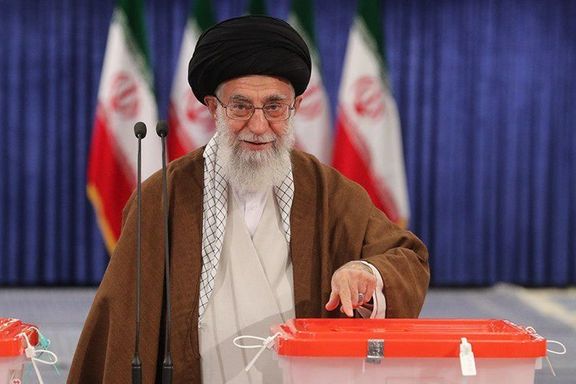
Iran’s Supreme Leader Ali Khamenei casting his vote during an election

In a significant shift from his previously conciliatory stance, former President Mohammad Khatami has asserted that the upcoming elections are far from being free, fair, and competitive.

According to Jamaran News website, speaking to the leaders of Hambastegi [Solidarity], one of Iran's smallest Reformist parties, Khatami highlighted widespread dissatisfaction among educated youth, elites, and over 50 percent of the population who abstained from voting in the 2020 and 2021 elections. He also noted millions who cast blank votes.

Khatami cautioned the government against assuming satisfaction among past election participants with the country's situation. He emphasized the need for competitive, free, and fair elections, advocating for representation of reformists, conservatives, and all Iranians. He urged the government to address existing dissatisfactions seriously to ensure future elections are fair.

Khatami cautioned the government that "it should not assume that those who voted in the past two elections are necessarily happy about the country's situation."

Khatami further said, "A free, fair, and competitive election is an election in which not only the reformists and conservatives, but also all other Iranians can have their own candidates." He expressed hope that "the government takes the existing dissatisfactions seriously and paves the way for free and fair elections in the future."

Since the establishment of the Islamic Republic in 1979, only individuals loyal to the clerical regime have been permitted to run in elections. Those with dissenting views not only faced bans on political activities but also risked arrest and lengthy prison terms.

Iran's ruler Ali Khamenei (left) and former president Mohammad Khatami  (undated)
100%
Iran's ruler Ali Khamenei (left) and former president Mohammad Khatami

In another development, Mohammad Taghi Akbarnejad, a conservative cleric at the Qom seminary was arrested on February 17 for his critical comments about the upcoming elections and Supreme Leader Ali Khamenei and his regime's track record during the past 45 years. Akbarnejad said in a video that went viral on social media that "both voting and not voting in the elections carry a message to the government and reflect people's reaction to the officials' [objectionable] performance."

He also compared Iran's economic situation to those of China and South Korea: "This government has had 45 years to prove itself. It has been in control of a wealthy country for 45 years. We own eight to nine percent of the wealth of the whole world. In the modern world 45 years is a lot of time. China has become [modern] China during the past 45 years. South Korea has become what it is during the same 45 years."

Iran’s GDP is less than half of its neighbors Turkey and Saudi Arabia, while before the revolution it was the leading economic power in the Middle East.

Akbarnejad continued to make startling remarks as a conservative cleric. He directly challenged the leaders of the Islamic Republic by questioning the practical benefits of their religion for the people. "I do not believe in a religion that does not serve the nation's interests," he boldly declared. It's worth noting that, as a devout Muslim, he was questioning the application of religious principles by the rulers rather than expressing disbelief in religion itself.

Following his arrest, the number of his followers on Instagram rose from around 1,000 to over 93,000.

In yet another development , following a panel discussion about the election at the University of Tehran, which turned out to be mainly about the expected low turnout, former government spokesman Ali Rabiei wrote about his take on the reasons for a likely low turnout in an article for Etemad Online website.

"When those in power are not prepared to make any compromise, the society falls out with the government and avoids any form of reconciliatory behavior," he argued.

He censured a small yet powerful faction for engineering a political deadlock fueled by narrow factional interests, which prioritizes their own agenda over national security. Rabiei concluded by asserting that Iranians are utilizing the elections as a platform to articulate their discontent.


Most Viewed

Ghalibaf defends Iran-US talks amid hardline backlash
1
INSIGHT

Ghalibaf defends Iran-US talks amid hardline backlash

2
VOICES FROM IRAN

Bread shortages, soaring prices strain households in Iran, residents say

3
INSIGHT

Iran diplomacy wobbles as factions compete to avoid looking soft on US

4
ANALYSIS

The politics of pink: how Iran uses cuteness to rebrand violence

5

War-hit homeowners feel abandoned as Iran’s reconstruction aid fades

Banner
Banner

Spotlight

  • Lights out, then gunfire: Witnesses recount Mashhad protest crackdown
    VOICES FROM IRAN

    Lights out, then gunfire: Witnesses recount Mashhad protest crackdown

  • Family told missing teen was alive, then received his body 60 days later
    EXCLUSIVE

    Family told missing teen was alive, then received his body 60 days later

  • Is Iran entering its Gorbachev moment?
    INSIGHT

    Is Iran entering its Gorbachev moment?

  • Iran crackdown reaches cemeteries as graves of slain protesters defaced
    EXCLUSIVE

    Iran crackdown reaches cemeteries as graves of slain protesters defaced

  • Iran diplomacy wobbles as factions compete to avoid looking soft on US
    INSIGHT

    Iran diplomacy wobbles as factions compete to avoid looking soft on US

  • The politics of pink: how Iran uses cuteness to rebrand violence
    ANALYSIS

    The politics of pink: how Iran uses cuteness to rebrand violence

  • Bread shortages, soaring prices strain households in Iran, residents say
    VOICES FROM IRAN

    Bread shortages, soaring prices strain households in Iran, residents say

•
•
•

More Stories

Three-Quarters Of Iranians Will Boycott Elections

Feb 19, 2024, 23:47 GMT+0
•
Iran International Newsroom

A recent survey has shown that the majority of Iranians will boycott the upcoming parliamentary elections, with 75 percent seeking the overthrow of the government. 

A survey by the Netherlands-based Gamaan institute collected information from 58,015 Iranian residents over an eight-day period from January 31 to February 7. Titled “Iranians’ Attitudes Toward the 2024 Elections,” the survey targeted people aged 19 and above, a sample from 90% of the country's literate adult population. 

Several balancing techniques were used to ensure that the demographics and characteristics of the sample closely mirror those of the population, but the survey was conducted via a specialized platform for sampling on the internet, which is not openly accessible to all Iranians. Although such methods help mitigate the risk of bias in the results, the sample may not accurately represent the population as most people who use censorship circumvention tools to access the internet are critical of the regime. 

Iran-parliament-election-survey-gamaan (February 2024)
100%

The survey by the non-profit research foundation provides a nuanced understanding of voter sentiments and preferences as the nation approaches a pivotal moment in its political trajectory, the first election after the 2022 popular uprising. The nationwide protests, ignited by the death of 22-year-old Mahsa Amini, were the boldest challenge the regime witnessed since its establishment in 1979. 

While a staggering 77 percent of respondents expressed their intention not to participate in the upcoming elections, eight percent of respondents remain undecided, while only around 15 percent expressed a definite intention to vote on March 1. 

Iran-parliament-election-survey-gamaan (February 2024)
100%

Underlining deep skepticism towards the efficacy of the electoral process in effecting meaningful change within the country, the survey revealed that approximately 38 percent of respondents were unaware of the exact date of the upcoming elections. 

Additionally, 39 percent of those who voted in the previous round of parliamentary elections in 2019 do not intend to vote this year. Among people who are legally allowed to vote for the first time, 65 percent expressed their disinclination towards participating in the upcoming polls.

On SUnday, Iran's ruler, Ali Khamenei, made a fervent appeal for voter turnout in the March 1 elections, amidst indications of a potential low participation rate, signaling a declining legitimacy.

Iran-parliament-election-survey-gamaan (February 2024)
100%

A sobering finding was the high number of people who would vote against the Islamic Republic in case of a referendum. In a hypothetical plebiscite with the question “Islamic Republic: Yes or No?” around 75 percent would vote “No,” 16 percent “Yes,” and about nine percent are unsure.

Iran-parliament-election-Referendum-survey-gamaan (February 2024)
100%

The survey also delved into Iranians' perspectives on alternative avenues for effecting societal change, contrasting electoral participation with participation in protests. Notably, approximately one-third of respondents (33 percent) considered participation in protests as a more effective means of effecting change, while around 13 percent viewed electoral participation as preferable. Additionally, around one-third of respondents (33%) expressed skepticism towards the efficacy of both methods in catalyzing meaningful change within the nation.

Iran-parliament-election-survey-gamaan (February 2024)
100%

Replying to a question about their political orientation, 40 percent of the participants favored overthrowing the Islamic Republic as a precondition for any change and 25 percent voted for structural transformations and a transition from the Islamic Republic, while 11 percent supported preserving the principles and values of the Islamic Republic regime. Nine percent of the respondents expressed support for gradual reforms within the framework of the Islamic Republic system and 14 percent did not identify with any of these options.

Iran-political-orientation-survey-gamaan (February 2024)
100%

The survey also explored Iranians' attitudes towards the ongoing conflict between Israel and Hamas. Responses indicated varying perceptions regarding the primary instigator of the conflict, which started after Tehran-backed Islamist militia Hamas invaded Israel and killed 1,200 people on October 7. Approximately 35% attributed the blame to Hamas, 20% to Israel, and 31% believed both parties were responsible. 

Iran Regime Disrupts VPNs Amid Crackdown On Activists

Feb 19, 2024, 18:59 GMT+0

Iran's continued suppression of dissent has seen more disruptions to virtual private network (VPN) services amid an ongoing surge in internet crackdowns to silence opposition voices.

Reports say the disruptions have led to decreased internet access speed, exacerbating concerns over online censorship and surveillance in Iran.

The latest bans come amid a broader crackdown on internet freedom activists, with reports indicating the detention of several individuals engaged in advocating for unrestricted access to online content.

Among the detained activists, Youssef Ghobadi's unofficial detention has sparked widespread outcry, along with the arrest of another activist known as "Segaro," who was active on the X platform. The two had been working to develop and distribute circumvention tools such as VPNs to help Iranian citizens bypass internet censorship.

The crackdown aligns with legal measures announced by the Iranian judiciary aiming to penalize individuals involved in the VPN industry, allowing internet users to bypass state sanctioned bans.

Last year, Iran's judiciary announced its intention to punish unauthorized sellers and distributors of VPNs and other such tools based on Article 753 of the Islamic Penal Code. According to the article, the "production, dissemination, distribution, making available, or trading of data, software, or any type of electronic tool solely for the purpose of committing cybercrimes" is considered a crime. 

This comes as various evidence points to the existence of a government-led VPN mafia in Iran. Iranian MPs have accused the government of being involved in financially benefiting from internet censorship and the companies producing censorship circumvention tools like VPNs.

Among those is Jalal Rashidi Kouchi who estimated that the financial turnover of VPN sellers in Iran amounts to approximately 800 million to 1 billion dollars annually.

Iran Opposes Afghan Reconciliation And Reintegration – Diplomats

Feb 19, 2024, 18:32 GMT+0
•
Iran International Newsroom

Iran is trying to derail UN efforts to help internal dialogue in Afghanistan and foster engagement between Kabul and the international community, diplomatic sources have told Iran International.

The United Nations secretary general Antonio Guterres told a press conference in Doha on Monday that he will begin consultations on the appointment of a UN envoy to coordinate engagement between Afghanistan's Taliban and the international community.

Antonio Guterres said that Taliban representatives did not accept an invitation to a meeting of international envoys to Afghanistan that he convened in Doha on Sunday and Monday.

Diplomatic sources indicate that Tehran believes such efforts will reduce its influence with the Taliban in Afghanistan and boost US influence.

Afghanistan International, the sister broadcaster to Iran International, asked Iran’s representative, Hassan Kazemi Qomi, if Tehran was working against the goals of the Doha meeting. Qomi responded that the Islamic Republic of Iran engages in efforts that “benefit the Afghan people.”

Many international and non-governmental organizations and activists have attended the two-day meeting in Qatar. Guterres held closed-door meetings with diplomats and organizations to consult on prospects of improving the situation in Afghanistan and relations with Kabul.

A meeting between Iran’s foreign ministry officials and an Afghan delegation in Tehran on November 5, 2023
100%
A meeting between Iran’s foreign ministry officials and an Afghan delegation in Tehran on November 5, 2023

The Taliban government is largely unrecognized in the world, but it seems in no hurry to gain international acceptance.

The Taliban have refused the invitation from the UN Department of Political Affairs and Peacebuilding (DPPA) to attend the gathering. While Iran sent a representative, Russia has also refused to attend on the request of the Taliban.

Iran’s clerical regime and the Taliban have had mixed relations since 2021, when the US-supported government fell in Kabul and the militant group took over Afghanistan. Border clashes, a water dispute and million of Afghan refugees crossing the border into Iran have marked their attempts to foster relations.

Amid impasse on these issues, a 30-member Taliban “economic delegation” visited Iran in November. The delegation held talks with Iranian authorities on trade, transit, transportation, infrastructure, and railways, as well as regional development and the issue of the growing number of Afghan migrants in Iran.

The Afghan delegation was led by Abdul Ghani Baradar, First Deputy Prime Minister for Economic Affairs of Afghanistan and a co-founder of the Taliban along with Mullah Omar.

Amid the escalating Hamas-Israel conflict, the visit by the Afghan delegation was also be related to security issues. Baradar also held a meeting with Iran’s top security chief Ali-Akbar Ahmadian, the Secretary of the Supreme National Security Council and a close aide to Supreme Leader Ali Khamenei. "Afghanistan will not pose a threat to any of its neighbors," the Taliban official said according to IRNA.

Tehran has been urging internal reconciliation in Afghanistan between the Taliban, which heavily represent the Pashtuns in the country and Persian-speaking ethnic groups such as the Hazara. However, the Taliban reject Tehran’s call insisting that they are the government, and everyone should fall in line.

The aim of UN’s DPPA is to reintegrate Afghanistan into the world community with the objective of a country “at peace with itself and its neighbors, fully reintegrated into the international community, and meeting international obligations.”


IAEA Chief Says Iran's Nuclear Enrichment Activity Remains High

Feb 19, 2024, 18:31 GMT+0

Iran continues to enrich uranium well beyond the needs for commercial nuclear use, the IAEA chief said, adding he wanted to visit Tehran next month for the first time in a year to end the "drifting apart".

Speaking to Reuters after he briefed EU foreign ministers on the subject, the head of the UN's nuclear watchdog, Rafael Grossi, said that while the pace of uranium enrichment had slowed slightly since the end of last year, Iran was still enriching at an elevated rate of around 7 kg of uranium per month to 60% purity.

Enrichment to 60% brings uranium close to weapons grade, and is not necessary for commercial use in nuclear power production. Iran denies seeking nuclear weapons but no other state has enriched to that level without producing them.

Under a defunct 2015 agreement with world powers, Iran can enrich uranium only to 3.67%. After then-President Donald Trump pulled the US out of that deal in 2018 and re-imposed sanctions, Iran breached and moved well beyond the deal's nuclear restrictions.

Between June and November last year, Iran slowed down the enrichment to 3 kg per month, but jumped back up to a rate of 9 kg at the end of the year, the watchdog, known as the International Atomic Energy Agency (IAEA), previously reported.

The increase came soon after Tehran barred a third of the IAEA's core inspections team, including the most experienced, from taking part in agreed monitoring of the enrichment process.

A number of Iranian centrifuges on display during an expo in Shiraz, February 2024
100%
A number of Iranian centrifuges on display during an expo in Shiraz, February 2024

"This slowdown, speedup thing is like a cycle that for me does not alter the fundamental trend, which is a trend of constant increase in inventory of highly enriched uranium," said Grossi.

A spokesperson for Iran’s Atomic Energy Organisation was not immediately available for comment.

The IAEA warned at the end of 2023 that Tehran already had enough material to make three nuclear bombs if it enriches the material now at 60% to beyond 60%.

"There is a concerning rhetoric, you may have heard high officials in Iran saying they have all the elements for a nuclear weapon lately," Grossi said.

He said the concern was all the higher because of what he termed current circumstances in the Middle East, a reference to tensions over Israel's war with Iran-backed Hamas in Gaza.

"We seem to be drifting apart... Iran says they are not getting incentives from the West, but I find this logic very complicated to understand because they should work with us... It should never be contingent on economic or other incentives."

Before visiting Tehran, Grossi is to fly to Moscow to meet Russian President Vladimir Putin to discuss Iran and the Middle East, along with Ukraine.

Russia is a signatory of the 2015 deal, known as the Joint Comprehensive Plan of Action (JCPOA), alongside the US, China, France, Britain and Germany. The deal lifted sanctions on Iran in exchange for curbs on its nuclear activities.

"Russia has a role to play on Iran. It has played a role in the past as a JCPOA country and in the current circumstances where JCPOA is all but disintegrated, something must fill the void," he said.

Ukraine

Grossi said he saw a decrease in military operations around the Russian-occupied Zaporizhzhia nuclear power plant in Ukraine, the biggest nuclear power plant in Europe.

Fears of a serious nuclear incident were high when Russian forces took over the facility in 2022 and again following the destruction of the Kakhovka Dam last year.

"There hasn't been a militarization, any deployment of heavy artillery," he said, adding that nearby combat zones and recurring blackouts remained a worry.

"The minimum staff required to look after the plant in the current situation is there," he said.

Grossi said the minimum staffing was still met despite about 100 members refusing to sign a new contract with Russia's Rosatom that took over operations of the idled plant in 2022.

A participant is seen at the stand of Russian state nuclear agency Rosatom during the Russian Energy Week International Forum in Moscow, Russia October 13, 2021.
100%
A participant is seen at the stand of Russian state nuclear agency Rosatom during the Russian Energy Week International Forum in Moscow, Russia October 13, 2021.

Sanctioning Rosatom

The EU has so far held back on sanctioning Russia's state-owned nuclear firm Rosatom or any of its subsidiaries despite numerous calls to target that industry. Europe still relies heavily on Rosatom which supplies nearly 50% of the world's enriched uranium.

"Many companies in the West depend on Russian supplies - enriched uranium or fuel... The consensus is sanctioning Rosatom would not be realistic and it's impractical. It would put the nuclear industry at a standstill in many countries," Grossi said.

Reducing dependence on Russia's nuclear sector would cost Europe billions, Grossi said, and he saw no immediate shift away. He added that the larger issue was infrastructure and incentives, and projections of rising uranium demand globally.

"Frankly, I see an increased presence of Russian uranium enrichment capabilities in the world rather than a decrease," he said.

(Exclusive reporting by Reuters)

Iran Denounces Foreign Troops In Iraq Amidst Proxy War

Feb 19, 2024, 17:05 GMT+0

Amid escalating tensions over Iran's regional influence, Tehran repeated its stance against the presence of foreign forces in Iraq.

Nasser Kanaani, the spokesperson for Iran's foreign ministry, stated during a weekly briefing on Monday that Tehran views the implementation of a security agreement with Baghdad as beneficial for both countries' security interests.

"We do not see the presence of foreign forces in Iraq as helpful to Iraq's security, and we fundamentally oppose the presence of foreign forces in the region," Kanaani claimed. "We believe they have never been effective in ensuring regional security and, in fact, are detrimental to the security of the region."

Kanaani also expressed support to see the withdrawal of American forces. Iran's proxies in Syria, Yemen and Iraq have launched around 200 attacks on US troops and facilities in the region as retaliation for supporting the right of Israel to defend itself in the wake of the Hamas attacks on October 7.

The US stationed troops in Iraq after the 2003 invasion to combat terrorism and stabilize the country. Their presence continues as part of broader counterterrorism efforts against groups like ISIS, contributing to regional stability. US forces support Iraqi security forces with training, equipment, and advisory assistance to combat terrorism and protect sovereignty.

However, Iran supports proxy militias in Iraq to extend its regional influence and shape Iraqi politics. Viewing the US presence as a threat, Iran backs groups opposing it to undermine American influence and pressure troop withdrawal. Most proxies are Shiite Muslims, aligned with the regime, reflecting Iran's aim to empower Shiite communities and promote its Islamic ideology.

Iraq finds itself caught in the crossfire between the United States and Iran with conflicting interests. Since the US invasion in 2003, Iraq has struggled to maintain stability amidst political turmoil, sectarian violence, and external interference. With Iran exerting considerable influence over Iraqi politics and security through proxies and militias, tensions have escalated as the US and Iran engage in a complex geopolitical struggle for dominance in the region.

The assassination of Iranian Former IRGC Quds Force Commander Qasem Soleimani by a US drone strike in Baghdad further heightened tensions, pushing Iraq into the center stage of the conflict. Iraqi leaders face the daunting task of balancing their relationships with both the US and Iran while safeguarding their country's sovereignty and stability.

However, the balancing act is increasingly challenging as Iraq risks becoming a battleground for proxy conflicts and retaliation between Tehran and Washington, further exacerbating the already fragile situation in the region.