• العربية
  • فارسی
Brand
  • Iran Insight
  • Politics
  • Economy
  • Analysis
  • Special Report
  • Opinion
  • Podcast
  • Iran Insight
  • Politics
  • Economy
  • Analysis
  • Special Report
  • Opinion
  • Podcast
  • Theme
  • Language
    • العربية
    • فارسی
  • Iran Insight
  • Politics
  • Economy
  • Analysis
  • Special Report
  • Opinion
  • Podcast
All rights reserved for Volant Media UK Limited
volant media logo

Talks Continue Over Iran’s Minimum Wage Amid Rising Inflation

Iran International Newsroom
Feb 2, 2024, 15:33 GMT+0Updated: 11:07 GMT+0
File photo of construction workers in Iran

Negotiations continue in Iran among the representatives of workers, employers and the government to set the new minimum wage for workers, amid fast rising inflation and declining incomes.

Iran has been facing an annual inflation rate of more than 40 percent in the past three years, which has impoverished millions of ordinary workers, whose monthly wages are below $150.

Over recent days, Iran’s currency, the rial, has hit an all-time low amid fears of US retaliation for a drone attack that killed three American servicemen in Jordan on January 28.

On Monday, the US dollar rose to more than 584,000 rials, the highest since February 2022, when it briefly traded at that level. The euro topped 630,000 and the British pound reached 740,000 rials. This will directly impact the cost for essential imports and will further fuel inflation, crippling the lives of many across all levels of Iranian society, particularly workers.

Fararu website in Tehran reported that the point-to-point inflation rate in December once again surpassed the 40% mark after five months. The index indicates that Iranian households spent approximately 40% more in the past month compared to the corresponding period of the previous year to meet their needs or purchase a range of goods and services.

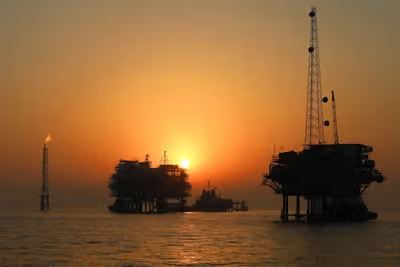
A group of Iranian oil workers  (january 2024)
100%
A group of Iranian oil workers

Mehraneh, a 30-year-old PhD student and a part-time university lecturer in Babolsar, northern Iran, told Iran International that the sharp decline in the value of rial in the past few days has left her “unbelievably stressed” awaiting another wave of inflation.

“Everyone has a number of dreams and goals. When this happens, confusion and uncertainty about the future hits you in the face and you see all your dreams and hopes slipping away,” added the student who lives on a monthly income of 80 million rials ($160).

Labor activists insist that workers’ minimum wages should be increased in proportion to the rising inflation rate in Iran. Employers have rejected this demand as “impractical” considering the current economic situation of the country.

While employers have demanded the minimum wage to be decided and specified regionally, workers strongly oppose such a policy.

Workers’ representatives in Iran’ High Council of Labor argue that a regional minimum wage plan could be abused by employers, thus running the risk of the exploitation in poorer regions.

Over recent years, many production plants have been suspended due to raw material shortages and difficulties in securing foreign currency.

(less than $110), Faramarz Tofighi, a labor activist stated that even in the least expensive regions of Iran, it is impossible to afford living costs with twice or three times this salary.

The activist accused the Iranian government of manipulating inflation statistics, saying it deliberately declares the official inflation rate lower than the actual rate.

Despite the constant requests of workers and experts, the government has refused to announce the exact indicators according to which it measures the inflation rate, Tofighi went on to add.

Tavakol, 52, the owner of a small clothes manufacturing company in Mashhad, northeastern Iran, highlighted the consequences of the recent rial crisis, saying it has brought about “chaos and confusion” in the market which is largely dependent upon imports.

“We have all stopped wholesaling our products till the currency fluctuations are over,” he pointed out, warning that if this recession period lingers, it will greatly impact workers, many of whom work on “daily verbal agreements” and have no long-term contracts or medical insurance.

Sanaz, 28, who works for a transportation company in the capital city Tehran, said the recent fluctuations have disrupted the ordinary lives of many Iranians.

“Three weeks ago, I was going to buy a foreign refrigerator in instalments. When I was paid on Tuesday, I went to buy it but the salesman told me the price has increased by 20 percent and buying in instalments is no longer an option due to currency fluctuations,” she explained.

However, Sanaz stressed that this is not just an economic issue: “The worst consequence of this crisis is widening class differences because it will give rise to numerous social anomalies.”

Most Viewed

Iran negotiators ordered to return after internal rift over Islamabad talks
1
EXCLUSIVE

Iran negotiators ordered to return after internal rift over Islamabad talks

2
ANALYSIS

US blockade enters murky phase as tankers spoof signals and buyers hesitate

3
ANALYSIS

Why the $100 billion Hormuz toll revenue is a myth

4

US tightens financial squeeze on Iran, warns banks over oil money flows

5
ANALYSIS

US blockade targets Iran oil boom amid regional disruption

Banner
Banner

Spotlight

  • Hardliners push Hormuz ‘red line’ as US blockade tests Iran’s leverage
    INSIGHT

    Hardliners push Hormuz ‘red line’ as US blockade tests Iran’s leverage

  • Ideology may be fading in Iran, but not in Kashmir's ‘Mini Iran'
    INSIGHT

    Ideology may be fading in Iran, but not in Kashmir's ‘Mini Iran'

  • War damage amounts to $3,000 per Iranian, with blockade set to add to losses
    INSIGHT

    War damage amounts to $3,000 per Iranian, with blockade set to add to losses

  • Why the $100 billion Hormuz toll revenue is a myth
    ANALYSIS

    Why the $100 billion Hormuz toll revenue is a myth

  • US blockade targets Iran oil boom amid regional disruption
    ANALYSIS

    US blockade targets Iran oil boom amid regional disruption

  • Iran's digital economy battered by prolonged blackout
    INSIGHT

    Iran's digital economy battered by prolonged blackout

•
•
•

More Stories

Iran-Backed Iraqi Militia Group Vows More Attacks On US Forces

Feb 2, 2024, 14:43 GMT+0

The Iran-backed Iraqi armed group Nujaba said on Friday it will continue launching attacks on US forces in the region until the Gaza war ends and US forces exit Iraq.

Nujaba's leader, Akram al-Kaabi, said in a statement that Nujaba and other factions in the Islamic Resistance in Iraq -- an umbrella group of hardline Shiite militias -- would continue operations.

The statement came a few days after Iraq's Kataib Hezbollah, another Iran-backed group, said it would pause attacks on US forces, a decision that followed the killing of three US service members in a drone attack in Jordan near the Syrian border by Iran-back militants. Part of Iran's so-called "Axis of Resistance," the umbrella group has claimed more than 150 attacks on US forces in Iraq and Syria since the Gaza war began.

Al-Kaabi said that he understood Kataib Hezbollah's decision.

The United States is preparing for strikes on Iran-linked targets in Iraq and Syria as it concluded that Iran manufactured the drone which slammed into a US base in Jordan. According to US officials, the response, expected to begin as soon as this weekend, will be “tiered,” mixing military actions with other steps that can be adjusted to signal that Washington does not seek further escalation.

Marking an escalation in tensions that have engulfed the Middle East, the drone attack in Jordan was the first deadly strike against US forces since the conflict began on October 7, when Tehran-backed Hamas invaded Israel, killed 1,200 mostly civilians and took hundreds of hostages.

In 2020, the US killed Iran Quds Force commander Qassem Soleimani and Kataib Hezbollah leader Abu Mahdi al-Muhandis in a drone strike at Baghdad airport. The strike came days after the US blamed Kataib Hezbollah for the killing of a US contractor.

Iraqi officials fear Washington's response to the killing of its soldiers could be severe, and along with Tehran pushed Kataib Hezbollah to stand down, sources told Reuters, hoping it could help de-escalate tensions.

Meanwhile, Iran's Revolutionary Guards, the IRGC, has reduced the presence of its senior officers in Syria due to a spate of deadly Israeli strikes and will rely more on its militia proxies.

Iran’s Top Carmakers Need Urgent Financial Boost

Feb 2, 2024, 12:21 GMT+0

In a letter to the Governor of Central Bank, Iran’s industry minister has called for more funds for the country’s two main government-controlled automakers: Iran Khodro and SAIPA.

Minister of Industry, Mine and Trade Abbas Aliabadi told Mohammad-Reza Farzin that the two car manufacturers face financial difficulties due to existing high inflation. The government claims the companies have not increased car prices, as an anti-inflationary measure, although prices have risen in the market in the past year. The move can be a prelude to a government-sanctioned rise of car prices.

Aliabadi requested an immediate increase in their credit limits, suggesting 100 trillion rials (about $200 million) for Iran Khodro and 50 trillion rials (about $100 million) for SAIPA. Aliabadi claimed that the request is in line with the Deputy President Mohammad Mokhber's approval for enhanced production in the final months of the Iranian year (which ends on March 20) to stabilize the market.

According to Iranian auto industry expert Farhad Ehteshamzad, the country’s state-owned carmakers are incurring daily losses of $3.7 million, totaling over one billion dollars annually. He claimed that the huge loss is the direct result of the government’s interventions in the auto industry.

Iran’s car industry is mired in a wide range of problems. The main manufacturers are owned by the state and enjoy huge incentives and support from the government. Despite the losses, Iran’s automotive industry is the third most active sector, after oil and gas sectors, accounting for about 10% of Iran's GDP and 4% of the workforce (700,000 persons). It was valued in 2020 at $26.4 billion by India-based Modor Intelligence, which forecasts 10 percent sectoral annual growth to 2026. This would be possible without sanctions and with a new infusion of investments and foreign partnerships.

Another IRGC Man In Syria Killed In Airstrike Attributed To Israel

Feb 2, 2024, 11:43 GMT+0

An Iranian Revolutionary Guards officer was killed on Friday in an Israeli missile strike that targeted a southern district of the Syrian capital Damascus.

According to Iran’s state-run media, IRGC “advisor” Saeid Alidadi was killed in the airstrikes. Iranian news sites did not give his rank. Iranian and Syrian sources claim the attack was launched by Israel, but there is no official acknowledgement about who was behind the missile strike.

Earlier in the day, Syria's state news agency SANA, citing a Syrian military source, said the country's military had downed a number of Israeli missiles launched from the Golan Heights at southern Damascus. 

Israel has for years carried out attacks on what it has described as Iran-linked targets in Syria, where Tehran's influence has grown since it began supporting President Bashar al-Assad in a civil war that started in 2011.

Since the October 7 attack on Israel by Palestinian militant group Hamas from Gaza, Israel has escalated its strikes on Iranian-backed militia targets in Syria and has also struck Syrian army air defenses and some Syrian forces.

Iran's Revolutionary Guards have started scaling back deployment of their senior officers in Syria due to concerns about Tehran being sucked into a wider regional conflict, sources have told Reuters.The Guards will instead rely more on allied Shiite militia to preserve their sway there, the sources said. Three of the sources said the Guards were once again recruiting Shiite fighters from Afghanistan and Pakistan to deploy to Syria, echoing earlier phases of the war when Shiite militias played a part in turning the tide of the conflict.

Mohammad Ebadi, an international relations researcher, described the withdrawal of Iranian Revolutionary Guard officers from Syria as merely a "tactical move," aimed at protecting the lives of its commanders. He claimed that Iran cannot afford to lose its ranking commanders.

Iran International reported last week that some in Tehran suspect an Israeli infiltration in tracking and pinpointing the whereabouts of senior IRGC officers in Syria.

In one of Israeli attacks, on January 20, five members of the Guards were killed, Iranian state media reported, including a general who ran intelligence for the Quds Force, which is responsible for the Guards' overseas operations. Another, on December 25 outside Damascus, killed a senior Guards adviser responsible for coordinating between Syria and Iran.

Gregory Brew, an analyst with Eurasia group, a political risk consultancy, told Reuters the failure to protect Iranian commanders had "clearly undermined Iran's position" but Tehran was unlikely to end its commitment to Syria to preserving its role in Syria.

Moreover, after a January drone attack by an Iranian-backed Iraqi group in Jordan that killed three US soldiers, Washington has vowed to retaliate against targets, that could include IRGC assets in Syria. CBS News, citing US officials, reported on Thursday that the United States had approved plans for multi-day strikes in Iraq and Syria against multiple targets, including Iranian personnel and facilities in those countries.

NBC also reported Thursday that The Biden administration hasn’t yet finalized targets, but it is preparing a “campaign” that could last “weeks.” Citing unnamed officials, NBC said the targets are expected to include Iranian targets outside Iran, and the campaign will involve both strikes and cyber operations.

Earlier in the week, an attack on the headquarters of the IRGC in the "Sayyidah Zainab" area in southern Damascus also killed "a number of Iranian advisers." Al-Arabiya network has identified the targeted location in Syria as the command center of forces affiliated with the Islamic Republic. Reuters, citing a source close to Iran, reported that the attack targeted a base used by the IRGC. Later, Iran's ambassador to Syria denied that the IRGC headquarters was hit, while Tasnim news agency in Tehran affiliated with the Revolutionary Guards did confirm the target.

(With reporting by Reuters)

Iran Claims To Have Identified Israeli Spies In 28 Countries

Feb 2, 2024, 10:51 GMT+0

Iran's Ministry of Intelligence has claimed that it has identified an undisclosed number of “spies” in 28 countries across Asia, Africa, and Europe, amid a high level of tensions with Israel.

In its 700-word statement released on Friday, the ministry did not provide any specific details about the so-called spies but claimed that the identities of some of the spies active in countries maintaining intelligence sharing treaties with Iran have been provided to the respective governments.

The statement also said some of these agents have volunteered to work for Mossad, which made them “carry out various treacherous operations against the interests of their countries and the security of their fellow citizens” as a measure to test their sincerity.

The intelligence ministry also claimed that some spies in Tehran and a few provinces have been identified and either faced legal action on charges of spying for Israel or placed under security surveillance.

“Additionally, a number of Iranian spies residing outside the country have been identified, and decisions will be made based on the circumstances of each and the level of relationships between the ministry and the intelligence agencies of the countries where the spies reside," read the statement. This raises concerns that Iran could take action against dissidents of Iranian origin living abroad, alleging collaboration with Israel as a pretext.

Iranian intelligence organs often claim success in identifying or arresting "terrorists" or "spies" but rarely produce any concrete evidence or follow up the initial news with public trials.

Iran's President Says 'We Can' And 'The Enemy Cannot'

Feb 2, 2024, 09:00 GMT+0

Iranian President Ebrahim Raisi during a visit to an IRGC naval exhibition on Friday said the message from what he observed is that “We can,” but the enemy “will never be able to.”

Raisi who has been visiting Hormozgan Province on the Persian Gulf, added: "The enemy cannot take any action against us because it knows that our forces are powerful and capable."

According to Fars news website affiliated with the IRGC, Raisi, apparently referring to the United Stated added , "Previously...they used to talk with threats and military options on the table. But now, there are no such talks, and they say they have no intention of conflict with the Islamic Republic. It is the strength of our people and our armed forces that has created this deterrence."

Raisi’s remarks follow a deadly drone attack on US forces in Jordan last Sunday that killed three American soldiers and led to the Biden administration vowing retaliation. However, after six days no military action has been taken against Iran and its proxy forces who launched the attack.

Iranian media on Friday carried headlines that the United States will not directly attack Iran, based on reports in Western media. Also, information by Reuters and others indicates that senior Revolutionary Guard officers and their affiliated bases in Iraq and Syria are being evacuated due to an expectation of US strikes.

The Biden administration is reportedly contemplating a prolonged retaliatory campaign, although several reports quoting officials on Thursday appear to show that Iran is being given the benefit of doubt about its role in the attack in Jordan and elsewhere.

As fears begin to subside in Tehran about direct US retaliation, Iran's currency has regained some stability after falling more than 10 percent since the deadly attack on US troops.