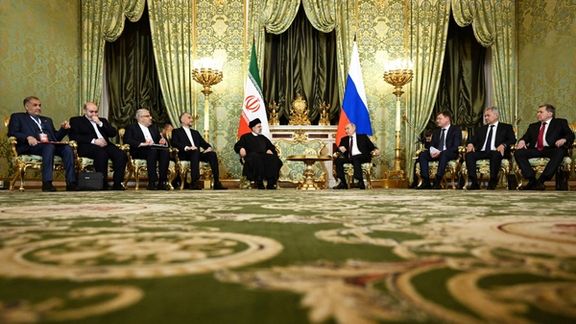
Russian President Vladimir Putin and Iranian President Ebrahim Raisi attend a meeting in Moscow, Russia December 7, 2023.
Iran's Foreign Investment Organization CEO claims the country has attracted $10.6
billion in “foreign investment” since President Ebrahim Raisi assumed office in
August 2021.
Ali Fekri stated that almost half of this figure is related to the oil and gas sector, with Russia leading other foreign investors with $2.7 billion in funds.
He went on to say that the attracted investment value during the last fiscal year, from March 2022 to 2023, was $4.2 billion. However, according to the United Nations Conference on Trade and Development (UNCTAD), Iran attracted only $1.5 billion in foreign direct investment in 2022.
Fekri's claim about $10.6 billion in "foreign investment" came after he recently cited the figure of $9.2 billion in an interview with the semi-official Tasnim news agency on November 23, 2023.
He explained at the time that the figure doesn’t mean $9.2 billion foreign cash funds flowed into the country; rather, it is the amount of "approved investment projects and contracts by foreigners" since the start of the Raisi administration. In simpler terms, what he refers to as "attracted foreign investment" is indeed the value of contracts with foreigners.
Fekri also mentioned that during the last fiscal year ending March 21, 2023, Iran attracted $4.2 billion in foreign investment, about 170% more than the previous year. However, UNCTAD's statistics do not indicate any significant investment inflow to Iran during 2022 compared to 2021.
He did not elaborate on why his claimed "attracted investment value" increased from $9.2 billion to $10.6 billion since November 2023, especially considering that Iran has not announced any new contracts with foreigners in the last three months. He named Russia, China, UAE, and Turkey as the biggest "investors" in Iran since August 2021.
Russian 'Investment'
Regarding Russian "investment," his claim about attracting $2.7 billion in investment came while Russian companies have only sealed contracts to drill wells in seven Iranian oil fields. This represents service exports rather than investment contracts. For example, one of these companies, Russian ZN Vostok Ltd., is obligated to drill 20 wells and install 22 pumps in the Cheshme Khosh oil field. Its CEO, Azamat Faridovich Ismagilov, stated that the total value of contracts with Iran is $500 million, including $170 million for the Cheshme Khosh field.
It’s CEO, Azamat Faridovich Ismagilov said on February 6 that ZN Vostok’s total value of contracts with Iran is $500 million, including $170 million on Cheshme Khosh field. “We have three drilling rigs in Iran and have a plan to add another one for drilling 6 new wells”.
ZN Vostok signed the contract with Iran in April 2022 to develop the above-mentioned field. It has increased the field’s production by 29% to 62,000 barrels per day so far by drilling 14 wells.
Iran has a history of exaggerating cooperation levels with its "anti-western" partners like Russia and China, especially when good economic news becomes scarce and the national currency, rial, nosedives. Since the beginning of January the rial has lost more than 10 percent of its value against the US dollar and other major currencies.
For instance, while Iran proudly announced the signing of the "largest oil and gas agreements in the country's history worth $40 billion” with Russian Gazprom in 2022, Morteza Behruzifar, an energy expert in Tehran told the ILNA news website that even before the Western sanctions on Russia, it had not invested a penny in Iran.
Like most Russian companies, Gazprom is hardly in a position to invest in another country. Its revenues plunged to $3.1 billion in the first half of 2023, from $16.5 billion in 2022.
Although Gazprom plans to invest $17.5 billion in 2024, 20 percent less than 2023, none of its mentioned investment are related to Iran.
Iranian fans wearing the Islamic Republic flag before Iran’s semifinal match against Qatar in Doha, February 7, 2024
Iran's football team, tightly controlled by the government, recently secured a spot in the semi-final round of the Asian Nations Cup with a 2-1 victory over the Japanese team.
While this achievement should have brought joy to Iranians, it has, unfortunately, led to more division and discontent among the people. Many are deeply frustrated that the players appear to be promoting the regime's propaganda and using their social media platforms to also promote the upcoming fraudulent elections and offer their support to entities like the Islamic Revolutionary Guards Council (IRGC) or the IRI leader.
This situation highlights the growing tension and discontent within the country and emphasizes the need for Iranians to express their grievances through acts of civil disobedience, such as boycotting the team, to send a powerful message to the regime.
In the wake of the tragic death of Mahsa Amini at the hands of security forces in September 2022, a wave of protests swept across Iran, igniting the Woman-Life-Freedom movement.
This movement has been a driving force behind demonstrations, demanding justice and equality in Iran. Mahsa Amini's untimely death has become a symbol of the ongoing struggle for women's rights in the country.
Protesters gather in support of Iranian women and against the death of Mahsa Amini at Callao square in Madrid, Spain, October 1, 2022.
As a revenge for the growing influence of the Woman-Life-Freedom movement and the widespread protests, a wave of executions began. These executions were carried out following hasty trials characterized by human rights organizations as deeply flawed and unjust. These victims stood up for human rights and freedom in Iran and paid a heavy price for their activism.
During the past year, the Woman-Life-Freedom movement in Iran has unleashed a wave of protests. A significant number of individuals who have been executed or are currently facing the threat of execution were arrested during street demonstrations.
The United Nations High Commissioner for Human Rights condemned the executions as "state murder." Detained activists were denied access to proper legal representation and subjected to torture, extracting confessions under duress. The oppressive tactics serve as a grim reminder of the Islamic government's relentless efforts to silence and intimidate those who dare to raise their voices against injustice. The regime's determination to carry out executions, often kept ambiguous until the last moment, serves to stifle both domestic and international reactions, making it crucial to draw global attention to this humanitarian crisis. The regime has resorted to executions as a scare tactic, creating an atmosphere of fear and terror to suppress any form of dissent.
It is essential to recognize the courage and sacrifice of these individuals who dared to advocate freedom and human rights in Iran. Their plight underscores the urgent need for global solidarity and action in support of human rights and justice in Iran as scores of others are in danger of execution.
Iran's prisons are overflowing with those who dare to dissent, facing terrible conditions and being denied basic human rights. Some have languished behind bars for decades while the regime demands exorbitant bail fees for their release, effectively bankrupting opposition movements. The regime further silences dissent by unjustly imprisoning individuals under bogus charges like "insulting the Prophet" or "spreading propaganda against national security." These unjust incarcerations not only rob individuals of their freedom but also strip away their dignity and fundamental rights.
One of the major obstacles in addressing the violations by Iran's oppressive regime is the support it receives from certain Western governments and institutions. Despite the Islamic regime's discriminatory policies and human rights abuses, some Western entities welcome its officials in various fields, from media to academia and even as advisors. This support raises a moral dilemma – can athletes continue playing under the guise of being "forced to play," thereby avoiding their national responsibility to protect human rights and their people's right to life?
The heart of the matter lies in the realm of morality. Every individual faces choices, especially in times of great historical significance. The philosopher Zygmunt Bauman reminds us that while our destiny may be to act in a particular historical moment not of our choosing, our personality determines our choices among the available options. The focus should not waver from the paramount issue at hand – morality. Are we willing to prioritize morality over politics and sports, relinquishing the comforts of everyday life to forge a meaningful human society, as Václav Havel advocates?
Critics argue that soccer players are merely trying to escape the responsibility of confronting political issues by pleading they are "forced to play." However, history provides a stark example – during the Nazi era, most top officials of the German Football Association did not believe in Nazi ideology but failed to resist the totalitarian regime. They unwittingly supported Hitler's regime and became complicit in its oppressive actions. The monetary loss incurred by not playing is a small price to pay when compared to the sacrifice required to free a nation from religious tyranny.
Championing the team of a regime regularly using violence only aids in perpetuating propaganda that portrays everything as normal. Playing under such circumstances is, in essence, a political act. It involves cooperating with the representatives of the Ministry of Intelligence and Security, participating in religious rituals, and receiving awards from individuals complicit in mass repression.
The Islamic regime of Iran operates as a gender apartheid regime, imposing strict segregation between boys and girls from birth and perpetuating gender-based discrimination throughout society. Women are systematically excluded from various aspects of public life, including participation in certain sports and access to sports stadiums. This gender-based discrimination extends to female athletes who face numerous restrictions and are often denied opportunities to compete at an international level.
The regime's oppressive policies not only infringe upon women's rights but also hinder the development of Iranian sports, as talented female athletes are denied the chance to showcase their skills on the world stage. Iranian women cannot leave the country without obtaining permission from their husbands or fathers. This further exemplifies the extent of gender-based discrimination and control imposed by the regime, highlighting the urgent need for Iranians to unite and engage in acts of civil disobedience to challenge these unjust practices.
Boycotting the regime's soccer team serves as a powerful statement against the totalitarian government. It signals that Iranians are willing to put morality first and confront a regime that infringes upon every aspect of their lives. Civil disobedience and mass protests are the keys to challenging the regime's existence, as it would hardly survive without the cooperation of the people.
International sanctions and isolation must be imposed to combat this brutal regime and hold it accountable. Iranians should boycott not only sports but also science, art, theater, music, and cinema produced or supported by the Islamic regime. This echoes the United Nations' call for artists and writers to boycott South Africa during the apartheid era.
Boycotting Iran's soccer team is a call for international recognition and support in isolating the oppressive regime. In the face of overwhelming odds, Iranians are determined to prepare for direct conflict, destabilize the regime, and raise the cost of its crimes. Drawing lessons from history and making ethical choices will free Iran from religious tyranny and create a more meaningful human society.
The opinions expressed by the author are not necessarily the views of Iran International
Mehrad Ebad, a member of the Iranian Chamber of Commerce
Mehrad Ebad, a member of the Iranian Chamber of Commerce, has voiced concerns over the volatility of Iran's national currency.
He stated on Wednesday that, "Nowhere else in the world does the national currency's value drop by 20% overnight."
In the address, he added, “Economic stability is one of the most crucial needs for businesses, enabling their owners to plan based on this stability. Unfortunately, in recent decades, stability has been lacking in the Iranian economy, and domestic and international events with direct and indirect impacts on Iran's economy have influenced the exchange rate.”
The Iranian rial's recent nosedive against the US dollar has exacerbated the concerns. Last week, the rial plummeted to 575,000 against the dollar amidst escalating regional tensions and uncertainties surrounding the US presidential election, particularly regarding the potential re-election of Donald Trump.
Although the rial has regained some of its value in the past few days, reaching 557,000 against the dollar, the overall trend remains worrying. Since 2018, the currency has depreciated 13-fold, triggered by the US withdrawal from the JCPOA nuclear deal and subsequent sanctions on Iran's oil exports and international banking.
With an annual inflation rate exceeding 50 percent, the diminishing value of the rial is expected to exacerbate inflationary pressures in the coming months. The economic instability is compounded by low monthly wages for workers, averaging less than $200, leading to widespread discontent and protests across various sectors, including oil and gas production platforms and refineries.
Acting United Nations High Commissioner for Human Rights Nada Al-Nashif attends the Human Rights Council in Geneva, Switzerland, September 12, 2022.
The Deputy UN Commissioner for Human Rights has visited Iran in total media silence after Iranian opposition urged her to cancel or postpone her visit in protest to Iran's recent executions.
Neither the Iranian authorities, nor the UN Human Rights Office have issued statements regarding Nada Al-Nashif’s visit, which took place between 2 to 5 February as scheduled. However, in an email to Voice of America (VOA) on Monday, rights office spokesperson Ravina Shamdasani confirmed that Al-Nashif arrived in Iran on Friday, with her departure scheduled for later on Monday.
The UN Human Rights Office has yet to respond to Iran International’s inquiries about the media silence surrounding the visit by both sides, and the objectives achieved during her time in Tehran.
Last week, the office of the UN High Commissioner for Human Rights assured that the planned visit of the deputy high commissioner to Iran would not compromise their reporting and advocacy efforts, despite criticisms.
Responding to Iran International on Saturday, the UN Human Rights Office acknowledged concerns raised by Iranian and other rights activists over the visit. They stated that the visit, initially scheduled for 2020 but delayed due to various factors including the COVID pandemic, aimed to discuss critical human rights issues such as the death penalty and women's rights.
An Iranian police force stands on a street during the revival of morality police in Tehran, Iran, July 16, 2023.
The Human Rights Office said the aim of Al-Nashif’s visit was “to discuss critical human rights issues, including the death penalty and rights of women, as well as Iran’s obligations under international human rights law as a state party to a number of treaties” and added that the visit would entail meeting with relevant state interlocutors, including judicial officials, and UN partners.
“Our mandate requires us to seek all avenues to promote States’ compliance with their international human rights obligations,” the Human Rights Office said.
The timing of Al-Nashif's visit, following Iran's recent executions and a surge in human rights abuses, raised concerns that the Islamic Republic might exploit it for propaganda purposes. Rights activists, including a coalition of 25 human rights organizations, called on Al-Nashif to postpone or cancel her visit in protest against the executions.
Iran executed four Kurdish prisoners on Monday, accusing them of collaborating with Israel. Rights organizations claim these executions were based on coerced confessions and lacked fair trials.
Another young man, a protester, was hanged on January 23 although his death sentence had been overturned by the Supreme Court and a retrial had been ordered, due to gross violations in his first trial. Recent weeks have seen an average of three executions per day in Iran.
The coalition of 25 human rights organizations expressed suspicions that Iranian authorities might exploit the visit to undermine international mechanisms critical to human rights promotion and protection in Iran.
“The visit will not undermine our approach in terms of reporting and advocacy. We hope that our combined advocacy and engagement contribute to progress towards strengthened alignment with international human rights standards,” the Human Rights Office responded about such concerns while stressing that its dialogue with the authorities allows them to follow up on all recommendations emanating from human rights mechanisms, including special procedures and fact-finding missions.
The United Nations’ Human Rights Council appointed an independent fact-finding mission in November 2022 to review Iran's human rights violations during the Woman, Life, Freedom movement that began in mid-September and spread throughout the country but was brutally crushed by killing around 500 civilians and arresting tens of thousands of protesters.
The Islamic Republic said it would not allow an independent investigation into the protests and has refused to cooperate with UN human rights rapporteurs since 1992.
Police officers stand near the Israeli embassy, on the day an object believed to be an explosive device was found and destroyed by the national bomb squad according to police, in Stockholm, Sweden January 31, 2024.
A Swedish Radio investigation has revealed that two Iranians were deported following a murder plot to kill Swedish Jews.
A Swedish Radio investigation has revealed that two Iranians were deported following a murder plot to kill Swedish Jews.
The couple, Mahdi Ramezani and Fereshteh Sanaeifarid, who had entered Sweden in 2015 on forged Afghan passports seeking asylum, were deported in 2022 after their arrest in 2021.
They had targeted three Swedish Jews including Aron Verständig, Chair of the Official Council of Swedish Jewish communities, who was informed of the plot in 2021. One of the other potential targets was a dual US citizen, according to theSwedish Radio report.
The suspects, believed to have been part of an IRGC plot, lived under fake identities in the country.
“I think that what Iran wants to do is to harm Israel and I think it’s very difficult for them to do these kinds of things in Israel. So instead they are randomly choosing people who have some kind of official position in the Jewish diaspora and trying to create fear," Verständig told the radio station, though it is unclear why the case has only gone public now.
Deputy chief prosecutor Hans Ihrman said the FBI in the US was also investigating the couple. While there was not enough evidence to prosecute in Sweden, Ihrman said: “We have strong belief that they were here on a mission on behalf of Iran. They were seen here in Sweden as a very severe security threat. And that's the reason why they were expelled, even if we couldn't prosecute them."
Jews and Israelis abroad have increasingly been targets of the regime in recent years, plots foiled in countries including Greece, Cyprus, Azerbaijan and Argentina.
Last year, Sweden's parliament voted to designate the IRGC and relations between the two countries are ever more strained since 2019 and the arrest of a former Iranian jailor, Hamid Nouri. Sweden sentenced him to life imprisonment last year over executions of political prisoners in 1988.
A series of high profile arrests of Swedish citizens has followed as Iran's hostage-diplomacycontinues.
The commander of the Shiraz Police Rescue Unit, Colonel Kourosh Bazyar
The commander of the Shiraz Police Rescue Unit, Colonel Kourosh Bazyar, was killed in a hit-and-run incident in the early hours of Tuesday.
According to a statement released by the Fars Province Police Information Center, “Bazyar was on patrol when he encountered a pickup truck suspected of carrying suspicious cargo. He ordered the driver to halt, but the driver, disregarding the command, attempted to flee the scene.”
After a pursuit, law enforcement officers managed to disable the pickup truck by firing shots at its tires. However, during the subsequent inspection of the vehicle, a sedan Peugeot, which was accompanying the cargo, “deliberately collided with Colonel Bazyar at high speed, inflicting severe injuries.”
Despite immediate medical attention and being rushed to the hospital, Bazyar succumbed to his injuries.
While further details regarding the incident are yet to be disclosed, social media users have already begun circulating videos identifying the dead police commander as one of the key figures involved in suppressing the 2022 protests in Fars Province.
Rahambakhsh Habibi, the commander of law enforcement in Fars Province, announced the arrest of a suspect. Additionally, two accomplices aiding the suspect's escape were also apprehended, he claimed.