Iran, Russia Sign Energy Memorandum On Eve of Putin Trip

Russian energy giant Gazprom and the National Iranian Oil Company have signed a $40-billion memorandum-of-understanding on the eve of President Putin’s visit.
Russian energy giant Gazprom and the National Iranian Oil Company have signed a $40-billion memorandum-of-understanding on the eve of President Putin’s visit.
The current worth of Russia’s contracts in Iran's oil and gas fields is $4 billion, but Iran’s state news agency IRNA says if the new MoU leads to any contracts, Moscow’s total investment will increase 10-fold to $40 billion.
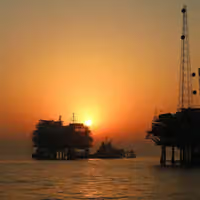
The agreement, as announced by the oil ministry’s Shana news agency, covers development of the Kish and North Pars gas-fields, as well as six oil fields.
It was penned during an online ceremony by the companies’ chief executives on the day Vladimir Putin arrives for a three-way summit with Iran’s President Ebrahim Raisi and Turkey’s President Recep Tayyip Erdogan.
The most significant aspect of the Gazprom-NIOC memorandum for Iran may be access to technology for LNG (liquid natural gas), which Tehran once hoped to access through agreements with western majors, especially Total, that withdrew in the face of United States ‘maximum pressure’ sanctions after 2018.
North Pars has around 33,000 billion cubic feet (bcf) of gas, and Kish gas-field 8,300 bcf. Both are currently at the feasibility stage.
While Iran has the world’s second largest gas reserves after Russia, it has been slow to develop its fields and boost exports in the face of sanctions.
Putin’s visit is being watched close with the expectation of closer links between Moscow and Tehran, boosting trade from just $4 billion in 2021, with both subject to international sanctions and as the Ukraine crisis pushes up global oil and food prices.