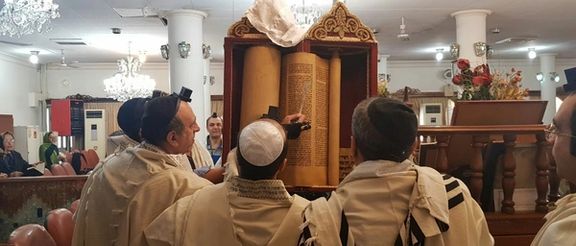
A few members of the Jewish community during a ceremony in Iran
The one-year anniversary of Mahsa Amini’s murder coincides with the Jewish New Year on September 16, prompting community leaders to warn Jews to stay off the streets.
In a Telegram posting from Iran’s Jewish community on Sunday, the leadership wrote “All worshipers are strongly requested to refrain from stopping and gathering in the streets for any reason during Rosh Hashanah and after performing religious duties in synagogues.”
Alireza Nader, an Iran scholar based in Washington, DC, told Iran International, “The remaining few members of the Jewish community in Iran live in constant fear. Any sort of public pronouncement or guidance from their leadership should be seen in light of the community’s extreme vulnerability.” Nader has written about the persecution of Iranian Jews.
Beni Sabti, an expert on Iran from the Israeli National Security and Strategy Institute, who first located the Telegram post, told Iran International that the Jewish leadership is “worried that Jews can be in trouble if they stay in the streets” and urged them “to rapidly go from the synagogues to their houses.”
Sabti is a Tehran-born Jew who speaks fluent Persian and has extensively documented the Iranian regime’s repression of the country’s tiny Jewish population, which is estimated to number 9,000 members.
An Iranian woman walking past a Hanukkah menorah symbol
In April, Iran International reported that the Islamic Republic ordered Jews to participate in the antisemitic al-Quds Day rally during the Jewish holiday of Passover.
Sabti said the situation with Rosh Hashanah is comparable to Passover because the Jewish leadership said at the time on its Telegram platform: “Please do not go for picnics or enjoyable activities on al-Quds Day.”
Sabti added, “It is like al-Quds Day. They have to show their loyalty. They use delicate words. They use the kind of words that the regime can’t be upset with them for. The regime and Jews understand it.
They don’t say directly there are protests. This would be forbidden. They go around it. This is the kind of cultural talking for people with a Persian background in Iran.”
Prior to Iran’s Islamic revolution in 1979, Iran’s Jewish population numbered at least 100,000, most of whom fled after Ayatollah Ruhollah Khomeini seized power.
Iranian Jews preparing for prayers at the Abrishami synagogue at Tehran’s Palestine street
According to the Telegram post, the Jewish community wrote: “Coordination with the police force to create security and comfort for the grand ceremony of Rosh Hashanah .Respectfully, while congratulating in advance on Rosh Hashanah and wishing you a prosperous year, we inform you that by the grace of the Almighty and with the coordination made with the respected police force of Greater Tehran, the necessary arrangements have been made for the safety and comfort of our dear fellow believers for the celebration of the glorious and fateful day of Rosh Hashanah.”
Sabti noted the “Iranian Jewish leadership complimented the Iranian regime police. This is what they have to do.” He says the Iranian Jewish community has to “show they are loyal to the Iranian regime.”
The Telegram post noted “The public relations of the Tehran Jews Association, while thanking the loved ones of the police force for their unquestionable and constant help, has no doubt that the Kalimi community will once again draw a line against the evil plans of Iran's enemies and celebrate the magnificent ceremony of Rosh Hashanah away from any sidelines.”
Anniversary of Islamic Republic’s founder Ruhollah Khomeini at Yusef Abad Synagogue in Tehran (Photo: Mehdi Marizad)
Sabti said the word Kalimi is a “polite word for Jewish” and “They don’t use the Jew because it means Zionist for the regime.” He said the Iranian word Kalimi can be loosely translated as the people from “Moses’s nation.”
Iran International exclusively reported in December that the Islamic Republic imposed pressure on religious minorities to compel them to condemn the uprising of the Iranian people following the murder of Amini in police custody.
Also in December, the regime arrested five Iranian Jews during the nationwide protests.
Iran’s regime and its foreign policy are based on an antisemitic world view, according to experts on the Middle East. The Middle East Media Research Institute (MEMRI) exposed Iran’s former foreign minister Mohammad Javad Zarif using an antisemitic term for Jews. “In a December 9, 2020 interview with Arman TV, Zarif used the antisemitic term for Jews – johood in Persian,” wrote MEMRI.
MEMRI noted, “A few days later, he attempted to cover up his statement with a dishonest attack on MEMRI. On December 16, he tweeted: ‘MEMRI has sunk to a new low in taking my pejorative usage of a word to accuse me of Antisemitism..."’
MEMRI added, “Foreign Minister Zarif is lying about Iran's positions on Jews and Israel. The MEMRI archives are full of research proving that the Iranian regime and its leaders are antisemitic and call openly for the annihilation of Israel.”
George Haroonian, one of the leading voices of the Iranian-Jewish community in the US, told Iran International "Contacting and coordinating with police in High Holidays is common practice wherever Jews are, but this announcement has some peculiar 'matters.' Who they mean by 'enemies' who might seize the occasion? Seems they are concerned about anti-Jewish elements within the country who might want to cause harm. As always, Jews are at the mercy of the regime."
He added, "I believe majority of Iranian people do not wish anything negative for Iranian Jewish community, but there is a minority who justifies their antisemitism based on variety of rationals. Based on Islamic beliefs as well as their hate for Israel."
A tragedy unfolded in Ravansar in the Iranian province of Kermanshah as a 14-year-old child bride, Mona Aghaie, lost her life at the hands of her own brother.
According to the Center For Human Rights In Iran, the victim had been seeking a divorce before her life was cut short. Apparently, the brother killed her to uphold the family's honor.
The death of Mona Aghaie is not an isolated incident. Individual acts of violence, often referred to as honor killings, remain alarmingly intertwined with certain societal beliefs and Iran's legal framework. Many perpetrators of such acts are not brought to justice, especially when they are family members of the victim. This is particularly true if the perpetrator is the victim's father.
Iran's Islamic Penal Code includes a provision that fathers, and paternal grandfathers cannot be sentenced to death for killing their child or grandchild. Instead, they may face prison sentences and the obligation to pay "blood money" to the next of kin, typically the mother if demanded. Moreover, mothers have the authority to forgive the murderer entirely, waiving the blood money.
In cases of particularly violent crimes or those deemed to harm society, judges have the authority to impose additional sentences "on behalf of the public." However, the prevalence of honor killings in certain parts of Iran persists, largely due to the Islamic Republic's lenient laws and light sentences, which can encourage such behavior.
Advocates and organizations dedicated to women's rights and human rights have been calling for immediate action to address these pressing issues and ensure justice for victims like Mona.
Iran’s Supreme Leader Ali Khamenei during a meeting with a group pf people from provinces of Sistan-Baluchestan and South Khorasan in Tehran on September 11, 2023
Iran’s Supreme Leader met a group of Baluch people Monday in a bid to pacify the community which has been holding protests since a government massacre last September.
The meeting in Tehran, which had been advertised by state media for weeks, included people from Sistan-Baluchestan Province where most Baluchis live and its neighboring province of South Khorasan. Rumors circulated that khamenei's office offered money for people to attend.
As Iranians are readying for rallies on the anniversary of last year’s protests, there are reports that the office of the Supreme Leader is especially worried about the protests among the Sunni population of the country, more than 10 million people who are mainly Baluch or Kurd.
Since earlier this month, regime-affiliated media had been reporting that Khamenei may meet with some of the families of the victims of Bloody Friday, the massacre that killed around 90 civilians in the wake of Mahsa Amini's death. Residents have been holding anti-regime demonstrations for the past 49 weeks unabated. Bloody Friday, the suppression of protests on September 30, 2022, saw citizens, including women and children lose their lives due to direct gunfire from military and security forces, with many succumbing to head and chest injuries.
Protests in Zahedan In September 2022
The Sunni Friday Prayer Imam of Zahedan, Mowlavi Abdolhamid, persistently called for an investigation into the massacre and the prosecution of those responsible. However, to date, no one has been charged or tried in connection with the incident. The outspoken cleric, officially known as Sheikh Abdolhamdid Esmailzehi, is largely popular because of his willingness to challenge the absolute authority of Khamenei. Late last year, a hacktivist group leaked documents indicating that Khamenei is dismayed by Abdolhamid’s unrelenting criticism, and has ordered underlings to tarnish Abdolhamid’s reputation to diminish his influence.
The advocacy group Haalvsh, which reports on issues and events in Sistan-Baluchestan province, said that people of provincial capital Zahedan have written slogans on the walls of the city against those meeting with Khamenei, noting that the attendees by no means represent the people of the province. Many were referred to as “disgraced" and traitors to the martyrs. An X (formerly twitter) campaign was also launched against the meeting, trending a hashtag translated as “No to meeting the dictator.”
Khamenei’s speech during the meeting was predictably trite, with the aging ruler repeating his usual jargon, deflecting blame for all the failings of the regime onto the US and its allies, while at the same time claiming that Western powers are in decline with new regional and global powerhouses on the rise. “The arrogant power of America and some European countries has weakened and will become weaker,” he said.
“Our information tells us that the American government has created a crisis group with the mission to search for the points which they think can be used to provoke a crisis in Iran. With contemplation and study, they have concluded that there are several crisis points in Iran: ethnic differences, religious differences, and the issue of gender and women, which should be provoked to create a crisis,” Khamenei claimed.
It was not clear if he was referring to a particular group or just repeating conspiracy theories about US supported groups and organizations.
“All people from different ethnicities and religion groups should join together. Since there is a clear direction, this unity is important," Iran's ruler added.
Iranian LGBTQ activists have endorsed worldwide protests on September 16 to commemorate the death of Mahsa Amini.
In a joint statement, activist groups such as Simorgh, Six Colors, the Iranian Rainbow Coalition, and the Queer Rights Group claim that the current revolutionary wave holds the potential to secure the liberation and equality of the rainbow community in Iran, marking the end of centuries of discrimination and prejudice, including to the country's LGBTQ community.
They have called on political and social groups, both within and outside of Iran, to join in anti-regime protests.
Since the inception of the Women, Life, Freedom uprising, the Iranian LGBTQ community has been at the forefront, articulating their vision for a post-Islamic Republic Iran through active participation in both domestic and international protests.
Despite the many challenges faced by LGBTQ individuals in Iran, they continue to confront dangers, including the risk of execution and other forms of punishment under the laws of the Islamic Republic.
Iranian authorities have resorted to derogatory labels and stigmatization when addressing LGBTQ citizens, referring to them as "deviant" and "sick", same sex relations forbidden in Islamic laws.
UN nuclear watchdog chief Rafael Grossi attends a press conference during the International Atomic Energy Agency 's (IAEA) 35-nation Board of Governors meeting in Vienna, Austria, September 11, 2023.
The head of the UN's nuclear watchdog, IAEA's Rafael Grossi, has said that bilateral talks between Iran and the United States could "provide clarity" and be beneficial.
Speaking at a news conference on Monday, Grossi acknowledged that Washington has informed the International Atomic Energy Agency of confidential talks with Iran, but he clarified that he is not privy to the details.
“We are aware that there is a bilateral process of sorts. We have been informed by the United States about this…and cooperation is good.” However, he commented on the nuclear part that "we are not clear about" what is being discussed/agreed. He also added that Washington might be discussing the 2015 JCPOA nuclear deal with Tehran but the IAEA has a host of outstanding issues with Iran, including monitoring of its nuclear activities.
He cautioned that his agency is not happy with how relations with Iran progress on the outstanding nuclear issues and has expressed its concerns in reports to the Board of Governors of the IAEA, as they hold their quarterly meeting this month.
UN nuclear watchdog chief Rafael Grossi waits for the start of International Atomic Energy Agency 's (IAEA) 35-nation Board of Governors meeting in Vienna, Austria, September 11, 2023.
Iran and the United States announced a hostage release deal last month that also included the release of $6 billion in Iranian funds blocked South Korea due to US sanctions. Earlier, the US had also agreed to Iraq releasing $2.7 billion of its energy debts to Iran.
Western media began reporting that talks between the two countries go beyond a prisoner release agreement and the two sides are engaged in a “de-escalation” effort. Washington will allow the gradual release of all Iranian frozen funds, estimated to be around $20 billion and Iran would slow down its uranium enrichment.
Asked about IAEA not having access to the data of monitoring cameras re-installed at an Iranian nuclear facility in Esfahan (Isfahan) in June, he acknowledged the reality and said that the issue is open for negotiations with Iran, but “at this time we are nowhere near this point,” Grossi announced. He acknowledged that the data from the cameras are important and “we need to reconstruct” what transpires at Natanz “as a baseline.”
Mohsen Naziri-Asl, Iranian ambassador to the IAEA, arrives for the start of International Atomic Energy Agency 's 35-nation Board of Governors meeting in Vienna, Austria, September 11, 2023.
Behrouz Kamalvandi, the spokesman of Iran’s atomic agency, was quoted by local media June 15 as saying that ten of these cameras were re-installed in Esfahan’s Natanz facility, which is a major enrichment center, and apparently has a centrifuge production facility making the machines used in uranium enrichment.
Grossi also asked for more support from member states, emphasizing that IAEA depends on states to do its job.
For the second consecutive night, Iran has experienced a significant disruption to its internet services, the nation's connectivity plummeting to 71% of its standard levels during the latest outage.
The development follows a consistent trend of internet restrictions within Iran, with the government exerting more pressure to quash anti-regime sentiment online, particularly relating to raising momentum for further protests in the coming days as the anniversary of Mahsa Amini's death nears.
Over the past two decades, Iran has imposed strict censorship measures on internet access, limiting citizens' ability to freely obtain information. This encompasses the blocking of numerous foreign and domestic websites, including reputable news outlets. However, these restrictions have been circumvented through the widespread use of Virtual Private Networks (VPNs) and anti-filtering software.
Recent months have witnessed a more aggressive push by hardliners in the Iranian parliament to ratify legislation that would further restrict access to social media and the internet. Additionally, reports have circulated regarding plans to launch a domestic intranet, enabling authorities to exercise greater supervision over its content.