• العربية
  • فارسی
Brand
  • Iran Insight
  • Politics
  • Economy
  • Analysis
  • Special Report
  • Opinion
  • Podcast
  • Iran Insight
  • Politics
  • Economy
  • Analysis
  • Special Report
  • Opinion
  • Podcast
  • Theme
  • Language
    • العربية
    • فارسی
  • Iran Insight
  • Politics
  • Economy
  • Analysis
  • Special Report
  • Opinion
  • Podcast
All rights reserved for Volant Media UK Limited
volant media logo

Iran’s Top Negotiator Defends Talks Over Nuclear Issue
Iran International Newsroom
Sep 12, 2023, 10:40 GMT+1Updated: 17:44 GMT+1
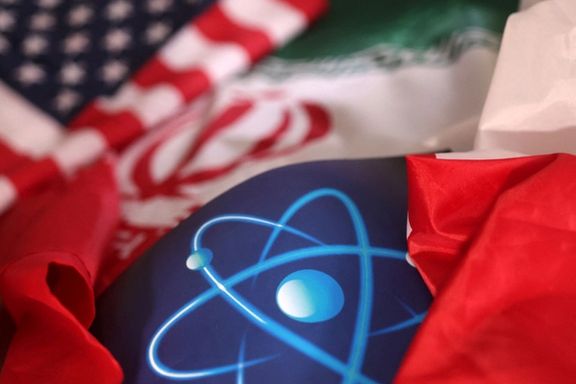
Atomic symbol and USA and Iranian flags are seen in this illustration taken, September 8, 2022.

Iran’s chief nuclear negotiator and Deputy Foreign Minister Ali Bagheri-Kani has defended negotiations with the West as a means of securing “national interests.”

During a speech on Monday, Bagheri-Kani leveled criticism at opponents of negotiations, accusing them of stripping the regime of a vital and crucial “instrument for securing national interests.”

His remarks came amid an ongoing debate among the country’s politicians regarding the approach towards international negotiations over the country’s nuclear program. Bagheri-Kani's support for diplomatic interactions with the West seemed contrary to what his political camp was pushing for when hardliner Saeed Jalili was the secretary of the Supreme National Security Council (2007-2013) and former president Hassan Rouhani held office (2013-2021).

Bagheri-Kani was a protégé of hardliner Jalili, who was traditionally opposed to any accommodation with West and has been playing an influential role among Iran's hardliners who were incessantly attacking Rouhani over the JCPOA nuclear deal.

But Bagheri-Kani now maintains that Tehran sees negotiations as a vital means to secure national interests. “The redline in criticizing the government’s foreign policy is safeguarding national interests, not individuals or institutions,” he added.

“Foreign policy is not a realm of emotions but rather a field of beliefs, rationality, and intelligence," Bagheri-Kani said addressing a group of university professors. He pointed out that some try to portray "security and development" as being in conflict with "commitment to ideals and values," explaining that “sustainable security and development" is, in fact, contingent upon "adherence to ideals and values." 

Iran's chief nuclear negotiator Ali Bagheri-Kani in Vienna  (undated)
100%
Iran's chief nuclear negotiator Ali Bagheri-Kani in Vienna

In a clear jab directed at hardliners, he said, "Those who, under the guise of defending values, seek to portray negotiations as fundamentally opposed to values are essentially aiming to deplete the regime's hand in utilizing this key and vital tool for national interests,” he stated.

Emphasizing that there is no obstacle to the talks aimed at reviving the 2015 nuclear agreement --officially known as the Joint Comprehensive Plan of Action (JCPOA), he said, "The Islamic Republic of Iran sees no obstacle to resuming negotiations and finalizing an agreement if the other parties act realistically and prevent repeating the past mistakes."

"The administration has never blocked the path to diplomacy, negotiations and efforts to secure the national interests through achievement of a balanced agreement," the senior diplomat said.

World powers were in talks in Vienna for 11 months in 2021-2022 to revive the 2015 Iran nuclear deal. The negotiations collapsed in March 2022 over Tehran’s demands that the Revolutionary Guards be removed from a US list of foreign terrorist organizations and ‘guarantees’ to cushion its economy and nuclear program from the US again leaving the accord. The Biden administration has been striving to bring the United States back into the JCPOA, a deal that was previously abandoned under the Trump administration.

Recently, Washington and Tehran reached a contentious agreement, whose details have been concealed from the public as well as lawmakers in Washington. The deal entails the release of five American prisoners detained in Tehran in exchange for five Iranian prisoners held in the United States as well as the release of $6 billion of frozen Iranian assets.

As a first step in this deal – which followed a two-year mediation effort by Qatar and Oman -- Iran on August 10 released four imprisoned US citizens from Evin prison into house arrest, where they joined a fifth already under home confinement.

These include businessman Siamak Namazi, 51, Emad Sharqi, 58, and environmental activist Morad Tahbaz, 67, who holds British nationality in addition to Iranian citizenship. The identities of the fourth and fifth Americans who either left prison or were under house arrest have not been disclosed.

Earlier in the day, the head of the UN's nuclear watchdog, IAEA's Rafael Grossi, said that bilateral talks between Iran and the United States could "provide clarity" and be beneficial.

Speaking at a news conference during the International Atomic Energy Agency 's (IAEA) 35-nation Board of Governors meeting in Vienna, Grossi acknowledged that Washington has informed the International Atomic Energy Agency of confidential talks with Iran, but he clarified that he is not privy to the details. He also added that Washington might be discussing the 2015 JCPOA nuclear deal with Tehran but the IAEA has a host of outstanding issues with Iran, including monitoring of its nuclear activities.


Most Viewed

Iran negotiators ordered to return after internal rift over Islamabad talks
1
EXCLUSIVE

Iran negotiators ordered to return after internal rift over Islamabad talks

2
ANALYSIS

US blockade enters murky phase as tankers spoof signals and buyers hesitate

3
ANALYSIS

Why the $100 billion Hormuz toll revenue is a myth

4

US tightens financial squeeze on Iran, warns banks over oil money flows

5
ANALYSIS

US blockade targets Iran oil boom amid regional disruption

Banner
Banner

Spotlight

  • Hardliners push Hormuz ‘red line’ as US blockade tests Iran’s leverage
    INSIGHT

    Hardliners push Hormuz ‘red line’ as US blockade tests Iran’s leverage

  • Ideology may be fading in Iran, but not in Kashmir's ‘Mini Iran'
    INSIGHT

    Ideology may be fading in Iran, but not in Kashmir's ‘Mini Iran'

  • War damage amounts to $3,000 per Iranian, with blockade set to add to losses
    INSIGHT

    War damage amounts to $3,000 per Iranian, with blockade set to add to losses

  • Why the $100 billion Hormuz toll revenue is a myth
    ANALYSIS

    Why the $100 billion Hormuz toll revenue is a myth

  • US blockade targets Iran oil boom amid regional disruption
    ANALYSIS

    US blockade targets Iran oil boom amid regional disruption

  • Iran's digital economy battered by prolonged blackout
    INSIGHT

    Iran's digital economy battered by prolonged blackout

•
•
•

More Stories

US Nods $6b To Iran Amid EU Concern For Swedish Hostage In Tehran

Sep 12, 2023, 07:35 GMT+1
•
Iran International Newsroom

US Secretary of State Antony Blinken has signed a sanction waiver to allow the release of $6 billion of Iran’s frozen assets in a hostage release deal with Tehran.

The move will allow the funds blocked in two South Korean banks to reach Qatar without violating US banking sanctions imposed on Iran. According to the State Department document, Secretary of State Blinken determined that waiving the sanctions was in the national security interests of the United States.

Sources told AP that Blinken had approved the waiver last week, but Congress was only informed on Monday.

Both Washington and Tehran since announcing the prisoner release deal in August were hinting that the prisoner release deal and the unblocking of the funds were separate issues, but the waiver document clearly links the two as one agreement.

"Allowing these funds to be transferred from restricted Iranian accounts held in the (Republic of Korea) to accounts in Qatar for humanitarian trade is necessary to facilitate the release of these US citizens," the document said.

The news about the waiver came hours after an EU Commissioner expressed deep concern over the situation of Johan Floderus, a Swedish diplomat detained in Iran more than 500 days ago.

Johan Floderus, a Swedish diplomat detained in Iran
100%
Johan Floderus, a Swedish diplomat detained in Iran


Floderus seems to be yet another victim of Iran's 'hostage diplomacy'. His case was kept secret for a long time by Sweden and the European Union in the hope that silence would secure his release.

On Monday, Ylva Johansson, the EU Commissioner previously responsible for Floderus's work, publicly addressed his case for the first time. "I'm very sad. I'm very worried," she said, “let’s hope that we can have him home soon”.

The long-kept secret of Floderus' plight first came to light in a New York Times report on 1 September. Shortly after, his family broke their silence and set out some details of his mistreatment in prison, including 24-hour lighting in the cell and over 300 days in solitary confinement.

Floderus turned 33 in prison last week.

In a statement published by a Swedish newspaper, Floderus’ family said he had spent some time in Iran on EU official business and had no issues. Sometime in early April 2022, he went back to Iran for vacation with his Swedish friends. On 17 April, he wanted to fly back home but was detained at Tehran’s international airport.

It’s not clear if Floderus had been advised against traveling to Iran on a personal capacity.

He has now joined a long list of foreigners and Iranian dual-nationals who in recent years have been detained in Iran and used as bargaining chips to force prisoner exchange or financial concessions.

Early August, four US dual-nationals were released from prison into house arrest in Tehran. Blinken said at the time that the move was the first step of a process to fly them home.

Opponents of the prospective deal say it encourages the Islamic Republic to detain more American and EU citizens.

Michael Rubin, a senior fellow at the American Enterprise Institute and a former Pentagon official, is a vocal critic of what seems to be the current EU/US policy towards Iran.

In a piece for Washington Examiner on Monday, he wrote: "When Iran brings a gun, Biden and his European partners wave cash. No wonder it is open season for Americans and Europeans worldwide."

Rubin lamented the 500-day silence over Johan Floderus' detainment and suggested that the authorities in Iran are looking to "trade him for Hamid Nouri".

Nouri is a former official of the Islamic Republic Judiciary who was arrested in Sweden and is now serving a life sentence for his involvement in the mass execution of up to 5,000 Iranian political prisoners in 1988.

Khamenei Meets Cherrypicked Baluchis In Bid To Calm Tensions

Sep 11, 2023, 19:30 GMT+1
•
Iran International Newsroom

Iran’s Supreme Leader met a group of Baluch people Monday in a bid to pacify the community which has been holding protests since a government massacre last September.

The meeting in Tehran, which had been advertised by state media for weeks, included people from Sistan-Baluchestan Province where most Baluchis live and its neighboring province of South Khorasan. Rumors circulated that khamenei's office offered money for people to attend. 

As Iranians are readying for rallies on the anniversary of last year’s protests, there are reports that the office of the Supreme Leader is especially worried about the protests among the Sunni population of the country, more than 10 million people who are mainly Baluch or Kurd.

Since earlier this month, regime-affiliated media had been reporting that Khamenei may meet with some of the families of the victims of Bloody Friday, the massacre that killed around 90 civilians in the wake of Mahsa Amini's death. Residents have been holding anti-regime demonstrations for the past 49 weeks unabated. Bloody Friday, the suppression of protests on September 30, 2022, saw citizens, including women and children lose their lives due to direct gunfire from military and security forces, with many succumbing to head and chest injuries. 

Protests in Zahedan In September 2022
100%
Protests in Zahedan In September 2022

The Sunni Friday Prayer Imam of Zahedan, Mowlavi Abdolhamid, persistently called for an investigation into the massacre and the prosecution of those responsible. However, to date, no one has been charged or tried in connection with the incident. The outspoken cleric, officially known as Sheikh Abdolhamdid Esmailzehi, is largely popular because of his willingness to challenge the absolute authority of Khamenei. Late last year, a hacktivist group leaked documents indicating that Khamenei is dismayed by Abdolhamid’s unrelenting criticism, and has ordered underlings to tarnish Abdolhamid’s reputation to diminish his influence. 

The advocacy group Haalvsh, which reports on issues and events in Sistan-Baluchestan province, said that people of provincial capital Zahedan have written slogans on the walls of the city against those meeting with Khamenei, noting that the attendees by no means represent the people of the province. Many were referred to as “disgraced" and traitors to the martyrs. An X (formerly twitter) campaign was also launched against the meeting, trending a hashtag translated as “No to meeting the dictator.” 

Khamenei’s speech during the meeting was predictably trite, with the aging ruler repeating his usual jargon, deflecting blame for all the failings of the regime onto the US and its allies, while at the same time claiming that Western powers are in decline with new regional and global powerhouses on the rise. “The arrogant power of America and some European countries has weakened and will become weaker,” he said. 

“Our information tells us that the American government has created a crisis group with the mission to search for the points which they think can be used to provoke a crisis in Iran. With contemplation and study, they have concluded that there are several crisis points in Iran: ethnic differences, religious differences, and the issue of gender and women, which should be provoked to create a crisis,” Khamenei claimed.

It was not clear if he was referring to a particular group or just repeating conspiracy theories about US supported groups and organizations.

“All people from different ethnicities and religion groups should join together. Since there is a clear direction, this unity is important," Iran's ruler added.

UN Nuclear Watchdog Confirms US-Iran Nuclear Talks

Sep 11, 2023, 15:27 GMT+1
•
Iran International Newsroom

The head of the UN's nuclear watchdog, IAEA's Rafael Grossi, has said that bilateral talks between Iran and the United States could "provide clarity" and be beneficial.

Speaking at a news conference on Monday, Grossi acknowledged that Washington has informed the International Atomic Energy Agency of confidential talks with Iran, but he clarified that he is not privy to the details.

“We are aware that there is a bilateral process of sorts. We have been informed by the United States about this…and cooperation is good.” However, he commented on the nuclear part that "we are not clear about" what is being discussed/agreed. He also added that Washington might be discussing the 2015 JCPOA nuclear deal with Tehran but the IAEA has a host of outstanding issues with Iran, including monitoring of its nuclear activities.

He cautioned that his agency is not happy with how relations with Iran progress on the outstanding nuclear issues and has expressed its concerns in reports to the Board of Governors of the IAEA, as they hold their quarterly meeting this month.

UN nuclear watchdog chief Rafael Grossi waits for the start of International Atomic Energy Agency 's (IAEA) 35-nation Board of Governors meeting in Vienna, Austria, September 11, 2023.
100%
UN nuclear watchdog chief Rafael Grossi waits for the start of International Atomic Energy Agency 's (IAEA) 35-nation Board of Governors meeting in Vienna, Austria, September 11, 2023.

Iran and the United States announced a hostage release deal last month that also included the release of $6 billion in Iranian funds blocked South Korea due to US sanctions. Earlier, the US had also agreed to Iraq releasing $2.7 billion of its energy debts to Iran. 

Western media began reporting that talks between the two countries go beyond a prisoner release agreement and the two sides are engaged in a “de-escalation” effort. Washington will allow the gradual release of all Iranian frozen funds, estimated to be around $20 billion and Iran would slow down its uranium enrichment.

The IAEA has reported to member states that Iran’s pace of enriching uranium to 60-percent purity has slowed in recent weeks, which could signal an understanding with the United States to de-escalate.

Asked about IAEA not having access to the data of monitoring cameras re-installed at an Iranian nuclear facility in Esfahan (Isfahan) in June, he acknowledged the reality and said that the issue is open for negotiations with Iran, but “at this time we are nowhere near this point,” Grossi announced. He acknowledged that the data from the cameras are important and “we need to reconstruct” what transpires at Natanz “as a baseline.”

Mohsen Naziri-Asl, Iranian ambassador to the IAEA, arrives for the start of International Atomic Energy Agency 's 35-nation Board of Governors meeting in Vienna, Austria, September 11, 2023.
100%
Mohsen Naziri-Asl, Iranian ambassador to the IAEA, arrives for the start of International Atomic Energy Agency 's 35-nation Board of Governors meeting in Vienna, Austria, September 11, 2023.

Behrouz Kamalvandi, the spokesman of Iran’s atomic agency, was quoted by local media June 15 as saying that ten of these cameras were re-installed in Esfahan’s Natanz facility, which is a major enrichment center, and apparently has a centrifuge production facility making the machines used in uranium enrichment.

Grossi also asked for more support from member states, emphasizing that IAEA depends on states to do its job.

Trade Offers Economic Diplomacy Channel Between UAE And Iran

Sep 11, 2023, 13:05 GMT+1
•
Iran International Newsroom

As diplomatic ties between the United Arab Emirates and Iran strengthen, economic and trade ties are also growing.

The two countries resumed diplomatic relations last year, the UAE sending its ambassador back to Tehran after six years of Cold War style ties.

The UAE downgraded its ties with Iran after Saudi Arabia severed its own relations with Tehran in January 2016. The move followed the storming of the Saudi embassy in Tehran by Iranian protesters after Riyadh executed a prominent Shiite cleric.

After years of animosity on different sides of geo-political rivalries, the UAE started re-engaging with Tehran in 2019 following attacks in Gulf waters and on Saudi energy sites amid heightened tensions after Washington quit global powers' nuclear pact with Iran.

In recent months, the UAE has rolled back limits on corporate registrations and the issuance of visas to companies from Iran, which remains subject to tough US sanctions. Iranian financiers are also exploring how to enhance bilateral trade by creating financial mechanisms to fund legitimate transactions, the Financial Times reported Sunday.

Iranian Foreign Minister Hossein Amir-Abdollahian (left) and his Emirati counterpart Abdullah bin Zayed Al Nahyan in Abu Dhabi (June 2023)
100%
Iranian Foreign Minister Hossein Amir-Abdollahian (left) and his Emirati counterpart Abdullah bin Zayed Al Nahyan in Abu Dhabi (June 2023)

The UAE, a traditional center for re-exports into the Islamic Republic, offers a boon to the two countries’ ties, which continue to be blighted by geopolitical tensions including disputed islands which both claim to be their territory, and Iran’s ongoing nuclear ambitions. Around half a million Iranians live in the country, one of the biggest centres for the Iranian diaspora after the US.

UAE diplomatic outreach to Iran since 2019, in response to attacks on international shipping around the Gulf, has been strengthened by the China-brokered breakthrough this year that re-established relations between the Islamic republic and its traditional foe Saudi Arabia.

China remains the regime’s top trade partner but the UAE is its second, according to The Financial Times, which claims trade between Iran and the UAE has recovered from a pandemic slump of $11bn in 2020/2021 to $24bn in the 12 months ending in March, according to Iranian data.

The increase surpasses the $22bn recorded in 2012 before US-led sanctions started to bite. Iranian officials have said they are now targeting a further increase in bilateral trade towards $30bn in the next two years.

“Pressure from the UAE central bank has decreased and some Emirati banks have started opening bank accounts,” said Masoud Daneshmand, a former head of Iran-UAE chamber of commerce, speaking to the FT.

“Currently, some Iranian companies which used to be in the UAE but had become inactive have become active again. Some new companies have also started business.”

Sanctions against Iran have made the UAE wary, but not so wary as to stop business entirely. Just like their relationship with Russia, the show must go on.

Some Iranian companies and banks have used trustees in the UAE who can act as a proxy for cross-border transactions as a way of sidestepping the current restrictions. “When goods come from Europe and Canada to Iran’s market, an Emirati pays for them and Iranians pay the Emirati,” said Daneshmand, speaking to the FT, which claims even some Iranian banks are now approaching counterparts in the UAE in a bid to formalise the previously grey nature of their business.

However, the UAE’s newfound relationship with Israel, following the 2020 US-brokered Abraham Accords, has also created tensions between the two nations.

The UAE has deployed Israeli missile defense technology to protect against possible attacks, stepping up security in the wake of the country’s worst attack in its history in 2022, when Iranian drones killed three, in the hands of Houthi rebels, an Iran backed proxy in Yemen. The act was retaliation for the UAE’s support of Saudi in the Yemen war.

While the UAE largely remains quiet on sensitive topics on the public stage, in August, Hamad Alkaabi, the UAE's permanent representative to the UN's International Atomic Energy Agency (IAEA), made a rare public voicing "profound concern" regarding Iran's nuclear program and called on Tehran to cooperate fully with United Nations inspectors, stressing that Iran's uranium enrichment activities lacked "realistic peaceful uses.”

In July, Iran summoned Russia's ambassador over the islands dispute following a statement in which Russia and the Gulf Cooperation Council (GCC) issued a statement calling for a “a peaceful solution” to the dispute over the Abu Musa and Greater and Lesser Tunbs islands “in accordance with international law.” The dispute remains a thorn in the side to both countries which both lay claim to the territorial sovereignty.

If trade between the UAE and Israel is anything to go by, economics could well be the path to peace, offering the UAE a position of strength to do soft diplomacy behind the scenes.

Last year private trade between Israel and the UAE reached $2.56 billion, excluding software, putting the UAE at number 16 out of Israel’s 126 trading partners. In the first four months of 2023 trade reached $990 million. The expectation is that this will rise to around $3 billion by the end of the year. Such numbers could only be a dream for Iran, but act as a bitter carrot to Tehran, nonetheless.


Former Iran Diplomats Say JCPOA Is Dead, Interim Deal Is Uncertain

Sep 11, 2023, 08:12 GMT+1
•
Iran International Newsroom

A former Iranian diplomat says the 2015 nuclear deal is now "a forgotten issue," and "it is not clear whether Iran and the United States will return to that deal."

Jalal Sadatian speaking to Fararu website in Tehran, explained that "nonetheless, from a legal point of view, the contents of the 2015 nuclear deal, also called the Joint Comprehensive Plan of Action (JCPOA), have cast a shadow on Iran's ties with the United States and Europe."

Sadatian further explained that the reason for shifting from the JCPOA to a reported interim agreement is that although Iran stood by its commitment to that deal for a long time, it finally reacted after the Europeans failed to fulfil their obligations after former US President Donald Trump pulled out of the agreement in 2018.

Those reactions included boosting uranium enrichment and using advanced centrifuges that violated the terms of the JCPOA. The Western view, Sadatian said, is that Iran is now very close to the technological stage where it could potentially make a nuclear bomb.

Iranian ex-diplomat Jalal Sadatian. FILE Photo
100%
Iranian ex-diplomat Jalal Sadatian

Regarding recent developments, UN’s International Atomic Energy Agency (IAEA) determined that Tehran had effectively reduced its enrichment pace, preventing Iran's nuclear case from being sent to the UN Security Council and opening the door to a potential interim agreement. As part of a prisoner swap deal, the United States agreed to release nearly $9 billion of Iran's funds blocked in Iraq and South Korea because of sanctions.

Sadatian noted that US President Joe Biden is cautious about a deal with Iran due to its potential implications for his position in the US elections. Therefore, it is highly unlikely that the United States will disclose any details about a possible agreement with Iran. He added that if the United States ever releases information about such a deal, it would likely be after the US elections.

Sadatian also mentioned that even if secret talks are ongoing between the two sides, it is challenging to gain early insight into their contents. However, it is known that a prisoner swap and relaxation of sanctions on Iran's oil sales are part of the deal.

The former diplomat also pointed out that Saudi Arabia and other Persian Gulf states welcome a deal between Tehran and Washington as it would reduce tensions in the region, although currently, there are no indications of positive attitudes from Arab states, Russia, or China toward an interim deal.

Iranian ex-diplomat Qasem Mohebali. File Photo
100%
Iranian ex-diplomat Qasem Mohebali

Meanwhile, in another interview with Fararu, former Iranian diplomat Qasem Mohebali said that the Arab states do not have common interests with Russia and China and the Europeans do not want another crisis after the Ukraine war and complications in energy supplies. The Europeans, he said, want Iran's nuclear program to come to a halt.

Mohebali explained the dynamics between Tehran and Washington is a "freeze for freeze deal," while also reminding that the future of Iran-US ties is unpredictable. "If Democrats win the US election and the Ukraine war ends the situation will be absolutely different from a scenario in which the Republicans win the elections, and the Ukraine war continues."

He also noted that Iran's nuclear problem has become a chronic issue, with the JCPOA's eight-year term having ended. Resolution 2231 remains valid until 2025, and Mohebali suggested that sanctions against Iran are unlikely to be fully lifted. However, some sanctions may change, and the United States might grant Iran partial waivers as the situation warrants, as indicated by US Secretary of State Antony Blinken.




