• العربية
  • فارسی
Brand
  • Iran Insight
  • Politics
  • Economy
  • Analysis
  • Special Report
  • Opinion
  • Podcast
  • Iran Insight
  • Politics
  • Economy
  • Analysis
  • Special Report
  • Opinion
  • Podcast
  • Theme
  • Language
    • العربية
    • فارسی
  • Iran Insight
  • Politics
  • Economy
  • Analysis
  • Special Report
  • Opinion
  • Podcast
All rights reserved for Volant Media UK Limited
volant media logo

Tensions Simmer Between Iran And Persian Gulf Arab Countries
Iran International Newsroom
Sep 9, 2023, 08:19 GMT+1Updated: 17:38 GMT+1
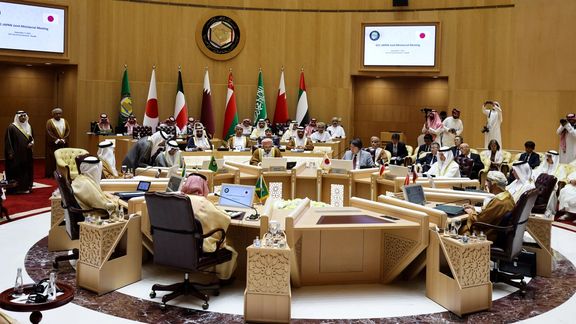
A general view of the Persian Gulf Cooperation Council Foreign Ministers' meeting in Riyadh, Saudi Arabia, September 7, 2023

Iran and neighboring Arab countries find themselves increasingly at odds as both sides are engaged in rhetoric that underscores their deep-seated differences.

Amid the persisting rivalries, the Gulf Cooperation Council of the Arab States condemned Iran on Friday for what they called “false” claims that prisoners were being treated badly in Bahrain, a long-time target of Iranian propaganda.

Hours earlier, Iran decried a statement issued at the end of the 157th session of the GCC Ministerial Council in the Saudi capital on Thursday about the “joint ownership” by Saudi Arabia and Kuwait of the maritime Arash/Al-Dorra (Al-Durra) oil and gas field.

The GCC’s foreign ministers cited the principles of the UN Charter on “good neighborliness and non-interference in the internal affairs of states,” calling on officials in Iran “to investigate accuracy and not rely on incorrect information.”

Bahraini Foreign Minister Abdullatif Al Zayani participates the Gulf Cooperation Council Ministerial Meeting in Riyadh on September 7, 2023.
100%
Bahraini Foreign Minister Abdullatif Al Zayani participates the Gulf Cooperation Council Ministerial Meeting in Riyadh on September 7, 2023.

Manama itself had earlier rejected Iran’s foreign ministry spokesman Nasser Kanaani’s claim that “unfavorable” jail conditions in Bahrain had led to a hunger strike by some 800 prisoners. Bahrain’s Ministry of Foreign Affairs said Iran should “be more accurate and not to be misled by false information that harms relations between the two countries.”

A Reuters report quoted Bahrain’s General Directorate of Reform and Rehabilitation as saying that the number of detainees who have reported being on hunger strike had at no time gone beyond 124 and that their complaints were being addressed. The Bahraini body said the hunger strikers are provided with access to medical check-ups daily and none of them have required critical care or hospitalization. “Any claims to the contrary are false,” it said. “They reviewed a number of demands made by some inmates and submitted a detailed report to the relevant authorities,” Bahrain’s foreign ministry said.

A map from Kuwait's oil ministry showing the Dorra gas field near the tip of the Persian Gulf.
100%
A map from Kuwait's oil ministry showing the Dorra gas field near the tip of the Persian Gulf.

The other issue of contention is a gas and oil field in the northwestern tip of the Persian Gulf straddling the maritime boundaries of Iran, Saudi Arabia and Kuwait. The two Arab states in recent months have been rejecting Iranian claims over the field and planning joint exploration. The GCC Ministerial Council’s rebuke over the issue was part of their comprehensive statement that rejected “any claims that any other party has rights in this field or the submerged area adjacent to the area divided by its designated borders between the Kingdom of Saudi Arabia and the State of Kuwait.”

The joint offshore field -- called Arash in Iran and Durra by Saudi Arabia and Kuwait -- was discovered in 1967 and is estimated to have a total proven reserves of around 310 million barrels of oil and 20 trillion cubic feet of gas. Iran claims any development without its consent breaks international laws, and insists that 40 percent of the field located in its territorial waters. Saudi Arabia and Kuwait insist that Iran has no share in the field and the precise demarcation of the territorial waters can prove that. The disputed maritime field in the Persian Gulf has become a litmus test for the recent détente between Tehran and Riyadh as controversies surrounding it escalate.

“The ownership of the natural resources in the submerged area adjacent to the Saudi-Kuwaiti divided zone, including the entire Al Durra field, is joint ownership between the Kingdom of Saudi Arabia and the State of Kuwait only, and they alone have full rights to exploit the wealth in that area,” the GCC statement said.

In March last year, Kuwait and Saudi Arabia started projects to extract gas from the field. Iran's foreign ministry spokesman at the time, Saeed Khatibzadeh said that as Iran has a share in the field it must be included in any action to operate and develop it. "The Arash/Al-Durra gas field is a joint field between Iran, Kuwait and Saudi Arabia. Parts of it are located in areas between Iran and Kuwait whose water boundaries have not been defined,” he said.

Kanaani said on Friday, “The Persian Gulf littoral states should utilize the resources and subsoil of the Persian Gulf based on goodwill and historical rights in line with the common interests of the nations.”

He also dismissed the GCC claims about the three Iranian islands of Abu Musa, the Greater Tunb, and the Lesser Tunb in the Persian Gulf, describing them as an “eternal and integral” part of the Iranian territory. He said any claim about their ownership have no “political or legal value.”

“The Islamic Republic of Iran has repeatedly emphasized its territorial integrity and sovereignty over the three Iranian islands based on accepted principles and rules of international law,” the regime’s spokesman said.


Most Viewed

US blockade enters murky phase as tankers spoof signals and buyers hesitate
1
ANALYSIS

US blockade enters murky phase as tankers spoof signals and buyers hesitate

2

US tightens financial squeeze on Iran, warns banks over oil money flows

3
INSIGHT

Ideology may be fading in Iran, but not in Kashmir's ‘Mini Iran'

4
INSIGHT

Hardliners push Hormuz ‘red line’ as US blockade tests Iran’s leverage

5
VOICES FROM IRAN

Hope and anger in Iran as fragile ceasefire persists

Banner
Banner

Spotlight

  • Hardliners push Hormuz ‘red line’ as US blockade tests Iran’s leverage
    INSIGHT

    Hardliners push Hormuz ‘red line’ as US blockade tests Iran’s leverage

  • Ideology may be fading in Iran, but not in Kashmir's ‘Mini Iran'
    INSIGHT

    Ideology may be fading in Iran, but not in Kashmir's ‘Mini Iran'

  • War damage amounts to $3,000 per Iranian, with blockade set to add to losses
    INSIGHT

    War damage amounts to $3,000 per Iranian, with blockade set to add to losses

  • Why the $100 billion Hormuz toll revenue is a myth
    ANALYSIS

    Why the $100 billion Hormuz toll revenue is a myth

  • US blockade targets Iran oil boom amid regional disruption
    ANALYSIS

    US blockade targets Iran oil boom amid regional disruption

  • Iran's digital economy battered by prolonged blackout
    INSIGHT

    Iran's digital economy battered by prolonged blackout

•
•
•

More Stories

Family Of Jailed Iranian Ex-Official Awarded $20m In US Court

Sep 8, 2023, 23:24 GMT+1
•
Maryam Sinaiee

A US federal court has ruled that Iran should pay nearly $20m in damages to the family of an Iranian politician illegally imprisoned and tortured for four decades. 

The ruling in favor of the three children of Abbas Amir-Entezam was announced by Herischi and Associates, a Washington-based law firm that represented them in a US federal court in the District of Columbia. 

The law firm sued the Islamic Republic and the Revolutionary Guards in July 2019 on behalf of Amir-Entezam’s children -- Ardeshir, Anoush, and Elham – who were 2, 6, and 9 at the time of his imprisonment. 

Herischi and associates have also represented the families of ten crew members of Sanchi oil tanker, family of Omar “Chicho" Mahmoudzadeh, a US citizen who was killed in an Iranian ballistic missile and drone attack in Iraq, the families of victims of the Ukrainian flight PS752 which was shot down by Iran’s air defenses on January 8, 2020, shortly after it took off from Imam Khomeini Airport, Tehran, and US-based activist Masih Alinejad. 

The plaintiffs who never saw their father again were awarded $3.25m in compensatory damages and $3.25m in punitive damages for a total of $6.5m each. Amir-Entezam passed away in Tehran in July 2018 at the age of 86. The fine is to be collected from Iranian funds in the US allocated to provide compensation to American victims of international terrorism. 

(From left) Ali Khamenei (later Supreme Leader), politician Dariush Forouhar (later killed), former Prime Minister Mehdi Bazargan (later forced into retirement), and Abbas Amir-Entezam
100%
(From left) Ali Khamenei (later Supreme Leader), politician Dariush Forouhar (later killed), former Prime Minister Mehdi Bazargan (later forced into retirement), and Abbas Amir-Entezam

Amir-Entezam was a France and US-educated civil engineer was appointed as deputy prime minister and government spokesman in the interim cabinet formed by Mehdi Bazargan immediately after the Islamic Revolution of 1979. He was sent to Sweden a few months later as ambassador when some political groups objected to his qualifications.

Amir-Entezam was summoned from Sweden and was arrested upon his arrival at Tehran’s Mehrabad Airport in December 1979, soon after revolutionary students took over the US embassy in Tehran and was later charged with spying for the United States based on embassy documents the students had seized. 

These documents were minutes of the meetings between Amir-Entezam and the US ambassador and other diplomats in Tehran when he was deputy prime minister. 

Amir-Entezam who was one of the first political prisoners, and the longest-held, in the Islamic Republic, always insisted the charges of espionage and said these had held routine diplomatic meetings. 

He also alleged that he had been a victim of the prevalent anti-American atmosphere in the country at the time, created by the Soviet Union and the Toudeh party in Iran which upheld Soviet interests. 

The former official and diplomat was reportedly held in solitary confinement for over 550 days without access to lawyers during which time he was subjected to many tortures. He was subsequently sentenced to death by a revolutionary Court. 

The death sentence was later commuted to life imprisonment with Bazargan’s help. It took seventeen years before Amir-Entezam was allowed to leave the prison and live in his own house, under constant supervision. 

Even his limited freedom did not take long, and he was sent back to prison three months later in 1998 after criticizing Assadollah Lajevardi, the warden of the Evin Prison where he had been held, in an interview with the Voice of America, and calling him “an executioner”. 

Amir-Entezam was released and sent back to prison twice more after that for objecting to the principle of a ‘Supreme Leader’ being the absolute ruler of the country and proposing a referendum on the Constitution in his interviews and writings. In 2003 authorities decided to release him from prison due to serious health issues but he was never allowed to leave the country. 

Some Iranians have criticized the ruling and similar cases when US courts awarded monetary judgments to plaintiffs to be paid from Iran’s funds in the United States. They argue that these funds belong to the Iranian people and should be returned once the Islamic Republic ceases to exist.

Iran's Foreign Minister Presents Report To Hardline Cleric

Sep 8, 2023, 21:23 GMT+1

Iran's Minister of Foreign Affairs Hossein Amir-Abdollahian has met with Ayatollah Ahmad Alamolhoda, to report to him about the state of the country's foreign affairs.

Iranian government officials occasionally meet with high-ranking clerics to explain policies and re-assure them over controversial decisions, but a meeting by the foreign minister with just one cleric has raised eyebrows.

Alamolhoda, the father-in-law of President Ebrahim Raisi, is known for his ultraconservative positions. In December 2009, he was famously quoted as referring to opponents of Supreme Leader Ali Khamenei as part of the "party of Satan."

In late March, the European Union imposed sanctions on Alamolhoda in its sixth round of measures related to the suppression of protests in Iran. The EU Council cited his involvement in promoting hatred against women, protesters, and religious minorities, holding him accountable for significant human rights violations within Iran.

Recently, the senior Ayatollah characterized the release of Iran's frozen funds by the United States to free for five American hostages as a "humiliation" and a "ransom" in exchange for protecting "their spies."

He asserted that the ransom was paid not out of humanitarian concern for the hostages but to prevent the exposure of espionage secrets through Iran's interrogation of the prisoners. Alamolhoda also criticized "Westernized" Iranians for placing their hopes on the United States and Europe.

Sberbank Launches Transfers To Iran For Russian Customers

Sep 8, 2023, 20:35 GMT+1

Sberbank, the largest bank in Russia, has introduced a new service allowing its customers to make transfers to Iran amid sanctions on both countries.

This service enables both personal and corporate banking, as reported by the bank's press service to RIA Novosti.

The transfers are conducted in Russian rubles and are directed to Pasargad Bank in Iran. The standard commission for these international transfers is set at 1% of the transfer amount.

According to Sberbank, the launch of this transfer service in September is aimed at catering to tourists, although it can be used by both individuals and businesses. The bank acknowledges that the demand for this service is yet to be fully assessed.

The move comes as the war in Ukraine has fostered closer cooperation between Russia and Iran in various sectors, including military, economic, and political realms.

In May, it was reported that two Iranian banks had established representative offices in Russia, as announced by the Central Bank of Iran (CBI). This development followed the opening of a representative office in Tehran by Russia's second-largest bank, VTB Bank. Iran's Mir Business Bank, owned by Bank Melli Iran, has been operating in Russia since 2002, contributing to financial ties between the two nations.

Following the Russian invasion of Ukraine, VTB found itself among the Russian banks subjected to comprehensive sanctions imposed by both the United States and the European Union, resulting in their prohibition from conducting operations within European nations.

As a consequence, the bank was compelled to shutter its European and African branches, leaving it with operational branches solely in Azerbaijan, Armenia, Kazakhstan, and Vietnam.

New Indo-Saudi Trade Route To Bypass Iran As Transit Hub

Sep 8, 2023, 18:57 GMT+1
•
Iran International Newsroom

The US, Saudi Arabia and India are mulling over a trade route between the Persian Gulf and South Asia, a rival to a similar project that involves Iran and China. 

US officials told Reuters Friday that the infrastructure deal could reconfigure the landscape of trade in the Eurasia region, linking Middle Eastern countries by a network of railways and connecting to India through shipping lanes, bypassing Iran in trade routes from Asia to Europe. 

The talks, which have also included the United Arab Emirates and Europe, may yield a concrete result in time for an announcement on the sidelines of this week's Group of 20 (G20) leaders meeting, the sources said. Axios said earlier in the week that the plan would be announced on Saturday. 

The announcement came as US President Joe Biden is on his way to the G20 conference in New Delhi, India, where he is set to meet Indian Prime Minister Narendra Modi and may also have talks with Saudi Crown Prince Mohammed bin Salman. 

US President Joe Biden arrives ahead of G20 Summit, in New Delhi, India, September 8, 2023.
100%
US President Joe Biden arrives ahead of G20 Summit, in New Delhi, India, September 8, 2023.

The plans for a sweeping, multi-national ports and rail deal would potentially counter China's growing influence through the Belt and Road global initiative as Biden is pitching Washington as an alternative partner for an investor in developing countries at the G20, especially in the Indo-Pacific region. According to The Brookings Institution, “China’s growing role in the Middle East is positioning the rising superpower in direct confrontation with shifting US interests in the domains of energy security, Israel, and Iran.”

The project, being discussed for 18 months, is seen as a part of the Biden administration’s mega deal that would have Saudi Arabia recognize Israel. The strategic concept of the "Indo-Abrahamic Alliance" has laid the framework for the formation of the I2U2 group, a grouping of India, Israel, the United Arab Emirates, and the United States.

Biden’s national security advisor, Jake Sullivan, told reporters aboard Air Force One en route to the summit that it was an initiative the US was invested in along with its partner countries, and that there was a "broad understanding of many of the key elements.” 

"Many of the elements of a pathway to normalization are now on the table. We don't have a framework, we don't have the terms ready to be signed. There is still work to do," Sullivan added. Biden himself said in early July that Israel and Saudi Arabia were a long way from a normalization agreement that would also involve a US-Saudi defense treaty and a civilian nuclear program for the Saudis from the United States.

US officials see a potential deal between Israel and Saudi Arabia as possible after the administration of then-President Donald Trump reached similar agreements between Israel and Morocco, Sudan, Bahrain and the United Arab Emirates.

In addition to the diplomatic implications, the project could reduce shipping times, costs, the use of diesel and make trade faster and cheaper, potentially making Iran redundant in the transit of goods in the region. 

In May, Iranian lawmaker Mojtaba Yousefi admitted that Iran has been supplanted by Turkey as the region’s transport hub despite Tehran’s ambitions. Iran suffers from poor infrastructure that makes a mockery of its ambitions in recent years to be the leader. The country’s roads and railways are in need of significant upgrades, while the ports are not equipped to handle the large volumes of cargo that would be necessary for Iran to become a regional hub. Political instability and economic sanctions mean the situation is highly unlikely to improve any time soon. 

A layout for China's Belt And Road Initiative
100%
A layout for China's Belt And Road Initiative

However, Tehran Times, a pro-regime publication, said in an article last year that the Russian invasion of Ukraine, “despite its grave consequences for many countries, has presented Iran with a golden opportunity to realize the long-awaited goal of becoming the global transit hub it once was,” referring to the Silk Road, an ancient network of Eurasian trade routes active from the second century BCE until the mid-15th century that span over 6,400 kilometers (about 3976.78 mi).

Hit by sanctions that severely hampered trade of Russian goods, Moscow sought alternative routes for global distribution, with a renewed focus on the International North-South Transit Corridor (INSTC), the daily claimed. The agreement for launching INSTC was signed by Iran, India, and Russia in 2000, however, despite all the hype, the project yielded no results mainly due to the US sanctions on Iran. 

Expert Warns of Potential Devastation As Iran Faces Severe Quake Risk

Sep 8, 2023, 16:29 GMT+1

An Iranian expert has issued a stark warning about the country's vulnerability to devastating earthquakes.

Ali Beitollahi, the head of the Seismology Center at the Housing and Urban Development Research Center, has revealed that in the event of an earthquake measuring seven on the Richter scale, approximately 60 percent of buildings in Iran could be destroyed.

Beitollahi explained that the Tehran-Karaj region, a densely populated area, faces a significantly higher risk. An earthquake with a magnitude of seven in the region alone could potentially result in the destruction of more than two million residential units, placing six million people in immediate danger.

The warning follows recent concerns expressed by Mehdi Pirhadi, a member of the Tehran Council, who emphasized the urgent need for building renovations in the capital to enhance earthquake resilience.

However, it is essential to recognize that the seismic risk is not limited to Tehran. Active fault lines stretch from Hamedan in the west to Gilan in the north, posing an imminent threat of a potentially catastrophic earthquake.

Iran, located at the convergence of the Arabian, Indian, and Eurasian tectonic plates, is renowned for its high seismic activity, making it one of the most earthquake-prone countries globally. The nation has witnessed several massive earthquakes in recent history, resulting in significant loss of life and substantial economic damage.





