• العربية
  • فارسی
Brand
  • Iran Insight
  • Politics
  • Economy
  • Analysis
  • Special Report
  • Opinion
  • Podcast
  • Iran Insight
  • Politics
  • Economy
  • Analysis
  • Special Report
  • Opinion
  • Podcast
  • Theme
  • Language
    • العربية
    • فارسی
  • Iran Insight
  • Politics
  • Economy
  • Analysis
  • Special Report
  • Opinion
  • Podcast
All rights reserved for Volant Media UK Limited
volant media logo

New Indo-Saudi Trade Route To Bypass Iran As Transit Hub
Iran International Newsroom
Sep 8, 2023, 18:57 GMT+1Updated: 17:30 GMT+1
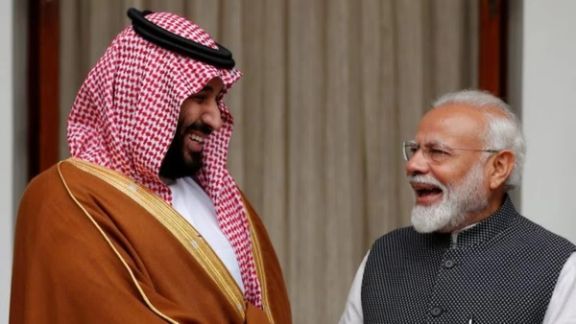
Saudi Arabia's Crown Prince Mohammed bin Salman and India's Prime Minister Narendra Modi react ahead of their meeting at Hyderabad House in New Delhi, India, February 20, 2019.

The US, Saudi Arabia and India are mulling over a trade route between the Persian Gulf and South Asia, a rival to a similar project that involves Iran and China. 

US officials told Reuters Friday that the infrastructure deal could reconfigure the landscape of trade in the Eurasia region, linking Middle Eastern countries by a network of railways and connecting to India through shipping lanes, bypassing Iran in trade routes from Asia to Europe. 

The talks, which have also included the United Arab Emirates and Europe, may yield a concrete result in time for an announcement on the sidelines of this week's Group of 20 (G20) leaders meeting, the sources said. Axios said earlier in the week that the plan would be announced on Saturday. 

The announcement came as US President Joe Biden is on his way to the G20 conference in New Delhi, India, where he is set to meet Indian Prime Minister Narendra Modi and may also have talks with Saudi Crown Prince Mohammed bin Salman. 

US President Joe Biden arrives ahead of G20 Summit, in New Delhi, India, September 8, 2023.
100%
US President Joe Biden arrives ahead of G20 Summit, in New Delhi, India, September 8, 2023.

The plans for a sweeping, multi-national ports and rail deal would potentially counter China's growing influence through the Belt and Road global initiative as Biden is pitching Washington as an alternative partner for an investor in developing countries at the G20, especially in the Indo-Pacific region. According to The Brookings Institution, “China’s growing role in the Middle East is positioning the rising superpower in direct confrontation with shifting US interests in the domains of energy security, Israel, and Iran.”

The project, being discussed for 18 months, is seen as a part of the Biden administration’s mega deal that would have Saudi Arabia recognize Israel. The strategic concept of the "Indo-Abrahamic Alliance" has laid the framework for the formation of the I2U2 group, a grouping of India, Israel, the United Arab Emirates, and the United States.

Biden’s national security advisor, Jake Sullivan, told reporters aboard Air Force One en route to the summit that it was an initiative the US was invested in along with its partner countries, and that there was a "broad understanding of many of the key elements.” 

"Many of the elements of a pathway to normalization are now on the table. We don't have a framework, we don't have the terms ready to be signed. There is still work to do," Sullivan added. Biden himself said in early July that Israel and Saudi Arabia were a long way from a normalization agreement that would also involve a US-Saudi defense treaty and a civilian nuclear program for the Saudis from the United States.

US officials see a potential deal between Israel and Saudi Arabia as possible after the administration of then-President Donald Trump reached similar agreements between Israel and Morocco, Sudan, Bahrain and the United Arab Emirates.

In addition to the diplomatic implications, the project could reduce shipping times, costs, the use of diesel and make trade faster and cheaper, potentially making Iran redundant in the transit of goods in the region. 

In May, Iranian lawmaker Mojtaba Yousefi admitted that Iran has been supplanted by Turkey as the region’s transport hub despite Tehran’s ambitions. Iran suffers from poor infrastructure that makes a mockery of its ambitions in recent years to be the leader. The country’s roads and railways are in need of significant upgrades, while the ports are not equipped to handle the large volumes of cargo that would be necessary for Iran to become a regional hub. Political instability and economic sanctions mean the situation is highly unlikely to improve any time soon. 

A layout for China's Belt And Road Initiative
100%
A layout for China's Belt And Road Initiative

However, Tehran Times, a pro-regime publication, said in an article last year that the Russian invasion of Ukraine, “despite its grave consequences for many countries, has presented Iran with a golden opportunity to realize the long-awaited goal of becoming the global transit hub it once was,” referring to the Silk Road, an ancient network of Eurasian trade routes active from the second century BCE until the mid-15th century that span over 6,400 kilometers (about 3976.78 mi).

Hit by sanctions that severely hampered trade of Russian goods, Moscow sought alternative routes for global distribution, with a renewed focus on the International North-South Transit Corridor (INSTC), the daily claimed. The agreement for launching INSTC was signed by Iran, India, and Russia in 2000, however, despite all the hype, the project yielded no results mainly due to the US sanctions on Iran. 

Most Viewed

Iran International says it won’t be silenced after London arson attack
1

Iran International says it won’t be silenced after London arson attack

2
VOICES FROM IRAN

Hope and anger in Iran as fragile ceasefire persists

3

Iran halts petrochemical exports to supply domestic market

4
INSIGHT

How Tehran bends its own red lines to boost state rallies

5

US arrests Iranian national over alleged Basij-linked visa fraud

Banner
Banner

Spotlight

  • Too early to tell who is winning Iran war, experts say
    PODCAST

    Too early to tell who is winning Iran war, experts say

  • How Tehran bends its own red lines to boost state rallies
    INSIGHT

    How Tehran bends its own red lines to boost state rallies

  • Iran blackout cripples freelancer, small business incomes
    VOICES FROM IRAN

    Iran blackout cripples freelancer, small business incomes

  • Ideology may be fading in Iran, but not in Kashmir's ‘Mini Iran'
    INSIGHT

    Ideology may be fading in Iran, but not in Kashmir's ‘Mini Iran'

  • US blockade enters murky phase as tankers spoof signals and buyers hesitate
    ANALYSIS

    US blockade enters murky phase as tankers spoof signals and buyers hesitate

  • Why the $100 billion Hormuz toll revenue is a myth
    ANALYSIS

    Why the $100 billion Hormuz toll revenue is a myth

•
•
•

More Stories

Expert Warns of Potential Devastation As Iran Faces Severe Quake Risk

Sep 8, 2023, 16:29 GMT+1

An Iranian expert has issued a stark warning about the country's vulnerability to devastating earthquakes.

Ali Beitollahi, the head of the Seismology Center at the Housing and Urban Development Research Center, has revealed that in the event of an earthquake measuring seven on the Richter scale, approximately 60 percent of buildings in Iran could be destroyed.

Beitollahi explained that the Tehran-Karaj region, a densely populated area, faces a significantly higher risk. An earthquake with a magnitude of seven in the region alone could potentially result in the destruction of more than two million residential units, placing six million people in immediate danger.

The warning follows recent concerns expressed by Mehdi Pirhadi, a member of the Tehran Council, who emphasized the urgent need for building renovations in the capital to enhance earthquake resilience.

However, it is essential to recognize that the seismic risk is not limited to Tehran. Active fault lines stretch from Hamedan in the west to Gilan in the north, posing an imminent threat of a potentially catastrophic earthquake.

Iran, located at the convergence of the Arabian, Indian, and Eurasian tectonic plates, is renowned for its high seismic activity, making it one of the most earthquake-prone countries globally. The nation has witnessed several massive earthquakes in recent history, resulting in significant loss of life and substantial economic damage.


Iran Faces Soaring Cost Of Living Amidst Escalating Inflation

Sep 8, 2023, 08:55 GMT+1

The cost of living in Iran has reached staggering levels, with the year-on-year inflation rate for households across the country soaring to 39.8 percent in August.

According to a report by Iran’s Labor News Agency, when considering minimum living standards, the cost of living has surged to 194 million rials, equivalent to approximately $400 per month. However, when factoring in housing expenses, particularly in Tehran, the cost of living exceeds a daunting 230 million rials, approximately $460 monthly.

Major industrial cities such as Mashhad, Esfahan, and Tabriz also witness high costs of living ranging from 200 to 220 million rials per month.

Currently the minimum wage in Iran is about $150 a month and the average income of people is between $150 to $250. Key workers remain at the bottom of the pay scale. Iran's Teachers' Association recently said that a third of the country's educators earn less than $200 a month, meaning many are fleeing for work abroad.

One of the primary contributors to Iran's economic turmoil is the drastic depreciation of its currency, the rial. Just over a year ago, the rial was trading at approximately 300,000 to the US dollar. However, in early May, it plummeted to as low as 550,000 rials to the dollar, and currently hovers around 490,000 rials to the dollar. This catastrophic devaluation of the rial directly reflects the nation's inflationary crisis.

Iran heavily relies on imports for essentials like food, animal feed, medicines, raw materials, and finished goods. As the local currency continues to lose value, the cost of imports escalates, ultimately leading to higher prices for consumers. This, in turn, places an additional burden on Iranian households already grappling with soaring living costs.

Iranian Pilots Readying For Migration As Drivers

Sep 6, 2023, 12:31 GMT+1

A wave of Iranian pilots are seeking commercial drivers' licenses as a path to migrate abroad, says the head of the Passenger Transport Companies Union.

Ahmadreza Ameri, during an interview with ILNA, shed light on the increasing interest of individuals with higher education backgrounds, including pilots, in obtaining commercial drivers' licenses as a strategic move towards migration opportunities. He admitted, "Today, we see individuals with higher education, including pilots, who are seeking to obtain a commercial drivers' license for migration."

This unconventional career shift among pilots is driven by the realization that possessing the license opens doors to opportunities in the cargo transportation sector, enabling them to work as bus or truck drivers. Importantly, several countries are currently offering attractive incentives, including residence permits and competitive salaries, often amounting to several thousand dollars, to drivers in the cargo transportation industry.

The desire for migration from Iran has been on the rise in recent years, encompassing not only educated professionals but also individuals from various occupational backgrounds such as the healthcare sector. Several factors contribute to the trend, including political and economic instability, rampant systemic corruption, the adverse effects of sanctions, a depreciating national currency, and inflation.

The Iran Migration Observatory's latest annual outlook underscores the scale of this migration phenomenon. The United Arab Emirates (UAE) stands out as the host to the highest number of Iranians living abroad, with over 450,000 Iranian-born residents. This is followed by countries such as the United States, Canada, Germany, Turkey, and the United Kingdom, as Iranians increasingly seek improved living standards and economic opportunities beyond their homeland.


South Korea Says Still Working To Transfer Iran's Frozen Funds

Sep 5, 2023, 13:33 GMT+1

South Korea has announced it is actively coordinating with relevant nations in their ongoing endeavors to unfreeze Iranian funds held within its banking institutions.

In a statement released on Tuesday, South Korea's Foreign Minister Park Jin confirmed that he spoke to Hossein Amir-Abdollahian, his Iranian counterpart, and that he is working to resolve this matter.

This comes following a recent diplomatic agreement between Tehran and Washington, in which Iran agreed to release five imprisoned American citizens in exchange for the release of $6billion frozen Iranian assets in South Korea.

According to reports from South Korean media, these funds, earned from oil sales before the US reimposed sanctions on Iran in 2018, have been transferred to the Swiss Central Bank, after which they will be converted into euros and then transferred to an account in Qatar that Iran can access.

American news source CNN, reported in August that the transfer of funds from South Korea to Qatar is likely to take 30 to 45 days.

The official news agency of the Islamic Republic has also confirmed the continuous efforts to transfer Iran's frozen assets from South Korean banks. According to IRNA, Amir-Abdollahian expressed optimism, stating that this development could “mark the commencement of a new phase in bilateral relations, and he welcomes any initiatives that contribute to enhancing ties between the two nations.”

Presently, the five American citizens are under house arrest in Iran. However, specific details regarding the Iranian prisoners to be exchanged with the five individuals as part of the recent agreement have not been publicly disclosed.


Will Iranian Proxies Target Israel In September Or October?

Sep 5, 2023, 11:45 GMT+1
•
Benjamin Weinthal

A former counter-terrorism advisor to two Israeli prime ministers triggered an intense debate about whether Iranian proxies will attack Israel in September or October.

There is, however, disagreement within Israel’s security and defense establishment over a planned Iran-backed attack against the Jewish state. 

Yigal Carmon, the founder of the Middle East Media Research Institute (MEMRI) and one of Israel’s leading counter-terrorism experts, wrote an August 31st article titled “Signs Of Possible War In September-October,“ in which he argued a “confrontation could result from an uncontrolled deterioration on the ground or from the use of new and unusually deadly weapons by these movements [Hamas and Hezbollah].” 

Carmon said, “neither Hamas nor Hezbollah are eager to start a comprehensive confrontation with Israel” but noted that growing acts of jingoism and saber-rattling by both Iranian regime-backed jihadi movements (including Palestinian Islamic Jihad) on Israel’s borders.

Yigal Carmon, the founder of the Middle East Media Research Institute (MEMRI) (Undated)
100%
Yigal Carmon, the founder of the Middle East Media Research Institute (MEMRI)

Hezbollah has set up tents in the Har Dov area within Israeli territory and was involved in “dismantling surveillance cameras along the border fence near Fatima Gate, and firing an anti-tank missile into Israel,” wrote Carmon.

Carmon, who is a fluent Arabic speaker, added “Hezbollah, which does not recognize the Blue Line as the international border between Lebanon and Israel, has recently made a new territorial claim, demanding that Israel give Lebanon sovereignty over the northern Rosh Hanikra railway tunnel, likewise in Israeli territory. At the same time, it also demands to curtail UNIFIL's freedom of action in South Lebanon.”

The US government and many European states have classified Iran’s strategic partner, Hezbollah, a foreign terrorist organization. Both the US and EU have designated Hamas and the PIJ terrorist entities.

Members of Lebanon's Hezbollah hold flags during a rally (November 2022)
100%
Members of Lebanon's Hezbollah hold flags during a rally

Carmon wrote, “There has also been an increase in efforts by Iran and Hezbollah to smuggle weapons into the West Bank, similar to the smuggling of weapons into Gaza. PIJ secretary-general Ziad Al-Nakhaleh said that, during his June 2023 meeting with Iranian Leader Ali Khamenei, the latter had ‘reiterated [the need to] develop the arming of the West Bank and the resistance there.’ Nakhaleh added: ‘We, as Palestinians and as resistance forces and movements, understand the importance of arming the West Bank, but this requires efforts by the Palestinians themselves, and also the assistance of our brothers in the Islamic Republic of Iran.’”

The spike in recent activity between Iran’s foreign minister Hossein Amir-Abdollahian and Tehran’s PIJ, Hamas and Lebanese allies in Beirut was also a subject of Carmon’s analysis.

Secretary-General of the Palestinian Islamic Jihad resistance movement Ziad al-Nakhaleh (2nd from right) meets with Iran’s Supreme Leader Ali Khamenei in Tehran on June 14, 2023.
100%
Secretary-General of the Palestinian Islamic Jihad resistance movement Ziad al-Nakhaleh (2nd from right) meets with Iran’s Supreme Leader Ali Khamenei in Tehran on June 14, 2023.

Abdollahian stressed that in the Beirut meeting the statements of Khamenei about the need "to help the West Bank" and about Iran's "ongoing [commitment to] assisting the resistance with all its might." Amir-Abdollahian added, "the establishment of the joint Hamas-PIJ [war] room reflected a smart move on the part of the resistance.”

Carmon noted that Amir-Abdollahian also met with Hezbollah Secretary-General Nasrallah, who then met with Al-'Arouri and Al-Nakhaleh to "make a joint assessment of the situation in the West Bank, the escalation of the resistance activity and the latest Israeli threats." 

Abdollahian and Iran’s allies underscored at the meeting "the steadfastness and steadiness of all the forces of the resistance axis in the struggle against the Zionist enemy," and cooperation between the "resistance movements" in Palestine and Lebanon.

When asked about Carmon’s analysis, Brigadier-General (res) Amir Avivi told Iran International, "While the specter of war unfortunately always looms along and beyond our borders, whether fueled by Iranian money and weapons or online incitement, at this time I do not share the assessment of an imminent war in September or October. 

The terrorist organization Hezbollah in Lebanon has indeed been conducting provocations along the border, and the other Iranian proxies have made belligerent statements.”

Avivi, the founder and CEO of the Israel Defense and Security Forum (IDSF), added, “And yes, religious holidays are historically periods of inter-community tensions, but at this time I believe that neither Hezbollah nor Hamas have an appetite for a full-blown confrontation with Israel, because they understand how devastating it would be for them.”

Carmon had also warned in his article that “During the Jewish holidays in September and October, Jews are likely to visit the Al-Aqsa compound, as happens every year. Hamas and Hezbollah spokesmen have stressed that this could lead to a regional war.”

Avivi noted that “Both Hamas and Hezbollah are suffering from internal unrest and lack of legitimacy in their respective fiefdoms, and it would be wise of them to refrain from jeopardizing their own future. Contrary to media reports and wishful thinking amongst Iranian proxies, the IDF is fully fit for combat, alert and ready to respond to any aggression."

Israeli air force F-35 pilots (undated)
100%
Israeli air force F-35 pilots

When presented with these arguments, Carmon told Iran International that “I said they [Hamas, Hezbollah and Palestinian Islamic Jihad] do not want it[war] but things can get out of control.”

Carmon raised the example of Nasrallah who said after the 2006 Second War in Lebanon about the kidnapping of Israeli soldiers that sparked the war: “We did not think, even one percent, that the capture would lead to a war at this time and of this magnitude. You ask me, if I had known on July 11 ... that the operation would lead to such a war, would I do it? I say no, absolutely not.”

A second factor that is part and parcel of Carmon’s “uncontrolled deterioration” framework during the lead up to the full-blown war in 2006 was the entry of an Israeli Merkava 2 tank into Lebanon that passed over a massive explosive device, destroying the tank and killing its four crew members. 

Carmon said “People do things without knowing repercussions. This is what happens when people like Avivi listen only to themselves and not to the other side.” Carmon also warned about the shipments of advanced new weapons, including Kornet anti-tank missiles, to Iran-backed terrorist terrorists, that can be used by against Israelis.






