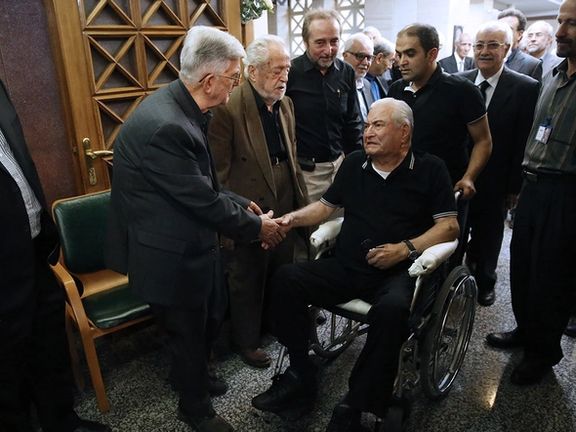
Late Iranian politician Abbas Amir-Entezam during a wake for Ebrahim Yazdi, a former Iranian foreign minister in Tehran (August 2017)
A US federal court has ruled that Iran should pay nearly $20m in damages to the family of an Iranian politician illegally imprisoned and tortured for four decades.
The ruling in favor of the three children of Abbas Amir-Entezam was announced by Herischi and Associates, a Washington-based law firm that represented them in a US federal court in the District of Columbia.
The plaintiffs who never saw their father again were awarded $3.25m in compensatory damages and $3.25m in punitive damages for a total of $6.5m each. Amir-Entezam passed away in Tehran in July 2018 at the age of 86. The fine is to be collected from Iranian funds in the US allocated to provide compensation to American victims of international terrorism.
(From left) Ali Khamenei (later Supreme Leader), politician Dariush Forouhar (later killed), former Prime Minister Mehdi Bazargan (later forced into retirement), and Abbas Amir-Entezam
Amir-Entezam was a France and US-educated civil engineer was appointed as deputy prime minister and government spokesman in the interim cabinet formed by Mehdi Bazargan immediately after the Islamic Revolution of 1979. He was sent to Sweden a few months later as ambassador when some political groups objected to his qualifications.
Amir-Entezam was summoned from Sweden and was arrested upon his arrival at Tehran’s Mehrabad Airport in December 1979, soon after revolutionary students took over the US embassy in Tehran and was later charged with spying for the United States based on embassy documents the students had seized.
These documents were minutes of the meetings between Amir-Entezam and the US ambassador and other diplomats in Tehran when he was deputy prime minister.
Amir-Entezam who was one of the first political prisoners, and the longest-held, in the Islamic Republic, always insisted the charges of espionage and said these had held routine diplomatic meetings.
He also alleged that he had been a victim of the prevalent anti-American atmosphere in the country at the time, created by the Soviet Union and the Toudeh party in Iran which upheld Soviet interests.
The former official and diplomat was reportedly held in solitary confinement for over 550 days without access to lawyers during which time he was subjected to many tortures. He was subsequently sentenced to death by a revolutionary Court.
The death sentence was later commuted to life imprisonment with Bazargan’s help. It took seventeen years before Amir-Entezam was allowed to leave the prison and live in his own house, under constant supervision.
Even his limited freedom did not take long, and he was sent back to prison three months later in 1998 after criticizing Assadollah Lajevardi, the warden of the Evin Prison where he had been held, in an interview with the Voice of America, and calling him “an executioner”.
Amir-Entezam was released and sent back to prison twice more after that for objecting to the principle of a ‘Supreme Leader’ being the absolute ruler of the country and proposing a referendum on the Constitution in his interviews and writings. In 2003 authorities decided to release him from prison due to serious health issues but he was never allowed to leave the country.
Some Iranians have criticized the ruling and similar cases when US courts awarded monetary judgments to plaintiffs to be paid from Iran’s funds in the United States. They argue that these funds belong to the Iranian people and should be returned once the Islamic Republic ceases to exist.
Iran's Minister of Foreign Affairs Hossein Amir-Abdollahian during a meeting with Ahmad Alamolhoda on September 8, 2023
Iran's Minister of Foreign Affairs Hossein Amir-Abdollahian has met with Ayatollah Ahmad Alamolhoda, to report to him about the state of the country's foreign affairs.
Iranian government officials occasionally meet with high-ranking clerics to explain policies and re-assure them over controversial decisions, but a meeting by the foreign minister with just one cleric has raised eyebrows.
Alamolhoda, the father-in-law of President Ebrahim Raisi, is known for his ultraconservative positions. In December 2009, he was famously quoted as referring to opponents of Supreme Leader Ali Khamenei as part of the "party of Satan."
In late March, the European Union imposed sanctions on Alamolhoda in its sixth round of measures related to the suppression of protests in Iran. The EU Council cited his involvement in promoting hatred against women, protesters, and religious minorities, holding him accountable for significant human rights violations within Iran.
Recently, the senior Ayatollah characterized the release of Iran's frozen funds by the United States to free for five American hostages as a "humiliation" and a "ransom" in exchange for protecting "their spies."
He asserted that the ransom was paid not out of humanitarian concern for the hostages but to prevent the exposure of espionage secrets through Iran's interrogation of the prisoners. Alamolhoda also criticized "Westernized" Iranians for placing their hopes on the United States and Europe.
The transfers are conducted in Russian rubles and are directed to Pasargad Bank in Iran. The standard commission for these international transfers is set at 1% of the transfer amount.
According to Sberbank, the launch of this transfer service in September is aimed at catering to tourists, although it can be used by both individuals and businesses. The bank acknowledges that the demand for this service is yet to be fully assessed.
The move comes as the war in Ukraine has fostered closer cooperation between Russia and Iran in various sectors, including military, economic, and political realms.
In May, it was reported that two Iranian banks had established representative offices in Russia, as announced by the Central Bank of Iran (CBI). This development followed the opening of a representative office in Tehran by Russia's second-largest bank, VTB Bank. Iran's Mir Business Bank, owned by Bank Melli Iran, has been operating in Russia since 2002, contributing to financial ties between the two nations.
Following the Russian invasion of Ukraine, VTB found itself among the Russian banks subjected to comprehensive sanctions imposed by both the United States and the European Union, resulting in their prohibition from conducting operations within European nations.
As a consequence, the bank was compelled to shutter its European and African branches, leaving it with operational branches solely in Azerbaijan, Armenia, Kazakhstan, and Vietnam.
The Afkari brothers before their ordeal, with Navid on the left
Habib Afkari, a former detainee and the brother of Navid Afkari, has penned a heartfelt open letter on the third anniversary of his brother Vahid's imprisonment.
Vahid Afkari, who continues to be incarcerated in solitary confinement, stands as a symbol of resilience in the face of injustice and remains an enduring source of inspiration for many across Iran.
Navid Afkari, a talented wrestler, was apprehended in August 2018 amid widespread protests against escalating prices and economic hardships in Shiraz. Tragically, he was executed on September 12, 2020, following a trial marred by inconsistencies and irregularities.
In a poignant letter addressed to his brother Vahid, Habib Afkari wrote "Every day you endure in solitary confinement, bearing the weight of suffering and pain, you understand that you are paving the path towards a brighter future for our nation. You are the one forgotten and abandoned in that dim cell, yet you steadfastly cling to your faith, believing that your unwavering resolve will hasten the day of freedom."
Vahid Afkari has been sentenced to 33 years and 9 months in prison, accompanied by 74 lashes, following a controversial trial. He has endured three years of solitary confinement.
Afkari’s sister, Elham, who was also arrested by Shiraz's intelligence office in November 2021, regained her freedom several months later after receiving a five-year suspended sentence.
The latest audio recording released by Navid Afkari has prominently featured a phrase that has resonated widely over the past three years: "They search for the neck for their noose."
An Iranian expert has issued a stark warning about the country's vulnerability to devastating earthquakes.
Ali Beitollahi, the head of the Seismology Center at the Housing and Urban Development Research Center, has revealed that in the event of an earthquake measuring seven on the Richter scale, approximately 60 percent of buildings in Iran could be destroyed.
Beitollahi explained that the Tehran-Karaj region, a densely populated area, faces a significantly higher risk. An earthquake with a magnitude of seven in the region alone could potentially result in the destruction of more than two million residential units, placing six million people in immediate danger.
The warning follows recent concerns expressed by Mehdi Pirhadi, a member of the Tehran Council, who emphasized the urgent need for building renovations in the capital to enhance earthquake resilience.
However, it is essential to recognize that the seismic risk is not limited to Tehran. Active fault lines stretch from Hamedan in the west to Gilan in the north, posing an imminent threat of a potentially catastrophic earthquake.
Iran, located at the convergence of the Arabian, Indian, and Eurasian tectonic plates, is renowned for its high seismic activity, making it one of the most earthquake-prone countries globally. The nation has witnessed several massive earthquakes in recent history, resulting in significant loss of life and substantial economic damage.
Members of the Islamic Revolutionary Guard Corps (IRGC) attend an IRGC ground forces military drill in the Aras area, East Azerbaijan province, Iran, October 17, 2022
The Israeli Minister of Intelligence visiting London has spoken of the need for the world to unite against the Iranian regime and its terror force, the IRGC.
One of a number of high-profile guests in a House of Lords event in honor of the Woman, Life, Freedom movement, Gila Gamliel said: "The world must understand that Iran is not only Israel's problem. Other attendees included Lord Stuart Polak.
“The Ayatollah regime is extending its arms throughout the world. Therefore, the modern world must stand together like a wall," she told Iran International.
Lord Polak also told Iran International's reporter that this meeting was meant to hear the voices of the Iranian people and their demands.During her trip to London this week, Gamliel said that based on her conversations with many Iranians in the diaspora, she feels there is a true movement of change happening in Iran.
A source in her office told Iran International that Gamliel has emphasized that Israel, due to the role Iran played in saving Jews 2,500 years ago, considers itself committed to doing whatever it can to save Iranians.
Member of the House of Lords of the United Kingdom Baron Stuart Polak
Referencing the Jewish expression, 'see you next year in Jerusalem', the heart of the Jewish people, she gave a message to the Iranian people, "I hope that next year we will see each other in Tehran. I wholeheartedly believe that we can fulfill this promise together."
Gamliel also met with a group of Iranian opposition activists and reporters in London on Wednesday.
The Israeli minister also considered the goal of her trip to be "changing Western leaders' perception of the Iranian regime and imposing stricter sanctions on this government and listing the Revolutionary Guards as a terrorist group."
The United States government sanctioned Iran’s Islamic Revolutionary Guard Corps as a Foreign Terrorist Organization in 2019, but European states have hesitated to take the step, although they have imposed many sanctions on IRGC officials and entities.
The UK’s security minister and home secretary have both recently said Iran now poses one of the biggest threats to the country. Earlier this year, Iran International was forced to relocate its London office to Washington amidst threats to reporters’ lives which UK spy agency MI5 said it could no longer counter.
While speaking to Iran International, the Israeli minister said she wishes to send “support messages to the Iranian people and that the West should be with the Iranians and not make it easy for the regime.”
Israeli Intelligence Minister Gila Gamliel (leeft) and Iranian exiled Prince Reza Pahlavi in Tel Aviv, Israel
Gamliel hosted Iran’s exiled Prince Reza Pahlavi in Israel earlier this year during an unprecedented visit in April when he met with Prime Minister Benjamin Netanyahu.
Writing in the Israeli Maariv newspaper on International Women's Day in March, she said, "The citizens of Iran are not Israel's enemies. Peaceful relations, respect and appreciation prevailed between the peoples for many years" before the Islamic Revolution in 1979.