• العربية
  • فارسی
Brand
  • Iran Insight
  • Politics
  • Economy
  • Analysis
  • Special Report
  • Opinion
  • Podcast
  • Iran Insight
  • Politics
  • Economy
  • Analysis
  • Special Report
  • Opinion
  • Podcast
  • Theme
  • Language
    • العربية
    • فارسی
  • Iran Insight
  • Politics
  • Economy
  • Analysis
  • Special Report
  • Opinion
  • Podcast
All rights reserved for Volant Media UK Limited
volant media logo

Iran’s Exiled Prince Calls For Protests In Memory Of Mahsa Amini
Iran International Newsroom
Aug 26, 2023, 22:19 GMT+1Updated: 17:34 GMT+1
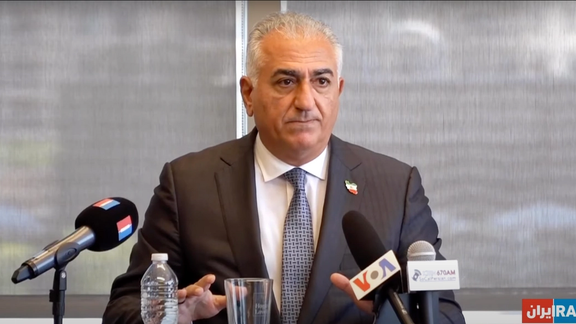
Iran's exiled prince Reza Pahlavi

Iran's exiled prince has urged Iranians across the nation and around the world to hold protests in commemoration of the anniversary of Mahsa Amini's tragic killing.

Speaking during a meeting with reporters in Los Angeles, Prince Reza Pahlavi a prominent opposition leader, emphasized that the focus of these protests should extend beyond Tehran, encompassing all regions of Iran.

Pahlavi asserted that should protests proliferate across different regions of Iran, the Islamic Republic could find itself obligated to distribute its repressive forces to various areas. He argued that this dispersal would potentially enhance the effectiveness of countermeasures against governmental forces.

Mahsa Amini, a 22-year-old woman was arrested in the street by Iran’s morality or hijab police in mid-September and hours later was transferred to hospital with fatal head injuries, where she died three days later. The news immediately sparked nationwide protests, which lasted for five months and posed the most serious challenge to the Islamic Republic in its 44-year history.

Prince Pahlavi outlined the significance of Mahsa Amini's anniversary, highlighting it as an exceptional opportunity to strengthen the resolve of the people and sustain the momentum of protests and strikes against the Islamic Republic. He also emphasized that this movement's progress would experience both ebbs and flows, underscoring the difference between a campaign and a cause.

Describing the combination of protests and strikes as a potent strategy in confronting the Islamic Republic, he noted: "In my view, more than calling [the movement] a campaign, I think it's really a cause."

Prince Reza Pahlavi pointed out the considerable number of Iranians living abroad, stating, "We have more than eight million Iranians living abroad; if you take 10% of those to be active participants in the movement, it will change the entire dynamic."

A scene of Iran protests in 2022
100%
A scene of Iran protests in 2022

He called on democratic countries worldwide to support Iranians in their journey towards democracy, noting the shared values of human rights, freedom, and an end to discrimination, which stand in stark contrast to the Iranian regime's stance.

Concurrently, 27 international groups and organizations have united in a call for a global gathering on September 16, coinciding with the first anniversary of Mahsa Amini's tragic death. These groups are urging global unity on this significant occasion, setting the stage for demonstrations in various cities and countries worldwide.

However, amidst the buildup to the anniversary, The Wall Street Journal has highlighted the Iranian government's intensified efforts to suppress protesters and activists. This crackdown reflects the government's deep-seated concerns that the intensity of the protest movement remains undiminished.

Mahmoud Amiri-Moghaddam, the director of Iran Human Rights, disclosed that the government is targeting individuals who may have been leaders or participants in past protests during this anniversary period.

According to the latest report by the United Nations High Commissioner for Human Rights, released on August 8, over 20,000 individuals have been arrested by agents of the Islamic Republic since the inception of the revolutionary uprising. These arrests pertain to participation in or support for the protests. Many of those detained have been granted temporary release on bail, while their cases remain pending within security organizations. Hundreds have also been re-arrested.

As global attention remains on Iran's human rights situation, Antonio Guterres, the Secretary-General of the United Nations, has recently called for immediate action by the Iranian government. He has emphasized the need to halt executions, release political prisoners of conscience, human rights activists, lawyers, and journalists in the country.




Most Viewed

Iran negotiators ordered to return after internal rift over Islamabad talks
1
EXCLUSIVE

Iran negotiators ordered to return after internal rift over Islamabad talks

2
ANALYSIS

US blockade enters murky phase as tankers spoof signals and buyers hesitate

3
ANALYSIS

Why the $100 billion Hormuz toll revenue is a myth

4

US tightens financial squeeze on Iran, warns banks over oil money flows

5
INSIGHT

Ideology may be fading in Iran, but not in Kashmir's ‘Mini Iran'

Banner
Banner

Spotlight

  • Hardliners push Hormuz ‘red line’ as US blockade tests Iran’s leverage
    INSIGHT

    Hardliners push Hormuz ‘red line’ as US blockade tests Iran’s leverage

  • Ideology may be fading in Iran, but not in Kashmir's ‘Mini Iran'
    INSIGHT

    Ideology may be fading in Iran, but not in Kashmir's ‘Mini Iran'

  • War damage amounts to $3,000 per Iranian, with blockade set to add to losses
    INSIGHT

    War damage amounts to $3,000 per Iranian, with blockade set to add to losses

  • Why the $100 billion Hormuz toll revenue is a myth
    ANALYSIS

    Why the $100 billion Hormuz toll revenue is a myth

  • US blockade targets Iran oil boom amid regional disruption
    ANALYSIS

    US blockade targets Iran oil boom amid regional disruption

  • Iran's digital economy battered by prolonged blackout
    INSIGHT

    Iran's digital economy battered by prolonged blackout

•
•
•

More Stories

Iranian Regime Insider Slanders Mahsa Amini

Aug 26, 2023, 14:22 GMT+1

Iranian conservative Asadollah Badamchian claimed without evidence Mahsa Amini, who died in morality police custody, supported the a Kurdish militant group.

Badamchian, who is a long-time regime insider, accused the symbol of the antiregime movement of being a part of the Kurdish Komala Party three weeks before her death anniversary, expected to be a tumultuous period in Iran.
The Islamic Republic designates Kurdish armed groups operating in western provinces of Iran as either "terrorist groups" or "anti-revolutionary." These groups, however, assert that their armed campaigns are aimed at "defending the rights of the Kurds."

Assadollah Badamchian, a regime politician for more than four decades
100%
Assadollah Badamchian, a regime politician for more than four decades

Badamchian in an interview with ILNA alleged that there exists a photograph depicting Mahsa Amini engaged in dancing with the Komala Party.

Badamchian tried to defend Amini's arrest by the morality policy last September, saying that "she was inappropriately dressed." During this process, Amini became visibly agitated, subsequently collapsing and passing out. Subsequent to these events, an organized movement, both domestically and internationally, emerged involving media outlets such as BBC, CNN, Manoto TV, and Zionists, alleging that Mahsa Amini had been fatally harmed by the morality police.”

Mahsa Amini received fatal head injuries during the brief period she was under arrest.

Badamchian, a hardline principlist politician with two parliamentary terms to his name, and a founding member of the Islamic Coalition Party, even claimed that the regime exhibited some “leniency” toward Mahsa Amini.

Amidst the fallout from Mahsa Amini's tragic incident, a series of protests erupted, resulting in the loss of over 500 lives at the hands of the regime's agents. Approximately 22,000 arrests were made, with seven executions and additional death sentences on dubious charges casting a shadow over the broader discourse.

Iranian Lawyers Protest Move To Further Limit Bar Associations

Aug 26, 2023, 07:18 GMT+1
•
Iran International Newsroom

Iranian lawyers have staged demonstrations to protest a recent parliamentary decision to strip the limited independence of the country’s bar associations. 

The rallies were held outside the provincial offices of the bar associations in several provinces this week. Expressing their objections, attorneys at these protests described the measure as "contrary to the fundamental rights of the people and in violation of the independence of the Bar Association.” 

They also urged the Guardian Council – a constitutional 12-member council that wields veto power over legislation passed by the parliament -- to annul the decision. They also called on the heads of the three branches of Iran’s government – administration, judiciary and legislative – to review the newly approved resolution. 

On August 21, lawmakers passed a new bill that compels bar associations to comply with the decisions of the Regulatory Board of the Ministry of Economy, practically turning them into government subsidiaries. The new law also prohibits annulment of the Regulatory Board’s decisions in the Administrative Justice Court. 

The resolution also grants authority to the Ministry of Economy for issuing, extending, and revoking attorney licenses. Outraged over the measure, Iranian lawyers say the move runs contrary to international legal norms and existing regulations. 

The parliament’s resolution also tasks the Economy Ministry to draft new monitoring regulations to assess the performance of lawyers in collaboration with the Ministry of Justice and the Judiciary. Another clause of the resolution mandates the ministry to establish a "system for assessing the commitment and effectiveness of lawyers by clients" and publish the "results of each lawyer's assessment by previous clients" to the public. 

Lawyers protest in the city of Kermanshah, western Iran   (August 2023)
100%
Lawyers protest in the city of Kermanshah, western Iran (August 2023)

The resolution coincided with intensified measures by the regime to discourage possible protests ahead of the anniversary of last year’s nationwide uprising, ignited by the death of Mahsa Amini in police custody. More than 500 protesters were killed and over 22,000 were arrested during the regime’s crackdown. Although protesters were given harsh sentences and were denied legal representation and due process in most cases, independent lawyers were the only hope of the prisoners, making their voices heard in Iran and abroad. 

Bar associations, as a long-standing professional and legal institution in Iran, has consistently encountered pressures from governmental bodies and the judiciary, gradually losing its autonomy and authority through the enactment of various laws. 

In June 2021, President Ebrahims Raisi introduced another set of regulations to restrict the bar associations in his last weeks as chief justice. In May 2020, over 12,000 legal practitioners in a letter to Raisi protested another set of regulations as "devastating” for bar associations and distorting “the procedures of fair legal investigations." 

After the establishment of the Islamic Republic the existing Bar Association was closed down and many top attorneys were persecuted. In 1997, parliament passed the Law on Conditions for Lawyerhood Licenses, allowing the reopening of bar associations in all provinces with members required to profess belief and “practical commitment" to Islam, Zoroastrianism, Judaism or Christianity. 

Dadban, a group of pro-bono lawyers in Iran defending political prisoners and rights activists, reported Thursday several cases of “increasing pressure on lawyers ahead of the first anniversary of Mahsa Amini's murder and the beginning of the Women, Life, Freedom movement.” It said the intelligence organization of the Judiciary has summoned several lawyers in the past few days and seeks to revoke the licenses of many others. Iran has several parallel intelligence organizations.

In addition to the ongoing protest rallies, an online campaign against the resolution has garnered about 20,000 signatures in less than 48 hours after its launch, calling for amendments to “the new regulations that contradict the principles of the Constitution and Islamic Sharia law.” 

Ali Mandanipour, the former head of the National Union of Iranian Bar Associations – which includes the Central Bar Association (Tehran Bar Association) as well as 15 regional bar associations – issued an open letter to the heads of government branches, calling the new resolution as the final nail in the coffin of bar associations in Iran. 


People Protest In Iran's Sunni Cities, Calling For Release Of Cleric

Aug 25, 2023, 21:57 GMT+1
•
Iran International Newsroom

People in several cities across Iran’s Sistan-Baluchestan province held antiregime rallies Friday but this week they had a new specific demand: freedom of a senior Sunni leader. 

Mowlavi Fat’hi-Mohammad Naghshbandi, the Friday prayer leader of the city of Rask, was arrested earlier in the week, leading to several days of demonstrations and a heavy security presence by regime agents.

According to the advocacy group Haalvsh, which reports on issues affecting the Baluch people in the predominantly Sunni province, intelligence agents and Revolutionary Guard in collaboration with officials from the Chabahar Oil Company, asked the Sunni leader over the phone to come to Chabahar to resolve problems regarding his fuel rationing. After Naghshbandi set off for Chabahar along with his son and several others, they were pursued by security forces and subsequently detained along the way.

The detention of Mowlavi Naghshbandi has struck a chord with the local population, prompting them to take to the streets in a display of unity and solidarity. He is accused of "disturbing public opinion through false speeches, slander, and defamation against the Islamic Republic, acting against national security, and illegal occupation of national lands."

The intensified security atmosphere did not stop the weekly protests in the province, which were held regularly in the past 47 weeks, since Bloody Friday on September 30, 2022, when security forces killed more than 80 people, including women and children.

Mowlavi Fat’hi-Mohammad Naghshbandi, the Friday prayer leader of the city of Rask (left) and Iran’s top Sunni cleric Mowlavi Abdolhamid
100%
Mowlavi Fat’hi-Mohammad Naghshbandi, the Friday prayer leader of the city of Rask (left) and Iran’s top Sunni cleric Mowlavi Abdolhamid

This Friday, in addition to the provincial capital Zahedan, people held demonstrations in several other cities such as Rask, Khash, Sarbaaz, Dashtiari, Sib and Suran, demanding the release of Naghshbandi as well as other political prisoners. Local media reported that protesters in various cities blocked key routes by setting car tires ablaze in a dramatic display of dissent. 

The heightened protests signify mounting frustration in the region, which has long experienced economic and social hardships as well as discrimination agonist its Baluch minority.

Meanwhile, Iran’s top Sunni cleric Mowlavi Abdolhamid delivered another fiery sermon Friday, condemning the regime for taking advantage of people’s religious beliefs for its own political gains, implicitly referring to the regime-sponsored pilgrimage to Iraq for the Shiite ceremony of Arbaeen. 

Without mentioning the Arbaeen, the outspoken Sunni cleric of Zahedan decried the regime for allocation of huge resources for the pilgrimage. “In a country where people are suffering so much... spending billions on one religious ceremony from the nation's treasury and people’s pocket is not right."

"In a country where people can't find medicine and are hungry, is it fair to spend so much on a religious ceremony?" he asked. 

Arbaeen (literally meaning fortieth) is a Shiite religious observance that occurs forty days after the Day of Ashura, when according to religious legend Husayn (Hussain) ibn Ali, the grandson of Prophet Muhammad was killed on the 10th day of the month of Muharram in 680 AD. The Islamic Republic regime views the event as a show of influence in the region, encouraging high participation via numerous perks, including providing free medical services and rest stops along the way, free internet on the road and inside Iraq, offering interest-free loans and granting 200,000 Iraqi dinars ($153) to pilgrim as well as special passports with less bureaucratic requirements. The ration of cheap foreign currency – which used to be dollars or euros until this year – will be paid from Iran's frozen funds in Iraq, about to be released as part of a prisoner swap deal with the United States.

Watchdog Reveals Harrowing Details Of Detained Protesters Torture

Aug 25, 2023, 13:10 GMT+1

A rights monitoring group has revealed horrifying details of torture inflicted on detainees in the case of a Basij agent killed during antigovernment protests.

The Follow-up Committee of Iranian Detainees, an independent organization monitoring the status of protesters arrested during anti-regime rallies across the country, reported that the prisoners linked to the death of Basij member Rouhollah Ajamian were subjected to brutal methods. These methods included hanging them for extended periods while their hands and feet were cuffed behind their backs.

While earlier reports hinted at torture and forced confessions, this recent disclosure reveals the extent of the abuse. A source close to the accused in the case revealed that the torture had persisted for over a month. It involved methods such as mock executions, electric shocks, punches, kicks, and prolonged beatings.

Iran executed Mohammad-Mehdi Karami and Mohammad Hosseini in January, and this week the country's Supreme Court upheld harsh sentences for several other protesters allegedly involved in the killing of the Basij agent during antigovernment demonstrations near the capital Tehran in October.

Fourteen protestors faced trial in the case, with some receiving sentences of up to 15 years, which has been criticized by human rights advocates. "On the day the sentences were issued, everyone was sentenced to 25 years in prison, and five were sentenced to death," the committee cited an informed source as saying.

According to the rights group, Karami and Hosseini were told they had been pardoned just one day before their execution.

Iran’s Police Chief Issues Stern Warning To Potential Protesters

Aug 25, 2023, 09:52 GMT+1

Islamic Republic’s police chief has once again issued a harsh warning to potential protesters ahead of the first anniversary of anti-regime demonstrations in mid-September.

The Chief of the Law Enforcement Force of the Islamic Republic of Iran, Ahmedreza Radan, described the firm handling of troublemakers and thugs as a serious police directive, stating: I assure everyone that we will not be lenient against lawbreakers."

As the anniversary of the Women, Life Freedom movement approaches, Iranian officials and hardliner clerics have repeatedly warned potential demonstrators that the government will harshly deal with them. It took the regime months to quell nationwide street protests that started last September, when Mahsa Amini was killed in hijab police custody. Now, officials and hardcore regime supporters are concerned that a new round of protests will start next month.

Radan who was appointed at police chief in January amid the most serious antiregime protests in the past four decades, has been sanctioned by the United States for being “responsible for or complicit in, or responsible for ordering, controlling, or otherwise directing, the commission of serious human rights abuses against citizens of Iran or their family members."

He replaced Gen. Hossein Ashtari, whom according to Iran International’s sources, Supreme Leader Ali Khamenei scolded for his “incompetence” in quelling the protests.

Radan served as a deputy police chief from 2008 to 2014 and played a key role in the crackdown on protesters after the disputed 2009 presidential elections and in the formation of “morality police”.