• العربية
  • فارسی
Brand
  • Iran Insight
  • Politics
  • Economy
  • Analysis
  • Special Report
  • Opinion
  • Podcast
  • Iran Insight
  • Politics
  • Economy
  • Analysis
  • Special Report
  • Opinion
  • Podcast
  • Theme
  • Language
    • العربية
    • فارسی
  • Iran Insight
  • Politics
  • Economy
  • Analysis
  • Special Report
  • Opinion
  • Podcast
All rights reserved for Volant Media UK Limited
volant media logo

Iran Politicians Blame 'Infiltrators' For Obstructing Foreign Relations
Iran International Newsroom
Aug 22, 2023, 23:35 GMT+1Updated: 17:31 GMT+1
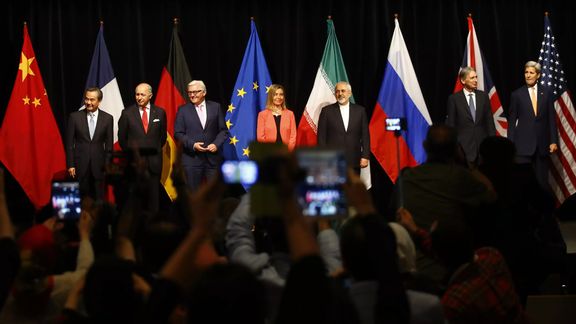
2015 nuclear deal negotiators pose for a photo at the UN building in Vienna, Austria.

A former senior official of Iran’s Foreign Ministry and a lawmaker have warned that "infiltrators" in the upper echelons of the government pose a threat to national interests.

A former Director General for the Middle East, Mohammad Ali Sobhani, has said in an interview with Entekhab website last week that "a radical group of infiltrators are furthering measures that prevents the Iranian government from normalizing its relations with other countries."

In April 2021, former Foreign Minister Mohammad Javad Zarif had said that Russia interfered in Iran's domestic affairs particularly by dictating ideas to the top-level commanders of the revolutionary Guards (IRGC). Zarif said that Russia summoned former IRGC Qods Force commander Qassem Soleimani to Moscow on a few occasions. 

Sobhani did not name any individual as an 'infiltrator,' but he stated that although he had suggested to the government the need for a team of experts to advance the negotiations to revive the 2015 nuclear deal, the government appointed Ali Bagheri-Kani as Iran's chief negotiator. He added that Bagheri did not seem to possess the right expertise and experience for the job. In the interview, Sobhani said, “I knew that he was not the right person to revive the JCPOA.”

He mentioned that due to Bagheri's performance, which yielded no tangible results, both sides came to the conclusion that the talks were not progressing effectively. Consequently, they considered the possibility of pursuing an interim agreement.

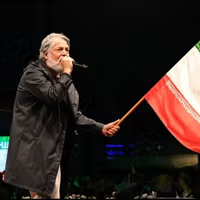
Mohammad Ali Sobhani, a former Director General for the Middle East office of Iran’s Foreign Ministry (undated)
100%
Mohammad Ali Sobhani, a former Director General for the Middle East office of Iran’s Foreign Ministry

Sobhani further stated that if President Ebrahim Raisi was truly committed to serving the people of Iran, he should have promptly pursued a comprehensive agreement with the United States after assuming office in August 2021.

Sobhani remarked, “The government and its foreign minister consistently assert that Iran seeks an agreement, yet they contend that the United States does not uphold its promises. Bagheri has also reiterated that returning to the JCPOA is the only solution to the political impasse.”

He added, “However, two obstacles hinder an agreement between Iran and America. The first pertains to a radical group of potential infiltrators opposing the normalization of Iran's situation. The second set of obstacles involves the technicalities within the JCPOA.” If the government fails to normalize the country's situation by reaching an agreement and lifting sanctions, it will face more severe economic consequences.

The former diplomat reiterated, “I believe that Iran's main problem lies in the sanctions. These sanctions can only be lifted through international agreements, particularly with the United States.”

In a separate development, conservative lawmaker Ehsan Arkani stated in an interview with the Etemad Online website on Thursday that “a deviant current has infiltrated the government, the parliament, and the country's management system.”

Referring to a recent conflict between the parliament and the Interior Ministry, Arkani noted that “the influence of the deviant current extends beyond the Interior Ministry and has spread throughout a significant portion of the government, the parliament, and the country's administrative system.”

Attributing a significant portion of the country's problems to President Raisi's government, he highlighted a 50-percent inflation rate wreaking havoc, a standstill in agriculture and animal husbandry, a major water shortage, and unpaid teachers and pensioners. Arkani reminded that around 220 lawmakers had called on Raisi to run for the presidency in 2021.

He added that while the government is incapable of resolving these issues, it feigns disputes with the parliament to divert attention. Arkani reiterated, “A deviant group within the government is tarnishing the reputation of the parliament and its members while striving to ensure that the upcoming parliament's members will represent the government rather than the nation."



Most Viewed

Iran negotiators ordered to return after internal rift over Islamabad talks
1
EXCLUSIVE

Iran negotiators ordered to return after internal rift over Islamabad talks

2
EXCLUSIVE

Iran’s central bank warns economy may take 12 years to rebuild after war

3
INSIGHT

Iran's digital economy battered by prolonged blackout

4
ANALYSIS

US blockade enters murky phase as tankers spoof signals and buyers hesitate

5
ANALYSIS

Why the $100 billion Hormuz toll revenue is a myth

Banner
Banner

Spotlight

  • Hardliners push Hormuz ‘red line’ as US blockade tests Iran’s leverage
    INSIGHT

    Hardliners push Hormuz ‘red line’ as US blockade tests Iran’s leverage

  • Ideology may be fading in Iran, but not in Kashmir's ‘Mini Iran'
    INSIGHT

    Ideology may be fading in Iran, but not in Kashmir's ‘Mini Iran'

  • War damage amounts to $3,000 per Iranian, with blockade set to add to losses
    INSIGHT

    War damage amounts to $3,000 per Iranian, with blockade set to add to losses

  • Why the $100 billion Hormuz toll revenue is a myth
    ANALYSIS

    Why the $100 billion Hormuz toll revenue is a myth

  • US blockade targets Iran oil boom amid regional disruption
    ANALYSIS

    US blockade targets Iran oil boom amid regional disruption

  • Iran's digital economy battered by prolonged blackout
    INSIGHT

    Iran's digital economy battered by prolonged blackout

•
•
•

More Stories

US Says Deal On Iran Releasing Five US Citizens On Track

Aug 22, 2023, 20:30 GMT+1

An understanding with Iran to eventually release five Americans remains on track, White House National Security Adviser Jake Sullivan said Tuesday but declined to offer any timeline.

Iran on August 10 released four imprisoned US citizens into house arrest, where they joined a fifth already under home confinement, in the first step of a deal under which $6 billion in Iranian funds in South Korea would be unfrozen and the five would eventually be allowed to leave.

"We believe that things are proceeding according to the understanding that we've reached with Iran. I don't have an exact timetable for you because there's steps that need to yet unfold. But we believe that that remains on track," Sullivan told reporters in a conference call.

South Korean media reported Monday the money has already been transferred to the Swiss central bank that would convert the funds to euros and send it to Iranian bank accounts in Qatar. Iran’s foreign ministry said Monday that it would take two months for the hostages to be allowed to leave.

Allowing the five to leave Iran, which could take weeks, would remove a major irritant between Washington and Tehran, which remain at odds on issues from the Iranian nuclear program to Tehran's support for regional Shi'ite militias.

The Iranian Americans who were allowed to leave Iran's Evin prison included businessmen Siamak Namazi, 51, and Emad Shargi, 58, as well as environmentalist Morad Tahbaz, 67, who also has British nationality. The identity of the fourth US citizen who left the prison has not been made public, nor has that of the fifth who was already under house arrest.


Iranian Banks Liquidating As Regime Seeks To Avert Panic

Aug 22, 2023, 19:16 GMT+1
•
Iran International Newsroom

Islamic Republic’s officials are in damage control mode over the Central Bank of Iran’s decision to dissolve several banks and financial institutions by October.

The liquidation of Tosse-eh (Development) Credit Institution is in its final stages while the order to dissolve Ayandeh (Future) Bank was given to the Central Bank earlier this week. There are several other financial institutions, such as Caspian and Nour, that are set to dissolve or merge with other banks.

Reports of the liquidation of the unprofitable banks have been circulating in recent years, with Tosse-eh sending messages to its customers asking them to close their accounts until mid-March 2022. The institution has 30 branches all over Iran.

However, like a lot of other decisions in Iran, the liquidation never actualized, perhaps to avoid a mass panic among the population who already distrust the country’s banking system.

Lawmaker Gholamreza Marhaba, a member of the parliament’s economic committee, said Monday that according to the Constitution if a bank or financial institution strays from regulatory oversight and becomes unprofitable, the law outlines a series of measures, with the final step being dissolution or merger of the bank.

“There are unhealthy banks within the country's banking system, with some institutions in the liquidation phase, but we cannot discuss them in detail at present due to the lack of official information,” he explained.

Lawmaker Gholamreza Marhaba (undated)
100%
Lawmaker Gholamreza Marhaba

Marhaba, however, said, “I want to emphasize that fortunately, none of the private or state-owned banks are at risk of bankruptcy. These banks have sufficient assets to easily cover their losses and compensate them. Therefore, customers can rest assured that neither Ayandeh Bank nor any other bank is facing bankruptcy.”

The Ministry of Economy seeks to exercise greater oversight over the unprofitable banks to ensure their financial stability, especially the non-state banks that have engaged in non-banking activities, he noted and said that “military organizations” had created institutions and banks that did not perform successfully, and at least five of them have so far merged into Bank Sepah, the official bank of Iran’s Revolutionary Guards (IRGC).

The dissolution of banks should not be sensationalized in the media, and discussions about the fate of such banks should be held behind closed doors “to maintain customers' confidence without tarnishing the reputation of these financial institutions,” he added in remarks typical of regime insiders who prefer to hide negative news.

A similar approach was evident in remarks by ultra-conservative lawmaker Fereydoun Abbasi who called Monday for confidentiality of economic indicators and other statistics, under claims of security risk.

Mashregh News, a hardline website affiliated with Iran's Revolutionary Guard, published an article in July titled “Countdown for Bankrupt Banks,” explaining the threats of such entities for Iran’s economy.

“Bankruptcies among Iranian banks are becoming increasingly prominent due to the country's economic crisis, posing irreversible consequences if ignored,” Mashregh News said, noting that big loans to officials with links to regime insiders – called ‘Major Debtors’ in Iranian media – as well as a lack of transparency in real asset holdings are among the major factors behind the issue.

The Central Bank of Iran issued a warning earlier in the year, giving ultimatum to underperforming banks to rectify their financial situations by late-September, with CBI Governor Mohammadreza Farzin saying that any bank or financial institution that fails may face liquidation.

Government interventions, excessive borrowing, and a lack of accountability in the banking sector are cited as other key factors leading to these bankruptcies. While some banks may be temporarily bailed out by the government, the overall trust in Iran's financial system has been significantly eroded, making it difficult for the economy to recover. Iran’s government has been aggressively borrowing from quasi-public banks to fill its budgetary gap and keep its unprofitable companies afloat.

Abbas Pourkhosravi, a banking analyst, told Mashregh News that changing the current banking structure will help prevent bankruptcies, highlighting that “unless Iran establishes connections with the international banking system, significant transformations in the country's banking system will not occur.”

Bankruptcies in the banking sector have a ripple effect, impacting various industries and causing widespread dissatisfaction among the public, Mashregh News added, warning that restoring trust in the financial system will be a challenging task, as eroded confidence can have long-lasting consequences.

The government is in debt, and the banks are even more indebted, a vicious circle that sees accumulated losses concealed from the public through manipulating financial statements on losses and loans and deferring the losses to the following year.


Iran Unveils New Upgraded Drone With Extended Range And Capabilities

Aug 22, 2023, 15:32 GMT+1
•
Iran International Newsroom

Iran has unveiled a new drone, the Mohajer-10, with enhanced capabilities and increased flight duration, according to state news media agency.

Official statements from Iranian media on Tuesday reveal that the homemade UAV (unmanned aerial vehicle), has an operational range of 2,000 km and can fly for up to 24 hours.

Reports indicate that the drone is equipped to carry missiles, bombs, and hand grenades. It is also outfitted with electronic warfare and reconnaissance systems.

Iran claims that drone's payload capacity can now accommodate up to 300 kilograms, double that of its predecessor; the Mohajer-6 drone.

The Mohajer-10 was unveiled in the presence of President Ebrahim Raisi, and is part of a new generation of Iranian military drones.

Iran’s President Ebrahim Raisi (2nd right) during a ceremony to unveil Mohajer-10 drone on August 22, 2023
100%
Iran’s President Ebrahim Raisi (2nd right) during a ceremony to unveil Mohajer-10 drone on August 22, 2023

During the same ceremony, the air-launched Arman-1 bomb was also revealed. Concurrently, the release of a large quantity of advanced missiles – the Khorramshahr and Haj Qasem missiles – to the Armed Forces and the Aerospace Force of the Islamic Revolutionary Guard Corps (IRGC) has already commenced.

While US officials have alleged that Iran supplied Mohajer-6 drones, along with other unmanned aerial vehicles, to Russia to aid with their invasion of Ukraine, Iranian authorities have denied such allegations.

Rising tensions in the region have continued to draw global attention. Iran's attempt to seize two commercial vessels in early July was met with a resolute response from the United States, prompting Iran to withdraw, as confirmed by the Pentagon. Over the past two years, Tehran has reportedly harassed or seized more than 15 commercial ships in the broader Persian Gulf region.

In light of these challenges, the White House announced its intention to take decisive actions to safeguard stability in the region. While specific details were not provided at the time, subsequent actions have included a bolstered US military presence. In July, the Pentagon deployed F-16 and F-35 warplanes, and dispatched three naval vessels carrying over 3,000 sailors and marines, underscoring their commitment to maintaining a robust presence in the region.

Addressing the evolving situation, the Pentagon has affirmed its readiness to provide onboard armed protection to commercial vessels in the region, a development that Iranian media described as unprecedented. This move has also ignited discussions about the heightened prospects of potential military clashes in the region.

In recent months, numerous media reports have discussed covert diplomatic initiatives aimed at mitigating tensions with Iran. These efforts include the potential release of Tehran's frozen funds from nations like Iraq and South Korea, contingent upon Iran's commitment not to escalate its uranium enrichment to weapons-grade levels.

However, as of now, apart from a US sanctions waiver granted to Iraq to facilitate a partial fund release, there have been no notable developments. Simultaneously, in addition to the discourse surrounding Iran's nuclear program, the United States is actively pursuing the liberation of several American dual-nationals held captive in Iran. The unlocking of $7 billion in South Korean funds has been proposed as a concession in exchange for the release of these detainees.

IRGC Awards Naval Forces Amid Escalating Tensions

Aug 22, 2023, 13:37 GMT+1

The IRGC have named their Navy as “the foremost and highest-ranking” unit in the organization, following the supposed ‘interception’ of a US warship.

Reports also reveal that Hossein Salami, the Commander in Chief of the IRGC has recognized Rear Admiral Alireza Tangsiri, the Commander of the Naval Force, as the most successful commander in the organization.

This internal praise follows an incident at sea on August 17, of which the IRGC released a video showing Iran’s navy following a US warship in waters off the coast of the Strait of Hormuz in the Persian Gulf. Touted as a demonstration of the regime’s military control, the video was broadcast to prominent IRGC commanders and officials in Tehran on Saturday.

In the footage, IRGC Navy speed boats issued a clear warning to the USS Thomas Hudner warship, accompanied by two helicopters, advising them against breaching Iran's territorial waters.

A helicopter is seen landing on the deck but it is not clear if it took the actions because of an Iranian warning. Nevertheless, Rear Admiral Tangsiri highlighted the "achievement," citing the IRGC Navy's successful enforcement of compliance to their orders.

Recent maritime incidents involving Iran's seizure and harassment of vessels have triggered heightened uncertainties in the region.

Iran's introduction of advanced maritime weaponry prompted Washington to extend armed protection to commercial ships traversing the Strait of Hormuz. A substantial portion of the world's crude oil is transported through these waters and thus, it has significant strategic importance.

Iranian MP Calls For Confidentiality Of Economic Indicators

Aug 22, 2023, 11:22 GMT+1

An ultra-conservative member of Iranian parliament has called for confidentiality of economic indicators and other statistics, under claims of security risk.

In a statement, Fereydoun Abbasi expressed support for withholding economic data, including statistical information about geographical data such as crop yields, information about dams and river water levels.

Abbasi, the former head of the Atomic Energy Organization of Iran and a member of the parliamentary energy commission, said, "Security and commercial data should not be made transparent, as enemies can exploit them to harm the country."

He claimed that revealing economic statistics could impact food security and open up vulnerabilities in economic warfare scenarios. He also said that disclosing geographical data, such as river water levels, dams, and electricity production could also be “detrimental to Iran's interests”.

His statements come following President Ebrahim Raisi decision to halt the publication of a substantial portion of economic statistics and indicators.

Internationally, indicators like inflation rates and foreign exchange reserves are generally considered non-confidential data, but Iran continues to call for non-disclosure, causing cause for suspicion from other nations.