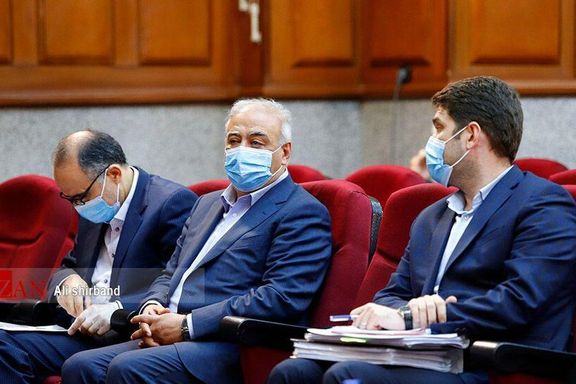
Iran's president quickly took credit for state banks publishing names of major debtors, while critics say the list is not new and the move is a publicity stunt.
Four state-owned banks including Bank-e Melli, Iran's largest bank, published the list of their major debtors on Saturday, six months after the ministry of economy ordered them to publish quarterly lists of major debtors.
"At first glance this can be interpreted as an important and positive step in battling corruption and recovering the money owed to state banks," Eghtesad Online (Economy Online) wrote Sunday, but it added that the lists are extremely vague and do not offer any details.
The lists show no information other than names of individuals and companies. It is very hard to trace the background of these individuals or the ownership of the companies, that appear to be subsidiaries or front companies set up by unknown firms, some connected with state enterprises with well-connected managers.
A man who defaulted on a large loan during defense in an Iranian court.
"None of the lists include information on the time the loans were granted to persons and entities that have a long record of getting loans and not paying back. It's also not clear if the banks decided on their own to grant the loans or were ordered [by other entities]. The information also does not reveal what the collateral for the loans were," Eghtesad Online wrote.
The publication also said it is equally important to know who endorsed the loans and bring them to account. It also said the purpose of publishing the lists is meant to enable the government to convince people that President Ebrahim Raisi is delivering on his election promises of fighting corruption and establishing transparency.
Officials say the move is proof that Raisi is delivering on his election promise of fighting corruption in the banking system. "One more of the President's promises was implemented. Melli Bank, the largest bank in the country, published the names of its major creditors," Government Spokesman Ali Bahadori-Jahromi said in a tweet Saturday.
Others such as Malek Shariati, a Tehran lawmaker in the parliament, say the publication of names of major creditors is proof that the administration and parliament are steadfast in establishing transparency and battling corruption.
Based on the budget bill, the government was mandated with publishing all information on major creditors on the central bank’s.
In 2017, outspoken reformist lawmaker Mahmoud Sadeghi published a list of major debtors of Sarmayeh Bank who has defaulted. In some cases, he said, the collaterals for the loans had been evaluated at a much higher price than their real worth.
Sadeghi called the phenomenon widespread in Iran 'crony capitalism', meaning those who have connections with centers of power could easily get loans that others find extremely difficult to secure. Many of the debtors had received low-interest, subsidized loans from banks.
Major debtors to banks with bad credit have allegedly used the money to speculate in the housing, foreign currency and gold markets rather than invest in production and have thus contributed to higher inflation.
Abolfazl Bahauddini, representative of Ali Khamenei in Pakistan
A report has revealed a money laundering network in Pakistan transferred huge amounts of illicit funds to Iran, with Supreme Leader’s representative as one of the recipients.
Saudi website Arab News said in a report on Saturday that court documents recently submitted by Pakistani federal investigators show that members of the network operated between Pakistan, Iran and Iraq over the past seven years.
According to Pakistan’s Federal Investigation Agency, the group Shiite used pilgrims traveling to the cities of Najaf in Iraq and Qom in Iran to smuggle money, as well as hawala and hundi -- two informal ways of transferring cash across borders, which are illegal in Pakistan.
One of the people who received money from the main suspect in the case, identified as Ali Raza, was Abolfazl Bahauddini, Ali Khamenei’s former representative in Pakistan.
Raza was among 13 people arrested by police in Karachi in December 2020 and January 2021 on charges of money laundering and being “associated with a foreign intelligence agency”. They were members of an Iran-backed militant group, the Zainabiyoun Brigade, which is believed to have sent young members of the Pakistani Shiite community to fight in Syria.
The charges said Raza was giving an amount of $200,000 monthly to Bahauddini through his representative Syed Wisal Haider Naqvi -- a government official, but it did not specify for how long Bahauddini had received the monthly payments.
Spokesman of the Israeli Defense Forces Brigadier General Ran Kochav
The Israeli military has dismissed claims by Iranian media that IDF Chief of Staff Aviv Kochavi had admitted to the failure of security forces in dealing with the recent Tel Aviv terror attacks.
Iran’s official news agency IRNA claimed on Saturday that following the Tel Aviv shooting, Kochavi said the security forces could not control the situation and the perpetrator managed to escape easily.
The spokesman of the IDF, Brigadier General Ran Kochav, told Iran International on Saturday that the Israeli Defense Forces held a meeting to discuss the country's current security situation amid the rise of attacks on civilians on Friday but Kochavi didn’t talk about any failure of the security apparatus.
IRNA cited a report by al-Manar TV – the official media of Iran-backed Hezbollah Lebanese group – as its source.
However, the assailant of the shooting on Dizengoff street, identified as 28-year-old Ra’ad Fathi Hazem from the Jenin refugee camp, was killed by security forces a few hours later, something Iranian media affiliated with the Revolutionary Guard (IRGC) described as martyrdom.
The shooting spree that killed three Israelis and injured at least 10 others this week in Dizengoff street was the latest in a wave that has claimed the lives of 13 people so far.
Iran on Saturday imposed sanctions on 24 more Americans in a largely symbolic move, as months of talks to revive a 2015 nuclear deal have stalled.
Among those sanctioned are former Army Chief of Staff George Casey and former President Donald Trump's attorney Rudy Giuliani.
Almost all the people named were officials who served during Trump's administration, which imposed sanctions on Iranian officials, politicians and companies and withdrew the United States from Iran's nuclear agreement with world powers.
In a statement carried by local media, the Iranian Foreign Ministry accused the sanctioned Americans - who also included several business figures and politicians - of supporting "terrorist groups and terrorist acts" against Iran, and Israel's "repressive acts" in the region and against Palestinians.
Eleven months of indirect talks between Iran and the United States in Vienna on salvaging the 2015 deal have stalled as both sides say political decisions are required by Tehran and Washington to settle the remaining issues.
Gen. Austin Scott Miller, former commander of US forces in Afghanistan, former Commerce Secretary Wilbur Ross, and several former ambassadors are among the officials targeted by the new Iranian sanctions.
In a similar move announced in January, Iran imposed sanctions on 51 Americans, many of them from the U.S. military, over the 2020 killing of General Qassem Soleimani in a drone strike in Iraq.
Last year, it imposed sanctions on Trump and several senior US officials.
The venue where Iftars take place in the presidential compound
Some Iranian media report that an Iftar dinner by Iranian president Ebrahim Raisi was cancelled after most invited guests who were artists declined to attend.
Sharq newspaper and others reported Saturday that the Ramadan dinner, or Iftar, scheduled for Friday was cancelled after “99 percent” of artists, actors and film industry personalities declined invitations using various excuses, such as the Covid pandemic, travel or other reasons.
The government’s official news website IRNA strongly denied the reports as “complete fabrication”, insisting that the Iftar was cancelled due to high air pollution in Tehran. IRNA added that the dinner was supposed to be served in an open courtyard of the presidential complex but due to pollution it was decided to hold indoors, but the space was too small for accommodating 170 guests.
Sharq, however, emphasized that the real reason for the cancellation was the refusal of most invitees to attend.
The Iftar invitation by the president for artists and cinema figures has become an annual tradition in recent years. In 2018, many declined the invitation by then-president Hassan Rouhani, saying that he had not fulfilled his election promises.
Raisi’s leadership is being sharply criticized in the media, as Iran’s economic conditions deteriorate, and food prices continue to rise. Reports say that many working class people cannot afford even bread and buy it with a promise to bakeries to pay later.
A controversial tunnel built by IRGC construction arm to transfer water.
Over 20 people arrested during protests seven years ago against water scarcity and distribution policies in south-west Iran have been sentenced to prison and lashes, the United States-based Human Rights Activists' News Agency (HRANA) said Saturday.
HRANA reported that those sentenced were arrested in Chaharmahal-Bakhtiari province in 2015 during protests against plans to transfer water from their town, and were holding a symbolic mourning ceremony for the drying up of a spring.
After a complaint by Khatam-al Anbiya Construction Headquarters, the engineering and construction arm of the Revolutionary Guard, the protestors were sentenced to up to seven years in prison and 74 lashes on charges of disturbing public order and destroying public property. They denied the charges.
Chaharmahal-Bakhtiari, a traditionally water-rich region in the Zagros mountains, has seen its water resources decline due to both drought and projects to irrigate arid regions. Protests in Chaharmahal-Bakhtiari broke out again last year in response to demonstrations in Esfahan over the drying up of the Zayandeh Roud river, which rises in Chaharmahal-Bakhtiari.
Drought and desertification across the Middle East in recent years has fed tensions between and within states over water. The government’s encouragement of water-intensive industries in Yazd, east of Esfahan, diverting water, has also contributed to farmers in Chaharmahal-Bakhtiari facing shortages.