• العربية
  • فارسی
Brand
  • Iran Insight
  • Politics
  • Economy
  • Analysis
  • Special Report
  • Opinion
  • Podcast
  • Iran Insight
  • Politics
  • Economy
  • Analysis
  • Special Report
  • Opinion
  • Podcast
  • Theme
  • Language
    • العربية
    • فارسی
  • Iran Insight
  • Politics
  • Economy
  • Analysis
  • Special Report
  • Opinion
  • Podcast
All rights reserved for Volant Media UK Limited
volant media logo

A Pistachio Family Business In US Boosts The Iranian Regime
Iran International Newsroom
Aug 21, 2023, 12:18 GMT+1Updated: 17:20 GMT+1
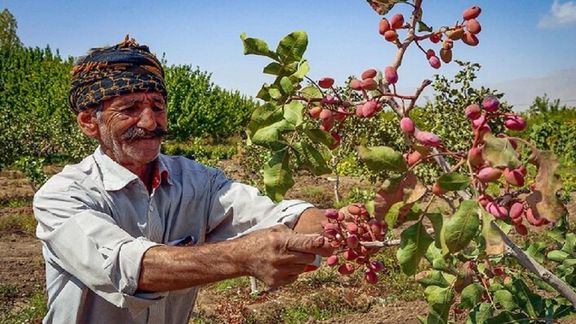
An Iranian farmer during a harvest season of pistachio

A recent report by Middle East Forum (MEF) delves into Amin family's US pistachio business, uncovering its role in advancing Islamic Republic's agenda.

The shocking six-month investigation of the Philadelphia-based MEF revealed “The Amin family’s activities in Iran… have involved collaboration with Iranian institutions sanctioned by the US government or which are linked to violent regime entities, such as the Iran’s Islamic Revolutionary Guard Corps (IRGC), a designated terrorist group under United States law.”

MEF sounded the national security alarm bells, urging that the US Department of the Treasury’s Office of Foreign Assets Control (OFAC) and Department of Justice’s Foreign Agents Registration Act (FARA) unit launch investigations into Amin’s questionable business practices and the family’s alleged pro-Iran regime network.

The origin of the Amin’s family pistachio empire started with Ali Akbar Amin who moved to the US in 1952. According to the MEF investigation, “Around 2002, he established the Anar branch of Iran’s Azad University, which analysts today consider an important component of Tehran’s ‘soft power’ efforts. University faculty members stand accused of working on the regime’s nuclear and missile programs.”

The Amin family’s charities-- Maximum Difference and the Amin Foundation—have also pumped significant funds into the National Iranian American Council (NIAC)—an American-based organization widely viewed by many Iranians as a lobby entity for the Islamic Republic, although NIAC says it is a non-profit and non-partisan advocacy organization.

The Amin Family Focus on Western Islamism
100%
The Amin Family (source: Focus on Western Islamism)

According to MEF, “Since 2015, for instance, both foundations have handed over $400,000 to the National Iranian American Council.”

The authors of the MEF investigation, Kara Hashemi and Sam Westrop, listed a lengthy bill of particulars against the Amin family business dealings with sanctioned Iranian banks and IRGC entities.

According to MEF’s research, the pistachio giant Amin Padidar, founded and run by the Amin family, works with the US-sanctioned Iranian conglomerate Bonyad Mostazafan. The Iranian multi-billion company Mostazafan, according to the US government, is controlled by Supreme Leader Ali Khamenei and the IRGC.

The US Department of Treasury sanctioned Iran’s Bank Sina, which is “Bonyad Mostazafan’s holding company in the investment and financial services industry, “according to the US government. 

The EU classified Bank Sina in a list of “Persons and entities involved in nuclear or ballistic missile activities and persons and entities providing support to the Government of Iran.” 

The brother of former Iranian president Akbar Hashemi Rafsanjani, whose family comes from the Kerman province, where pistachios are cultivated, referred to the Amin family as his blood relations. Rafsanjani was born into a family of opulent pistachio farmers. The Amin family hails from Rafsanjan in Kerman. 

Fatemeh Amin in Tehran being honored by regime officials. Undated
100%
Fatemeh Amin in Tehran being honored by regime officials

Amin family members live both in California and in Iran. The Amins are one of the giant pistachio producers in the US.

The MEF report said, “Amin Padidar’s parent company, Golrang, is closely involved with the regime and its paramilitary force, the Islamic Revolutionary Guards Corps.”

An additional startling finding of the MEF report is Amin Padidar, collaborates through a trade group known as the Iran Pistachio Association (IPA).

According to the MEF report, “The IRGC-linked company Arian Milan is listed as a financial sponsor of the IPA, alongside Sirjan Bonyad, the primary pistachio subsidiary of the regime’s Bonyad Mostazafan. The Sirjan Bonyad website states that the organization serves to ‘[implement] the policies of Mostazafan Foundation of the Islamic Revolution.’” 

In addition to financing NIAC, the Amin family had donated to who’s who of largely pro-Iran regime NGOs in the United States.

MEF wrote, “In 2019 and 2020, the Amin Foundation appeared to split the $50,000 it had given NIAC in previous years, instead now giving $25,000 each year to both NIAC and Quincy. In total, Quincy has received $75,000 from Mark and Reza Amin’s foundation.”

The former NIAC head, Trita Parsi, is a co-founder of the Quincy Institute. In 2012, US District Court for the District of Columbia determined Parsi’s work was “not inconsistent with the idea that he was first and foremost an advocate for the regime.”

MEF revealed that “The Amin Foundation has also given thousands to the Ploughshares Fund, a left-leaning grant-making foundation that Hassan Dai writes has ‘financially supported groups and individuals who advocate for a friendlier policy with Iran and the lifting of economic sanctions.’”

Ploughshares has worked tirelessly to promote the Obama administration’s nuclear deal with Iran and has funded accused regime apologists such as Iran’s former ambassador to Germany, Seyed Hossein Mousavian, who was accused of complicity in Iran’s killing of four Iranian dissidents in Germany in 1992 in Berlin, noted the MEF report.

Iran International previously reported that Mousavian, who teaches at Princeton University, was under fire for bragging about the Iranian regime’s revenge for the US assassination of the US and EU-designated IRGC’s Qassem Soleimani, who coordinated militant groups throughout the region to attack Israel and US interests.

Amin family members have also faced criminal proceeding, including a conviction for illicit transport of $17 million from Iran to the US.

In 2015, Ali Amin (who has the same name as his grandfather) “pleaded guilty to transporting $17 million illegally through unlicensed means from Iran to the United States, using family members and family businesses to effect the transfers. Other Amin family members, including Ali’s brother, as well as his cousins, Fatemeh Amin and her unnamed brothers, were also implicated in the prosecution’s case. Fatemeh was found guilty in a US District Court of having filed a false tax return.” 

Fatemeh is a cousin of Ali Amin who is the son of Ali Akbar’s other brother, Hossein Amin, who died in the US in 2008.

Ali Amin’s brother, Michael Amin (also known as Mahmood Michael Amin) is the founder and CEO of Los Angeles-based Primex Worldwide. Primex is major owner of pistachio farms. 

MEF also disclosed that ”In 2012, Michael Amin, Mark Amin, his brother Reza Amin, and several others settled with the US Securities and Exchange Commission (SEC) for nearly $2 million after the agency charged them with insider trading concerning a company named DuPont Fabros Technology.”

According to MEF, “Ideologically, several members of the family are openly radical. Michael Amin regularly posts a wide variety of extremist rhetoric on his social media, citing both far-Left and far-Right sources regularly. His posts include wildly anti-Semitic claims about Jewish genetics and alleged Jewish control over the media and the government.”

The Amin family declined to provide a comment to MEF before the publication of its report.

Most Viewed

Iran negotiators ordered to return after internal rift over Islamabad talks
1
EXCLUSIVE

Iran negotiators ordered to return after internal rift over Islamabad talks

2
INSIGHT

Iran's digital economy battered by prolonged blackout

3
ANALYSIS

US blockade enters murky phase as tankers spoof signals and buyers hesitate

4
ANALYSIS

Why the $100 billion Hormuz toll revenue is a myth

5

US tightens financial squeeze on Iran, warns banks over oil money flows

Banner
Banner

Spotlight

  • Hardliners push Hormuz ‘red line’ as US blockade tests Iran’s leverage
    INSIGHT

    Hardliners push Hormuz ‘red line’ as US blockade tests Iran’s leverage

  • Ideology may be fading in Iran, but not in Kashmir's ‘Mini Iran'
    INSIGHT

    Ideology may be fading in Iran, but not in Kashmir's ‘Mini Iran'

  • War damage amounts to $3,000 per Iranian, with blockade set to add to losses
    INSIGHT

    War damage amounts to $3,000 per Iranian, with blockade set to add to losses

  • Why the $100 billion Hormuz toll revenue is a myth
    ANALYSIS

    Why the $100 billion Hormuz toll revenue is a myth

  • US blockade targets Iran oil boom amid regional disruption
    ANALYSIS

    US blockade targets Iran oil boom amid regional disruption

  • Iran's digital economy battered by prolonged blackout
    INSIGHT

    Iran's digital economy battered by prolonged blackout

•
•
•

More Stories

Released Iranian Funds Transferred From Seoul To Swiss Central Bank

Aug 21, 2023, 09:07 GMT+1

South Korea transferred frozen Iranian funds to Switzerland's central bank last week for exchange and transfer to Qatar, South Korean media reported on Monday.

The Swiss National Bank plans to exchange its $6 billion holdings in won for dollars and then euros in the currency market, converting about 300 billion won ($223.85 million) to 400 billion each day for next five weeks, Yonhap Infomax reported, citing an unnamed currency market source.

An official at South Korea's finance ministry declined to confirm the report, citing the legal and diplomatic sensitivity of the matter.

Iran and the United States recently reached an agreement in which five US citizens held hostage in Iran would be released while Iranian assets in South Korea would be unfrozen and sent to an account in Qatar that Iran could access. The Biden administration insists that the funds can only be used by Iran to purchase food, medicine and other humanitarian needs, but the Iranian foreign ministry and officials have insisted there would be no restrictions on the funds.

Iranian President Ebrahim Raisi said last week that the released assets would be used to enhance domestic production.

The deal has led to a lot of criticism in the United States by those who say the $6 billion is essentially a ransom paid for five hostages and it will only encourage Iran and other actors to detain Americans and demand money or concessions. Twenty-six Republican Senators have written to President Joe Biden demanding clarifications. Critics also argue that the money will provide Iran with the ability to spread its terror activities and other malign acts.

IRGC Navy 'Intercepts' US Warships At Strait Of Hormuz

Aug 20, 2023, 19:54 GMT+1
•
Iran International Newsroom

Iran’s Revolutionary Guard has released a video of surveilling and following a US Navy ship in waters off the coast of the Strait of Hormuz in the Persian Gulf.

The incident of Iran’s military adventurism, which apparently occurred on August 17, was portrayed as a demonstration of the regime’s military control over the Persian Gulf's strategic waterway. This was showcased during a gathering of prominent IRGC commanders and officials in Tehran on Saturday.

In the video, IRGC Navy speedboats issued a warning to the USS Thomas Hudner warship and two of its helicopters seen flying above the vessel, not to violate Iran's territorial waters. Rear Admiral Alireza Tangsiri boasted about "the achievement," stating that the IRGC Navy compelled the intruding vessel to obey orders from the Iranian speedboats.

Iranian President Ebrahim Raisi (center) among senior Revolutionary Guards commanders during an event where IRGC Navy released a video of intercepting US Navy ships
100%
Iranian President Ebrahim Raisi (center) among senior Revolutionary Guards commanders during an event where IRGC Navy released a video of intercepting US Navy ships

He elaborated that the IRGC deployed vessels from the Zolfaqar flotilla to the location where helicopters were approaching Iran’s territorial waters. In coordination with the speedboats, they pressured the choppers to land shortly after taking off from the vessel's flying deck.

The only thing clear in the video is that the IRGC navy issues its warning and the US warship replies that it is in international waters. A helicopter is seen landing on the deck but it is not clear if it took the actions because of an Iranian warning.

"Iran and other neighboring Persian Gulf countries can ensure regional security and they have no need to the presence of outsiders," he said, referring to more than 3,000 US sailors and marines that have arrived in the region along with the USS Bataan (LHD 50), an amphibious assault ship, and the USS Carter Hall (LSD 50), a dock landing ship.

The forces from the Bataan Amphibious Ready Group (ARG) and 26th Marine Expeditionary Unit (MEU) have been deployed in response to escalating tensions with Iran and as a show of maritime strength. In June, the Pentagon had already sent additional F-35 and F-16 fighter jets along with a warship to the Middle East in a bid to monitor key waterways in the region following Iran's seizure and harassment of commercial vessels.

The IRGC held drills around three Iranian islands in the Persian Gulf contested by the United Arab Emirates and claimed that it has added a 600-kilometer-range new missile to its arsenal “for defending the islands’ territory.”

Elsewhere in the Saturday event, Tangsiri said the IRGC Navy’s is especially vigilant in the face of threats from the warships of extra-regional countries.

Recent developments in the region, including Iran's seizure and harassment of vessels has seen tensions rising. Iran unveiled new maritime weaponry earlier this month and Washington offered commercial ships onboard armed protection through the Strait of Hormuz, which sees roughly one fifth of the world's crude oil travel out of the Persian Gulf. The US Navy's assertive posture also aligns with its efforts to reassure regional allies and maintain security in a volatile geopolitical landscape.

The deployment falls within the context of the US 5th Fleet's extensive area of operations, spanning approximately 2.5 million square miles and encompassing vital waterways like the Arabian Sea, Gulf of Oman, Red Sea, and critical choke points such as the Strait of Hormuz, Suez Canal, and Strait of Bab el-Mandeb.

Additionally, the Biden administration's efforts to address Iranian drone supplies to Russia have led to mounting pressure. The Defense Intelligence Agency's presentation of evidence demonstrating the Iranian origin of drones shot down over Ukraine highlights the administration's commitment to countering destabilizing activities.

US-Seized Iranian Oil Offloaded Near Texas

Aug 20, 2023, 14:33 GMT+1

A tanker seized by the US for carrying sanctioned Iranian crude oil has begun offloading its cargo despite Tehran’s threats against shipping shipping companies.

The Associated Press cited tanker-tracking data on Sunday that showed the oil cargo is being transferred from Marshall Islands-flagged Suez Rajan, a tanker anchored off the coast of Texas, near Galveston about 50 miles (80 km) from Houston.

The owners of the Suez Rajan, the Los Angeles-based private equity firm Oaktree Capital Management, did not immediately respond to requests for comment about the ship-to-ship transfer.

On Wednesday, a bipartisan group of US lawmakers from the House and Senate asked the Biden administration to respond to “unprecedented intimidation” tactics from Iran that have prevented American firms from offloading the confiscated oil cargo.

The US seized the Iranian oil onboard the ship late in May in accordance with US sanctions, but the oil had reportedly not been offloaded as US federal prosecutors have faced challenges in auctioning off the 800,000 barrels of oil. The lawmakers estimated the value of the oil to be $56 million.

According to the Wall Street Journal, the US companies are reluctant to unload the oil due to concerns about potential Iranian reprisals, particularly threats of violence by Iran’s Revolutionary Guards. Iran's IRGC navy commander Alireza Tangsiri warned in July that Tehran would retaliate against any oil company involved in unloading the Iranian oil.

The US Navy has increased its presence steadily in recent weeks in the Mideast, sending the troop-and-helicopter-carrying USS Bataan through the Strait of Hormuz in recent days and considering putting armed personnel on commercial ships traveling through the strait to stop Iran from seizing additional ships.

UK Probing Islamic Center Linked To Iran

Aug 20, 2023, 12:00 GMT+1

The UK Charity Commission has begun investigating an Iran-linked British foundation, which has hosted hardline Islamic clerics and paramilitary figures.

According to The Sunday Times, the watchdog, which regulates registered charities in UK, opened a compliance case into the Al-Tawheed Charitable Trust (TUCF), located in a repurposed Methodist church in Hammersmith, west London, which promotes Islamic Republic’s regime propaganda among Shia Muslim youth in the UK. The TUCF owns and operates the Kanoon Towhid and a student association.

The center claims to “relieve poverty and sickness of persons who profess the Islamic religion in the UK” but it mainly glorifies Ruhollah Khomeini, the founder and first Supreme Leader of the Islamic Republic who ruled until his death in 1989, and hosts events featuring figures affiliated with the regime.

On January 5, 2020, it hosted a packed event celebrating Qassem Soleimani, the commander of the IRGC’s Quds Force, an extraterritorial arm of the Revolutionary Guard, which oversees clandestine operations and supports terrorist groups such as Hezbollah. He had been killed in a US airstrike 48 hours earlier. The trust’s literature described him as a “great martyr”.

Several other events were held in the center with representatives of the regime delivering lectures, such as Seyyed Hashem Mousavi, a charity trustee described as the UK representative of Ali Khamenei.

The Jewish Chronicle reported that the center hosted an event last month in which an imam praised “martyrs” of the “axis of resistance” -- an Islamic Republic term meaning Tehran-backed regional militias who are “the greatest threat to the Zionists”.The Chronicle also linked the center to virtual and in-person talks by members of the IRGC.

Iran's Exiled Prince Criticizes US Release Of Funds To Iranian Regime

Aug 19, 2023, 19:53 GMT+1

Iran's exiled Prince Reza Pahlavi has strongly condemned the recent decision by the Biden administration to release billions of dollars to the Iranian regime.

Through a statement posted on the X platform (formerly Twitter), Pahlavi expressed his concern over the dire situation faced by the Iranian people due to the corrupt practices and "criminal incompetence" of the Islamic Republic.

He emphasized that the people of Iran are being denied the benefits of their country's abundant natural resources, leading to their ongoing suffering.

Pahlavi remarked, "Unfortunately, the reported billions of dollars that the Biden administration plans to release to the regime as part of a ransom for five hostages will not alleviate the hardships experienced by my fellow countrymen."

Alongside his message, he shared a graph prepared by the National Union for Democracy in Iran, which highlighted the potential uses of the $6 billion released to the regime.

The graph indicated that with this funding, the regime could acquire 316 million tear gas canisters, 60 million batons, 18 million shotguns, and a staggering 12 billion bullets, ostensibly for suppressing protesters.

Pahlavi's message continued, "This windfall will only serve to fuel the regime's illicit activities, providing further incentive for its hostage-taking and blackmailing tactics, akin to previous ransom payments."

Pahlavi pointed out the distressing timing of this financial infusion, which coincides with the anniversary of the tragic death of Mahsa Amini and numerous other courageous Iranians. He referred to the situation as an additional, painful insult to the memory of those who have suffered under the regime's rule.