• العربية
  • فارسی
Brand
  • Iran Insight
  • Politics
  • Economy
  • Analysis
  • Special Report
  • Opinion
  • Podcast
  • Iran Insight
  • Politics
  • Economy
  • Analysis
  • Special Report
  • Opinion
  • Podcast
  • Theme
  • Language
    • العربية
    • فارسی
  • Iran Insight
  • Politics
  • Economy
  • Analysis
  • Special Report
  • Opinion
  • Podcast
All rights reserved for Volant Media UK Limited
volant media logo

Former President Rafsanjani's Son Suggests He May Have Been Murdered
Iran International Newsroom
Jan 15, 2022, 15:21 GMT+0Updated: 17:44 GMT+1
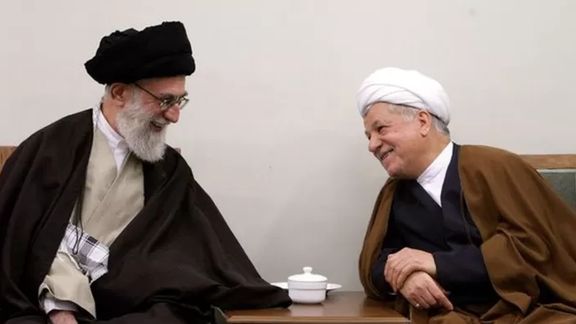
Iran's Ali Khamenei (L) and Hashemi Rafsanjani. Undated

Mohsen Hashemi, former Iranian President Akbar Hashemi Rafsanjani’s son, has called his father's death in 2017 "suspicious".

Rafsanjani who started his career in 1979 as an aide to Ruhollah Khomeini, the founder of the Islamic Republic held high offices until his death. He was the Speaker of Iran's parliament (1980-1989), became Iran's president (1989-1997) and was the Chairman of the country's Expediency Council (1989-2017), and the Assembly of Experts (2007-2011).

According to official reports he died of a heart attack while swimming in a pool in northern Tehran on January 8, 2017, after his bodyguards took him to a nearby hospital. He was 82 and suffering from diabetes at the time of his death.

In an interview published by reformist Etemad Online website on January 15, Mohsen Hashemi said that it was Islamic Republic's policy to say that his father died of natural causes. He added that the investigation carried out by the Supreme Council of National Security into Rafsanjani's death was "superficial".

This was the first time Mohsen Hashemi was speaking about his father's death to the media while his siblings have always insisted that Rafsanjani was "killed." According to commentator Mohammad Rahbar, who spoke to Iran International TV, the reason for Mohsen's silence during the past four years was that he held official positions and did not want to compromise his future, but now that he is holding no office, he has decided to disclose what he knows about his father's death.

Mohsen Hashemi in front of a portrait of his father. Undated
100%
Mohsen Hashemi in front of a portrait of his father.

Mohsen Hashemi, however, threaded carefully during the interview. He cautiously said that there is still no evidence to prove his father was killed, nor there is any evidence about a natural death. He said that there was no water in his lungs, which meant he did not drown. He added the family was never given access to CCTV footage. The fact that doctors at the hospital said he was "nearly" dead when he was brought in, was also "suspicious".

One of Rafsanjani's daughters, Fatemeh, had said in 2018 that the towel wrapped around her father's body was contaminated with radioactive material. Rafsanjani had reportedly told former IRGC commander and Supreme Leader Khamenei's military adviser General Yaya Rahim Safavi that he knew about a plot to kill him.

Rafsanjani had played a pivotal role in getting Ali Khamenei elected as Supreme Leader in 1989, but their relationship deteriorated by 2009. Rafsanjani was seen as an influential figure and possibly a threat to Khamenei’s increasingly authoritarian rule.

Mohsen Hashemi said in the interview that contrary to usual protocols, on the day of his death Rafsanjani was not accompanied by a medical team that usually went everywhere with him in an ambulance. But Hassan Ghazizadeh Hashemi, the health minister at the time, said Rafsanjani did not want the medical team to accompany him.

Hashemi also said that he has spoken to Khamenei and IRGC Intelligence Chief about a possible assassination attempt, but he was told that such a hypothesis was nonsense.

He added that against Rafsanjani's will, the IRGC had replaced the former President's bodyguards. He also accused an unnamed IRGC member of an arson in Rafsanjani's office in 2013.

Iran analyst Mehdi Mahdavi Azad told Iran International TV that "There is very little new information in the interview. His sisters had very openly talked about a murder plot." He added that "It is difficult to make a definite judgment based on the evidence available, but we are talking about a government under whose jurisdiction there have been so many suspicious murders. This is a government whose Intelligence Ministry officials have confessed to committing political murders in the past."

Mahdavi Azad concluded that "Based on the Islamic Republic's background, Akbar Hashemi Rafsanjani may have been killed, particularly because his death happened at a time Khamenei was perceiving him as a threat. Based on evidence, one can say that Rafsanjani's death was a murder on behalf of the ruling faction and Ali Khamenei."


Most Viewed

Iran negotiators ordered to return after internal rift over Islamabad talks
1
EXCLUSIVE

Iran negotiators ordered to return after internal rift over Islamabad talks

2
INSIGHT

Iran's digital economy battered by prolonged blackout

3
ANALYSIS

US blockade enters murky phase as tankers spoof signals and buyers hesitate

4
ANALYSIS

Why the $100 billion Hormuz toll revenue is a myth

5

US tightens financial squeeze on Iran, warns banks over oil money flows

Banner
Banner

Spotlight

  • Hardliners push Hormuz ‘red line’ as US blockade tests Iran’s leverage
    INSIGHT

    Hardliners push Hormuz ‘red line’ as US blockade tests Iran’s leverage

  • Ideology may be fading in Iran, but not in Kashmir's ‘Mini Iran'
    INSIGHT

    Ideology may be fading in Iran, but not in Kashmir's ‘Mini Iran'

  • War damage amounts to $3,000 per Iranian, with blockade set to add to losses
    INSIGHT

    War damage amounts to $3,000 per Iranian, with blockade set to add to losses

  • Why the $100 billion Hormuz toll revenue is a myth
    ANALYSIS

    Why the $100 billion Hormuz toll revenue is a myth

  • US blockade targets Iran oil boom amid regional disruption
    ANALYSIS

    US blockade targets Iran oil boom amid regional disruption

  • Iran's digital economy battered by prolonged blackout
    INSIGHT

    Iran's digital economy battered by prolonged blackout

•
•
•

More Stories

'Big Jobs To Small People' Stirs Controversy In Iran

Jan 12, 2022, 14:01 GMT+0
•
Iran International Newsroom

A hardliner Iranian lawmaker has accused the labor minister of treating his ministry's resources as spoils of war and giving top jobs to his friends.

Naser Mousavi Largani said Labor Minister Hojat Abdolmaleki, a former state television showman, approaches his work as if it is a television game. He further accused the minister of employing individuals whose credentials have been rejected by the intelligence organizations.

According to Rouydad24 website, Largani said that as Abdolmaleki knew he could not officially employ those individuals, he appointed them as caretakers of various departments of the labor ministry.

The website wrote that "Surprisingly, instead of supporting their colleague, other lawmakers at tried to persuade Largani to drop the issue against the labor minister.

Meanwhile another scandal broke out on Tuesday as Iranians on social media slammed the appointment of former state TV chief Abdolali Aliasgari as the head of Iran's most important petrochemical plant that reportedly provides some 20 percent of Iran's much needed hard currency. Critics said he is neither an expert in industrial management nor in the petrochemical industry. Others argued: "Who else in Iran is in charge of anything based on education or expertise?"

Regarding the labor minister, activists on social media had disclosed a letter he wrote to the country's Administrative and Employment Office asking it to disregard the standards about employment and approve the hiring of 12 of his friends who would occupy top posts at the ministry. Meanwhile, the IRGC Intelligence Organization reportedly arrested one of those hired by Abdolmaleki on charges of financial corruption, but the minister intervened and promised to fire the man.

In August, when 191 lawmakers endorsed Abdolmaleki's credentials as minister, a few lawmakers, including Largani, warned that those who voted for the showman will regret their decision soon.Largani argued that "70 million people's livelihood depends on this ministry in one way or another as it is in charge of the national Pension Fund as well as being tasked with boosting employment in Iran." He added that the ministry owns several companies including the Isfahan Steel Mill and it cannot be run by a young man who lacks the necessary experience and expertise.

Other lawmakers including Hassan Lotfi, a member of the Social Affairs Committee of the Majles, have also criticized Abdolmaleki for nepotism and "giving big jobs to small people."

In Monday's session of parliament Largani said that not only Abdolmaleki has hired people who have no relevant skills or experience, he has also fired some of the experienced managers at the labor ministry. Meanwhile, Largani criticized Abdolmaleki for saying that as labor minister he is not responsible for creating jobs. "What you are doing is bad for the president's reputation," he said.

Largani said that the Minister was breaking the law and he, as a lawmaker, will oppose him with all that he has in his power.

Nepotism and giving big jobs to friends is also an issue in Tehran Municipality. According to ILNA, on Tuesday, Mehdi Eghrarian, a member of the Tehran City Council criticized Mayor Alireza Zakani for disorderly hirings. He particularly criticized the mayor for appointing individuals from his circle of friends and family as the head of the Municipality's Welfare, Social Services and Partnerships Organization. Eghrarian said that a series of employments have taken place at the Tehran Municipality that do not conform to rules and regulations.

"We cannot constantly talk about the importance of laws and violate the same laws at the same time," he added.

Again, in the same way that hardliner lawmakers stopped the debate about the labor minister, the Chairman of the Tehran City Council, Mehdi Chamran insisted that the discussion about illegal employments at the municipality should stop at once.

IRGC Official Discloses Details Of Confrontation With Rouhani

Jan 12, 2022, 11:45 GMT+0
•
Maryam Sinaiee

An IRGC commander has disclosed details of a "very frank and fierce meeting" with former President Hasan Rouhani in which commanders, including Ghasem Soleimani, issued a stark warning to him.

The interview with the IRGC Aerospace commander Amir-Ali Hajizadeh was published by the hardline Kayhan newspaper Wednesday and was focused on Soleimani, the slain commander of the IRGC Qods Force, who was killed in Baghdad by a US drone strike on January 3, 2020.

Hajizadeh told Kayhan that the meeting with the former president was held during his second term of presidency to warn him that the IRGC would not stay silent regarding his “transgressions.”

Hajizadeh was probably referring to Rouhani's meeting including Commander-in-Chief Mohammad-Ali Jafari and Soleimani on July 25, 2017, a few days before the confirmation of Rouhani’s re-election by Supreme Leader Ali Khamenei. Hajizadeh's account of the meeting is in stark contradiction to state media reports at the time which said Rouhani and the commanders had expressed support for each other without mention of any confrontation.

Summer of discontent

Tensions between Rouhani and the IRGC rose to new heights after his re-election on May 29, 2017. In a June 23 meeting with businessmen, Rouhani strongly criticized IRGC's business activities. "Part of the economy is controlled by an unarmed government, but we surrendered it to a government armed with guns," he said about IRGC's meddling in government affairs.

Rouhani was apparently referring to IRGC-affiliated business consortiums' taking over big companies such as the Iran Telecommunications Company in 2009 in the name of privatization during the presidency of Mahmoud Ahmadinejad. The Mobin Trust Consortium, largely owned by the IRGC Co-op Foundation, had won the tender for $7.8 billion along with two other state entities under irregular and suspicious circumstances.

In the interview with Kayhan, Hajizadeh did not make any mention of IRGC's economic activities and said the commanders offered to help Rouhani's government. "You saw in crises such as floods and earthquakes and other things the IRGC was really present," he said in the interview while accusing Rouhani of "assaulting friendly forces," meaning regime insiders.

"The Revolution, people, the ruling system, and the Leader are our redlines. Don't think you can always say these things and we will remain silent," Hajizadeh said the commanders in the meeting warned Rouhani while adding that Soleimani expressly warned Rouhani not to follow the same path as Ahmadinejad.

"Do you want to become like him? Why are you self-harming? Why are you constantly attacking us? Let's solve the problems," Soleimani told Rouhani according to Hajizadeh.

Do you want to become like Ahmadinejad?

Many allege that it was the IRGC that helped Ahmadinejad, a quite obscure figure, to climb the political ladder and capture presidency in 2005.

Relations between Ahmadinejad and the IRGC deteriorated during his second term, after he was once again helped by the Guards to overcome rivals in the disputed elections of 2009. But in 2011, Ahmadinejad publicly defied Supreme Leader Ali Khameneiover sacking his intelligence minister Heydar Moslehi. He also attacked the Guards publicly on several occasions and even dubbed them "our smuggler brothers" in reference to IRGC's massive role in hugely profitable illicit imports through ports under its direct control.

Apparently referring to Ahmadinejad and Rouhani's objection to IRGC's support of proxy forces in regional countries, Hajizadeh said under the influence of "poisonous propaganda" many questioned Soleimani's spending of Iranian money in other countries. "Why does he take our money abroad? Why, in their view, does he support a dictator? Why should we get involved in Syria anyway?" Hajizadeh said, presumably referring to Ahmadinejad and Rouhani.

In the interview, Hajizadeh also admitted that there was so much opposition to the IRGC's involvement in Iraq and Syria that the death of its forces in the early days of the conflicts had to be kept secret. "We really didn't know how to justify the deaths of the first martyrs of the wars in Iraq and Syria," he said adding that not being able to call them martyrs and burying them as such was a big problem and they had to be buried without any ceremonies.

Outspoken Politician Says Iran Involved In Killing Half A Million Syrians

Jan 10, 2022, 16:11 GMT+0
•
Iran International Newsroom

Iran’s domestic and foreign policies are "irrational, Taliban-style, and propaganda based,” outspoken former lawmaker and presidential daughter, Faezeh Hashemi has said.

Referring to the sizable number of security and military officials working for President Ebrahim Raisi as top managers, she said, "Raisi is just a front man. There are others who puppeteer him from behind the scenes and influence his decision-making." She said, "I hope I am mistaken, but if this is true, Raisi is going to be blamed for his aides' mistakes."

Faezeh hashem is the daughter of Iran's former president Akbar Hashemi Rafsanjani, who was a close collaborator with Supreme Leader Ali Khamenei but later fell out of favor whne he supported protesters in 2009.

Meanwhile, Hashemi said Iran has been involved in killing some 500,000 people in Syria. Pointing out Iran's involvement in killing Muslims in Yemen and elsewhere, she said it is highly unlikely that Israel has killed 100 to 200 thousands Palestinians. "We have killed more Muslims than Israel with our wrong policies," she said.

In an interview with the news website Didehban-e Iran [Iran Monitor], published on Monday [January 10], she said IRGC officers who have joined the Raisi administration as his provincial governors-general cannot help him solve the country's problems. She also charged that Basij militia and IRGC officers are placed in cabinet ministers' offices to control them. She warned Raisi that in this way, he is going to have more problems in the future.

Hashemi, who spent time in jail as a political prisoner, shocked many in April 2021 when she praised Donald Trump and Iran’s last monarch, Mohammad Reza Shah.

Hashemi criticized the government's economic policies and said that Vice President Mohammad Mokhber, who has been working in an organization confiscating people's properties throughout his career, cannot understand the importance of privatization and economic reforms as the leader of Raisi's economic team. "There is no bright prospect for Iran's economy," she said.

She further criticized the appointment of inexperienced officials to key posts and said, "Corruption is not limited to financial corruption and astronomical salaries. Appointing incapable individuals to key posts will lead to corruption."

Hashemi’s criticisms of Raisi’s appointments are shred by many observers and politicians, some even from the country’s conservative camp.

Speaking about some government officials who usually suggest that people should tolerate hardships, Hashemi said: "OK. We will tolerate, but first we need to know where we are going. Are we tolerating the hardships to reach freedom? Good economy? Justice? Development? Or what? Unfortunately, there is no prospect ahead of us."

Criticizing Khamenei's policy for increasing Iran’s population, she said, he should have first assessed why there is a decline in population growth. Perhaps people do not want more children because of economic hardships. She added, there is nothing wrong with men and women living together without getting married, but she said she detested the idea of some men getting married to more than one woman.

To hardliner lawmakers who wish to impose an ideological lifestyle on Iranians, she said: "They are reckless. Iran is not North Korea." Speaking about other ideas such as only female doctors being allowed to treat female patients at hospitals, Hashemi said "these are Taliban-style policies."

In another part of the interview, Hashemi said the presidential election that brought Raisi to power was odd. "Everything was pre-planned for his election and anything that could possibly prevent his election was taken out of the way."

Speaking on the impact of sanctions on the Iranian economy, she said: "Sanctioned have caused essential problems, but the impact of mismanagement is bigger. If it were not for mismanagement, we would have not been sanctioned in the first place."

Victims' Parents Sue Top Iran Officials For Role In Downing Of Airliner

Jan 10, 2022, 11:32 GMT+0
•
Maryam Sinaiee

The mother of two victims killed when Iran shot down an airliner in 2020 says the family has sued senior officials for what they call a ‘premediated act.’

In a new interview published Monday in the reformist newspaper Shargh, Zahra Majd and her husband Hossein Asadi-Lari, who lost their children when flight PS752 was shot down January 8, 2020, disclosed their family had sued Ali Shamkhani, Secretary of the Supreme National Security Council (SNSC), and Hossein Salami, commander-in-chief of the Revolutionary Guards (IRGC).

Iran has said the Ukrainian Airways plane was shot down because a of “human error” at a time of high alert due to a possible United States attack, leading to the civilian airliner being misidentified. The lawsuit brought against Shamkhani claims the SNSC was responsible for not closing Iran’s airspace on the day of the incident and was involved in the deliberate downing of the plane.

The IRGC Aerospace Commander Amir-Ali Hajizadeh took overall responsibility for the downing of the plane three days after the incident.

Monday’s interview came a day after the publication of the family's two other interviews with Ensaf News and the Iranian Students News Agency (ISNA), when the family, breaking a silence of two years, alleged the missiles were intentionally fired at the plane to prevent US retaliation against Iran for a missile attack on US bases in Iraq just hours earlier, itself in response for the US killing Iranian general Qasem Soleimani and nine others in Baghdad.

Majd told Shargh that over a month after the incident, when visiting to express condolences, a visit implying he expected the family to accept their loss with stoicism, Salami had said the incident had prevented 10 million from being killed in a war with the US, making her children martyrs.

The family believes Salami's remarks, which he asked them to keep confidential, proves the flight was downed intentionally and not through human error.

This is the first time that one of the victims' families living in Iran has made such allegations in press interviews. Mohsen Asadi-Lari is a former high-ranking health ministry official.

Majd and her husband said that for three days after January 8 they had refused to believe that the plane had been targeted by Iran’s defense forces. Majd complained that the state broadcaster (IRIB) never talked to victims' families even though they had shunned foreign media, which she alleged would distort their remarks.

But she told Shargh that she would not talk to IRIB even if asked. “They will manipulate it to get what they want even if they talk to us," she told Shargh, accusing authorities of rigidly controlling the trial and court sessions, as well as private memorial ceremonies held by families and inscriptions on victims' gravestones. "We are not free to do and talk as we want."

Majd and her husband insisted that the ten low-ranking military personnel on trial are not the real culprits. Her husband claimed the person named as the operator of the air-defense system, referred to by the initials M.KH, was an expert in the Tor-M1 surface-to-air system that shot down the plane and that it was unbelievable that he had made such an error.”

"Hajizadeh [the IRGC aerospace commander] was indicted but his prosecution was prohibited,” Majd told Shargh. “This is very important. He has been indicted but [will not be prosecuted] no matter how much we shout… We found out about this in our private meeting [with the judge presiding the trial].”

Iran's Parliament Approves Budget Outline Amid Warnings Of More Inflation

Jan 9, 2022, 17:05 GMT+0

Iran’s parliament approved the broad outline of the budget on Sunday with a significant number voting against the bill that would raise taxes and cut subsidies.

With 174 in favor and 76 against, the bill proposed for the Iranian year starting March 21 will go through further examination in the budget committee tasked with reconciling differences and improving details.

The major issue expected to impact the population is the elimination of an indirect subsidy the government pays to make imports of essential foods and medicines cheaper amid high inflation for the past three years. Importers of essential goods receive US dollars at roughly one-seventh of the free market rate.

The scheme was launched as Donald Trump’s administration prepared to leave the Obama-era nuclear agreement (JCPOA), throwing Iran’s economy off the hinge by threatening sanctions. As the national currency began to fall in early 2018, the government fixed the rate for US dollars at 42,000 rials for importers of essential goods. The rial kept falling to the current level of around 280,000 to the dollar.

President Ebrahim Raisi speaking with lawmakers. January 9, 2022
100%
President Ebrahim Raisi speaking with lawmakers on Sunday.

The government spent at least $10 billion dollars a year to finance the subsidy and when President Ebrahim Raisi came to office last August his administration began signaling that it would stop the subsidy.

As talks to restore the nuclear agreement and lift US sanctions dragged on in 2021, Iran’s economic crisis worsened to the point that financing the subsidy apparently became a problem.

In the meantime, annual inflation reached almost 50 percent despite the subsidy. Many now fear that lifting it would further fuel price rises for the very commodities that ordinary people need most.

Many lawmakers in the Sunday session opposed the move, but it seems the die is cast. However, opponents fear that removing the subsidy will especially fuel inflation in food prices, which have already topped general inflation. In recent months the cost for food increased between 60-70 percent compared with last year.

Politicians inside the regime and pundits fear that people will not tolerate any further price increases, and that can lead to unrest and threaten the regime. Even if US sanctions are lifted in the next few months, it would take a long time to bring inflation down. Salaries have woefully lagged behind inflation and workers from all sectors are demanding substantially higher wages. Salaries must be at least doubled to save the middle class from poverty.

A typical worker gets around $120 to $200 a month, while rents and other daily necessities have risen with the fall of the national currency, keeping pace with the value of the US dollar. Mehdi Asgari, a lawmaker warned during debate that “Ten million families have fallen below the poverty line” and stopping the subsidy will bring about a shock to many who would not be able to afford even “bread and cheese.”

At the same time the budget bill proposes to raise taxes for generating 62 percent more revenues. Lawmakers warned that this would stifle whatever production is left in the country.

President Ebrahim Raisi who attended Sunday’s parliament session said, “It is not possible that we would eliminate the preferred exchange rate without finding a way to ensure people’s livelihood.”

The government has been promising cash handouts to lower classes to help them cope, but the amounts mentioned are a few dollars a month.

Asgari, the lawmaker who opposed eliminating the subsidy, gave a “serious warning” to the president, saying that people cannot afford “such a high inflation.”