• العربية
  • فارسی
Brand
  • Iran Insight
  • Politics
  • Economy
  • Analysis
  • Special Report
  • Opinion
  • Podcast
  • Iran Insight
  • Politics
  • Economy
  • Analysis
  • Special Report
  • Opinion
  • Podcast
  • Theme
  • Language
    • العربية
    • فارسی
  • Iran Insight
  • Politics
  • Economy
  • Analysis
  • Special Report
  • Opinion
  • Podcast
All rights reserved for Volant Media UK Limited
volant media logo

US Continues Efforts To Reassure Allies In The Persian Gulf
Iran International Newsroom
Aug 9, 2023, 10:05 GMT+1Updated: 17:38 GMT+1
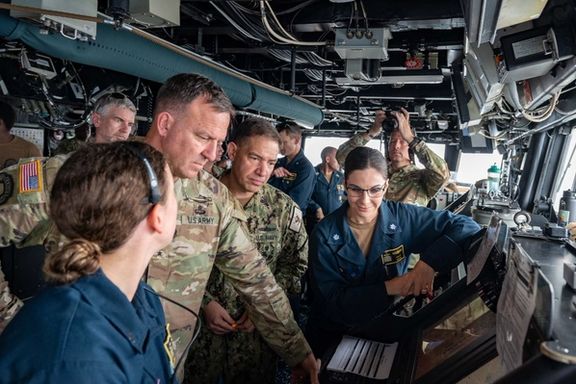
Gen. Erik Kurilla reviewing operations aboard USS THOMAS HUDNER in the Persian Gulf, August 2023

As a display of power in the region, US Gen. Michael “Erik” Kurilla commander of CENTCOM sailed through the Strait of Hormuz aboard a Navy warship, August 6-8.

The US Central Command announced on Tuesday that Gen. Kurilla also paid a visit to the United Arab Emirates and Bahrain, two US allies in the Persian Gulf, whose commercial maritime traffic face a constant threat harassment from Iran.

Iran attempted to seize two commercial vessels in early July in the Persian Gulf but was met with a US response and withdrew, according to the Pentagon. Tehran has harassed or seized more than 15 commercial ships in the past two years in the general area of the Persian Gulf.

Anticipating continued Iranian attacks on commercial shipping, the White House had announced in May that the Biden administration would be making moves in the region, but at the time did not say what they would include.

Later, the Pentagon began to augment the US military presence in the region by deploying F-16 and F-35 warplanes in July, and also dispatching three additional naval vessels carrying more than 3,000 sailors, including Marines.

Following Iran's March agreement to a détente with Saudi Arabia facilitated by China, numerous observers have asserted that the United States is experiencing a loss of influence in the Middle East, signaling a potential end to the era of American dominance in the region.

100%

In a perplexing announcement on May 31st, the UAE announced its withdrawal from a US-led maritime security coalition, a move that took place earlier in the year. The UAE further indicated its ongoing evaluation of its security partnerships.

"As a result of our ongoing evaluation of effective security cooperation with all partners, two months ago, the UAE withdrew its participation in the Combined Maritime Forces," the Ministry of Foreign Affairs said in a statement carried by state news agency WAM.

Iran's navy commander said June 3 that his country and Saudi Arabia, as well as three other Persian Gulf states, plan to form a naval alliance, including India and Pakistan.

"The countries of the region have today realized that only cooperation with each other brings security to the area," Iranian army's navy commander Shahram Irani was quoted as saying.

However, this was not confirmed by any of the other countries allegedly involved and seemed to be an Iranian attempt to gain political leverage after the UAE announcement.

The following day, US 5th Fleet and Combined Maritime Forces spokesperson Cmdr. Tim Hawkins told Breaking Defense, a digital news outlet on global military, “It defies reason that Iran, the number one cause of regional instability, claims it wants to form a naval security alliance to protect the very waters it threatens.”

The UAE announcement, however, remained a mystery, without any follow-up confirmation of its withdrawal from the US-led coalition, or a clear denial by the United States. It is possible that Abu Dhabi was exerting pressure on Washington to show more determination in deterring Iranian maritime adventures.

In this context, General Kurilla's recent sea voyage through the Strait of Hormuz, his diplomatic visits to two allied nations, and the bolstering of US naval and aerial capabilities in the region collectively aimed to provide reassurance to Arab allies.

Kurilla visited UAE where he met with Armed Forces Chief of Staff Lieutenant General Issa Saif Mohammed al-Mazrouei. He then traveled to Bahrain where he met with King Hamad bin Isa Al Khalifa, Lieutenant General Abdullah bin Hassan Al Nuaimi, the Bahrain Minister of Defense Affairs, and the US Fifth Fleet Headquarters.

“These trips to the region provide me deep insights into the relationships with our partners and the readiness of the US and Coalition forces deployed there” said Gen. Kurilla. “I continue to be impressed with the high level of readiness, professionalism, and capability of the US forces serving in CENTCOM. The commitment of our forces and partners is key to regional security.”


Most Viewed

US blockade enters murky phase as tankers spoof signals and buyers hesitate
1
ANALYSIS

US blockade enters murky phase as tankers spoof signals and buyers hesitate

2
INSIGHT

Ideology may be fading in Iran, but not in Kashmir's ‘Mini Iran'

3
INSIGHT

Hardliners push Hormuz ‘red line’ as US blockade tests Iran’s leverage

4
VOICES FROM IRAN

Hope and anger in Iran as fragile ceasefire persists

5

US sanctions oil network tied to Iranian tycoon Shamkhani

Banner
Banner

Spotlight

  • Hardliners push Hormuz ‘red line’ as US blockade tests Iran’s leverage
    INSIGHT

    Hardliners push Hormuz ‘red line’ as US blockade tests Iran’s leverage

  • Ideology may be fading in Iran, but not in Kashmir's ‘Mini Iran'
    INSIGHT

    Ideology may be fading in Iran, but not in Kashmir's ‘Mini Iran'

  • War damage amounts to $3,000 per Iranian, with blockade set to add to losses
    INSIGHT

    War damage amounts to $3,000 per Iranian, with blockade set to add to losses

  • Why the $100 billion Hormuz toll revenue is a myth
    ANALYSIS

    Why the $100 billion Hormuz toll revenue is a myth

  • US blockade targets Iran oil boom amid regional disruption
    ANALYSIS

    US blockade targets Iran oil boom amid regional disruption

  • Iran's digital economy battered by prolonged blackout
    INSIGHT

    Iran's digital economy battered by prolonged blackout

•
•
•

More Stories

UN Calls To Abolish Death Penalty In Iran, Repeal Hijab Laws

Aug 9, 2023, 07:52 GMT+1
•
Iran International Newsroom

A report submitted to the UN High Commissioner for Human Rights and the Secretary General has called for Iran to halt surging executions and rollback mandatory veiling. 

It was among a long list of recommendations in a report submitted last month pursuant to General Assembly resolution 77/228, in which the UN General Assembly requested the Secretary-General to submit an interim report on the situation of human rights in Iran to the Human Rights Council at its fifty-third session.

The report calls for the regime to “immediately halt the execution of all individuals, including those sentenced to death in the context of protests and for drug-related offences, and to refrain from further application of the death penalty”.

This year alone, more than 350 Iranians have been hanged, according to Norway-based Iran Human Rights. The rights group noted it is a 36% increase on the same period last year, likely exacerbated by the ongoing uprising since the death in morality police custody of Mahsa Amini and the subsequent unrest sweeping the country.

People making their way towards Aychi cemetery in Saqqez, the hometown of Mahsa Amini, to take part in a memorial service to mark 40 days since her death
100%
People making their way towards Aychi cemetery in Saqqez, the hometown of Mahsa Amini, to take part in a memorial service to mark 40 days since her death

As the trend sees no sign of halting, the UN calls on the regime to “abolish the death penalty and introduce an immediate moratorium on its use and prohibit the execution of child offenders in all circumstances and commute their sentences”.

Referring to the innumerable cases of prisoners detained arbitrarily, including women and girls, human rights defenders, lawyers, and journalists, for legitimately exercising their rights to freedoms of opinion and expression, association and of peaceful assembly, the UN calls on their release. In the 2023 Freedom House report, Iran ranked 12 out of 100 countries for its being “not free”, moving up from 14 in 2022.

Additionally, the UN urged the regime to “guarantee the right of peaceful assembly” and called on the regime to “uphold the full respect for due process and fair trial rights in line with international standards”, including access to legal counsel. Iran refuted the allegations made in the report of a disproportionate response by security forces to the protests.

As internet shutdowns and censorship continue to blight millions across the country, including decimating small businesses which rely on e-commerce, the UN asked that “internet shutdowns are never applied as they inherently impose unacceptable consequences for human rights”.

Addressing the mandatory hijab laws which have most recently seen the return of the morality police to the streets, high level surveillance of the population, brutality and the banning of women from many public places, the UN called on Iran to “take further steps to eliminate all forms of gender-based discrimination and violence against women and girls in law and in practice, including thorough revision and repeal of laws and policies which criminalize non-compliance with compulsory veiling”.

Two Iranian women without the mandatory hijab in a street in Tehran  (July 2023)
100%
Two Iranian women without the mandatory hijab in a street in Tehran

While the hundreds of mystery school poisonings which began last November in Qom and spread nationwide have still got no clearer answers as to the culprits, the UN reiterated the need for an “independent, impartial, prompt, thorough and effective investigation into reported poison attacks on girls’ schools with a view to hold the perpetrators to account; provide full reparations to the victims and guarantee the right to education without discrimination”.

Last month, Viviana Krsticevic, a member of the Fact-Finding Mission on Iran, speaking at a press conference in Geneva said the team, established by the Human Rights Council in November 2022, said: “We have identified major risks of further erosion of women's and girls’ rights in Iran. We have expressed concern about the continuous repression of women and girls opposing forced veiling and their reported use of facial recognition technologies to identify and arrest them.” 

The team is also investigating whether alleged poisonings of girls in schools have been orchestrated as a way to punish or deter girls for their involvement in the protests. “Just two months after the protests occurred, a series of alleged poisonings started in dozens of schools in 28 provinces”, added Krsticevic. “Reports said this may have been orchestrated to punish girls or to turn them from involvement in the protests and are being duly investigated in the framework of our mandate.”

Echoing concerns about the proposed use of flogging for those defying compulsory veiling rules, Sara Hossein, Chair of the Fact-Finding Mission, said some of the penalties were “clearly what would constitute inhuman punishment under international law”.

Alongside gender discrimination, the UN also addressed the regime’s continued campaign of repression against minority groups, including the Baha’i community and Iran’s Kurdish population.

The report points out that the regime has still not agreed to join several UN conventions including the Convention on the Elimination of All Forms of Discrimination against Women and the Convention against Torture and Other Cruel, Inhuman or Degrading Treatment or Punishment, emphasizing the need for Iran to conform to international practice.

The Fact-Finding Mission is preparing a comprehensive report on its findings to the Human Rights Council for its 55th session in March 2024.

Britain, Canada Slap Fresh Sanctions On Iran Over Ukraine

Aug 8, 2023, 23:31 GMT+1
•
Iran International Newsroom

Britain and Canada have announced new Iran-related sanctions targeting individuals and entities threatening international peace and those involved in arms supply to Russia. 

Britain on Tuesday imposed sanctions on an Iranian drone maker and a range of other foreign businesses, accusing them of supplying Russian forces with weapons and components for use against Ukraine. Canada targeted seven people whom Ottawa accused of being a menace to international security or involved in activities that constitute gross and systemic violations of human rights in Iran.

According to a statement from the Canadian foreign ministry, the sanctioned individuals include senior Iranian officials involved in entities that supply materials to Iran's national Law Enforcement Command or individuals who hold senior positions in state-directed firms that produce lethal combat drones used by Iran-backed forces “to destabilize the region” or that are exported to Russia.

Canada’s package of sanctions – its 13th against the regime since October 2022 – included Ali-Akbar Ahmadian, the new Secretary of Iran’s Supreme National Security Council; Brigadier General Abdolkarim Bani-Tarafi, the Chairman of the Iran Aviation Industry Organization; as well as three board members of the company Reza Khaki, Majid Reza Niyazi-Angili, and Vali Arlanizadeh. Fatemeh Haghshenas and Masoumeh Teymouri, board members of Imen Sanat Zaman Fara -- a company that manufactures equipment for security forces – were also sanctioned in this round. 

“Today’s sanctions send a clear message to the Iranian regime that Canada will not tolerate its gross and systematic violations of human rights and its ongoing grave breach of international peace and security. We will continue to use all the tools at our disposal to respond to Iran’s egregious actions,” said Canadian Foreign Minister Mélanie Joly. 

Canadian Foreign Minister Melanie Joly attends a joint news conference with US Secretary of State Antony Blinken, at the State Department in Washington, US, September 30, 2022.
100%
Canadian Foreign Minister Melanie Joly attends a joint news conference with US Secretary of State Antony Blinken, at the State Department in Washington, US, September 30, 2022.

London’s punitive measures focused more on Moscow’s access to foreign military equipment, blacklisting 25 individuals and businesses in Iran, Turkey, Belarus, Slovakia, Switzerland and the United Arab Emirates, as well as Russia supporting the war in Ukraine. 

Iranian drone maker Paravar Pars and seven of its executives -- already under US sanctions since February – who are involved in the research, development and production of UAVs for the Islamic Revolutionary Guard Corps (IRGC) as well as two Turkey-based exporters of microelectronics, Azu International and Turkik Union, were among those targeted by Britain.

A statement by British Foreign Minister James Cleverly described Paravar Pars as “a key regime-linked UAV manufacturer” and accused the Islamic Republic of being “responsible for supplying Russia with the kamikaze drones used to bombard Ukraine.”

Cleverly said on Tuesday, “We are also taking further action to tackle Iran and Belarus’ support for Russia’s military,” highlighting that “The UK has previously imposed sanctions on Belarus for continuing to actively facilitate Russia’s invasion of Ukraine and has called out Iran’s destabilizing role in global security, including through sanctions against Iranian suppliers of the Unmanned Aerial Vehicles (UAVs) used by Russia to target Ukrainian civilians.”

An image shows Iranian drone transfer to Russia, as evidence of new Russian-Iran cooperation, in this handout acquired June 9, 2023.
100%
An image shows Iranian drone transfer to Russia, as evidence of new Russian-Iran cooperation, in this handout acquired June 9, 2023.

“There is nowhere for those sustaining Russia’s military machine to hide," he underlined. 

The British government has sanctioned over 1,600 individuals and entities since the start of the Russian invasion of Ukraine, but according to Cleverly, the latest round of sanctions marked its biggest ever action on military suppliers in third countries.

"Today's landmark sanctions will further diminish Russia’s arsenal and close the net on supply chains propping up (President) Putin's now struggling defense industry," British foreign minister James Cleverly said.

Britain, the US, the European Union and several other countries have imposed a range of sanctions since last February to punish Russia for its invasion of Ukraine, which Moscow calls a "special military operation". 

Russia Slams Western Pressure On Iran Over Nuclear Issue

Aug 8, 2023, 18:30 GMT+1
•
Iran International Newsroom

Russia on Tuesday aligned itself with its ally Iran in rejecting Western attempts to maintain sanctions on Iran despite the collapse of the 2015 JCPOA nuclear deal.

After a meeting between respective deputy foreign ministers in Tehran, Russia's foreign ministry said Moscow and Tehran were unanimous in believing that the failure to implement the deal stemmed from the "erroneous policy of 'maximum pressure' pursued by the United States and those who think similarly".

Russia is one of the participants in the Joint Comprehensive Plan of Action (JCPOA), the accord signed between world powers and Iran to restrict Tehran’s controversial nuclear program, especially limiting its uranium enrichment.

Then-US president Donald Trump quit the deal in 2018, imposing economic sanctions, and Iran's relations with the West have been deteriorating ever since, as it has accelerated its nuclear program. Tehran has been enriching uranium to 60-percent purity since 2021 and has accumulated enough fissile material for at least two nuclear weapons.

But Russia, which signed the deal alongside the US, China, Britain, France, Germany and the European Union, has been deepening ties with Iran since its invasion of Ukraine. Iran has supplied hundreds of kamikaze Shahed drones to Russia that have been widely used to attack civilian and infrastructure targets in Ukraine.

The war, which Russia calls a "special military operation", has driven its own relations with the West to their lowest level in decades, bringing on Western sanctions that has isolated Russia economically and politically. Iran is in a similar if not worse situation.

Reports in June indicated that European diplomats had informed Iran they planned to join the US in retaining sanctions on Iran's ballistic missile program that are set to expire in October under the nuclear deal.

They gave three reasons: Russia's use of Iranian drones against Ukraine; the possibility that Iran might transfer ballistic missiles to Russia; and depriving Iran of the benefits of the nuclear deal, which it violated after the US withdrew.

Russian Deputy Foreign Minister Sergei Ryabkov met Iranian counterparts Ali Bagheri-Kani and Reza Najafi.

Russia's foreign ministry said the meeting had emphasized "the unacceptability of any attempts on the part of the West to impose some new schemes and approaches to solving problems related to the JCPOA, which imply damage to legitimate and mutually beneficial Russian-Iranian cooperation in various fields".

It said there was still "no reasonable alternative" to implementing the JCPOA, as approved by the UN Security Council.

In recent months, many media reports have spoken of secret diplomatic efforts to control the tensions with Iran, including releasing Tehran’s frozen funds from countries such as Iraq and South Korea in return for a pledge by Iran not to further increase its uranium enrichment to weapons grade levels, which is 90-percent purity.

So far, except a US sanctions waiver to Iraq for a partial release of funds, no developments have taken place signaling an agreement. Parallel to discussions about Iran’s nuclear program, the US is also trying to secure the release of several American dual-nationals held hostage in Iran. Apparently, the release of $7 billion held in South Korea is the price for releasing the prisoners. But a new complication has emerged with reports that while talks were taking place, Tehran arrested two more individuals, bringing the total to five hostages.

Observers and media in Iran have accused Russia of using the nuclear issue for its own leverage with the West. Multilateral talks that began in Vienna in April 2021, with the Biden administration’s new policy of reviving the JCPOA, failed immediately after Russia’s attack on Ukraine.

Germany Intensifies Efforts To Release Death Row Prisoner In Iran

Aug 8, 2023, 14:02 GMT+1

The case of Jamshid Sharmahd, a German citizen, who was sentenced to death by Iran's regime, has become a "top priority" for the German Foreign Ministry.

In a statement to Iran International, a spokesperson for the ministry affirmed their active campaign to secure Sharmahd's release.

"The case of Jamshid Sharmahd is our top priority," the spokesperson stated, underscoring the significance of the matter. "We are actively campaigning for Sharmahd with the utmost effort at a high level, through all available channels and at every opportunity. We are making it clear to the Iranian side that the execution of the death sentence would have serious consequences. Preventing the enforcement of the decision is of the utmost importance to us."

However, the German Foreign Ministry has refrained from disclosing whether diplomatic relations with Tehran or its substantial export business with Iran, amounting to over $1.2 billion, would be severed as part of efforts to secure Sharmahd's release.

Sharmahd was sentenced to death in April by Iran's judiciary on charges of alleged terrorism. He was accused of leading the pro-monarchist group Kingdom Assembly of Iran, believed to be responsible for a fatal 2008 bombing and plotting additional attacks within the country. The group, operating from Los Angeles, advocates for the restoration of Iran's monarchy and operates opposition media platforms.

His case is emblematic of what human rights organizations term "hostage diplomacy," where Western prisoners are held on charges of espionage or alleged crimes. Iran maintains that the prisoners are being held for legitimate reasons, despite international concerns and objections. 


Iranian MP Blames Regime For Medicine Shortages

Aug 8, 2023, 12:04 GMT+1

An Iranian MP has decried the government's neglect of the dire medicine shortages rocking the country.

Salman Es’haghi, Spokesperson of the Parliament’s Health Commission, highlighted the detrimental consequences, including an alarming rise in patient mortality rates.

He asserted that “despite the critical shortages, the Central Bank has refused to allocate the necessary currency for drugs,” placing domestic pharmaceutical producers in a challenging situation regarding pricing and currency allocation.

The parliament had approved the government's decision to discontinue an annual subsidy of $9-14 billion for essential food and medicines in March last year, despite concerns about heightened inflation and hardships.

The subsequent shortages have severely affected Iran's pharmaceutical industry, which heavily relies on government funding for importing raw materials.

Shortages of imported ingredients have disrupted medicine production, leaving approximately 200 types of common medicines and hospital drugs scarce or unavailable, according to local media reports.

Es’haghi underscored that repeated warnings about the drug crisis have been issued to the government by the health commission. Nevertheless, the government's lack of attention has exacerbated the situation.

In the previous Iranian year, the medicine crisis intensified, driving people to the black market for smuggled medicines due to soaring prices and unavailability of many essential items.

While Iranian officials often attribute medicine shortages to United States sanctions, Washington maintains that humanitarian aid is exempt from sanctions. Iran annually imports over $1.5 billion worth of medicines, including substantial quantities from Europe, China, and India.

There are also speculations that the Iranian government may exploit the psychological effects of these shortages to influence foreign perceptions and further exhaust a populace already fatigued by months of revolutionary fervor.



