• العربية
  • فارسی
Brand
  • Iran Insight
  • Politics
  • Economy
  • Analysis
  • Special Report
  • Opinion
  • Podcast
  • Iran Insight
  • Politics
  • Economy
  • Analysis
  • Special Report
  • Opinion
  • Podcast
  • Theme
  • Language
    • العربية
    • فارسی
  • Iran Insight
  • Politics
  • Economy
  • Analysis
  • Special Report
  • Opinion
  • Podcast
All rights reserved for Volant Media UK Limited
volant media logo

Britain, Canada Slap Fresh Sanctions On Iran Over Ukraine
Iran International Newsroom
Aug 8, 2023, 23:31 GMT+1Updated: 17:36 GMT+1
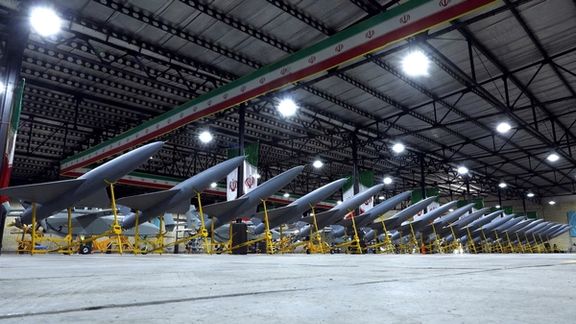
Drones are seen at a site at an undisclosed location in Iran, in this handout image obtained on April 20, 2023.

Britain and Canada have announced new Iran-related sanctions targeting individuals and entities threatening international peace and those involved in arms supply to Russia. 

Britain on Tuesday imposed sanctions on an Iranian drone maker and a range of other foreign businesses, accusing them of supplying Russian forces with weapons and components for use against Ukraine. Canada targeted seven people whom Ottawa accused of being a menace to international security or involved in activities that constitute gross and systemic violations of human rights in Iran.

According to a statement from the Canadian foreign ministry, the sanctioned individuals include senior Iranian officials involved in entities that supply materials to Iran's national Law Enforcement Command or individuals who hold senior positions in state-directed firms that produce lethal combat drones used by Iran-backed forces “to destabilize the region” or that are exported to Russia.

Canada’s package of sanctions – its 13th against the regime since October 2022 – included Ali-Akbar Ahmadian, the new Secretary of Iran’s Supreme National Security Council; Brigadier General Abdolkarim Bani-Tarafi, the Chairman of the Iran Aviation Industry Organization; as well as three board members of the company Reza Khaki, Majid Reza Niyazi-Angili, and Vali Arlanizadeh. Fatemeh Haghshenas and Masoumeh Teymouri, board members of Imen Sanat Zaman Fara -- a company that manufactures equipment for security forces – were also sanctioned in this round. 

“Today’s sanctions send a clear message to the Iranian regime that Canada will not tolerate its gross and systematic violations of human rights and its ongoing grave breach of international peace and security. We will continue to use all the tools at our disposal to respond to Iran’s egregious actions,” said Canadian Foreign Minister Mélanie Joly. 

Canadian Foreign Minister Melanie Joly attends a joint news conference with US Secretary of State Antony Blinken, at the State Department in Washington, US, September 30, 2022.
100%
Canadian Foreign Minister Melanie Joly attends a joint news conference with US Secretary of State Antony Blinken, at the State Department in Washington, US, September 30, 2022.

London’s punitive measures focused more on Moscow’s access to foreign military equipment, blacklisting 25 individuals and businesses in Iran, Turkey, Belarus, Slovakia, Switzerland and the United Arab Emirates, as well as Russia supporting the war in Ukraine. 

Iranian drone maker Paravar Pars and seven of its executives -- already under US sanctions since February – who are involved in the research, development and production of UAVs for the Islamic Revolutionary Guard Corps (IRGC) as well as two Turkey-based exporters of microelectronics, Azu International and Turkik Union, were among those targeted by Britain.

A statement by British Foreign Minister James Cleverly described Paravar Pars as “a key regime-linked UAV manufacturer” and accused the Islamic Republic of being “responsible for supplying Russia with the kamikaze drones used to bombard Ukraine.”

Cleverly said on Tuesday, “We are also taking further action to tackle Iran and Belarus’ support for Russia’s military,” highlighting that “The UK has previously imposed sanctions on Belarus for continuing to actively facilitate Russia’s invasion of Ukraine and has called out Iran’s destabilizing role in global security, including through sanctions against Iranian suppliers of the Unmanned Aerial Vehicles (UAVs) used by Russia to target Ukrainian civilians.”

An image shows Iranian drone transfer to Russia, as evidence of new Russian-Iran cooperation, in this handout acquired June 9, 2023.
100%
An image shows Iranian drone transfer to Russia, as evidence of new Russian-Iran cooperation, in this handout acquired June 9, 2023.

“There is nowhere for those sustaining Russia’s military machine to hide," he underlined. 

The British government has sanctioned over 1,600 individuals and entities since the start of the Russian invasion of Ukraine, but according to Cleverly, the latest round of sanctions marked its biggest ever action on military suppliers in third countries.

"Today's landmark sanctions will further diminish Russia’s arsenal and close the net on supply chains propping up (President) Putin's now struggling defense industry," British foreign minister James Cleverly said.

Britain, the US, the European Union and several other countries have imposed a range of sanctions since last February to punish Russia for its invasion of Ukraine, which Moscow calls a "special military operation". 

Most Viewed

100 days after carnage: Iran economy reels from war, inflation, unemployment
1
INSIGHT

100 days after carnage: Iran economy reels from war, inflation, unemployment

2
INSIGHT

Ghalibaf defends Iran-US talks amid hardline backlash

3
EXCLUSIVE

Iranian assaulted in London amid concern over threats to regime critics

4

IRGC fires at Indian vessel in Hormuz

5
INSIGHT

A nation in limbo: 100 days after the massacre, has the world moved on?

Banner
Banner

Spotlight

  • War-hit homeowners feel abandoned as Iran’s reconstruction aid fades

    War-hit homeowners feel abandoned as Iran’s reconstruction aid fades

  • 100 days on: the anatomy of Iran’s January crackdown
    INSIGHT

    100 days on: the anatomy of Iran’s January crackdown

  • Ghalibaf defends Iran-US talks amid hardline backlash
    INSIGHT

    Ghalibaf defends Iran-US talks amid hardline backlash

  • 100 days on: why Iran’s January protests spread across social classes
    ANALYSIS

    100 days on: why Iran’s January protests spread across social classes

  • From instability to influence: Pakistan’s pivotal role in US-Iran diplomacy
    ANALYSIS

    From instability to influence: Pakistan’s pivotal role in US-Iran diplomacy

  • A nation in limbo: 100 days after the massacre, has the world moved on?
    INSIGHT

    A nation in limbo: 100 days after the massacre, has the world moved on?

•
•
•

More Stories

IRGC Threatens Retaliation If US Seizes Iranian Vessels

Aug 8, 2023, 08:33 GMT+1
•
Iran International Newsroom

The Revolutionary Guard (IRGC) has threatened to respond in kind if the United States seizes Iranian vessels, as the US has augmented its forces in the Persian Gulf.

Speaking at a ceremony on Monday, spokesperson of the Guards, Ramazan Sharif claimed that Iran’s military power is at a level to confront the United States.

“The enemies of the Iranian nation are well aware of its power, especially its military capabilities to confront all threats and plots. We remind once again that mischiefs by America will be met with reciprocal action of the Islamic Republic,” Sharif said.

Iran attempted to seize two commercial vessels in early July in the Persian Gulf but was met with a US response and withdrew, according to the Pentagon. Tehran has harassed or seized more than 15 commercial ships in the past two years in the general area of the Persian Gulf.

Anticipating more Iranian action, the White House announced in May that the Biden administration would be making moves in the region, but at the time did not say what they would include.

Later, the Pentagon began to augment the US military presence in the region by deploying F-16 and F-35 warplanes in July and also dispatching three additional naval vessels carrying more than 3,000 sailors, including Marines.

The forces from the Bataan Amphibious Ready Group (ARG) and 26th Marine Expeditionary Unit (MEU) that sailed in mid-July from bases in the US reached the Red Sea on Monday.

Last week, the Pentagon said it is ready to offer onboard armed protection to commercial vessels in the region. Media in Tehran characterized this move as unprecedented and headlines appeared flagging higher chances of a military clash.

Ramazan Sharif in his speech underlined that “We thank the Almighty that Islamic Iran has reached such a degree of power that it is capable of confronting every American mischief, such as responding in kind and seizing their vessels.”

In April, US seized an Iranian oil tanker and in the past it has also confiscated cargos from tankers carrying sanctioned Iranian oil.

In recent months, many media reports have spoken of secret diplomatic efforts to control the tensions with Iran, including releasing Tehran’s frozen funds from countries such as Iraq and South Korea in return for a pledge by Iran not to further increase its uranium enrichment to weapons grade levels.

So far, except a US sanctions waiver to Iraq for a partial release of funds no changes have taken place. Parallel to discussions about Iran’s nuclear program, the US is also trying to secure the release of several American dual-nationals held hostage in Iran. Apparently, the release of $7 billion held in South Korea is the price for releasing the prisoners. But a new complication has emerged with reports that while talks were taking place, Tehran arrested two more individuals, bringing the total to five hostages.

Reporters on Monday pressed the State Department spokesperson Matt Miller for clarification if a fifth person has been seized, but he refused to confirm the news, which was reported by a local newspaper in Iran.

After more than two years of attempting diplomacy with the Islamic Republic, the Biden administration is coming under pressure by its critics, who demand a tougher posture toward Iran and a more vigorous enforcement of economic sanctions.

UK Gov't Divided On Whether To Proscribe Iran's Guards

Aug 7, 2023, 23:27 GMT+1
•
Iran International Newsroom

Britain says there is a split within the UK government over whether to proscribe Iran’s Revolutionary Guard despite the regime’s “significant threat” to the UK.

The office of the British Prime Minister reiterated Monday that the Islamic Republic regime poses a “significant threat” to the country with “direct threats” to dissidents living in the UK.

The statement by the 10 Downing Street came a day after reports emerged of Home Secretary Suella Braverman labeling the IRGC as “the single biggest threat” to Britain’s national security amid fresh evidence of its reach.

As pressure is growing on the British government to proscribe the IRGC, The Sunday Times quoted a source close to the home secretary as saying that “The Iranian threat is the one that worries us the most,” adding that Braverman fears that the outfit is stepping up its activities, attempting to recruit members of organized crime gangs to target opponents of the regime. 

In November 2022, Iran International was warned by authorities that its journalists were under threat from Iranian agents and after initial security measures around its headquarters in London, the television network temporarily relocated its broadcasts to Washington DC. Later, one suspect was arrested and is facing trial.

Britain's Home Secretary Suella Braverman (March 23, 2022)
100%
Britain's Home Secretary Suella Braverman outside Downing Street in London

British media quoted the Prime Minister's spokesman Max Blain as saying that London had already taken “strong action” against Tehran, but the government is divided whether the IRGC should be banned as a terrorist group, with the Foreign Office reportedly reluctant to back the move over fears it would cause lasting diplomatic damage. Last month, the British government again rejected calls to proscribe the IRGC as a terrorist group in favor of expanding the criteria by which its supporters and affiliated companies can be put under sanctions.

Asked if Braverman was echoing the government's view, the Prime Minister’s spokesman said, “Certainly we think that the behavior of the Iranian regime, including the actions of the IRGC, pose a significant threat to the safety and security of the UK and of our allies.”

Refraining from clarifying the opposing views about the designation of the IRGC, the spokesperson said, “I can’t get into speculation around who we may or may not be considering proscribing in the future.” But he said the government had “a range of tools at our disposal” and would make decisions based on using the most effective measures “to curb Iran’s destabilizing activity”.

The issue of nuclear proliferation and “direct threats against dissidents in the UK” were particularly concerning, the spokesman emphasized, highlighting the high number of threats to kill or kidnap British citizens or people based in the UK in just over a year.

“We’ve identified 15 credible threats by the Iranian regime to kill or kidnap British or UK-based individuals since 2022,” he said.

Referring to the measures taken by London, he said that “we have rightly taken strong action, including sanctions, and we’ve announced new powers to give the UK a greater ability to target Iran’s key decision makers.” “We have sanctions on 350 Iranian individuals and entities,” he underlined.

Earlier in the day, Iran’s Foreign Ministry spokesman Nasser Kanaani reacted to the statement attributed to UK Home Secretary Braverman, the UK is in no place to make such “baseless” claims.

Iran’s Foreign Ministry spokesman Nasser Kanaani during his weekly press briefing in Tehran on August 7, 2023
100%
Iran’s Foreign Ministry spokesman Nasser Kanaani during his weekly press briefing in Tehran on August 7, 2023

“The UK is not in a position to make accusations against the IRGC with its dark history in West Asia, which has caused deep instability in the region, as well as its role in covert and overt support of terrorism,” Kanaani said during his weekly press briefing in Tehran on Monday, claiming that “The IRGC has provided many services not only to the regional countries but also to the European states.”

The remarks by Downing Street and Braverman came just after Iran's IRGC commanders were revealed to be spreading extremist antisemitic propaganda in UK universities via a London student organization. The Sunday Times disclosed details of the close relationship between the Islamic Republic and the Islamic Students Association set up to promote religious and political views of Ruhollah Khomeini, the founder and first Supreme Leader of the regime who ruled until his death in 1989. 

According to an investigation by the Jewish Chronicle, since early 2020, at least eight IRGC leaders addressed British student audiences during events hosted by the center, trying to radicalize them.

An infographic created by The Jewish Chronicle about the IRGC commanders given a platform to spread propaganda to UK students
100%
An infographic created by The Jewish Chronicle about the IRGC commanders given a platform to spread propaganda to UK students

In the wake of the new revelations, Sir Richard Dearlove, the former head of MI6, led calls to proscribe the IRGC to outlaw its propaganda activities. “The case for strong preventive action seems clear-cut,” he said.

Shadow foreign secretary David Lammy said, “The invitation of IRGC commanders and other speakers who glorify its actions to speak to British students is incredibly concerning. Robust action is needed now.”

Tory MP Alicia Kearns, the chair of the Foreign Affairs committee, condemned the organization's activities, stating, “In organizing such despicable talks, the Islamic Students Association of Britain acts at best as a willing propaganda arm of the Iranian regime, and at worst as an agitator for state sponsored terrorism.”

Iranian-American's Arrest Complicates US Prisoner Swap

Aug 7, 2023, 19:27 GMT+1

An Iranian-American woman known for her NGO work in Afghanistan has been arrested in Iran, intensifying diplomatic tensions, a government newspaper reported.

The arrest has prompted the United States to suspend the implementation of a planned prisoner swap deal with Tehran, as reported by Iran's state-run Khorasan newspaper.

The woman's identity has not been disclosed, with sources citing the need to protect ongoing negotiations over her release. This latest arrest follows the detention of a fourth US national in Iran, as previously reported by Semafor news website. The inclusion of this new case has now become a pivotal element in the escalated negotiations between the two nations.

Efforts to secure the release of American citizens held in Iran have been ongoing, with previous detainees including Siamak Namazi, Emad Sharqi, and Morad Tahbaz. The Biden administration has pursued the return of these individuals who have been held on alleged espionage charges that have been widely criticized as lacking credible evidence.

Iran seeks the release of its citizens convicted of crimes in Western countries, while the United States seeks the return of its nationals detained in Iran and access to frozen funds totaling billions of dollars held in overseas banks.

Tensions have escalated further due to Iran's recent arrest of the fourth and now fifth US citizens, disrupting the progress toward a potential agreement. Sources close to the situation indicate that the fourth American detainee was intended to be part of the exchange deal, potentially prompting Iran to adjust its demands.

While Iran maintains that its policy does not involve hostage-taking, human rights organizations have raised concerns about the country's track record of detaining dual nationals and foreigners on questionable grounds. Official figures of Iran's diplomatic hostages are unknown, but it is believed it spans a vast array of countries globally. 

US Navy Deploys 3,000 Personnel To MidEast To Counter Iran Threat

Aug 7, 2023, 16:57 GMT+1

More than 3,000 US sailors and marines have arrived in the Middle East as part of a Department of Defense deployment.

The forces from the Bataan Amphibious Ready Group (ARG) and 26th Marine Expeditionary Unit (MEU) have been deployed in response to escalating tensions with Iran and as a show of maritime strength.

Recent developments in the region, including Iran's seizure and harassment of vessels has seen tensions rising, most recently seeing Iran's unveiling of new maritime weaponry and Washington's potential armed presence on commercial ships through the Strait of Hormuz, which sees roughly one fifth of the world's crude oil travel through the Strait of Hormuz between Iran and Oman. The US Navy's assertive posture also aligns with its efforts to reassure regional allies and maintain security in a volatile geopolitical landscape.

Additionally, the Biden administration's efforts to address Iranian drone supplies to Russia have led to mounting pressure. The Defense Intelligence Agency's presentation of evidence demonstrating the Iranian origin of drones shot down over Ukraine highlights the administration's commitment to countering destabilizing activities.

The USS Bataan (LHD 50), an amphibious assault ship, and the USS Carter Hall (LSD 50), a dock landing ship, entered the Red Sea via the Suez Canal after traversing the Mediterranean Sea.

The deployment falls within the context of the US 5th Fleet's extensive area of operations, spanning approximately 2.5 million square miles and encompassing vital waterways like the Arabian Gulf, Gulf of Oman, Red Sea, and critical choke points such as the Strait of Hormuz, Suez Canal, and Strait of Bab el-Mandeb.


Iran FM Visiting Japan Pursues Release Of Frozen Funds

Aug 7, 2023, 15:50 GMT+1
•
Iran International Newsroom

Iranian Foreign Minister Hossein Amir-Abdollahian visited Japan on Monday as a possible move to cajole Tokyo into releasing its $3 billion frozen in banks there. 

Amir-Abdollahian, the first Iranian foreign minister to visit Japan since Iranian President Ebrahim Raisi took office in August 2021, met with his counterpart Yoshimasa Hayashi, Japanese Prime Minister Fumio Kishida and Health, Labour and Welfare Minister Katsunobu Katō on Monday. 

The readout from his meetings did not mention any talks about Iran’s funds mainly from exports of oil frozen due to US sanctions, but Iranian Foreign Ministry spokesman Nasser Kanaani said earlier in the day that following up the issue was on the minister’s agenda during his trip. 

Amir-Abdollahian most likely raised the issue of the funds, as Tehran is also pressuring South Korea to release $7 billion frozen by two Seoul banks. Iran has tens of billions of dollars worth of funds in foreign banks that it cannot access because of US sanctions. The funds are mostly kept in banks in South Korea, Iraq, China, Japan and India where Iran is owed for shipments of crude and other oil products that took place before the United States pulled out of the 2015 nuclear deal and re-imposed full energy sanctions on Tehran in 2018 and 2019.

Kanani emphasized Monday that “We will continue to follow up on the issue of unfreezing Iranian funds held in various countries, as we did before,” adding that the issue has been raised at different levels, such as during a meeting on the sidelines of the 77th session of the United Nations General Assembly in New York last year when Raisi and Kishida discussed the matter. He went on to say that the Japanese government has repeatedly announced its readiness to repatriate the frozen assets and is making efforts to make this happen.

Iranian Foreign Minister Hossein Amir-Abdollahian (left) and his Japanese counterpart Yoshimasa Hayashi in Tokyo on August 7, 2023
100%
Iranian Foreign Minister Hossein Amir-Abdollahian (left) and his Japanese counterpart Yoshimasa Hayashi in Tokyo on August 7, 2023

A lot of recent reports and statements point to an interim deal with the possible release of regime funds in exchange for several US citizens held hostage in Iran and a freeze in Iran's nuclear program. Both the nuclear talks and the prisoner release talks have not succeeded in making meaningful progress. However, US officials say that efforts to secure the release of four Americans continue.

Japan – which holds this year's presidency of the Group of Seven nations – may seek to reduce Iran’s tension with the West to facilitate its dealings with Tehran; the most pressing issue is perhaps Tehran’s military support for Moscow’s invasion of Ukraine, deemed a threat to Europe. 

According to the readout of Amir-Abdollahian's meeting with his Japanese counterpart, apart from the usual calls for bolstering bilateral relations “in fields such as medical, environment and disaster risk reduction,” the most important issue discussed was Iran’s supply of drones and missiles for the Russian war on Ukraine. 

As was reported before the visit, Japan urged Iran not to provide Russia with weapons for its war against Ukraine, with Foreign Minister Hayashi calling on Tehran “to respond in a constructive manner.” The two agreed to continue "close communication" over issues affecting the Middle East, Japan's Foreign Ministry said. It also said the ministers exchanged “frank views” on the latest developments surrounding Iran’s nuclear issue.

The Japanese diplomat stated that Tokyo has consistently supported the Joint Comprehensive Plan of Action (JCPOA) and is “seriously concerned about the expansion of Iran’s nuclear activities,” calling on Iran to take constructive measures including the full and unconditional cooperation under the latest joint statement between Iran and the International Atomic Energy Agency (IAEA). 

Between 2006 and 2015, Tokyo fully supported the four UN sanctions resolutions designed to prevent the regime from developing nuclear weapons. Japan also complied with US sanctions reimposed by the Trump administration in 2018, which sought to eliminate all Iran’s oil exports.

Amir-Abdollahian explained that Iran is pursuing the restoration of the JCPOA through negotiations, and expressed his appreciation for Japan’s diplomatic efforts, noting that Iran seeks to continue close communication with Japan on the matter.

Later in the day, Amir-Abdollahian held a press conference in the Japanese capital, where he used it as an opportunity to further deny the extent of Iran’s involvement in the Russian invasion, calling claims “completely wrong and incorrect,” and instead blaming the conflict on the US-led NATO military alliance and its provocations, in spite of troves of evidence to the contrary.

“We consider NATO and its provocations among the root causes of the war and crisis. We continue our efforts to stop the war and make the parties focus on a political solution,” he said, claiming that “We have provided no parties [to the war] with drones for use in Ukraine.”

His remarks came just a day after Russia used 27 Iranian-made drones and 30 missiles to attack large swaths of Ukraine. Ukrainian officials said all 27 Shahed 136 and 131 drones were shot down by air defenses but some of the missiles fired from the Black Sea and the Caspian region got through.