• العربية
  • فارسی
Brand
  • Iran Insight
  • Politics
  • Economy
  • Analysis
  • Special Report
  • Opinion
  • Podcast
  • Iran Insight
  • Politics
  • Economy
  • Analysis
  • Special Report
  • Opinion
  • Podcast
  • Theme
  • Language
    • العربية
    • فارسی
  • Iran Insight
  • Politics
  • Economy
  • Analysis
  • Special Report
  • Opinion
  • Podcast
All rights reserved for Volant Media UK Limited
volant media logo

Iran Irked By Iraqi MP’s Claim Of Dollar Smuggling
Iran International Newsroom
Aug 6, 2023, 20:01 GMT+1Updated: 17:38 GMT+1
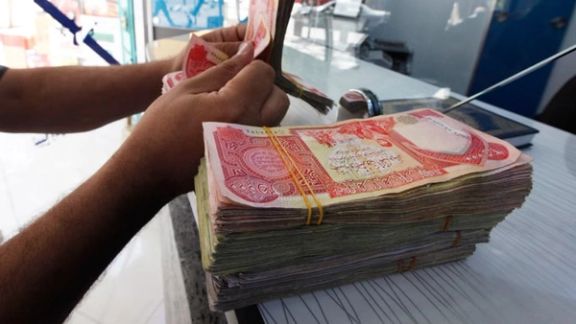
A customer counts Iraqi dinars at a money changer in Baghdad.

Iran’s Oil Products Exporters Union has reacted to the recent accusations made by an Iraqi MP regarding the smuggling of dollars to Iran through Argentina.

Hamid Hosseini, the spokesperson of the Iranian Oil, Gas, and Petrochemical Products Exporters Union, said Friday that this was a "very serious accusation" and called for accountability from the parliament, parties, and the central bank of Iraq.

Muhammad Nuri Aziz, a member of the Iraqi parliament, said on a television show last week that Iraqi Prime Minister Mohammed Shia al-Sudani and the country’s central bank are aware of the schemes Iran uses to get hold of US dollars it desperately needs amid US sanctions. The lawmaker noted that the smuggling started during Mustafa Al-Kadhimi's term as prime minister and still continues. Without providing any context or details, the Iraqi lawmaker alleged that Iran prints Iraqi dinars in Argentina, exchanges the money to US dollars in Iraq, from where it is smuggled to Iran by trucks.

The Iranian official said warned that given the recent alignments of some Iraqi officials with the United States against Iran, “it appears that these allegations may pave the ground for more serious disputes in the future.”

“This is a style of accusation by Iraqi nationalists and Ba'athists,” he claimed, accusing an Iraqi politician who happened to criticize the Iranian regime, without offering any evidence.

Hamid Hosseini, the spokesman of the Iranian Oil, Gas, and Petrochemical Products Exporters Union (undated)
100%
Hamid Hosseini, the spokesman of the Iranian Oil, Gas, and Petrochemical Products Exporters Union

Hosseini emphasized that Iran has been a strong supporter of Iraq, contributing significantly to its security and stability. He urged the Iraqi authorities and parties to address this issue and demanded that the Iranian embassy take action in response to the accusation. “If someone in the Iranian parliament had said such a thing, all of Iraq would have taken a position," he noted.

A source with the Iraqi government told Iran International that following the recent restrictions on Iraqi banks by the US, a portion of the smuggling is being carried out through shell companies, electronic travel cards, online shops, exchange offices, and even suitcases.

Reports about the transfer of $165 million to Iran within less than a month by just one exchange office led authorities to discover dozens of similar cases by other exchange offices.

The credibility of the Iraqi banking system has been tarnished due to the Islamic Republic's influence, and US financial restrictions have tightened on Baghdad because evidently all Iraqi banks have had interactions with the Islamic Republic.

Late in July, 14 Iraqi private banks sanctioned by Washington over helping to siphon US dollars to Iran said they were ready to challenge the measures and face audits and called on Iraqi authorities to provide assistance.

The US barred the Iraqi banks from conducting dollar transactions as part of a wider crackdown on dollar smuggling to Iran. The latest sanctions, along with earlier ones, have left nearly a third of Iraq's 72 banks blacklisted, two Iraqi central bank officials said.

The dinar has been falling against the dollar since the New York Federal Reserve imposed tighter controls on international dollar transactions by commercial Iraqi banks in November to halt the illegal siphoning of dollars to Iran.

Under curbs that took effect in January, Iraqi banks were required to use an online platform to reveal their transaction details. But most private banks have not registered on the platform and resorted to informal black markets in Baghdad to buy dollars.

Iran International revealed in May that an aide to former IRGC’s Quds force commander Qassem Soleimani, is a key figure in money laundering for Tehran. Iran International also reported details about the inner workings of a Quds force unit tasked with smuggling money from Iraq to Iran, proving that the Islamic Republic’s embassy in Iraq is also involved in money laundering operations aimed at funneling revenues from oil and gas exports back to Iran.


Most Viewed

Ideology may be fading in Iran, but not in Kashmir's ‘Mini Iran'
1
INSIGHT

Ideology may be fading in Iran, but not in Kashmir's ‘Mini Iran'

2
INSIGHT

Hardliners push Hormuz ‘red line’ as US blockade tests Iran’s leverage

3
VOICES FROM IRAN

Hope and anger in Iran as fragile ceasefire persists

4

Iran International says it won’t be silenced after London arson attack

5

US sanctions oil network tied to Iranian tycoon Shamkhani

Banner
Banner

Spotlight

  • Hardliners push Hormuz ‘red line’ as US blockade tests Iran’s leverage
    INSIGHT

    Hardliners push Hormuz ‘red line’ as US blockade tests Iran’s leverage

  • Ideology may be fading in Iran, but not in Kashmir's ‘Mini Iran'
    INSIGHT

    Ideology may be fading in Iran, but not in Kashmir's ‘Mini Iran'

  • War damage amounts to $3,000 per Iranian, with blockade set to add to losses
    INSIGHT

    War damage amounts to $3,000 per Iranian, with blockade set to add to losses

  • Why the $100 billion Hormuz toll revenue is a myth
    ANALYSIS

    Why the $100 billion Hormuz toll revenue is a myth

  • US blockade targets Iran oil boom amid regional disruption
    ANALYSIS

    US blockade targets Iran oil boom amid regional disruption

  • Iran's digital economy battered by prolonged blackout
    INSIGHT

    Iran's digital economy battered by prolonged blackout

•
•
•

More Stories

Iran Tourism Official Mocks Exaggerated Tourism Growth Figures

Aug 5, 2023, 21:05 GMT+1

A tourism industry representative in Iran has accused the government of providing false statistics on the growth of foreign tourism.

In an interview Hormatollah Rafi'ee quipped, "We are professionals in [ producingfalse] statistics," referring to the government.

He went on to express concerns about the country's inability to capitalize on tourism opportunities. He revealed that despite growth claimed by officials, the number of incoming tourists has in fact declined in recent years. This revelation raises questions about the accuracy of previous reports and the underlying challenges faced by Iran's tourism sector.

Last year, the government claimed the number of foreign visitors increased by 132 percent reaching 4.2 million people, amid the lingering COVID pandemic, which surprised many.

For years, Iran has been a destination of interest, enticing foreign visitors with its historical heritage. Even with strict dress codes for women and restrictions on alcohol and nightlife after the 1979 Islamic Revolution, a small but steady stream of mainly European tourists continued to visit the country.

Hopes for a significant boost in tourism arose when Iran and major powers reached a landmark nuclear deal in 2015.

However, these hopes were shattered when then-US President Donald Trump unilaterally withdrew from the agreement three years later, triggering a downturn in tourism prospects.

Last year, the country witnessed mass protests and detained more Europeans prompting several Western countries to issue travel advisories warning their citizens against visiting the country, citing the risk of "arbitrary detention."

Journalists Struggle In Iran: Low Salaries And Censorship

Aug 5, 2023, 15:30 GMT+1
•
Niki Mahjoub

Journalists in Iran say their salaries are not enough for their living expenses, and even if they are paid on time, it only covers basic expenses for half of the month.

Iran international conducted interviews with more than 20 journalists in various cities who work for newspapers or news agencies.

According to the interviewees, the average salaries of journalists in provinces like Esfahan, Khorasan Razavi, Gilan, West Azerbaijan and Sistan-Baluchistan range from 40 to 60 million rials ($80-120) a month.

This means that journalists get paid less than the minimum wage, which the government this year increased to above 70 million rials ($140).

A Journalist in Khorasan Razavi province in northeast, emphasizing the living difficulties for journalists said, "Salaries in some Telegram channels like Akbar Mashhad start from 7 million rials ($14) and may reach 4 million ($80) a month, like other journalist in our province. Of course, editors may receive between 100 and 120 million rials ($200-220)."

Tehran Bazaar in 2022, when food prices jumped from 99-350 percent
100%
Tehran Bazaar in 2022, when food prices jumped from 99-350 percent

According to a report by the Parliamentary Research Centre published this month the number of Iranian below the poverty line increased from 19 percent to over 30 percent in the past decade. In fact, more than 30 percent of Iran's populations lives below the poverty line. Some experts say that nearly half the population is now below the poverty line, which is defined as having an income of less than around $200 a month. Many journalists are also among the people living below the poverty line.

Journalists in Esfahan emphasized that their salaries have been paid with delays in the past year, and in some cases, they have been divided into instalments. They said, "A salary of 5.3 million rials ($105) is practically meaningless considering rising inflation and the high cost of living. There is no institution or syndicate to file a complaint with, and any protest is met with reprimands and dismissals."

Although the government claims annual inflation is at 40 percent, economists and some lawmakers believe it is closer to 70 percent. Food price inflation is estimated to be between 70-120 percent since May 2022.

A reporter from one of the news agencies in Tehran also said: "On paper, I receive around 80 million rials ($160) as my monthly salary, but due to various deductions, I end up with something close to 77 million. It's clear that with such a salary, it's impossible to live in Tehran. Depending on my shift, I do some extra work before or after my job as a driver. Once, I gave a ride to someone I had interviewed weeks earlier. The person was shocked that I was driving a taxi and repeatedly asked if I wanted to write an article about why I had to do a second job."

A reporter from one of the newspapers in Tehran told us, "I had left my parents’ home and lived alone, but my financial situation became so difficult that I had to return and live with them, however, not everyone has this option. We are barely making ends meet. I made around 100 million rials a month, but still, my income and expenses did not balance out."

Increasing censorship

The economic problem is not the only challenge facing journalists in Iran. They are daily confronted with various newly imposed restrictions. One journalist spoke about the pressures and new limitations, saying, "Reporting has become like the fluctuating dollar rate, they keep setting momentary red lines for us."

He added: "It is possible that yesterday an agreed upon report was allowed to be published, but the next day, the editors and chief editors, or the managing director say that the report should not be printed. To make our conscience suffer even more, they say, 'Are you willing to take the responsibility for others losing their jobs [if the news outlet is shut down]?’ “

Niloufar Hamedi and Elahe Mohammadi jailed for reporting on the death of Mahsa Amini.
100%
Niloufar Hamedi and Elahe Mohammadi jailed for reporting on the death of Mahsa Amini.

During months of anti-government protests that began last September, dozens of journalists were detained, some simply for a tweet or as a preventive measure. Two reporters who broke the news about Mahsa Amini, whose death in the custody of hijab police sparked the protests, are still in jail.

A reporter from one of the news agencies in Tehran stated: "Limitations on writing news depending on the country's situation have always existed. For example, we were not allowed to cover the Haft Tappeh workers' strike for a while, and later the choice of words was completely controlled. But during the protests since September 2022, these limitations have doubled."

This reporter went on to say, "After being shocked by the killing of Kian [a 10-year-old boy shot by security forces during protests], I posted a story on my personal page. In less than 24 hours, I received a call from an unknown number, and in a harsh tone, they told me to delete the story and warned that if it happened again, they would fire me from the newspaper."

Another journalist who was recently interrogated by security forces described the dangers inherent in censorship. "We used to know what words to use and what words were prohibited, or at least we followed the criteria according to directives from the Supreme National Security Council. But after the killing of Mahsa, the conditions drastically changed, and they began to apply all sorts of pressures to restrict independent journalists. They us no to do our professional work effectively, but…we take pride in our profession and stand with the people as long as we can."

UAE’s National Oil Firm Buys Share In Caspian Sea Field

Aug 5, 2023, 07:19 GMT+1
•
Iran International Newsroom

Abu Dhabi National Oil Company (ADNOC) is set to acquire a 30-percent equity stake in the Absheron gas and condensate field in the Caspian Sea.

According to the ADNOC on Friday, the agreement would see Azerbaijan's state oil company SOCAR and TotalEnergies, which had each previously held a 50-percent stake, both retaining a 35-percent share in the maritime field off the coast of Baku, Azerbaijan. 

TotalEnergies announced the first gas delivery from Absheron in July. The French energy group confirmed on Friday it and SOCAR had each sold a 15-percent interest in the field to ADNOC, without specifying the price.

The venture opens up opportunities for ADNOC to expand significantly in the Caspian region with rich energy resources and substantial growth potential, providing access to promising international gas markets in Europe and Central Asia. 

Following Russia's invasion of Ukraine in February 2022, the ADNOC has sharpened its focus on the gas market as competition for LNG has ramped up with Europe needing large amounts to help replace Russian gas. ADNOC listed its gas business in March after raising $2.5 billion from an initial public offering (IPO), which was the world's biggest in the first quarter of 2023.

Caspian region oil and natural gas infrastructure
100%
Caspian region oil and natural gas infrastructure

While the Islamic Republic is using the Caspian Sea as a route to move drones, ammunition, and mortar shells to Russia for use in Ukraine, other countries are vying for the huge European energy market. 

Iran is also cooperating with Russia in the Chalous gas field in the Caspian Sea, with the potentially lucrative field being at the center of discussions over an Iran-Russia 20-year strategic deal. In June 2021, Iran’s Khazar Exploration and Production Company (Kepco), then touted as the field’s main developer, suggested the field held 30 percent of the developable natural gas reserves of all Caspian Sea littoral counties and could potentially meet 20 percent of all European demand for gas. According to Simon Watkins of Oilprice.com in November 2021, further studies have revealed that the field has far more reserves than previously thought, with a total 7.1 trillion cubic meters, about half the reserves of South Pars, Iran’s huge field in the Persian Gulf.

The Caspian Sea was a Russo-Iranian shared water until 1991. Following the collapse of the Soviet Union, Kazakhstan, Azerbaijan, and Turkmenistan claimed a minimum 20-percent share of the sea. Tehran – along with Moscow – were the main losers of territory in the new demarcation of boundaries and prefer he Soviet-Iranian settlement to be valid in the post-Soviet era.

For almost three decades, the five littoral countries have argued over how to divide the world’s biggest enclosed body of water. The Convention on the legal status of the Caspian Sea -- a treaty signed in Aktau, Kazakhstan, in 2018 by the Islamic Republic of Iran, Russia, Kazakhstan, Azerbaijan, and Turkmenistan – significantly reduced Iran’s rights. Iran only controls 680 kilometers or, in other words, 10 percent of the 7,000-kilometer coastline of the Caspian Sea. Due to the presence of numerous oil fields on the seabed of the Caspian Sea the question of legal status is also very important, so the delimitation of the seabed is yet to be agreed on between littoral nations, Iranian President Hassan Rouhani said after signing the agreement.

Fifth Caspian Summit where the Convention on the legal status of the Caspian Sea was signed in August 2018
100%
Fifth Caspian Summit where the Convention on the legal status of the Caspian Sea was signed in August 2018

Nicolas Terraz, the president of exploration and production at TotalEnergies, welcomed ADNOC as one of the strategic partners to the project, saying the Absheron gas field “offers a significant further development potential to meet the growing gas demand.”

ADNOC's investment in Azerbaijan is in line with the UAE’s aspirations to grow its international gas business portfolio, a strategic plan that saw the oil giant offering with BP to jointly acquire 50% of Israeli offshore natural gas producer NewMed Energy. The $2-billion offer marked Abu Dhabi’s state oil company entering Israel's growing energy sector.

Wildfires in Western Iran Rage for Second Consecutive Day

Aug 4, 2023, 22:59 GMT+1

As the forest fire near the border with Iraq enters its second day, an Iranian government official has highlighted the alarming extent of the blaze.

Saeed Karimi, the Director General of Kordestan Governorate Crisis Management, revealed that the fires are spreading across the forests of three border villages in Marivan.

Karimi expressed concerns over the fire's magnitude, stating, "The scope of these fires is very high." He also noted that the area faces additional risks due to the presence of ammunition remnants from the Iran-Iraq war, with recent explosions adding to the challenges faced by firefighters.

The affected villages include Gomareh Lang, Darreh Varan, and Asanabad, with firefighting efforts intensified to contain the devastating blaze. Despite round-the-clock efforts by volunteers, the blaze has already extended to a nearby village.

The cause of the fire has not yet been officially confirmed, but authorities have not ruled out potential involvement from security institutions or profiteers.

There are suspicions that the IRGC may be responsible, allegedly setting fire to the forests to hinder the concealment of individuals and groups classified as "terrorists" by the Islamic Republic.

This is not the first time such fires have affected the Kordestan province. Three years ago, parts of the Zagros forests in the Kosalan mountain area of Sarvabad city suffered an intentional fire, reportedly ignited by an individual on a motorcycle, causing destruction to over 15 hectares of forests.

Iran To Use Released Iraqi Funds To Pay Pilgrims' Annual Subsidy

Aug 4, 2023, 19:50 GMT+1
•
Iran International Newsroom

Amid reports of releasing Iran's frozen funds in Iraq, the Iranian regime intends to provide 200,000 Iraqi dinars ($153) to pilgrims who travel to Iraq for Arbaeen.

The Governor of the Central Bank of Iran, Mohammad Reza Farzin, said Thursday that from this year onwards, instead of euros and dollars, pilgrims will be paid in Iraqi dinars for their pilgrimage. 

The regime offers several perks to encourage people to take the pilgrimage such as a ration of cheap foreign currency – which used to be dollars or euros until this year – as well as loans, free internet on the road and inside Iraq and free health checks and rest stops along the way. 

Arbaeen (literally meaning fortieth) is a Shiite religious observance that occurs forty days after the Day of Ashura, when according to religious legend Husayn (Hussain) ibn Ali , the grandson of Prophet Muhammad was killed on the 10th day of the month of Muharram in 680 AD. 

Millions of Shiite Muslims travel to the Iraqi city of Karbala, the site of the Shiite Imam’s shrine and resting place, for Arbaeen. A large number of the pilgrims start their journey from other religious cities – such as Najaf and Kadhimiya -- and walk on foot for days – hundreds of kilometers -- to reach Karbala. There are no reliable methods for tallying the number of visitors to Iraqi holy Shia sites during Arbaeen. In 2019, before the pandemic, an estimated 15 million people from various countries attended the ceremonies.

Different kinds of refreshments are distributed among the pilgrims of Arbaeen.  (September 2022)
100%
Different kinds of refreshments are distributed among the pilgrims of Arbaeen.

Majid Mirahmadi, a deputy interior minister and the head of Iran's taskforce for Arbaeen pilgrimage, has predicted that this year more than four million Iranian pilgrims will travel to Iraq to participate in the Arbaeen ceremony, which falls on September 5.

The figure is a speculation based on the number of pilgrims in the previous years but this year the annual Shiite mourning ceremonies took an unprecedented anti-regime tone as people chanted religious verses that were critical of the regime and its repressive actions. This may signal a lower turnout for the Arbaeen this year. 

If Mirahmadi’s number is right, it means that Iranian banks will pay at least 800 billion Iraqi dinars to the pilgrims, which is equivalent to more than $600 million. Although the regime will sell the dinars to the pilgrims cheaper than the rate in the market, it can still pocket a large sum of its national currency and thus make a cash profit from its released funds. 

Earlier this week, the Biden Administration announced that some of Iran’s frozen funds in Iraq will go to Oman, acting as a conduit to release the money for purchasing non-sanctionable goods under US supervision. Iraq owes Iran around $11 billion for imports of gas and electricity, but US banking sanctions prohibit dollar transactions with Iran. 

In June, the US agreed to make $2.7 billion available for Iran’s humanitarian needs. In July, Iraqi Prime Minister Mohammed Shia Sudani said Baghdad will begin trading crude oil for Iranian gas to end payment delays to Tehran due to the need for US approval. 

Critics of the Biden administration slam the White House for inconsistent enforcement of sanctions against Iran’s oil trade, leading to the highest Iranian oil export levels since the United States withdrew from the Joint Comprehensive Plan of Action (JCPOA) in 2018 and imposed sanctions.

“It’s troubling to see the administration helping to fill Iran’s coffers while the Islamic Republic continues to increase its malign activities on all fronts: terrorism and terror finance, nuclear mendacity, hostage-taking, and assassination attempts, in addition to human rights abuses against its own people," said Toby Dershowitz, a Senior Vice President at the Foundation for Defense of Democracies. 

A group of Iranian pilgrims of Arbaeen on their way to the Iraqi city of Karbala (September 2022)
100%
A group of Iranian pilgrims of Arbaeen on their way to the Iraqi city of Karbala (September 2022)

Iran's Roads Ministry said in June that 2,000 buses have been imported for this year's Arbaeen pilgrimage to Iraq, despite the country’s serious shortage of buses for the national fleet and city transportation. Last year, Iran had designated 2,200 buses for pilgrims inside Iraq, but the Iraqi authorities did not allow the buses to enter the country.

The Iranian government spends hundreds of millions of dollars and huge resources each year to sponsor the Arbaeen pilgrimage to Karbala, among the largest annual gatherings in the world, to show that its Shiite ideology is influential both domestically and in the region.

Government organizations and the state affiliated charities as well as municipalities and city councils often allocate considerable budgets to organize the Arbaeen Walk. Some officials and clerics say the Arbaeen gathering is one of the manifestations of the Shia “soft power’.