• العربية
  • فارسی
Brand
  • Iran Insight
  • Politics
  • Economy
  • Analysis
  • Special Report
  • Opinion
  • Podcast
  • Iran Insight
  • Politics
  • Economy
  • Analysis
  • Special Report
  • Opinion
  • Podcast
  • Theme
  • Language
    • العربية
    • فارسی
  • Iran Insight
  • Politics
  • Economy
  • Analysis
  • Special Report
  • Opinion
  • Podcast
All rights reserved for Volant Media UK Limited
volant media logo

Exclusive: IRGC Runs Iran’s Money Laundering Network In Iraq
Iran International Newsroom
Feb 1, 2023, 00:49 GMT+0Updated: 17:42 GMT+1
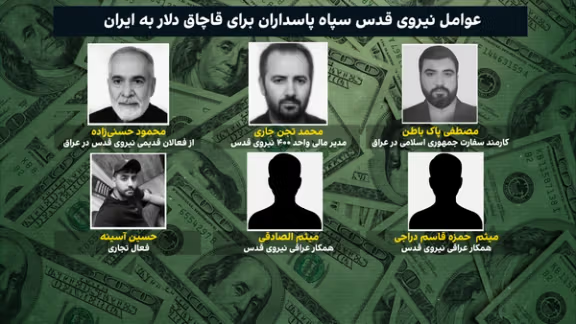
Main members of Iran’s Money Laundering Network In Iraq

Iran International has obtained information that unravels some details about the inner workings of a Revolutionary Guard’s Quds force unit tasked with smuggling money from Iraq to Iran. 

According to the information, the Islamic Republic’s embassy in Iraq is also involved in the money laundering operations that aim to funnel the regime’s revenues from oil and gas exports to Iran. As per a repeatedly extended sanctions’ waiver by Washington, Tehran is only allowed to import medicine and some essential goods in exchange for its export to its neighboring country. 

Iran International television revealed that Mohammad Tajan-Jari, the financial manager of the 400th unit of IRGC’s Quds Force, was in charge of transferring the funds to the unit’s account in a branch of Ansar Bank in the capital Tehran. The bank had been founded by the IRGC in 2010 and was officially merged into the IRGC’s official Bank Sepah. The IRGC had established several banks and credit institutions to help it in its money laundering operations and circumvent US sanctions but after they served their purpose and their affiliations were disclosed, all of them, including Ansar Bank, Mehr Eghtesad Bank, Hekmat Iranian Bank, Ghavamin Bank and Kowsar Credit Institution, were merged into Bank Sepah from 2018 to 2020. 

In Iraq, the network is apparently managed by an old Quds Force operative identified as Mahmoud Hasanizadeh, who oversees the job with the help of two Iraqi citizens. Tajan-Jari's executive officer in Iraq is Mostafa Pakbatan, an employee of the Embassy of the Islamic Republic and a member of the Quds Force, who receives the dollars from exchange offices in Iraq. He is not the only employee of the embassy involved in the money laundering network. The current ambassador, Mohammad-Kazem Al-e Sadegh, who was appointed to the post less than a year ago was also a commander of the Quds force and one of the close aides to former chief Qassem Soleimani, who was killed by a US drone strike in January 2020 in Baghdad.

About a year ago, during the tenure of Iraj Masjedi as the ambassador of the Islamic Republic, Al-Arabiya published a document that showed more than 60 billion Iraqi dinars (about $40 million) from the assets of Iranian energy companies were deposited into the account of the Iranian embassy in the Trade Bank of Iraq, which was supposed to be used for the expenses of the embassy. However, it ended up in the hands of Quds force officers. 

This financial network is bypassing the US sanction regimes at the cost of the Iraqi economy. An informed source in Baghdad told Iran International late in December that Washington has received reports that Iraq is still conducting trade with Iran using US dollars despite sanctions.

Iraqi protesters demonstrate against the dinar's slide in value against the US dollar, near the central bank in Baghdad, Iraq January 25, 2023.
100%
Iraqi protesters demonstrate against the dinar's slide in value against the US dollar, near the central bank in Baghdad, Iraq January 25, 2023.

According to a report by London-based newspaper Asharq Al-Awsat, the decline in the value of Iraq’s national currency and the accompanying price increases for foodstuffs and imported goods can be traced back to remarkable change in the policy adopted by the US Treasury and the Federal Reserve Bank of New York. The impact of US banking sanctions on Iran has affected neighboring Iraq, weakening its currency and leading to protests against the government. 

The dinar went into a tailspin against the dollar after the New York Federal Reserve imposed tighter controls on international dollar transactions by commercial Iraqi banks in November to halt the illegal siphoning of dollars to Iran.

Under the curbs that took effect this month, Iraqi banks must use an online platform to reveal their transaction details. But most private banks have not registered on the platform and resorted to informal black markets in Baghdad to buy dollars.

This has created dollar shortages as demand has outstripped supply and accelerated the dinar's fall against the greenback. Last week, hundreds of Iraqis demonstrated near central bank headquarters in Baghdad to protest at the recent slide of the Iraqi dinar against the dollar that has triggered a rise in prices of imported consumer goods.

Following demonstrations a delegation of Iraqi officials is set to travel to Washington to resolve issues related to US banking restrictions. 

Most Viewed

US blockade enters murky phase as tankers spoof signals and buyers hesitate
1
ANALYSIS

US blockade enters murky phase as tankers spoof signals and buyers hesitate

2

US tightens financial squeeze on Iran, warns banks over oil money flows

3
INSIGHT

Ideology may be fading in Iran, but not in Kashmir's ‘Mini Iran'

4
INSIGHT

Hardliners push Hormuz ‘red line’ as US blockade tests Iran’s leverage

5
VOICES FROM IRAN

Hope and anger in Iran as fragile ceasefire persists

Banner
Banner

Spotlight

  • Hardliners push Hormuz ‘red line’ as US blockade tests Iran’s leverage
    INSIGHT

    Hardliners push Hormuz ‘red line’ as US blockade tests Iran’s leverage

  • Ideology may be fading in Iran, but not in Kashmir's ‘Mini Iran'
    INSIGHT

    Ideology may be fading in Iran, but not in Kashmir's ‘Mini Iran'

  • War damage amounts to $3,000 per Iranian, with blockade set to add to losses
    INSIGHT

    War damage amounts to $3,000 per Iranian, with blockade set to add to losses

  • Why the $100 billion Hormuz toll revenue is a myth
    ANALYSIS

    Why the $100 billion Hormuz toll revenue is a myth

  • US blockade targets Iran oil boom amid regional disruption
    ANALYSIS

    US blockade targets Iran oil boom amid regional disruption

  • Iran's digital economy battered by prolonged blackout
    INSIGHT

    Iran's digital economy battered by prolonged blackout

•
•
•

More Stories

Iran Warns Pakistan To Complete Pipeline Or Face $18B Penalty: Media

Jan 31, 2023, 15:47 GMT+0

Pakistani media report that Tehran has warned Islamabad to construct its portion of the Iran-Pakistan gas pipeline until March 2024 or pay a penalty of $18 billion.

Iranian officials have communicated the message to a visiting Pakistani delegation about three weeks ago, a senior official of Pakistan’s Ministry of Energy told the media.

According to the official, Iran has stated that the US sanctions on Tehran are illegal and Pakistan, is bound to construct the 780-kilometer pipeline on its portion till February-March 2024.

The Islamic Republic has already completed part of the pipeline in its territory from the gas fields in the west to the border with Pakistan in the east.

The 25-year contract to export Iran's natural gas through a pipeline to Pakistan was signed between the two countries in 2009 and was supposed to be implemented by 2015, but international and US sanctions against Iran and Washington’s pressure on Islamabad have prevented its implementation so far.

The two sides inked a revised deal in September 2019. Iran agreed not to approach any international court if Pakistan would finish the pipeline until 2024.

Now the Iranian authorities have warned that there is only a short time left until March 2024, adding that if Pakistan does not complete the pipeline within 15 months, Tehran will demand $18 billion in compensation for the losses from laying the pipeline to the Pakistani border.

Iran Plans To Sell Off Public Properties To Stay Afloat

Jan 31, 2023, 01:19 GMT+0
•
Iran International Newsroom

The Islamic Republic has embarked on a journey to raise capital by selling public properties, a move that has people and pundits concerned about its repercussions.

The country’s parliament is trying to fiddle with existing laws to make the measures seem in accordance with the constitution. Supreme Leader Ali Khamenei has given his blessing, trying to sell the idea as long overdue, which should have been guiding principle in the early years of the regime. 

The shady privatization plan, which is promulgated to improve the generation of wealth and production in Iran, has been met with a lot of skepticism by the public, who have seen corrupt “privatization” in the past 15 years, when state properties were sold at ridiculously low prices to well-connected individuals.

The clerical regime – struggling with domestic unrest and grappling with rising inflation on the backdrop of global isolation – is in desperate need of money. People are terrified that the plan is the Islamic Republic’s last-ditch effort to liquidate public assets to keep itself afloat. 

On Monday, Ali Khamenei met with a group of businesspeople urging them to help kickstart the country’s economy. He stressed on the necessity of economic growth to reduce the hardship people face.

Khamenei, who almost never acknowledges the country’s problems and always blames the “enemies” for everything, said that Iran is at least a decade behind in its economic development. Calling for the privatization of industries, he said important mistakes were made in the early years of the Islamic Republic by making all major economic sectors run by the government.

Iran’s ruler Ali Khamenei in a meeting with businesspeople and entrepreneurs on January 30, 2023
100%
Iran’s ruler Ali Khamenei in a meeting with businesspeople and entrepreneurs on January 30, 2023

"The country will not be run without the activities of private enterprises, and these enterprises will not engage in such businesses without the support of the government, and if they do, they will not be successful,” he added. 

Iranian media and economic experts are characterizing the privatization plan that officials keep vague as "a plunder of public property" and "economic apartheid." 

According to reports, the new privatization plan approved by the heads of the three powers of the government, President Ebrahim Raisi, Majles Speaker Mohammad Bagher Ghalibaf and Judiciary Chief Gholamhossein Mohseni Ejei bars critics of disclosing details of transactions and suspends for two years all legislation that might prevent these transactions.

The transactions are going to take place under the supervision of a seven-man team, comprised of Vice President Mohammad Mokhber, Economy Minister Ehsan Khandouzi, Interior Minister Ahmad Vahidi, Roads Minister Mehrdad Bazrpash, Planning and Budget Chief Massoud Mirkazemi, and two representatives of the Parliament Speaker and Judiciary Chief, who are not appointed yet. The members of the taskforce are said to have absolute judicial immunity. 

Critics say that secrecy and immunity will give way to financial corruption as the seven-member board has the right to determine the prices for the transfer of assets to the private sector. 

In an article on Monday, Rouydad24 website labeled the move as “putting on auction the people’s properties,” elaborating some of its “horrible” points. The article said that the move is one of the most questionable decisions ever approved by the country’s leaders. 

“It has never happened in the history of Iran that seven people make decisions for the entire capital and future of a nation without being accountable for anything,” read the article. 

One of the clauses of the resolution gives the group the power for two years to overrule all laws and regulations that are already in place to block the sale of public properties. It means the current administration is coordinating with other branches of the government to suspend all current laws to do whatever it wants, fueling speculations that the government predicts it would not be able to stay office in the next election. 

Gholam Ali Jafarzadeh, a former lawmaker, has said that such an extrajudicial taskforce may be justified during wartime, asking what strange thing has happened now that justifies such a decision. 

The article described the long list of the public assets that are to be sold as “frightening,” especially because the government doesn’t have information about the exact value of the assets. “What is more frightening is that the properties are supposed to be sold without legal formalities,” it added. 


High Inflation Leading To Malnutrition In Iran: Daily

Jan 30, 2023, 20:05 GMT+0

While the food prices in Iran are soaring, reports say many are facing malnutrition and lawmakers have also predicted a 60% inflation for the next Iranian year which begins in March.

Ham-Mihan centrist daily reported Monday that the malnutrition rate in the country is on the rise and the consumption of dairy products has fallen to half of the world average.

"Dairy consumption in Iran has fallen to about half of the average per capita consumption in the world, and the elimination or reduction of red meat has affected the health of families and children," added the daily.

The report titled "On the road to hunger" said based on the health ministry figures “About 16% of children under the age of six are malnourished, and 800,000 children of growing age are facing lack of energy and protein.”

On Sunday, Morteza Hosseini, a member of parliament said “we may experience price increases in some goods up to 60%.”

Earlier, another MP Kioumars Sarmadi had warned that a planned 20% salary increase for civil servants despite the 40% inflation rate, means a 50% decrease in their purchasing power in the next year.

Iran's Statistical Center announced on January 21 that the annual inflation rate is 46.3% and the point-to-point inflation rate stands at 51.3%.

Meanwhile, economists and businessmen believe that the real inflation rate in Iran is much higher than the government figures show.

Iran Summons Ukraine’s Envoy Demanding Clarification Over Drone Attack

Jan 30, 2023, 12:40 GMT+0
•
Iran International Newsroom

Iran's Foreign Ministry has summoned Ukraine's charge d'affaires over remarks by a Kyiv official seen by Tehran as Kyiv’s role in a recent drone attack in Esfahan.

The ministry summoned the Ukrainian envoy to ask for explanation in reaction to comments by Mykhailo Podolyak, an adviser to President of Ukraine Volodymyr Zelenskyy, about the drone attacks against the Defense Ministry's facility in Esfahan (Isfahan) on Saturday night.

In a tweet in which Podolyak was mentioning some telegraphic developments of the Russian invasion, he said, “Explosive night in Iran - drone and missile production, oil refineries.” He continued, “Ukraine did warn you,” referring to repeated calls on Tehran to stop supplying arms to Moscow.

Podolyak said, "War logic is inexorable and murderous. It bills the authors and accomplices strictly," adding, “Panic in the Russian Federation -- endless mobilization, missile defense in Moscow, trenches 1,000 kilometers away, bomb shelters preparation.”

Nour News Agency, affiliated with the Iranian Supreme National Security Council (SNSC), said earlier that "If Ukraine’s government fails to officially renounce the tweet by Zelenskyy's advisor, which implied Kyiv's complicity in the move against Iran, it will have severe consequences for them."

Tehran is questioning Kyiv’s involvement in the attack despite reports that point the finger at Israel. The Wall Street Journal said in an exclusive report Sunday that Israel carried out the drone attack on the military center for research and development.

Screen grabs from videos sent by citizens in Esfahan of the explosions at the military facility on January 29, 2023
100%
Screen grabs from videos sent by citizens in Esfahan of the explosions at the military facility on January 29, 2023

Russia on Monday also condemned the drone strike and warned against what it called "provocative" actions that could trigger an escalation in an already tense situation.

"Such destructive actions could have unpredictable consequences for peace and stability in the Middle East," Moscow's Foreign Ministry said.

Tehran has supplied hundreds of drones to Russia since mid-2022 that have been used during missile attacks to inflict more damage or to swamp Ukrainian air defenses. The United States and Europe have imposed new sanctions on Tehran for its expanded military ties with Moscow and also its deadly crackdown on protests since last September.

The attack targeted what some sources said was Material and Energy Laboratory of Esfahan with what the defense ministry called “small drones.” Videos citizens sent to Iran International showed an explosion, although the government claimed its air defenses had fended off the attack. Small or quadcopter drones, however, cannot fly hundreds of kilometers to reach Esfahan, located in central Iran. If indeed the attack was carried out with small drones, it would mean operators were present on the ground, in Iran.

According to the Israeli weblog Intellitimes, the target of the drone attack was the "Iranian Space Research Institute" affiliated with the ministry of defense. The Jerusalem Post, citing Western and foreign intelligence sources, also wrote that contrary to Iran’s claim the attack on "advanced weapons development" facility was a "tremendous success".

The attack on Saturday comes as the United States and Israel have expanded close military coordination, including drills just days earlier, as well as discussing ways to combat Iran’s capabilities.

Tehran’s supply of large, kamikaze Shahed-136 drones with a 45-kilogram warhead to Russia are a concern for the US and NATO. Russia has used hundreds of these drones to target Ukraine’s civilian infrastructure.

In addition to the attack, an aircraft targeted a convoy of trucks crossing from Iraq to Syria carrying suspected Iranian cargo on Sunday.

Government controlled media in Tehran claimed that the 25-truck convoy attacked on the Iraqi-Syrian border was carrying flour and food, while the route taken is a customary juncture for weapons deliveries to Iranian proxies in Syria and Lebanon. Suspected Israeli attacks have targeted trucks and warehouses near the Iranian controlled al-Qaim border crossing multiple times.

Israeli Attacks Send A Message To Tehran After Military Drills With US

Jan 30, 2023, 09:05 GMT+0
•
Iran International Newsroom

Following the drone attack on an Iranian military facility on Saturday. Aircraft targeted a convoy of trucks crossing from Iraq to Syria carrying Iranian cargo.

Both attacks seem to have been conducted by Israel and Iranian officials except denying damage, have so far not issued their customary threats against Israel. While saber-rattling by IRGC commanders against Israel may still take place, so far, they have been silent, amid the embarrassing public fallout from the attack.

However, Mohammad Marandi an influential regime insider tweeted, “Not a good week for the apartheid regime [Israel] either at home or abroad.”

Those Iranians who have been protesting for more than four months against the clerical regime were quick to point out the inability of the Revolutionary Guard to defend its own military installations hundreds of kilometers from the nearest border.

It is not clear what the role of military installation in Esfahan was. The Iranian defense ministry said that it was an ammunition production center, while other reports pointed to drone and possibly missile production.

However, media controlled by hardliners in Iran continued to publish news about Israeli “barbarity” against Palestinians. Iranian foreign minister Hossein Amir-Abdollahian held a call with Palestinian militant leaders of Hamas and Islamic Jihad to express support after bloody events in the past few days, Tasnim news agency linked to the Revolutionary Guard reported.

Ziyad al-Nakhalah the leader of the Islamic Jihad thanked Amir-Abdollahian for “the principled positions of the Islamic Republic in defending the Palestinian people and the Islamic resistance.” He added, “We are proud of positions [taken by] the Islamic Republic.”

Government controlled media in Tehran claimed that the 25-truck convoy attacked on the Iraqi-Syrian border was carrying flour and food, while the route taken is a customary juncture for weapons deliveries to Iranian proxies in Syria and Lebanon. Suspected Israeli attacks have targeted trucks and warehouses near the Iranian controlled al-Qaim border crossing multiple times.

Al-Arabiya that first reported the attack said that the aircraft first fired a warning shot to give a chance to the truck drivers to leave their vehicles. A Europe-based Syrian activist and researcher reported the trucks belonged to Iranian proxy militias, and the attack also targeted a meeting of Iranian commanders inside the Syrian border region.

Following a report by the Wall Street Journal Sunday, the New York Times also quoted US officials that the drone attack in Esfahan on Saturday was the work of the Mossad.

The NYT also mentioned that the facility might have been related to missile production and referred to Iran supplying Russia with drones used against Ukraine, as well as possible missile deliveries to Moscow in the future.

Major American media quoting US officials about Israel having conducted the attack seemed to be an attempt to highlight that the United States was not involved. But large joint military drills with Israel last week are highlighted in Iranian media. The Islamic Republic is bound to see the attack as part of expanding US-Israeli close cooperation.