• العربية
  • فارسی
Brand
  • Iran Insight
  • Politics
  • Economy
  • Analysis
  • Special Report
  • Opinion
  • Podcast
  • Iran Insight
  • Politics
  • Economy
  • Analysis
  • Special Report
  • Opinion
  • Podcast
  • Theme
  • Language
    • العربية
    • فارسی
  • Iran Insight
  • Politics
  • Economy
  • Analysis
  • Special Report
  • Opinion
  • Podcast
All rights reserved for Volant Media UK Limited
volant media logo

Tehran Lawmaker Claims US And Europe Knocking On Iran's Door
Iran International Newsroom
Jul 30, 2023, 08:50 GMT+1Updated: 18:15 GMT+1
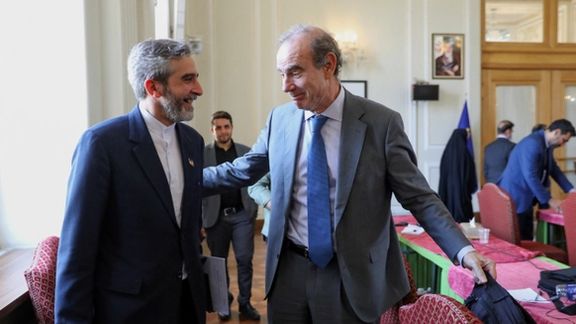
EU foreign policy official Enrique Mora (R) visiting Tehran in June 2022

As Iran grapples with its economic crisis, government officials periodically try to show optimism about a nuclear deal with the West, while pundits express caution.

Officials are well aware that people blame the regime for the continuation of US sanctions that has pushed annual inflation to 70 percent and has weakened the currency 12-fold in five years.

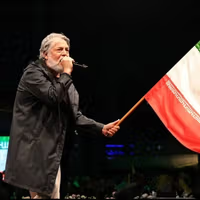
Iranian media on Sunday quoted Shahriar Haydari, the vice chair of parliament’s national security and foreign policy committee as insisting that there are unmistakable signs of a Western desire to conclude a nuclear deal. He claimed that European powers and the United States continue contacts with Tehran to re-start negotiations, possibly in Oman, which he said has indicated it readiness to host the talks.

US State Department repeatedly said in June and July that there are no deals in the offing, although contacts with Tehran continue and talks have taken place in Oman. The main purpose of these talks reportedly revolves around freeing four Americans held hostage by Iran, but even this process has not made any visible progress.

Prisoner release plans have always included the proposal of freeing Iran’s frozen funds in South Korea as the big prize for Tehran to let the prisoners who have been arrested on baseless charges go free.

Shahriar Haydari, member of Iranian parliament's national security committee. Undated
100%
Shahriar Haydari, member of Iranian parliament's national security committee. Undated

However, the Iranian government sent a draft bill to parliament July 29 that would authorize the executive to refer the case of the funds in Seoul to arbitration. This could be a sign that prisoner release talks have hit a snag and Tehran is resorting to desperate measures.

Nevertheless, lawmaker Haydari tried to sound optimistic about the outlook for a deal, blaming the “Zionist lobby” and Americans who oppose the revival of a nuclear agreement for its delay. Haydari said that a deal might not happen until after the US presidential elections, but the Americans and Europeans are knocking on Tehran’s door asking for negotiations.

Even before the November 2020 elections, candidate Joe Biden announced that he totally disagreed with President Donald Trump’s 2018 decision to leave the Obama-era JCPOA accord and would try to return to the agreement. However, 18 months of indirect talks with Iran failed in September 2022 and later Washington repeatedly insisted that the JCPOA was no longer on its agenda.

Iranian analysts have been voicing pessimist since 2022 over the prospects of a deal, some seeing intransigence by Tehran and an unwillingness to change its foreign policy.

A new factor that emerged in late June could have added another complication to efforts to reach deals with Iran. The US administration’s special envoy for Iran Rob Malley was put on unpaid leave for an apparent security breach that is now under FBI investigation. Malley was committed to reviving the JCPOA and willing to offer financial relief to Tehran for progress.

A former senior Iranian foreign ministry official, Qassem Mohebali was quoted by Khabar Online website in Tehran on Sunday as saying that Malley’s departure could hurt the talks.

“Although America’s policies are not made by single individuals, but a person who is positively inclined toward Iran and solving its problem, and a person who did not have good relations with Israel and those opposing the nuclear deal, naturally could have played a more positive role in concluding an agreement,” Mohebali stated. “His dismissal could be interpreted as a negative sign in the nuclear talks,” he added.


Most Viewed

Iran International says it won’t be silenced after London arson attack
1

Iran International says it won’t be silenced after London arson attack

2
VOICES FROM IRAN

Hope and anger in Iran as fragile ceasefire persists

3

US sanctions oil network tied to Iranian tycoon Shamkhani

4

Iran halts petrochemical exports to supply domestic market

5
INSIGHT

How Tehran bends its own red lines to boost state rallies

Banner
Banner

Spotlight

  • Hardliners push Hormuz ‘red line’ as US blockade tests Iran’s leverage
    INSIGHT

    Hardliners push Hormuz ‘red line’ as US blockade tests Iran’s leverage

  • Ideology may be fading in Iran, but not in Kashmir's ‘Mini Iran'
    INSIGHT

    Ideology may be fading in Iran, but not in Kashmir's ‘Mini Iran'

  • War damage amounts to $3,000 per Iranian, with blockade set to add to losses
    INSIGHT

    War damage amounts to $3,000 per Iranian, with blockade set to add to losses

  • Why the $100 billion Hormuz toll revenue is a myth
    ANALYSIS

    Why the $100 billion Hormuz toll revenue is a myth

  • US blockade targets Iran oil boom amid regional disruption
    ANALYSIS

    US blockade targets Iran oil boom amid regional disruption

  • Iran's digital economy battered by prolonged blackout
    INSIGHT

    Iran's digital economy battered by prolonged blackout

•
•
•

More Stories

Iran-Backed Militia Threaten US Forces After Sanctions On Iraqi Banks

Jul 29, 2023, 07:13 GMT+1
•
Iran International Newsroom

Amid joint efforts by Washington and Baghdad against Iran’s illicit financial activities in Iraq, a Tehran-backed militia group threatened US forces in Iraq.

The Harakat Hezbollah al-Nujaba group, a part of Iran-backed Shiite militia Hashd al-Shaabi – also known as Popular Mobilization Forces – warned of consequences to the US military presence and its dominance over Iraq's oil sector and its economy.

Akram al-Kaabi, Harakat Hezbollah al-Nujaba's leader – a US-designated terrorist who is regarded as one of the main operatives of Iran’s Revolutionary Guards' Quds Force in Iraq – said, “this is the last warning” to Americans who have flooded the country with ongoing political and economic crises. “We have repeatedly warned about the US interference in the country’s internal affairs and provoking strife,” he said.

The leader of the group -- unofficially operated by the IRGC's Quds Force that provides funding, weapons, and training to its members – added that if the US forces do not leave Iraq and Washington does not stop “blatant interference and evil in our country, there will be broad and decisive measures by the heroes of Iraq who did not and will not accept humiliation and indignity.”

The remarks came in a statement on Wednesday after 14 Iraqi private banks sanctioned by Washington over helping to siphon US dollars to Iran said they were ready to challenge the measures and face audits and called on Iraqi authorities to provide assistance.

Akram al-Kaabi, the leader of Iran-backed Harakat Hezbollah al-Nujaba's militia group  (undated)
100%
Akram al-Kaabi, the leader of Iran-backed Harakat Hezbollah al-Nujaba's militia group

US financial authorities last week barred the Iraqi banks from conducting dollar transactions as part of a wider crackdown on dollar smuggling to Iran via the Iraqi banking system. The latest sanctions, along with earlier sanctions against eight banks, have left nearly a third of Iraq's 72 banks blacklisted, two Iraqi central bank officials said.

Haider al-Shamma, speaking on behalf of the 14 sanctioned banks, said on Wednesday the sanctions could further weaken Iraq's currency, which has fallen from under 1,500 dinars per US dollar last week to 1,580 as of Wednesday.

The dinar tailspin against the dollar has worsened since the New York Federal Reserve imposed tighter controls on international dollar transactions by commercial Iraqi banks in November to halt the illegal siphoning of dollars to Iran.

Iraq's central bank says the dinar's depreciation is also tied to merchants, including some undertaking illegitimate financial transactions, sourcing currency from the black market rather than the official platform. Under the curbs that took effect in January, Iraqi banks must use an online platform to reveal their transaction details. But most private banks have not registered on the platform and resorted to informal black markets in Baghdad to buy dollars.

Iran International revealed in May that Qassem Soleimani, an aide to former IRGC’s Quds force commander, is a key figure in money laundering for Tehran. Earlier in the year, Iran International also unraveled some details about the inner workings of a Quds force unit tasked with smuggling money from Iraq to Iran, proving that the Islamic Republic’s embassy in Iraq is also involved in money laundering operations aimed at funneling revenues from oil and gas exports back to Iran.

This financial network is bypassing the US sanctions at the cost of the Iraqi economy. An informed source in Baghdad told Iran International late in December that Washington has received reports that Iraq is still conducting trade with Iran using US dollars despite sanctions.

Congressional Briefing On US Envoy Malley Reveals Little

Jul 28, 2023, 19:14 GMT+1

A classified briefing Friday at the US House Foreign Affairs Committee by administration officials did not reveal the reasons for the suspensions of US Iran envoy Rob Malley.

The Jewish Insider reported that committee Chairman Michael McCaul said officials had not been able to offer details on Malley’s status regarding an investigation over his security clearance.

Iran International first reported June 29 that Malley’s security clearance had been suspended and he has been under investigation related to his handling of classified documents. The Federal Bureau of Investigation is reportedly involved in the investigation, although until now no official details have been announced, except that Malley is on “unpaid leave.”

Chairman McCaul (R-TX) had threatened the Biden administration with subpoena if they failed to brief his committee on Malley’s status. While he had been suspended perhaps as early as April, the administration did not inform Congress about it.

“We don’t really have any details” on the Malley investigation “because it’s an ongoing investigation,” McCaul said according to the Insider. He also said that the administration will likely not be able to provide a full briefing until the investigation ends.

A spokesperson from the Committee told Iran International that officials refused to provide any significant new information, including the reason Malley's security clearance was revoked, citing the Privacy Act, but the Committee will try again to obtain more information.

McCaul was quoted by the Insider as saying, “They couldn’t get into the details,” adding, “the question is, is the FBI involved because if they are, then that’s a national security problem.”

Malley who was chief US nuclear negotiator with Iran has been replaced by Abram Paley as acting envoy.

Mourners In Iran Refuse To Trample On Swedish, American Flags

Jul 28, 2023, 17:37 GMT+1

Shiite mourners in Iran refused to trample on the flags of Sweden and the United States during an Ashura mourning procession.

The incident, captured in a video obtained by Iran International, shows supporters of the oppressive Iranian regime placing the Swedish and US flags on the procession route in an attempt to exploit the religious sentiments of the crowd and encourage further public outrage at the recent Quran burnings.

However, the mourners rejected these attempts, refusing to step on the flags and the propagators of the political agenda, were forced to the flags.

This incident is not the first time that Iranians have expressed their refusal to disrespect the US flag.

Back in 2020, following the tragic shooting down of a Ukrainian International Airlines passenger jet by the IRGC, people outside Beheshti University in Tehran similarly resisted trampling upon giant American and Israeli flags that had been painted on the ground.

Prominent figures, including Professor Sadegh Zibakalam, an academic and author who is described as reformist and neo-liberal, have also exemplified their commitment to avoiding acts of disrespect towards foreign symbols. In 2016, Zibakalam chose to show his respect for other nations by shuffling along a nearby railing to avoid stepping on flags painted on the ground

German MP Seeks Clarity On Iranian Hanging Judge's Treatment

Jul 28, 2023, 16:59 GMT+1

Concerns have been raised within Germany over the alleged treatment of an Iranian human rights violator in Hanover.

The individual in question, Hossein-Ali Nayeri, reportedly received medical care at the International Neuroscience Institute (INI), a private neurosurgical clinic in Hanover headed by prominent Iranian-born neurosurgeon Prof. Madjid Samii.

Nayeri was involved in the summary trial and execution of thousands of Iranian prisoners during the 1980s, which led to widespread condemnation. His medical treatment in Germany was revealed by German media outlet Presseportal reported last week on Nayeri’s admission to the INI.

Reacting to the news, Norbert Röttgen, a member of the German Bundestag, or federal parliament, expressed his concerns in a tweet on Thursday, calling Nayeri a “mass murderer” and stating that, "if he is here and leaves again, it will be a first-class scandal."

Volker Beck, the president of the German-Israeli Society, took immediate action after being informed of Nayeri's presence in Germany. On July 7, he notified Germany’s Federal Public Prosecutor, the Foreign Office, and the Federal Interior Ministry, urging them to initiate criminal prosecution measures against Nayeri.

"This must come to an end," he asserted, referencing a previous case involving another Iranian judge, Mahmoud Hashemi Shahroudi, who received treatment at the same clinic in Hanover back in 2018.

The allegations also sparked outrage among Iranian opponents of the Islamic Republic, who accused the INI of deleting Nayeri’s medical records.

Bild, Germany’s highest circulating newspaper, reported that the expunging of Nayeri's medical records appeared to be an attempt to avoid a new scandal against the Iranian regime; however, Prof. Samii, INI’s director, denied this allegation.

Targeting Iran’s Leadership, MAHSA Act Introduced At US Senate

Jul 28, 2023, 13:03 GMT+1
•
Iran International Newsroom

The bipartisan Mahsa Amini Human Rights and Security Accountability (MAHSA) Act has been submitted to the US Senate, seeking more sanctions on Iranian leadership.

Following a unanimous approval at US House of Representatives Foreign Affairs Committee in April, Senators Marco Rubio (R-FL) and Alex Padilla (D-CA) introduced the bipartisan legislation to the Senate on Thursday, potentially tightening the noose on top leaders of the regime -- the Supreme Leader and the President as well as their inner circles – over human rights abuses and support for terrorism.

“The Ayatollah’s systematic human rights violations against the Iranian people are barbaric," Rubio said, underlining that “as a State Sponsor of Terrorism, the Iranian regime has actively wreaked havoc against its own people and countless other nations.”

The MAHSA Act – which has 68 Republican and 60 Democrat cosponsors – and is supported by the National Union for Democracy in Iran (NUFDI), United Against Nuclear Iran (UANI) and the American Israel Public Affairs Committee (AIPAC), was first introduced by Representatives Jim Banks (R-IN) and Eric Swalwell (D-CA) during the 117th Congress in January, about four months into pro-democracy and anti-regime protests following the death of 22-year-old Iranian-Kurdish woman Mahsa Amini at the hands of Iran's hijab police.

US Sen. Marco Rubio (R-FL) speaking during a Senate Committee  (May 2020)
100%
US Sen. Marco Rubio (R-FL) speaking during a Senate Committee

Essentially similar and a companion to the one passed in the House committee, the MAHSA Act will potentially commit the administration to report to Congress in 90 days after the date of the enactment and periodically thereafter, making determinations about whether certain existing sanctions apply to specified persons and impose the applicable sanctions.

“The US must evaluate and re-amp economic pressure against Senior Iranian regime officials who are actively partaking in the crackdown of Iranian protesters and civilians,” Rubio added in a statement.

Senator Padilla said, “Iranian protesters have demonstrated tremendous courage in voicing their outrage toward the Iranian regime after the brutal murder of Mahsa Amini,” noting that “we must do our part to hold Iranian leaders accountable for their violent crackdown of these protests and the regime’s ongoing repression, censorship, and abuse against its people.”

Senator Alex Padilla (D-CA)  (March 2021)
100%
Senator Alex Padilla (D-CA)

The bipartisan bicameral move requires the executive branch to impose applicable sanctions on Ali Khamenei, his office and his appointees, as well as President Ebrahim Raisi and his cabinet officials, foundations and other entities affiliated with the Supreme Leader under section 105(c) of the Comprehensive Iran Sanctions, Accountability, and Divestment Act of 2010, section 7031 (c) of the Department of State, Foreign Operations, and Related Programs Appropriations Act, 2021, and Executive Orders 13876, 13553, 13224, and 13818.

“The Supreme Leader is an institution of the Islamic Republic of Iran...that holds ultimate authority over Iran’s judiciary and security apparatus, including the Ministry of Intelligence and Security, law enforcement forces under the Interior Ministry, the Islamic Revolutionary Guard Corps (IRGC), and the Basij, a nationwide volunteer paramilitary group, subordinate to the IRGC, all of which have engaged in human rights abuses in Iran,” read a paragraph of the MAHSA Act.

Some lobbyists and a few lawmakers have been seeking to dilute the act, describing it as “Islamophobic” or “not leading to any increased sanctions” because Khamenei and Raisi were already sanctioned by the US. NIAC, advocating non-confrontational policies toward the Islamic Republic, said in a statement that “the bill would make it more difficult for a President to lift sanctions on these officials as part of any diplomatic agreement... This bill does not include a sunset and would target the offices themselves, rather than individuals. As a result, it would remain in effect indefinitely and be applied to any future Supreme Leader or President of Iran until its repeal."

Amini’s death in September 2022 led to the boldest revolt against the clerical regime since its establishment in 1979 in Iran in what became known as the Woman, Life, Freedom movement. More than 500 people have been killed in the nationwide rallies, nearly 20,000 detained, and seven executed on trumped up charges.