• العربية
  • فارسی
Brand
  • Iran Insight
  • Politics
  • Economy
  • Analysis
  • Special Report
  • Opinion
  • Podcast
  • Iran Insight
  • Politics
  • Economy
  • Analysis
  • Special Report
  • Opinion
  • Podcast
  • Theme
  • Language
    • العربية
    • فارسی
  • Iran Insight
  • Politics
  • Economy
  • Analysis
  • Special Report
  • Opinion
  • Podcast
All rights reserved for Volant Media UK Limited
volant media logo

Iran's Unsold Oil Stockpile Stands At 50M Barrels Amid Supply Glut
Iran International Newsroom
Jun 4, 2023, 19:43 GMT+1Updated: 17:44 GMT+1
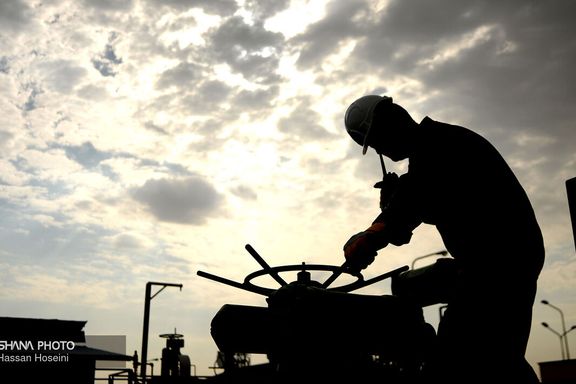
A worker at an Iranian oil facility (March 2023)

Unsold Iranian oil stored on tankers and in ports is 50 million barrels as the world faces a supply glut and OPEC+ decided to keep production cuts to support prices.

Kpler, a data and analytics firm, has issues figures showing that Iran currently has 19 million barrels of gas condensate and over 30 million barrels of unsold crude oil on vessels, the Persian Service of Radio Free Europe in Prague reported. 

Mehr state news agency quoted Oil Minister Javad Owji on Friday as claiming that since Ebrahim Raisi's administration took office, the process of selling 78 million barrels of gas condensate stocked on oil tankers has started and has now reached zero.

However, figures obtained from Kpler indicate that Iran’s stockpiled condensate on tankers was 44 million barrels by the end of 2021, but it decreased to 18 million last month and now it has reached 19 million.

Meanwhile, Iran’s stocked crude oil on tankers around the Persian Gulf region has reached 30.5 million barrels, down by 16 million in the same period.

Mehr also said that some of these tankers were stranded on the waters for over three years inflicting an annual cost of 400 to 500 million dollars on the country.

A 3D-printed oil pump jack is seen in front of the OPEC logo in this illustration picture
100%

Saudi Arabia said Sunday it will make deep production cuts in July as part of a broader output-limiting OPEC+ deal as the group faces flagging oil prices and a looming supply glut.

Saudi Energy Minister Prince Abdulaziz said the cut of 1 million barrels per day (bpd) by Riyadh could be extended beyond July if needed. "This is a Saudi lollipop," he said.

OPEC+ production cuts have angered the United States and its European allies for adding to existing high global inflation.

Referring to the contract signed between Iran and Venezuela in October 2021 for the monthly export of two million barrels of gas condensate, Mehr estimated that 40% of Iran's unsold gas condensate reserves have been delivered to Venezuela. It is not clear if Caracas pays international prices for imports from Iran, but in the past, there have been reports of gold deliveries to Iran for fuel purchases.

However, figures by Kpler reveal that since October 2021, a total of nearly 28 million barrels of Iranian gas condensate have been delivered to Venezuela.

Kpler's figures also show that Iran has not had a new shipment of gas condensate to Venezuela in the past three months.

Iran's oil exports in recent months - mostly to China - have exceeded one million barrels according to some industry sources, but its financial condition deteriorates as it is not clear how much hard currency it earns.

OPEC+, which groups the Organization of the Petroleum Exporting Countries and allies led by Russia, reached a deal on output policy after seven hours of talks and decided to reduce overall production targets from 2024 by a further total of 1.4 million barrels per day.

However, many of these reductions will not be real as the group lowered the targets for Russia, Nigeria and Angola to bring them into line with their actual current production levels.

By contrast, the United Arab Emirates was allowed to raise output.

OPEC+ pumps around 40% of the world's crude, meaning its policy decisions can have a major impact on oil prices.

OPEC+ already has in place a cut of 2 million bpd agreed last year and amounting to 2 percent of global demand.

With reporting by Reuters

Most Viewed

Ghalibaf defends Iran-US talks amid hardline backlash
1
INSIGHT

Ghalibaf defends Iran-US talks amid hardline backlash

2
INSIGHT

Iran diplomacy wobbles as factions compete to avoid looking soft on US

3
VOICES FROM IRAN

Bread shortages, soaring prices strain households in Iran, residents say

4
ANALYSIS

The politics of pink: how Iran uses cuteness to rebrand violence

5

Scam messages seek crypto for ships’ safe passage through Hormuz, firm warns

Banner
Banner

Spotlight

  • Tehran moderates see ‘no deal–no war’ limbo as worst outcome
    INSIGHT

    Tehran moderates see ‘no deal–no war’ limbo as worst outcome

  • The future has been switched off here
    TEHRAN INSIDER

    The future has been switched off here

  • Lights out, then gunfire: Witnesses recount Mashhad protest crackdown
    VOICES FROM IRAN

    Lights out, then gunfire: Witnesses recount Mashhad protest crackdown

  • Family told missing teen was alive, then received his body 60 days later
    EXCLUSIVE

    Family told missing teen was alive, then received his body 60 days later

  • Is Iran entering its Gorbachev moment?
    INSIGHT

    Is Iran entering its Gorbachev moment?

  • Iran crackdown reaches cemeteries as graves of slain protesters defaced
    EXCLUSIVE

    Iran crackdown reaches cemeteries as graves of slain protesters defaced

•
•
•

More Stories

Iran’s Imports Show 57% Jump Compared To Last Year

Jun 4, 2023, 19:38 GMT+1

The figures by Iran’s Chamber of Commerce indicate a 57% jump in the country's imports in the month of May this year compared to the same period last year.

According to the latest report by the chamber, Iran imported $4.9 billion worth of goods last month with China, the UAE, Turkey, Germany and Russia as the largest exporters to the country.

Last month, the non-oil export was worth $3.8 billion, which shows a growth of 6.1%.

Therefore, in the month of May, the non-oil trade balance of Iran was estimated to be negative 1.1 billion dollars.

A large part of what the Islamic Republic call "non-oil" exports are actually crude oil products.

Customs data show that in the first two months of the current Iranian year-- which began on March 21 -- five main exported items of the country were propane, liquefied natural gas, butane, methanol and bitumen.

Among the imported goods, corn, smart phones, soybeans, car parts, and rice accounted for 15% of the country's total imports.

Last year, the country's non-oil trade balance was negative. It means that the exports were 53 billion dollars while the imports were nearly 60 billion dollars.

For several years in a row, the country's imports exceeded the non-oil exports.

US Says Regional Naval Alliance Claimed By Iran ‘Defies Reason’

Jun 4, 2023, 15:06 GMT+1
•
Iran International Newsroom

The US says it “defies reason” for Iran to be part of a regional naval alliance while the Islamic Republic is the main reason for maritime insecurity in the Persian Gulf region.

US 5th Fleet and Combined Maritime Forces spokesperson Cmdr. Tim Hawkins told Breaking Defense, a digital news outlet on global military, “It defies reason that Iran, the number one cause of regional instability, claims it wants to form a naval security alliance to protect the very waters it threatens.”

Highlighting that in the past two years alone, Iran has attacked or seized 15 internationally flagged merchant vessels, Hawkins added that “Actions matter, which is why we are bolstering defense around the Strait of Hormuz with partners.”In its latest provocation in May, Iran seized two oil tankers transiting between UAE ports.

Iranian media claimed in recent days that a regional naval coalition is in the offing.On Saturday, Iran's navy commander officially announced that his country and Saudi Arabia, as well as the United Arab Emirates, Qatar and Bahrain, plan to form a naval alliance, that would include Iraq, India and Pakistan.

Admiral Shahram Irani also claimed that virtually all the countries located in the northern areas of the Indian Ocean have come to the conclusion that they should stand by Iran and jointly establish security through enhanced synergy and cooperation. He also referred to several joint naval drills with Oman as well a separate naval coalition consisting of Iran, Russia and China.

Iranian Navy’s IRIS Sahand, Moudge-class frigate, during a ceremony in Russia’s Army Day with President Vladimir Putin in attendance   (undated)
100%
Iranian Navy’s IRIS Sahand, Moudge-class frigate, during a ceremony in Russia’s Army Day with President Vladimir Putin in attendance

It came a few days after the UAE unexpectedly announced on May 31 that it had withdrawn from the US-led Bahrain-based 38-nation Combined Maritime Forces coalition, but on June 1, the US 5th Fleet refuted the UAE claim, saying that the country was still a "partner" in the multinational coalition.

"As a result of our ongoing evaluation of effective security cooperation with all partners, two months ago, the UAE withdrew its participation in the Combined Maritime Forces," the Emirati Ministry of Foreign Affairs said in a statement, to which Hawkins reacted by saying “Bottom line, UAE is currently a CMF partner. That hasn’t changed.”

The fact that none of the countries that Iran mentioned as its prospective coalition partners as well as the CMF partners have not confirmed or rejected the recent developments indicates that Iranian claim is dubious.

However, if it is true, it means the position of the United States in West Asia could become weaker. It is not long ago that the US had a large number of forces in Iraq and Afghanistan.

The Combined Maritime Forces task force, headquartered at the US naval base in Bahrain, works on security, counterterrorism and counter-piracy in the Red Sea and the Persian Gulf areas. But in fact, the US and Israel were trying to forge a regional coalition to contain Iran, including an air defense network.

Iranian officials often make exaggerated claims to boost domestic morale, therefore Irani’s claims have to be echoed by regional Arab countries to have any credibility.

The region contains some of the world's most important shipping routes where, since 2019, suspected Iranian attacks began against oil tankers amid tensions with the United States. The Obama, Trump and Biden administrations chose not to retaliate against Iranian naval provocations over the years or show a convincing military deterrent response.

Last June, Israel called for a military front with US leadership in the Middle East, saying Israel and Arab countries that share its worries about Iran should build up their military capabilities under Washington's aegis. A few months earlier in March, a summit of foreign ministers was held in Israel with the participation of the US, the UAE, Bahrain, Morocco and Egypt. Israel highlighted the event as a show of unity against Iran.

Taliban Border Guards Inexperienced Making Mistakes: Iranian Commander

Jun 4, 2023, 11:51 GMT+1

Deputy commander of Iran's Law Enforcement Forces says the Taliban border guards are inexperienced and disorganized and engage in unconventional acts.

Qasem Rezaei said Saturday that before the Taliban came to power, Iran had good communication with Afghan border guards and jointly managed the border.

“Although there were problems, they [Afghans] were responsive. Today, with the Taliban in power, we held meetings with them in Tehran, Kabul and at the borders, but we still we have problems, because the Taliban forces are not accepting any responsibility at the border.”

The Taliban and the Iranian border guards clashed last week in Nimroz. Two Iranian guards and one Taliban fighter were killed after shooting broke out near a border post.

It was not immediately clear what had caused the incident, in which several people were also injured, but it came amid tensions over water rights.

Iran has accused Afghanistan's Taliban of violating a 1973 treaty by restricting the flow of water from the Helmand River to Iran's parched eastern regions, an accusation denied by the Taliban.

In the meetings with their officials, they admit their forces made a mistake and will not repeat it, but sometime later this happens at another place, Rezaie stated.

“Like us, the Taliban seek to establish security at the borders for the movement of travelers and the exchange of goods, but what is happening is due to lack of attention by some Taliban forces at the border.”

The Taliban themselves are upset with the existing conditions on the border and have made sure such issues do not happen again, added Rezaie saying that “it is necessary for Taliban border guards to wear uniforms and adhere to international laws.”

Khamenei Aide Says Prophet Mohammed Predicted Iran's Revolution

Jun 4, 2023, 10:44 GMT+1

The head of the Political and Ideological Office of Iran’s Supreme Leader claims that the Quran has some predictions about the occurrence of the 1979 Revolution in Iran.

Ali Saeedi Shahroudi also added that the Prophet of Islam and the 7th Shia Imam also predicted Iran’s revolution and the leadership of Ruhollah Khomeini.

“Islamic revolution took place while the world was under the domination of the two superpowers, the United States and the Soviet Union, and the countries of the world were either part of the Western bloc, or part of the Eastern camp and supported by the Soviet Union,” he added.

However, he said, the Islamic Revolution came took place with the slogan of "Neither East nor West" and relying "purely Islam."

Most of the world Muslims are Sunnis and they do not follow Iranian religious leaders or doctrine.

‘Neither East nor West’ was the foreign policy approach promulgated by the founder of the Islamic Republic Ayatollah Ruhollah Khomeini and was Iran's official foreign policy motto until ‘Looking East’ came about.

The policy of relying on Asia or the East, particularly China and Russia, was promulgated by Supreme Leader Ali Khamenei in 2018, with the catchphrase, “Looking East”.

"We should look East, not West. Pinning our hope on the West or Europe would belittle us as we will have to beg them for favors and they will do nothing," Khamenei said in a speech in October 2018.

Khamenei Repeats Rhetoric About 'Enemies' In Televised Speech

Jun 4, 2023, 10:35 GMT+1
•
Mardo Soghom

Tactical compromises with “the enemies” will not reduce their enmity Supreme Leader Ali Khamenei said on the death anniversary of Ayatollah Ruhollah Khomeini.

“Our young people should pay attention. The enmity of world arrogance will not disappear with tactical retrenchments. Some imagine that if we retreat on some issue, their enmity will decrease against us. This is a mistake,” the 83-year-old ruler said.

‘World arrogance’ is a term coined by the Islamic Republic to refer to the United States, which it claims wants to subjugate Iran. Anti-Americanism is the ideological cornerstone of the regime Khamenei has created during more than three decades of his authoritarian rule.

In the speech, Khamenei seemed to be speaking both about tactical or partial retreats both by Iran and its enemies, but he clearly tells the audience that any concession by the Islamic Republic will not pacify the United States and end its “enmity”.

Khamenei in his televised speech on Sunday praised Khomeini, the founder of the Islamic Republic who died in June 1989. He said the revolutionary leader was a world figure who had a lasting impact on Iran, the Muslim world and the international community.

Supreme Leader Ali Khamenei talking to the grandson of Ruhollah Khomeini during a ceremony to mark 34th death anniversary of the Islamic Republic’s founder at his mausoleum near Tehran on June 4, 2023
100%
Supreme Leader Ali Khamenei talking to the grandson of Ruhollah Khomeini during a ceremony to mark 34th death anniversary of the Islamic Republic’s founder at his mausoleum near Tehran on June 4, 2023

Khamenei replaced Khomeini as Supreme Leader a few days after the revolutionary cleric’s death but lacked his stature, reputation and political power. During more than three decades, however, Khamenei has built powerful repressive institutions and killed thousands of ordinary people protesting his dictatorship.

Khamenei warned that no matter what diplomatic developments take place “Objectives do not change, confrontation remains constant, but the Iranian nation has become stronger.”

What poses a threat to the Islamic Republic, he said, “is to forget enmity.” He added that across the world there are forces ready to invade others and will do so wherever they can.

Despite his persistence in portraying the United States and the West as an enemy, Khamenei finds himself in an extremely difficult situation, facing a deep economic crisis and domestic unrest.

That reality also was apparent in his speech. He called on his followers to have “hope” and show the same resilience that, according to him, Khomeini displayed during his life.

“Whoever loves Iran and upholds national interests, whoever wants to see improvement in the economic situation, whoever wants to see Iran in an honorable international position, should strive to boost faith and hope among the people,” Khamenei stressed.

He also repeated his long-held argument that “the enemy” most of all wants to weaken the nation’s faith and hope.

Iran’s Parliament Speaker Mohammad-Bagher Ghalibaf (left), Chief Justice Gholam-Hossein Mohseni-Ejei (center) and President Ebrahim Raisi during a ceremony to mark 34th death anniversary of the Islamic Republic’s founder Ruhollah Khomeini at his mausoleum near Tehran on June 4, 2023
100%
Iran’s Parliament Speaker Mohammad-Bagher Ghalibaf (left), Chief Justice Gholam-Hossein Mohseni-Ejei (center) and President Ebrahim Raisi during a ceremony to mark 34th death anniversary of the Islamic Republic’s founder Ruhollah Khomeini at his mausoleum near Tehran on June 4, 2023

This political rhetoric bands everything Khamenei does not like into what the enemy is after. Women’s right, political freedoms, economic demands are all plots by the enemy. His underlings readily repeat this message and accuse those who have any criticism of “working for the enemy’s objectives.”

Along the same rhetoric, Khamenei also repeated his earlier claims that the recent nationwide protests were a plot hatched by the enemies. He told his followers that the enemy thought it had organized everything so well that “the fate of the Islamic Republic was sealed.” They were wrong he boasted.

Government forces killed more than 500 civilians and arrested more than 20,000 people until February, and more persecution and arrests continue.

Amid extremely high inflation and poverty, Khamenei said, “The aim of the enemy is to sow despair among the youth. There are some difficulties, and the enemy tries to constantly remind our young people about these problems. Inshallah, all these difficulties will be resolved.”