• العربية
  • فارسی
Brand
  • Iran Insight
  • Politics
  • Economy
  • Analysis
  • Special Report
  • Opinion
  • Podcast
  • Iran Insight
  • Politics
  • Economy
  • Analysis
  • Special Report
  • Opinion
  • Podcast
  • Theme
  • Language
    • العربية
    • فارسی
  • Iran Insight
  • Politics
  • Economy
  • Analysis
  • Special Report
  • Opinion
  • Podcast
All rights reserved for Volant Media UK Limited
volant media logo

Hardliners In Iran Dismiss Government Hijab Bill, Demand Harsher Approach
Iran International Newsroom
May 30, 2023, 18:57 GMT+1Updated: 17:39 GMT+1
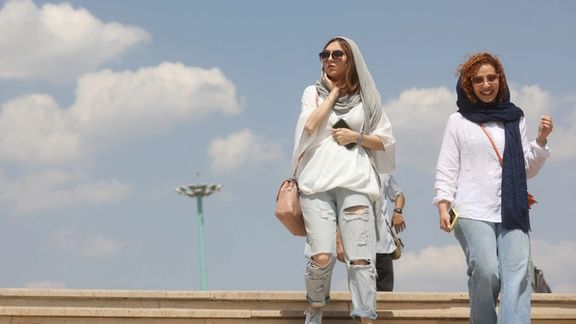
Iranian women in public

Heated debates over a new bill about how to deal with women who refuse to observe compulsory hijab continues inside and outside the Iranian parliament.

The bill is not forceful enough for hardliners, because it bans religious conservatives from confronting women who don’t cover their heads. The bill mainly relies on cash fines to force women to wear the hijab.

Part of the regime in Tehran fears strict and forceful enforcement of hijab might trigger another round of protests, similar to last September when a 22-year-old woman died after her injuries in ‘morality police’ custody. 

While some hardliners demand harsh treatment of bad-hijab women, Vice President for Legal Affairs Mohammad Dehghan told reporters in Tehran on Monday: "We wish to avoid making hijab a pretext for further deepening divides and disputes in the country." He added: "We are thinking of using the issue as a basis to bring about national solidarity."

Vice President for Legal Affairs Mohammad Dehghan (undated)
100%
Vice President for Legal Affairs Mohammad Dehghan

Dehghan said that the current bill, which has been criticized by some hardliners as being focused on levying monetary penalties rather than confronting women in the streets, has been prepared by the Judiciary and the administration has simply tried not to change it dramatically. 

Referring to the criticisms, Dehghan said, "After the recent protests which were organized by foreigners, the issue of hijab must be dealt with a more comprehensive approach." He probably meant that the government needs to take a pragmatic stance to avoid further unrest. He reiterated that the government believes in "a cultural approach" to the issue.

Dehghan, however, made it clear that the government agrees that celebrities who promote the idea of "hijablessness" should be dealt with legal prosecution. He added that the security forces will deal with those who promote anti-hijab ideas based on foreign views. In other cases, law enforcement will simply advise women to observe the hijab. If they accept the guidance, then that is all, but if they insist to defy the hijab, they will be fined. 

Lawmaker Jalal Rashidi Koochi (undated)
100%
Lawmaker Jalal Rashidi Koochi

One of the staunch critics of the hijab bill happens to be President Ebrahim Raisi's father-in-law Ahmad Alamolhoda, the Friday prayers Imam of Mashhad. Lawmaker Jalal Rashidi Koochi quipped that Raisi should take back the hijab bill from the Majles and hand it over to Alamolhoda for further review before giving it back to the parliament. 

Koochi charged that "the bill in its current form is all about arresting and fining women. If Alamolhoda wishes to make any change in the bill, he should not criticize the parliament as he did. He should instead address his complaints to his son-in-law Raisi." Alamolhoda had earlier called on the Majles not to ratify the bill as it will promote lack of hijab.

Koochi however criticized the bill for lacking any provision that would encourage women to observe the hijab. "The bill is mainly about if you do this, you have to pay this amount," Kooch said. 

During the past week, many conservatives and hardliners harshly criticized the bill. The hardline editor of Kayhan daily Hossein Shariatmadari said "It is funny that the police is only allowed to send text messages to women telling them that they have been seen without headscarf. This bill cannot enforce the hijab."

Former Deputy Judiciary Chief Mohammad Javad Larijani said: "If someone sees a naked woman standing behind the window, he should have the right to call the police." Meanwhile, responding to Iranian politicians who have called for holding a referendum about hijab, Larijani said that this will violate the Constitution of the Islamic Republic. 

Lawmaker Mohammad-Taghi Naghdali (undated)
100%
Lawmaker Mohammad-Taghi Naghdali

Lawmaker Mohammad-Taghi Naghdali, the secretary of the parliament's legal committee, in a video that quickly went viral suggested harsh punishments including lashes and deprivation from social rights as well as heavy fines for women who refuse to wear the compulsory hijab. 

Calls for harsher punishments than what is called for in the hijab bill continue by seminary clerics, Friday Prayer Imams and other hardliners in various parts of the country, while the number of women defying hijab has been on the rise in the streets during the past 8 months since the start of Women, Life, Freedom movement in Iran, despite the official ban on the entry of hijabless women to academic centers and administrative buildings and even subway stations. 

Most Viewed

US blockade enters murky phase as tankers spoof signals and buyers hesitate
1
ANALYSIS

US blockade enters murky phase as tankers spoof signals and buyers hesitate

2

US tightens financial squeeze on Iran, warns banks over oil money flows

3
INSIGHT

Ideology may be fading in Iran, but not in Kashmir's ‘Mini Iran'

4
INSIGHT

Hardliners push Hormuz ‘red line’ as US blockade tests Iran’s leverage

5
VOICES FROM IRAN

Hope and anger in Iran as fragile ceasefire persists

Banner
Banner

Spotlight

  • Hardliners push Hormuz ‘red line’ as US blockade tests Iran’s leverage
    INSIGHT

    Hardliners push Hormuz ‘red line’ as US blockade tests Iran’s leverage

  • Ideology may be fading in Iran, but not in Kashmir's ‘Mini Iran'
    INSIGHT

    Ideology may be fading in Iran, but not in Kashmir's ‘Mini Iran'

  • War damage amounts to $3,000 per Iranian, with blockade set to add to losses
    INSIGHT

    War damage amounts to $3,000 per Iranian, with blockade set to add to losses

  • Why the $100 billion Hormuz toll revenue is a myth
    ANALYSIS

    Why the $100 billion Hormuz toll revenue is a myth

  • US blockade targets Iran oil boom amid regional disruption
    ANALYSIS

    US blockade targets Iran oil boom amid regional disruption

  • Iran's digital economy battered by prolonged blackout
    INSIGHT

    Iran's digital economy battered by prolonged blackout

•
•
•

More Stories

Interior Minister Blasts UN Fact-Finding Mission As War Against Iran

May 30, 2023, 18:11 GMT+1

Iran’s Minister of Interior has rebuffed the UN fact finding mission on Iran calling it a media war against the regime.

Speaking at an ambassadorial meeting, Ahmad Vahidi said: “The enemy has created an unrealistic image of Iran in the minds of people in all parts of the world using its mainstream media.”

In spite of the deaths of around 750 civilians and arrest of 30,000 more, he claimed that in protests following the death in morality police custody of Mahsa Amini, the police and security forces 'exercised restraint', blatantly denying the brutal crackdowns which have been wrought across the country.

The Human Rights Council decided to establish an independent international fact-finding mission on Iran's deadly repression of protests in October, after unrest broke out in September. 

The UN mission in particular asked for information concerning violent crackdown on peaceful protests by security forces, including alleged arbitrary arrests and detentions, sexual and gender-based violence, excessive use of force, torture and other inhumane treatment and enforced disappearances, as well as the deaths of hundreds of peaceful protesters and thousands of arrests.

The mission is also seeking documentation on physical, psychological and sexual abuse of women and girls for exercising their human rights and fundamental freedoms, and children’s rights violations in relation to the protests, including in raids on schools, and the incarceration of children in ‘psychological centers.'

US Targets Syrian Money Service Businesses In Fresh Sanctions

May 30, 2023, 17:58 GMT+1

The United States Tuesday imposed punitive measures on two Syrian money services it said help the government maintain access to the international financial system in violation of sanctions.

This was Washington's first action targeting Syria since its readmittance to the Arab League.

The US Treasury Department in a statement accused the two money service businesses, Al-Fadel Exchange and Al-Adham Exchange Company, of helping President Bashar al-Assad's government and its allies, Hezbollah and Iran's Quds Force, an arm of its Revolutionary Guards (IRGC).

The sanctions, imposed under the Caesar Act that also levied a tough round of sanctions on Syria in 2020, come after Arab states earlier this month turned the page on years of confrontation with Assad and readmitted Syria to the Arab League, a milestone in his regional rehabilitation even as the West continues to shun him after years of civil war.

The move came as what seemed to be policy change by Saudi Arabia as it restored diplomatic ties with Iran in March after seven years tensions.

Regional countries - including Saudi Arabia, Qatar and others - had for years supported anti-Assad rebels, but Syria's army - backed by Iran, Russia and allied paramilitary groups - regained most of the country. The icy ties with Assad began to thaw more quickly after devastating earthquakes in Syria and Turkey in February.

The United States has said it will not normalize ties with Assad and has said Syria did not merit readmission into the Arab League.

With reporting by Reuters

Businesses Strike To Protest Heavy Charges Against Iran Protesters

May 30, 2023, 14:10 GMT+1

Businesses in Semirom city in Esfahan Province have gone on strike in protest to heavy charges against two local political prisoners.

Regime security and intelligence forces have framed Fazel and Mehran Bahramian for the murder of an IRGC Basij militia gunman during anti-government protests in the city last December.

The two were arrested in January after the government killed their brother Morad in November. Their detention was apparently aimed to silencing the family. Now they are being accused of killing the Basij member, Mohsen Rezaei, and face charges that could result in the death penalty.

The streets of Semirom witnessed a surge of protests on December 31. Security and military forces were heavily deployed throughout the city at the time. The paramilitary Basij force member, Mohsen Rezaei, allegedly died in clashes.

Hundreds of special police forces were deployed to Samirom starting January 1.

Several people, including Abbasi's sister and Bahramian's two brothers, were arrested during raids on the victims' families.

A source told IranWire that Fazel and Mehran Bahramian, a relative named Younes Bahramian, and another man named Dariush Saadi were tortured to extract confessions on the alleged murder of the Basij militiaman.


Iran Bans Protesting Filmmakers From Working

May 30, 2023, 12:27 GMT+1

Iran has banned protesting filmmakers from working after participating in the Cannes Film Festival without obtaining a permit.

Mohammad Khazaee, the head of the Iranian Cinema Organization, said these filmmakers will be prevented from operating in Iran, without referring to the fact many industry members had been part of protests and spoken out against regime oppression.

“They cannot be an opposition figure and work in the Iranian cinema,” stated Khazaee in a ceremony Monday evening. Over the months since the protests figures in the entertainment and sports industry have been punished with the likes of bank account freezes and salary cuts.

"Our duty is to protect the cinema and create job security. The fact that an underground film is produced and released in the market without complying with Sharia issues will put job security at risk."

It is believed he was referring to a feature called "Me, Maryam, the Children and 26 Others" directed by Farshad Hashemi, which was screened by the Iranian Independent Filmmakers' Association on Sunday, at the Cannes Film Festival.

The feature was made in Iran without following the censorship laws of the Islamic Republic, including the mandatory hijab for the actresses.

Last year, after the collapse of the Metropol building claimed scores of lives in Abadan, around 170 people in the film industry signed an open letter expressing solidarity with local protesters and asking security forces to “put down your guns”.

In recent months, a large number of filmmakers and cinema stars have expressed solidarity with anti-government protests, ignited by the death of 22-year-old woman Mahsa Amini in custody of the country’s hijab.


Hacked Document Shows Tehran Debating To ‘Redefine’ Ties With Baku

May 30, 2023, 11:40 GMT+1
•
Maryam Sinaiee

A report, claimed by an opposition group to have been hacked from the Iranian presidency servers, advises the government to redefine its relations with Azerbaijan. 

“The government of Azerbaijan has misunderstood the self-restraint and good-neighborliness policies of the Islamic Republic of Iran as its weakness and inferred out country’s determination to avoid conflict with itself,” the report released by MEK-affiliated Telegram account GhyamSarnegouni (Uprising till Overthrow) Monday says. 

The group released a trove of secret and top-secret document on Monday that it said were obtained by hacking the government’s servers.

Describing Baku’s actions as “serious threats,” the report provides a summary of recent developments in bilateral relations and a summary of Azerbaijan’s relations with other regional players, Turkey and Israel, in the context of its relations with the Islamic Republic of Iran and says failing to redefine relations will lead to “increased hostility” from Azerbaijan. 

“Undoubtedly, the Zionist regime will be the principal beneficiary of heightened tensions between the two sides,” the report says. 

The report, which MEK claims was among thousands of other documents it acquired, was apparently made by the foreign intelligence and security department of the ministry. The undated report, possibly a draft, is marked as “very confidential” but does not bear a reference number or signature. 

A sample of the leaked documents (May 2023)
100%
A sample of the leaked documents

An official of the presidential office, Mohammad-Mehdi Rahimi, claimed Monday afternoon that the presidency website had only temporarily been deactivated to carry out site security maintenance for a new version launched last week. 

Tensions have been high between Iran and Azerbaijan since November 2022 when both sides accused each other of engaging in terrorism and espionage in the other’s territory. 

Iran has suggested Azerbaijani involvement in the October 26 attack in Shiraz claimed by the Islamic State group (Isis-Daesh) and, also in the report accuses Baku of harboring Israeli intelligence and military elements that plan to use its territory in a possible attack against Iran’s nuclear facilities. 

The two countries in early May expelled each other’s diplomats after incidents that Baku also dubbed as "terrorist attacks". These included a gunman’s attack on Azerbaijani diplomatic mission in Tehran in January after which Baku shut down the embassy and an attack on Azerbaijani lawmaker Fazil Mustafa in March, who is an outspoken critic of the Islamic Republic.

Ethnic and religious issues complicate relations between Tehran and Baku and both parties have been using these factors against each other. 

Around a quarter of Iran’s population is Turki-speaking Azari, with analysts and activists disagreeing over the closeness of their cultural-linguistic links to their neighbors to the north. Iran fears separatism in its northwestern regions encouraged by Azerbaijan. 

On the other hand, Azerbaijan has a large Shiite population that is susceptible to agitation by the Islamic Republic, which considers itself the leader of the Shiite world. Supreme Leader Ali Khamenei is often referred to as the "leader of world Muslims". 

The Albania-based opposition group claimed it had breached 120 servers of the presidential office and accessed internal communications and minutes of meetings as well as President Ebrahim Raisi’s online conference platforms and about 1,300 computers inside the office.

Hackers posted images of MEK leaders, Maryam Rajavi and her husband Masoud who has not been seen in public since 2003, and defaced pictures of Supreme Leader Ali Khamenei and President Ebrahim Raisi on the compromised websites. 

Without any details, some Iranian news websites reported -- a few hours after the MEK’s announcement Monday that they had hacked the website of the presidency – that the website could not be reached. 

In early May the group released hundreds of identification documents, minutes of meetings, copies of correspondence, phone numbers of foreign ministry officials, and the names of 11,000 employees.



