• العربية
  • فارسی
Brand
  • Iran Insight
  • Politics
  • Economy
  • Analysis
  • Special Report
  • Opinion
  • Podcast
  • Iran Insight
  • Politics
  • Economy
  • Analysis
  • Special Report
  • Opinion
  • Podcast
  • Theme
  • Language
    • العربية
    • فارسی
  • Iran Insight
  • Politics
  • Economy
  • Analysis
  • Special Report
  • Opinion
  • Podcast
All rights reserved for Volant Media UK Limited
volant media logo

Filmmakers In Iran Start Shooting Without Hijab After Protests
Iran International Newsroom
Nov 27, 2022, 08:51 GMT+0Updated: 17:32 GMT+1
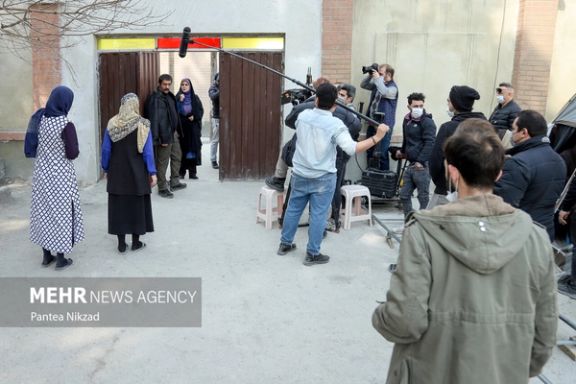
Behind-the-scenes of an Iranian movie

Unconfirmed reports about Iranian filmmakers shooting movies and TV series with actresses without hijab have led to controversy in the country.

The story was first reported by movie director Vahid Vakilifar and Mohammad Reza Shafiei, a producer linked to the Islamic Republic’s inner circles, who criticized the filmmakers, saying that “the enemy's hybrid warfare” has clouded their understanding and judgement of the current developments. 

According to these reports, filmmakers are shooting the same scenes both with hijab and without, leaving the impression that they think the Islamic Republic’s mandatory dress code may be relaxed in future.

Later on, people on social media said that not only the movies are being filmed both with and without hijab, some series for home streaming services are also being shot both ways.

An official with the Islamic Republic’s Cinema Organization, a body that works under the Ministry of Culture and Islamic Guidance, denied the reports on November 23, and threatened if the news is true, the production of the films will be stopped at any stage. Bahman Habashi warned of “irreparable consequences for the creators.” He also called on investors, producers and directors to be careful about the consequences of any violation of the country's official laws on their reputation, credit and capital. 

It is not yet clear who are the filmmakers who are purportedly making such movies or how they are funded or whether the movies are being produced for screening inside the country. 

Some scenes from Kianoush Ayari’s movie "Couch" (file photo)
100%
Some scenes from Kianoush Ayari’s movie "Couch"

Kianoush Ayari’s movie "Couch," in which the actresses do not have headscarves, but instead wear wigs, is still banned, or another movie “The Killer and the Savage” by Hamid Nematollah, in which the main character is a woman with a shaved head has not given permission for screening.

Although producing movies or shows in two version seems costly and arduous, there are some very famous examples for it, such as The Message, a 1976 epic flick by Syrian-American Moustapha Akkad that chronicles the life of Islam’s Prophet Muhammad. Having consulted with Islamic clerics in a thorough attempt to be respectful towards Islam, Akkad simultaneously filmed two versions of the drama - one with an international cast in English and one an Arabic version with an Arab cast.

Iranian actress Leila Hatami in Hamid Nematollah’s movie “The Killer and the Savage”  (file photo)
100%
Iranian actress Leila Hatami in Hamid Nematollah’s movie “The Killer and the Savage”

However, there are some people on social media who believe these rumors were created by regime insiders to justify the crackdown on filmmakers. This may be true because there are a few government-backed companies which want to control all film and TV series production and distribution. They have an interest in banning films or arresting independent filmmakers. 

In recent weeks, a large number of actresses and female filmmakers as well as sports celebrities have posted photos of themselves without the Islamic Republic’s mandatory hijab as a show of solidarity with antigovernment protests, ignited by the death of 22-year-old woman Mahsa Amini in custody of the country’s hijab – or the so-called morality – police. 

Such acts of defiance by actresses have become extremely troubling for the Islamic Republic’s state broadcaster that has to remove them from TV series and movies they had appeared in or stop airing the shows altogether. 

The regime has also arrested several of the celebrities who have unveiled in public and has threatened many with bans on their works and leaving the country. However, such measures seem futile as the list of people who are getting banned are increasing day by day. Even if the production of movies with a veiled and unveiled cast is only a rumor, it shows that many people are imagining the country’s cinematic landscape free of the Islamic Republic. 


Most Viewed

Hardliners push Hormuz ‘red line’ as US blockade tests Iran’s leverage
1
INSIGHT

Hardliners push Hormuz ‘red line’ as US blockade tests Iran’s leverage

2

Iran International says it won’t be silenced after London arson attack

3
VOICES FROM IRAN

Hope and anger in Iran as fragile ceasefire persists

4

US sanctions oil network tied to Iranian tycoon Shamkhani

5

Iran halts petrochemical exports to supply domestic market

Banner
Banner

Spotlight

  • Hardliners push Hormuz ‘red line’ as US blockade tests Iran’s leverage
    INSIGHT

    Hardliners push Hormuz ‘red line’ as US blockade tests Iran’s leverage

  • Ideology may be fading in Iran, but not in Kashmir's ‘Mini Iran'
    INSIGHT

    Ideology may be fading in Iran, but not in Kashmir's ‘Mini Iran'

  • War damage amounts to $3,000 per Iranian, with blockade set to add to losses
    INSIGHT

    War damage amounts to $3,000 per Iranian, with blockade set to add to losses

  • Why the $100 billion Hormuz toll revenue is a myth
    ANALYSIS

    Why the $100 billion Hormuz toll revenue is a myth

  • US blockade targets Iran oil boom amid regional disruption
    ANALYSIS

    US blockade targets Iran oil boom amid regional disruption

  • Iran's digital economy battered by prolonged blackout
    INSIGHT

    Iran's digital economy battered by prolonged blackout

•
•
•

More Stories

Hackers Publish Embarrassing Video Allegedly From Iranian News Agency

Nov 26, 2022, 11:15 GMT+0

A video showing a journalist at Iran’s hardline Fars News Agency who is apparently masturbating at the agency’s office has gone viral on Iranian social media.

Alleged security camera footage leaked by hackers who targeted the IRGC-affiliated Fars News Agency shows one of its employees in a compromising situation at work.

The group hacked the twitter account of Habib Torkashvand, one of the news agency’s managers and published the video on his account, captioning, “These are the freeloaders of Fars! At the beginning of every week, after coming to the office, they must check who has been at their desk the day before and jerked off!”

The agency has denied that the footage belongs to Fars News, however some users on Twitter have identified the person as one of the economic editors of the website.

The video shows the journo locking the door and then taking off his pants before playing a video to watch and masturbate.

His smoking and having potato chips while enjoying himself has become a fun topic for Iranian users on social media.

Since its creation, hardline Fars News has played a key role in promoting IRGC propaganda and waging psychological warfare against regime opponents.

The hacktivist group Black Reward announced on Friday [Nov. 25] that it had attacked the database of Fars News Agency claiming that it has deleted nearly 250 terabytes of data from all the servers and computers of the website.

Black Reward also said it has obtained the confidential bulletins and directives sent by the news agency to the office of Supreme Leader Ali Khamenei.

Based on the group’s statement, the hacked data includes all recorded calls, information on internal portals related to administrative conversations and news folders, image archives and financial documents of this news agency.

However, Fars says during the recent attack, hackers were only able to destroy the information and news from Friday, and other information and databases of the news agency were not hacked.

Various groups of anonymous hackers have targeted Iran’s government entities in recent years, publishing some confidential information or disrupting the state television’s programs and playing their own messages.

Back in October, Black Reward published a throve of documents from Iran’s nuclear program, after a 24-hour deadline it had given the government expired.

The group said it had hacked the email system of Iran’s Nuclear Power Production and Development company threatening that it will release the documents if the government did not stop its clampdown on protesters. It also said that a total of 50 GB data was obtained.

In the past weeks, Black Reward also hacked the e-mails of managers and employees of Press TV state channel, obtaining their personal information.

The hacker group, which says it is “part of the Iranian hacker community” and works “to confront the criminal clerical regime,” asked Press TV journalists to “be the voice of the people.”

Press TV claims it is the “voice of the voiceless” but it has recently been sanctioned by the European Union for “human rights violations.”

Black Reward had also hacked the emails of the employees of Al-Zahra University in Tehran and the Legal Medicine Organization of the country asking them to support the protesters.

After the start of anti-regime protests in mid-September, Black Reward, together with the hacker group called Tepandegan, sent millions of texts inviting people to participate in protest rallies.

Iran's Khamenei Tries To Boost Confidence Among Loyal Forces

Nov 26, 2022, 09:03 GMT+0
•
Iran International Newsroom

In a speech to loyal Basij forces Saturday, Supreme Leader Ali Khamenei tried to reinforce his ideology among followers amid popular protests threatening his rule.

Khamenei praised the Basij for their role in suppressing the protests, that he called “riots”, as a paramilitary force under the command of the Revolutionary Guard.

The Basij have been at the forefront of confronting protesters in the streets and using violence against unarmed civilians, including children and women. They have also used various types of guns that have killed and maimed hundreds of people.

"They have sacrificed their lives to protect people from rioters," Khamenei said in his televised speech, while an Iranian human rights monitor, HRANA said Saturday that so far 448 protesters have been killed, including 63 children and an estimated 18, 170 people arrested.

But an interesting part of Khamenei’s speech was his reference to the role the Islamic Republic plays in the region. He openly admitted that Tehran was successful in building a strong presence in Iraq, Syria and Lebanon, but he claimed, “we absolutely did not enter North Africa.”

The 83-year-old clerical ruler repeated a favorite propaganda line, proclaiming that the Islamic Revolution “transformed the hearts of neighboring nations.”

The Shiite regime in Iran loves to be seen as leading Muslims everywhere, but in fact most Sunnis, who are the majority in the Muslim world, see Shiites at best as a particular Muslim sect, while some even regard them as heretics. Except Shiites in the region, few Sunnis follow the Islamic Republic’s lead, and even most Shiites who assist Tehran’s policies receive large amounts of monetary support for their loyalty.

Khamenei also claimed that the United States decided in 2006 “to paralyze six countries that constitute the strategic depth” of the Islamic Republic in order to contain its power. He named Iraq, Syria, Lebanon, Libya, Sudan and Somalia, although Libya is in North Africa, contradicting his earlier remark of never having entered the region.

Iran’s ruler also criticized those who say that the government must reach an agreement with the United States to be able to solve its problems. He maintained that “Negotiations will not help our problem with America. Only one thing will solve our problem with America: Paying ransom on permanent basis.”

Khamenei regularly espouses an anti-US and anti-West ideology and regards a normal foreign policy and cordial relations with the West as capitulation. In fact, in his speech he called flexibility in dealing with the United States his “red line”.

“America wants the Iranian nation to cross all red lines,” he said.

Khamenei also indirectly alluded to the defiance of the new generation that has been the force behind current protests and told the Basij that there is no such thing as a generational gap and their religious philosophy remains vibrant as generations change.

In an obvious move to give confidence to his loyal forces he told them “Recognize your power, get to know your enemies and discover the weak points of the enemy, who is trying to show he is strong.”

The Basij forces are faced with thousands of Generation Z young people who want social and political freedoms and do not believe in the religious and clerical order. These forces have to face protesters almost on daily basis and several have been killed or humiliated in the streets.

There Is No Time For Reforms, Iran’s Leading Sunni Cleric Says

Nov 25, 2022, 16:17 GMT+0
•
Iran International Newsroom

A top Sunni cleric has dismissed the Islamic Republic’s efforts to garner the support of the reformists to help contain ongoing unrest, saying the opportunity for reforms is lost. 

In his Friday prayers sermons, Mowlavi Abdolhamid, officially known as Mowlavi Shaikh Abdolhamdid Esmailzehi, said whenever people were willing to go to the polls and vote for the reformist camp, they disappointed them with their inaction. 

“The time was wasted, and we have lost the opportunity for reforms," said the religious leader of Iran's largely Sunni Baluch population living in the southeastern province of Sistan and Baluchestan.

"The reformists did not manage to do anything, and the biggest complaint directed at them is why they did not enact any reforms,” he said. Indirectly referring to the Supreme Leader and possibly the Revolutionary Guards and hardliners, Abdolhamid said that if reformists were stopped from pursuing reforms, “why didn't they say who stopped them? Why did they remain silent? Those who came in the name of reformism and did not do anything should have had the courage to say who didn't allow them," he said.

Emphasizing that reformists have lost their chance, he said that “If reforms had been carried out in the Islamic Republic, today the people would not be suffering from miseries, and they would not be shouting for freedom and justice during their protests.”

Mowlavi Abdolhamid, who had previously supported Reformist President Mohammad Khatami (1997-2005) and moderate conservative Hassan Rouhani (2013-2021), encouraged Iran's Sunni population to support ultraconservative Ebrahim Raisi in the 2021 presidential election. Later he complained that Raisi failed to fulfil his promises to the Sunni community while millions had voted for him. Following the killing of more than 100 Sunnis in Zahedan during recent protests by security forces, some criticized Abdolhamid for having supported Raisi.

Abdolhamid (L) with President Raisi during the 2021 presidential election
100%
Abdolhamid (L) with President Raisi during the 2021 presidential election

At the start of the reform movement in 1997, Abdolhamid played a key part as a charismatic leader who rallied the Sunnis behind Khatami. The history of the Islamic Republic reveals that any candidate who had Abdolhamid's support won the election in Sistan and Baluchistan and Kordestan provinces.

Abdolhamid's popularity is largely because of his willingness to challenge the absolute authority of Supreme Leader Ali Khamenei. Earlier in November, the outspoken Sunni Imam said women, ethnic and religious groups, and minorities have faced discrimination after the establishment of the Islamic Republic in 1979. He was also brave enough to blame Khamenei for the attack on protesters in his hometown, Zahedan. 

He made the remarks on the backdrop of reports from recent meetings between senior officials and a number of reformist figures. Sources in Tehran say Iran's ruling hardliners are beseeching once popular reformists they purged from power to help save the regime and end the uprising. However, the reformists have been side-lined during the current wave of the protests – ignited by the death in custody of Mahsa Amini, as neither the government nor the protesters consider them a serious political alternative.

Former president Rafsanjani leading a prayer with Mohammad Khatami (C) and Khomeini's grandson (L) as well as former president Hassan Rouhani (2nd left) standing behind him  (file photo)
100%
Former president Rafsanjani leading a prayer with Mohammad Khatami (C) and Khomeini's grandson (L) as well as former president Hassan Rouhani (2nd left) standing behind him

During his Friday prayers sermons, Mowlavi Abdolhamid also criticized the crackdown on the Kurdish majority cities in western Iran, praising them as one of the best ethnic groups who protected the borders like the people of Sistan and Baluchestan.

Since last week, the Islamic Republic has intensified its repression of Kurdish-majority cities and towns following reports that parts of some small towns have fallen into the people’s hands. The majority of Iran's 10 million Kurds live in the western parts of the country. 

"Now that the people of Kordestan are complaining about their problems and protesting, they should not be shot at, and they should not be treated with violence," he said. 

He added that if he were an official, he would listen to the peoples’ demands, noting, "It is a matter of concern that many of our officials were not ready to listen to the critics. These problems were created by those who did not allow criticism."

Taking issue with spending Iran’s money in other regional countries, the cleric said, "This country does not belong to officials and rulers. It belongs to all of us and we all want this country to be prosperous. Its wealth should be spent here instead of somewhere else."

He also called on the authorities not to give "severe sentences" to protesters and urged the release of the political prisoners, referring to death sentences issued for at least 10 people.

Expressing concern about reports of torture and sexual harassment of prisoners, Abdolhamid cautioned, "There are some reports of mistreatment of prisoners, especially female prisoners, that are difficult for me to say... Torture is against the constitution and is not allowed in any religion."

Critics Ask Iran's President For Evidence Of ‘Achievements’ Claimed

Nov 25, 2022, 13:50 GMT+0
•
Maryam Sinaiee

Critics of President Ebrahim Raisi are asking for evidence of economic achievements that state media repeatedly claim amid continued unrest in the country.

“Do pro-government media aim to reassure the public with such coordinated news dissemination?” a commentary in Jomhouri Eslami (Islamic Republic) daily asked Thursday.

“If so, they are badly mistaken,” the commentary said arguing that the current minimum living conditions fails to meet the standards of living before the current administration took power.

Amid protests that have engulfed the country in the past two months, the state and pro-Raisi media including the state broadcaster (IRIB) are constantly claiming that the government has succeeded in bypassing US sanctions, is selling more oil, has improved the economy, has better relations with neighboring countries, and is making greater scientific and military strides.

“The discrepancy between the real situation with what government officials say is totally tangible … Quasi-state media’s disregard of this fact can cause social breakdown,” the commentary said.

The paper went on to demand answers for a host of questions pertaining to such achievements including claims about a drop in the inflation rate and success in thwarting the effects of US sanctions through membership in the Shanghai Cooperation Organization (SCO) which Raisi has repeatedly called one of his government’s achievements.

Editor of "Islamic Republic' newspaper, Masih Mohajeri
100%
Editor of "Islamic Republic' newspaper, Masih Mohajeri

“What’s the reason for the hike in the price of staples and other essential commodities given that pro-government newspapers constantly run headlines about inflation dropping?” the article asked.

Jomhouri Eslami is one of the oldest newspapers in the Islamic Republic and like the ultra-hardliner Kayhan daily receives funding from the Supreme Leader Ali Khamenei’s office.

However, unlike the firebrand editor of Kayhan, Hossein Shariatmadari, the editor of Jomhouri Eslami, Masih Mohajeri, has maintained a degree of political independence over the years and often criticizes hardliners. In May, he called on Raisi to resign for failing to deliver on promises of improving the lives of Iranians.

The list of Raisi’s unfulfilled campaign promises seems quite long. He pledged to build one million affordable housing units for sale during each year of his term in office, bring down inflation, provide fast internet and unrestricted social media, and mend relations with neighboring countries including old-time rival Saudi Arabia.

Raisi blames foreign powers and “enemies” for thwarting his plans, but this does not seem to convince anyone apart from his allies.

“Thank you for delivering on your promises of bridling the inflation and strengthening the national currency! Never mind the promises of [affordable] housing …,” the former governor of the Central Bank of Iran and election rival Abdolnaser Hemmati told Raisi in a tweet Tuesday.

As evidence of Raisi’s failure, Hemmati said point-to-point inflation has risen from 34.7 percent in the beginning of the Iranian calendar year [March 21] to 48.1 percent, the rial has dropped in value against the dollar from 262,000 rials to the dollar to 354,000 and printing money has increased by 3.2 percent only from September 23 to October 22.

Even many conservatives admit that the Raisi government is just inept and cannot organize any project, but few can say that continuing US sanctions on Iran is the main reason for so much economic failures. That would mean criticizing the Supreme Leader Ali Khamenei who is responsible for all major foreign policy decisions.

Iran's Football Team Sings Anthem Amid Jeers From Spectators

Nov 25, 2022, 10:40 GMT+0

Iran's national soccer team sang during the playing of the Islamic Republic anthem at their second World Cup match against Wales on Friday, barely moving their lips.

They had refused to sing the anthem in their opening game earlier this week in apparent support of protesters back home.

Loud jeers were heard from Iranian supporters as the anthem played, with the team singing quietly as it played. Iranian authorities have responded with deadly force to suppress protests that have marked one of the boldest challenges to its clerical rulers since the 1979 Islamic revolution.

Authorities in Tehran arrested a popular footballer Vorya Ghafouri on Thursday for his outspoken support for protesters.

The national team, called Team Melli has become controversial amid popular anti-regime protests, not siding with protesters who have defied the clerical rulers since September.

Iranians love soccer but not their team anymore as it keeps distancing itself from solidarity with the current wave of protests across the country.

The unsympathetic postureby Team Melli comes on the backdrop of several Iranian sportsmen and women using international competitions to show their support for the protests.

Numerous Iranian athletes have shown support for the protests. The Iranian football, beach football, water polo, basketball, and sitting volleyball teams refused to sing along with the anthem, which is customary in almost all international competitions. Authorities have made serious threats against athletes and other celebrities to stop them from public displays of solidarity with protesters but to no avail.