• العربية
  • فارسی
Brand
  • Iran Insight
  • Politics
  • Economy
  • Analysis
  • Special Report
  • Opinion
  • Podcast
  • Iran Insight
  • Politics
  • Economy
  • Analysis
  • Special Report
  • Opinion
  • Podcast
  • Theme
  • Language
    • العربية
    • فارسی
  • Iran Insight
  • Politics
  • Economy
  • Analysis
  • Special Report
  • Opinion
  • Podcast
All rights reserved for Volant Media UK Limited
volant media logo

World Outraged By Iran’s Execution Of Three Political Prisoners
Iran International Newsroom
May 19, 2023, 23:50 GMT+1Updated: 17:38 GMT+1
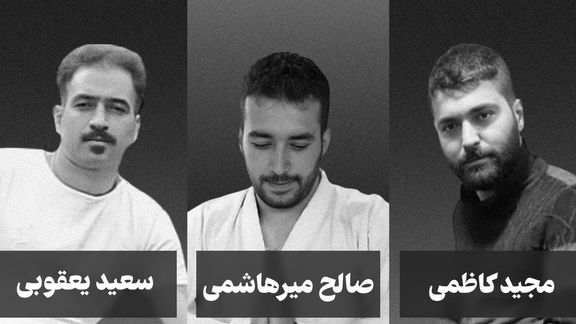
Majid Kazemi, Saeed Yaghoubi and Saleh Mirhashemi

The Iranian regime’s execution of three protesters, despite numerous global pleas, has outraged Western governments and people around the world.

The Islamic Republic executed Majid Kazemi, Saeed Yaghoubi and Saleh Mirhashemi on Friday morning over trumped up charges after extracting forced confessions, in a case described as a travesty of justice. Human rights campaigners say they were tortured into confessions, and there was no reliable evidence against them.

Friday's executions brought to at least seven the number of protesters hanged since the beginning of the nationwide protests last September, which turned into one of the boldest challenges to the clerical rulers since the 1979 revolution.

The protests were ignited by Mahsa Amini's death in the custody of Iran's morality police.

In anticipation of their imminent execution, the three men on Wednesday appealed in a handwritten note for public support, saying, "Don't let them kill us".

"We need your help," said the note that went viral on social media, drawing local and international appeals to halt the executions, including from Washington.

Iranians are outraged and frustrated over the hangings; frustrated that their protest rallies outside the prison where they were held failed to halt the executions and outraged that calls by the international community did not stop the Islamic Republic from hanging people who protested against its injustice.

People in numerous neighborhoods in the capital Tehran as well as Esfahan (Isfahan) and several other cities across Iran poured out into the streets, chanting slogans against the regime and calling for its downfall.

In Tehran’s neighborhoods of Sattar Khan, Tehran Pars, Ekbatan and several others, as well as numerous neighborhoods in Esfahan and Kurdish majority cities of Mahabad and many others protests took place. There are unconfirmed reports of security forces clashing with the protesters.

Leading Iranian opposition figure exiled prince Reza Pahlavi said, “Despite the brave protests of our compatriots, the Islamic Republic has hanged three young protesters in Esfahan.”

“This murderous regime is emboldened by the West’s inaction. Those nations that claim to stand for human rights must recall their ambassadors from Tehran immediately. Iranian lives matter.”

Condemning the executions, a US State Department spokesperson said that Washington joins the Iranian people and their families in mourning the deaths of these three men.

“As we have said, it is clear from this episode that the regime has learned nothing from the protests that began in September of last year. It is no wonder so many young people in Iran are calling for change or leaving the country in droves.”

The US once again urged Iran's leadership to stop the killing, stop the sham trials, and respect people’s human rights, said the spokesperson, adding, “Sadly, we have no expectation that they will do so.”

"That is why we are continuing to work in close coordination with our allies and partners around the world to condemn and confront these appalling human rights abuses.”

Several protest gatherings were held outside the Islamic Republic’s embassies across the globe, including in Australia and Germany.

Alireza Akhondi, Swedish-Iranian member of the Swedish parliament, said that the Islamic Republic executed an average of two people per day in 2023. "But our response to these criminal monsters is persistence and courage to continue the struggle to achieve freedom." he added.

Centrist academic Sadegh Zibakalam in Tehran said Friday that “If they had not been executed, I don't think anyone would have attributed it to the system's weakness and fear of the opposition,” adding that “On the contrary, many people would consider it the regime’s respect and attention to public opinion.”

Also on Friday, the European Union condemned the hangings “in the strongest possible terms."

“The EU urges the Iranian authorities to refrain from applying the death penalty and carrying out future executions,” EU foreign policy chief Josep Borrell’s office said in a statement.
Opposition activists say the death penalty was used against the three men as an intimidation tactic to stop further protests. Iranian expatriate communities called for demonstrations against the executions in cities worldwide on Saturday, May 20. 

Nazanin Boniadi, a British actor and activist of Iranian origin, tweeted that the three men had been executed “after forced confessions and sham trials.”

So far, around 500 civilians have been killed by security forces and at least 20,000 arrested. While many have been released, around 1,500 face criminal charges, and at least 80 detainees face the death sentence.


Majid Kazemi, Saeed Yaghoubi and Saleh Mirhashemi (file photo)
100%
Majid Kazemi, Saeed Yaghoubi and Saleh Mirhashemi

Most Viewed

100 days after carnage: Iran economy reels from war, inflation, unemployment
1
INSIGHT

100 days after carnage: Iran economy reels from war, inflation, unemployment

2
INSIGHT

Ghalibaf defends Iran-US talks amid hardline backlash

3
EXCLUSIVE

Iranian assaulted in London amid concern over threats to regime critics

4

IRGC fires at Indian vessel in Hormuz

5
INSIGHT

A nation in limbo: 100 days after the massacre, has the world moved on?

Banner
Banner

Spotlight

  • War-hit homeowners feel abandoned as Iran’s reconstruction aid fades

    War-hit homeowners feel abandoned as Iran’s reconstruction aid fades

  • 100 days on: the anatomy of Iran’s January crackdown
    INSIGHT

    100 days on: the anatomy of Iran’s January crackdown

  • Ghalibaf defends Iran-US talks amid hardline backlash
    INSIGHT

    Ghalibaf defends Iran-US talks amid hardline backlash

  • 100 days on: why Iran’s January protests spread across social classes
    ANALYSIS

    100 days on: why Iran’s January protests spread across social classes

  • From instability to influence: Pakistan’s pivotal role in US-Iran diplomacy
    ANALYSIS

    From instability to influence: Pakistan’s pivotal role in US-Iran diplomacy

  • A nation in limbo: 100 days after the massacre, has the world moved on?
    INSIGHT

    A nation in limbo: 100 days after the massacre, has the world moved on?

Tweet unavailable

Tweet unavailable

Tweet unavailable

•
•
•

More Stories

Iran ‘Resorts To Execution When Under Threat’

May 19, 2023, 16:29 GMT+1

Opposition activist Hamed Esmaeilion has accused Iran of resorting to mass executions whenever it faces a threat.

But speaking to Iran International radio on Thursday, he warned the Islamic Republic regime that this time around it cannot intimidate its critics as it did with thousands of hangings in the 1980s.

Esmaeilion’s wife and daughter were killed by Iran’s Revolutionary Guard in January 2020. He was speaking hours before political prisoners Majid Kazemi, Saleh Mirhashemi and Saeed Yaqoubi were hanged on Friday morning in Isfahan. The executions have been condemned around the world.

The mass execution of prisoners in 32 cities across Iran went on for five months starting in July 1988, ordered by the Islamic Republic’s founder Rouhollah Khomeini and carried out by officials including then Deputy Prosecutor General Ebrahim Raisi, now Iran's president. 

But Canada-based dissident Esmaeilion reiterated that the fall of the regime is “inevitable,” saying: "People have shown in polls and through street rallies that they have passed the Islamic Republic.

"The Islamic Republic has no chance to stay. Although the time of the fall of this regime cannot be predicted, it can be seen that the Islamic Republic is no longer capable of intimidating the people.”

Esmaeilion resigned as spokesman of families of victims of Ukrainian flight PS752 shot down by the IRGC in January 2020 to focus on his leading role in supporting Iran's protests and co-founded the Alliance for Freedom and Democracy.

The alliance announced its existence in a February event at Georgetown University and issued its charter, the Mahsa Charter, in early March based on “minimal positions” that could create the most consensus among the opposition.

However, Esmaeilion later resigned from the Alliance, blaming exiled Prince Reza Pahlavi for resisting the majority’s organizing efforts. The council consisted of Prince Reza Pahlavi, Nobel peace prize laureate Shirin Ebadi, US-based journalist and women’s rights activist Masih Alinejad, actress and activist Nazanin Boniadi and Secretary General of the Kurdish Komala Party Abdullah Mohtadi and Esmaeilion.


Salman Rushdie Backs Iran's Women In Their Struggle

May 19, 2023, 15:18 GMT+1

Salman Rushdie has voiced his support for the women of Iran in their struggle against the oppression of the Islamic Republic.

The celebrated author told Iran International: "I have sympathy with the women of Iran, they have fought so hard. I wish them luck.”

Rushdie was speaking while attending a gala event of artistic freedom campaigners PEN America on Thursday, when Iranian writer and human rights advocate Narges Mohammadi was awarded the 2023 PEN/Barbey Freedom to Write Award.

Rushdie was left with serious injuries including the loss of an eye when he was stabbed last August. The attempted murder is believed to have been inspired by the fatwa issued by the Islamic Republic’s founder Ruhollah Khomeini against Rushdie for his novel The Satanic Verses.

Earlier this year, the Islamic Republic said it will grant 1,000 square meters of farmland to the man who stabbed Rushdie on stage at a lecture in New York State, 24-year-old Hadi Matar.

Freedom To Write award recipient Mohammadi has been in and out of prison over the past decade. She is currently in Evin Prison in Tehran on charges of “spreading propaganda” and has been subjected to “prolonged solitary confinement and intense psychological torture,” PEN America said.

Mohammadi’s husband, journalist and activist Taghi Rahmani, who lives in Paris and has also been jailed in Iran, accepted the award on her behalf.

In a written message, which was read out from the stage during the event, Mohammadi called for an end to the Islamic Republic’s “misogynist, oppressive and theocratic” regime.

Founded in 1922 and headquartered in New York City, PEN America is a nonprofit organization that works to defend and celebrate free expression in the United States and worldwide through the advancement of literature and human rights.

IRGC Chief Commander Says US Has Yet To Receive ‘Final Blow’

May 19, 2023, 13:58 GMT+1
•
Iran International Newsroom

The United States will be forced to leave the Middle East and Iran’s “last blow” is yet to come, chief commander of the Revolutionary Guard (IRGC) said Thursday.

Speaking at a ceremony in memory of IRGC ‘martyrs’, Hossein Salami mentioned the targeted killing of Qassem Soleimani in Baghdad in 2020 in a US drone strike and said Iran already landed its first blow, by firing missiles at bases in Iraq hosting US troops, days after the killing.

“They received the first slap, and the second will be their gradual withdrawal from the region, but the last slap is yet to come,” he said.

Soleimani was the commander of IRGC’s extraterritorial Quds Force, who was the mastermind of the Iranian regime’s strategy of building a proxy network in the Middle East, made up of armed militias, Shiite groups, and the Syrian government.

Former commander of IRGC’s extraterritorial Quds Force Qassem Soleimani (left), IRGC Commander-in-Chief Hossein Salami (2nd left) IRGC Aerospace Force commander Amir Ali Hajizadeh (3rd left) and Chief of Staff for the Armed Forces of the Islamic Republic of Iran Mohammad Bagheri (May 2019)
100%
Former commander of IRGC’s extraterritorial Quds Force Qassem Soleimani (left), IRGC Commander-in-Chief Hossein Salami (2nd left) IRGC Aerospace Force commander Amir Ali Hajizadeh (3rd left) and Chief of Staff for the Armed Forces of the Islamic Republic of Iran Mohammad Bagheri (May 2019)

Soleimani invested heavily in post-Saddam Iraqi chaos, arming Iran’s proxies and instructing them to launch attacks against US forces in the country. As these attacks intensified in late 2019, former US President Donald Trump ordered his killing, which was a heavy blow to the regime.

Salami went on to highlight attacks against Israel. “These days fire is raining down on Israelis from Gaza, but the Zionists are unable to do anything and are powerless, and America has also left the region.”

Salami’s statement comes as the US and Israel are in close cooperation in intelligence and military matters, conducting large joint military drills. 

The US and Israel conducted their largest-ever joint military exercises in January, with thousands of troops, dozens of aircraft, and naval vessels in and around Israel.

The drills, dubbed Juniper Oak 2023 was widely seen as a message to Iran, although US officials said the live-fire exercise did not include mock-ups of Iranian targets, but American strategic bombers did take part.

Salami also warned that “no one can prevent our maritime trade, and if this happens, we will settle accounts anywhere in the world.”

It is not clear what Salami was referring to, but the US Navy and its European allies have interdicted several shipments of weapons and explosive from Iranian ports headed to Yemen in recent months. Iran also breaks US oil export sanctions by shipping cargos on “ghost tankers” that usually transfer the crude to other tankers on high seas to conceal their origin.

IRGC leaders have intensified their rhetoric since March and openly indicted that they are supporting the Palestinian Hamas and Islamic Jihad in rocket attacks against Israel.

The pressure of economic sanctions has crippled Iran’s economy, but the regime continues to expand its nuclear program, with high levels of uranium enrichment. Already, the UN nuclear watchdog and governments say that Tehran has accumulated enough enriched uranium to build two or more bombs.

Israel has repeatedly warned that it will not tolerate a nuclear-armed Iran in the region.

The Biden administration, despite holding indirect nuclear talks with Tehran, says that all options are on the table, indicating the US might assist Israel in a possible attack to prevent Iran from becoming a nuclear power.

However, Republicans in the US Congress criticize the Biden team for not having a new policy regarding Iran after nuclear talks reached an impasse last September.

Outrage Of Iran Sunni Leader Over Prisoner' Executions

May 19, 2023, 12:47 GMT+1

The execution by hanging of three political prisoners in Iran on Friday morning has been condemned by a leading Sunni cleric.

Mowlavi Abdolhamid Abdolhamid said Majid Kazemi, Saeed Yaghoubi and Saleh Mirhashemi had been sentenced to death after "forced confessions.".

Condemning the Shia theocracy in the harshest terms for the killings, he said: “These executions do not exist in Islam, and the world should not view them as results of the religion.”

Speaking in his Friday prayer sermon shortly after the men were hanged, Iran’s most senior Sunni cleric said that torturing the accused to obtain confessions has become a "common thing" in the Islamic Republic.

The three prisoners were convicted over the death of two IRGC’s Basij militia members and a police officer in protests of November last year, in what Persian media have dubbed the ‘Esfahan (Isfahan) House’ case. Human rights campaigners say the prisoners were tortured into confessions, and there is no reliable evidence against them.

Abdolhamid said: "On the one hand, the judicial officials said that they confessed to murder, and on the other hand, they sent a message from inside the prison saying that the confessions were made under duress.

“All the people of Iran and the world had called for stopping the executions. Now the public trust has been damaged, and people have lost their trust in the confessions."

In a defiant message to the authorities, he said: "Be sure that the nation cannot be stopped by executions."

Recent nationwide protests posed the biggest internal challenge to the Islamic Republic since its establishment in 1979. So far, around 500 civilians have been killed by security forces and at least 20,000 arrested. While many have been released, around 1,500 face criminal charges, and at least 80 detainees face the death sentence.

Iran Executes Three Political Prisoners After Sham Trial

May 19, 2023, 09:20 GMT+1
•
Iran International Newsroom

Despite global outcry, Iran’s regime on Friday morning executed three political prisoners who were arrested during last year's protests and framed for murder.

Majid Kazemi, Saeed Yaghoubi and Saleh Mirhashemi were convicted over the death of two IRGC’s Basij militia members and a police officer in protests of November last year, in what Persian media have dubbed the ‘Esfahan (Isfahan) House’ case.

The judiciary announced their execution in a statement on Twitter Friday morning, bringing to at least seven the number of protesters hanged since the beginning of the nationwide protests since September 2022 following the death in custody of 22-year-old Mahsa Amini.

The three were handed down the death sentence in a trial condemned as a travesty of justice by human rights campaigners, who say the prisoners were tortured into confessions, and there is no reliable evidence against them.

A photo of Saleh Mirhashmi's father went viral on Thursday holding a banner that reads, "My son is innocent. He didn't have any weapon."

Saleh Mirhashmi's father-executions-Esfhan-Isfahan-house
100%
Saleh Mirhashmi's father

The three wrote from jail on Wednesday, urging the people to stop their execution. Describing themselves as "children of Iran" in the letter, the three prisoners said: "Hello. We ask our dear fellow citizens not to let them kill us. We need your help. We need your support."

Following the news of the executions, videos are emerging on social media of people expressing anger and chanting slogans. There are dozens of social media users who are calling for protest rallies against the executions.

During the past several days, a large number of foreign officials and human rights activists had called on the Islamic Republic to stop the executions.

During a news briefing on Thursday, Vedant Patel, the Principal Deputy Spokesperson of US State Department, joined the international community in calling on the regime not to carry out the executions, saying, "We are aware that Iranian authorities may imminently execute Majid Kazemi and Saleh Mirhashemi and Saeed Yaghoubi in connection with their participation in protests in Iran.”

“The execution of these men, after what have been widely regarded as sham trials, would be an affront to human rights and basic dignity in Iran and everywhere,” he said, noting that “It is clear from this episode that the Iranian regime has learned nothing from the protests that began with another death, the death of Masa Amini in September of last year.”

“We once again urge Iran's leadership to stop the killing, stop the sham trials, and respect people's human rights."

Amnesty International also on Wednesday slammed their trial and sentencing saying it was “shocking”.

Diana Eltahawy, Amnesty International’s Deputy Director for the Middle East and North Africa, said: “The shocking manner in which the trial and sentencing of these protesters was fast-tracked through Iran’s judicial system amid the use of torture-tainted ‘confessions’, serious procedural flaws and a lack of evidence is another example of the Iranian authorities’ brazen disregard for the rights to life and fair trial.”

Amnesty’s statement also referred to Majid Kazemi’s audio recording from prison in which he said he was forced to make false self-incriminating statements after interrogators beat him, gave him electric shocks, subjected him to mock executions, threatened to rape him, execute his brothers and harass his parents.

On Sunday night and again on Wednesday night, people gathered outside Esfahan Central Prison hoping to stop the hangings.

Opposition activists say the death penalty was used against the three men as an intimidation tactic to stop further protests.

Iranian expatriate communities plan demonstrations against the executions in cities worldwide on Saturday, May 20.

Recent nationwide protests posed the biggest internal challenge to the Islamic Republic since its establishment in 1979. 

So far, around 500 civilians have been killed by security forces and at least 20,000 arrested. While many have been released, around 1,500 face criminal charges, and at least 80 detainees face the death sentence.