• العربية
  • فارسی
Brand
  • Iran Insight
  • Politics
  • Economy
  • Analysis
  • Special Report
  • Opinion
  • Podcast
  • Iran Insight
  • Politics
  • Economy
  • Analysis
  • Special Report
  • Opinion
  • Podcast
  • Theme
  • Language
    • العربية
    • فارسی
  • Iran Insight
  • Politics
  • Economy
  • Analysis
  • Special Report
  • Opinion
  • Podcast
All rights reserved for Volant Media UK Limited
volant media logo

IRGC Chief Commander Says US Has Yet To Receive ‘Final Blow’
Iran International Newsroom
May 19, 2023, 13:58 GMT+1Updated: 17:32 GMT+1
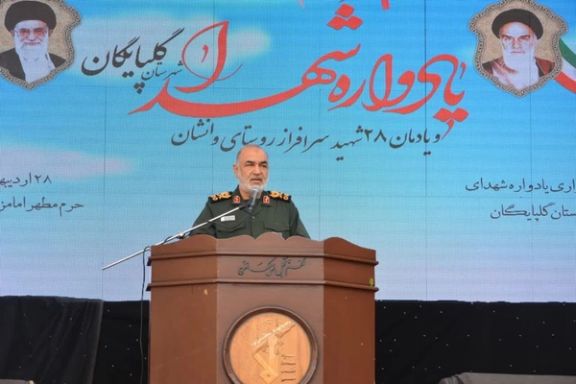
Chief commander of the Revolutionary Guard Hossein Salami speaking at a ceremony in memory of IRGC ‘martyrs’ in the city of Golpayegan, Esfahan (Isfahan) province, on May 18, 2023

The United States will be forced to leave the Middle East and Iran’s “last blow” is yet to come, chief commander of the Revolutionary Guard (IRGC) said Thursday.

Speaking at a ceremony in memory of IRGC ‘martyrs’, Hossein Salami mentioned the targeted killing of Qassem Soleimani in Baghdad in 2020 in a US drone strike and said Iran already landed its first blow, by firing missiles at bases in Iraq hosting US troops, days after the killing.

“They received the first slap, and the second will be their gradual withdrawal from the region, but the last slap is yet to come,” he said.

Soleimani was the commander of IRGC’s extraterritorial Quds Force, who was the mastermind of the Iranian regime’s strategy of building a proxy network in the Middle East, made up of armed militias, Shiite groups, and the Syrian government.

Former commander of IRGC’s extraterritorial Quds Force Qassem Soleimani (left), IRGC Commander-in-Chief Hossein Salami (2nd left) IRGC Aerospace Force commander Amir Ali Hajizadeh (3rd left) and Chief of Staff for the Armed Forces of the Islamic Republic of Iran Mohammad Bagheri (May 2019)
100%
Former commander of IRGC’s extraterritorial Quds Force Qassem Soleimani (left), IRGC Commander-in-Chief Hossein Salami (2nd left) IRGC Aerospace Force commander Amir Ali Hajizadeh (3rd left) and Chief of Staff for the Armed Forces of the Islamic Republic of Iran Mohammad Bagheri (May 2019)

Soleimani invested heavily in post-Saddam Iraqi chaos, arming Iran’s proxies and instructing them to launch attacks against US forces in the country. As these attacks intensified in late 2019, former US President Donald Trump ordered his killing, which was a heavy blow to the regime.

Salami went on to highlight attacks against Israel. “These days fire is raining down on Israelis from Gaza, but the Zionists are unable to do anything and are powerless, and America has also left the region.”

Salami’s statement comes as the US and Israel are in close cooperation in intelligence and military matters, conducting large joint military drills. 

The US and Israel conducted their largest-ever joint military exercises in January, with thousands of troops, dozens of aircraft, and naval vessels in and around Israel.

The drills, dubbed Juniper Oak 2023 was widely seen as a message to Iran, although US officials said the live-fire exercise did not include mock-ups of Iranian targets, but American strategic bombers did take part.

Salami also warned that “no one can prevent our maritime trade, and if this happens, we will settle accounts anywhere in the world.”

It is not clear what Salami was referring to, but the US Navy and its European allies have interdicted several shipments of weapons and explosive from Iranian ports headed to Yemen in recent months. Iran also breaks US oil export sanctions by shipping cargos on “ghost tankers” that usually transfer the crude to other tankers on high seas to conceal their origin.

IRGC leaders have intensified their rhetoric since March and openly indicted that they are supporting the Palestinian Hamas and Islamic Jihad in rocket attacks against Israel.

The pressure of economic sanctions has crippled Iran’s economy, but the regime continues to expand its nuclear program, with high levels of uranium enrichment. Already, the UN nuclear watchdog and governments say that Tehran has accumulated enough enriched uranium to build two or more bombs.

Israel has repeatedly warned that it will not tolerate a nuclear-armed Iran in the region.

The Biden administration, despite holding indirect nuclear talks with Tehran, says that all options are on the table, indicating the US might assist Israel in a possible attack to prevent Iran from becoming a nuclear power.

However, Republicans in the US Congress criticize the Biden team for not having a new policy regarding Iran after nuclear talks reached an impasse last September.


Most Viewed

US blockade enters murky phase as tankers spoof signals and buyers hesitate
1
ANALYSIS

US blockade enters murky phase as tankers spoof signals and buyers hesitate

2
INSIGHT

Ideology may be fading in Iran, but not in Kashmir's ‘Mini Iran'

3
INSIGHT

Hardliners push Hormuz ‘red line’ as US blockade tests Iran’s leverage

4
VOICES FROM IRAN

Hope and anger in Iran as fragile ceasefire persists

5

US sanctions oil network tied to Iranian tycoon Shamkhani

Banner
Banner

Spotlight

  • Hardliners push Hormuz ‘red line’ as US blockade tests Iran’s leverage
    INSIGHT

    Hardliners push Hormuz ‘red line’ as US blockade tests Iran’s leverage

  • Ideology may be fading in Iran, but not in Kashmir's ‘Mini Iran'
    INSIGHT

    Ideology may be fading in Iran, but not in Kashmir's ‘Mini Iran'

  • War damage amounts to $3,000 per Iranian, with blockade set to add to losses
    INSIGHT

    War damage amounts to $3,000 per Iranian, with blockade set to add to losses

  • Why the $100 billion Hormuz toll revenue is a myth
    ANALYSIS

    Why the $100 billion Hormuz toll revenue is a myth

  • US blockade targets Iran oil boom amid regional disruption
    ANALYSIS

    US blockade targets Iran oil boom amid regional disruption

  • Iran's digital economy battered by prolonged blackout
    INSIGHT

    Iran's digital economy battered by prolonged blackout

•
•
•

More Stories

20 Million Iranians Lack Basic Necessities – Official

May 19, 2023, 12:11 GMT+1

About 20 million Iranian citizens lack the basic necessities to survive, a leading official has revealed.

Ali Agha-Mohammadi, a member of Iran’s Expediency Discernment Council, said Thursday that about 19,700,000 Iranians do not have access to adequate housing, education, healthcare, food and clothing.

He criticized the officials who try to cover up the shortcomings with quick fixes and haphazard measures. 

The Expediency Discernment Council is an administrative assembly whose members are appointed by the Supreme Leader.

The figure disclosed by former deputy vice president Agha-Mohammadi equates to more than 1 in 5 of Iran’s total population of almost 88 million.

Earlier this year, the Islamic Republic’s Ministry of Cooperatives, Labor, and Social Welfare said that one-third of the country’s population is now living in extreme poverty, with the proportion having almost doubled from 2020 to 2021.

According to the ministry, the minimum monthly income needed to stay above the poverty line for a family of four in Tehran in 2022 was estimated at 147,000,000 rials (about $500 at the time) but the average nationwide is estimated to have been about 77,000,000 (about $250).

Iranian officials have set the minimum monthly salary for the current year at about 82 million rials, or about $160 at today’s exchange rate. This is one of the lowest minimum wages in the world.

Ecoiran quoted a central bank source on Wednesday as saying that inflation in the first Iranian month of the year (March 21-April 20) rose by 68.7 compared to the same period last year. Just in that one-month prices jumped 5.2 percent, with the previous month witnessing another substantial hike of 6.6 percent.


In Absence Of Official Stats, Media In Iran Say Inflation Is At 70%

May 19, 2023, 07:08 GMT+1
•
Mardo Soghom

A news website in Iran has warned that high inflation was detrimental in the fall of the Roman Empire, as the government conceals data to hide galloping prices.

Fararu website, considered to be moderate in Iran’s government-controlled media environment, wrote on Thursday that as Roman emperors reduced the silver content of their Denario coins, the foundations of the empire began to crumble.

Meanwhile, another website, Ecoiran quoted a central bank source on Wednesday as saying that inflation in the first Iranian month of the year (March 21-April 20) rose by 68.7 compared to the same period last year. Just in that one-month prices jumped 5.2 percent, with the previous month witnessing another substantial hike of 6.6 percent.

If true, this would represent a nearly 20-percent jump compared to the inflation rate last reported by the government in early 2023.

The Central Bank of Iran and the Statistical Center of Iran have not released figures on point-to-point inflation for the past two months, comparing prices to the same months in the past year.

The period in question coincides with persisting low exchange rates for the Iranian currency, rial, which has nearly halved in value since mid-2022. 

One year ago, the rial was trading at around 300,000 to the dollar, while in early May it dropped to as low as 550,000.

A woman shopping in Tehran with Iranian currency in hand (file photo)
100%
A woman shopping in Tehran with Iranian currency in hand

Rial’s huge drop tells the story of inflation in Iran. The country has to import a large part of its food, animal feed, medicines, raw materials and finished goods it needs. As the local currency loses value, imports become more expensive and higher prices have to be passed on to consumers.

The alarming comparison with the Roman Empire is not too far-fetched, as Iran faces a more immediate danger of rebellion by ever-impoverished masses. 

Although large-scale anti-regime protests in the fall of 2022 were driven by social and political oppression, but the current economic crisis was also making hopeless young people restive. Also, labor unrest began to rise in 2023, as workers’ real incomes declined.

It is important to note that price inflation is highest in the food sector, which even last year was estimated to have been between 70-100 percent. Reports began to emerge as early as 2021 that Iranians were cutting down on consumption of meat and dairy products. Recent reports have spoken of lower-income families cutting down on nutritious food and unable to afford many types of fruits and vegetables.

Iran has been suffering from lack of economic growth for more than a decade as international sanctions reduced its oil export revenues that were vital for financing an inefficient government and its more inefficient control of the economy.

But the regime has insisted to stick to its controversial nuclear program that brought about the sanctions in the first place. A brief respite came in 2016-2017, when the JCPOA accord with world powers lifted UN-imposed sanctions, but former US President Donald Trump withdrew from the deal and imposed unilateral sanctions in 2018.

Inflation soon began to surpass 20 percent and the rial started to nosedive, eventually losing value by 12-fold. 

Even politicians loyal to the regime have begun harshly criticizing President Ebrahim Raisi’s government for its inability to address the crisis, but almost no insiders openly say that the decision to resolve the nuclear dispute lies with the Iran’s anti-West ruler Ali Khamenei.

Iran’s high inflation rate is just behind other a few other troubled economies in the world, such as Venezuela, Sudan, Argentina and Zimbabwe.

Israel Accuses Iran Of Efforts to Disrupt Jerusalem Day Flag March

May 19, 2023, 00:04 GMT+1

On the eve of Jerusalem Day Flag on Thursday and Friday, Israeli police accused Iran of trying to disrupt a traditional march by creating “wild” incitement.

Police chief Kobi Shabtai warned against Iran-backed terror group incitement, saying “terrorist elements motivated by Iran — through Hezbollah, Hamas and Islamic Jihad — have been spreading false information on social media about the route of the flag parade…. in the capital of Israel, Jerusalem.”

“The goal of those terrorist elements is clear — it is to create wild incitement to terrorism against the thousands of Israelis who will come to celebrate Jerusalem Day at a number of events,” he said.

More than 3,000 police officers will be deployed across the city for the Jerusalem Day Flag March, which is anticipated to attract tens of thousands of mostly Orthodox Jewish nationalists.

The event marks Israel's unification of East and West Jerusalem during the 1967 Six Day War, but has gained notoriety over the years due to hate speech and violence by some Jewish participants.

On Wednesday, Hamas officials threatened an unspecified response if the march went ahead.

“The Zionist Flag March will not pass, and the response will inevitably come,” said senior Hamas official Salah al-Bardawil in a statement.

Israel has warned Hamas that if it fires rockets, it will respond.

Iranian proxies in Gaza, Lebanon and Syria have all recently attacked Israel with rockets as tensions simmered during the month of Ramadan.

Leaked Document Reveals Iran’s Multiple Telecom Deals With China

May 18, 2023, 23:07 GMT+1
•
Iran International Newsroom

A whistleblower active in the IT industry has leaked documents revealing hundreds of millions of dollars' worth of telecommunications contracts between Iran and China.

London-based Iranian-British internet security expert and cyber espionage investigator Nariman Gharib released a list of contracts signed between the Islamic Republic's Ministry of Information and Communications Technology and Chinese companies.

The secret document – which has no date and cannot be verified independently by Iran International -- contains a table of 10 contracts for various projects such as development of Iran’s landline network, infrastructure for fourth and fifth generation of broadband cellular networks and three satellite projects as well as production of smartphones and developing messenger services.

Feasibility studies for several of the projects have been carried out but some others are in the planning stages.

The project for the supply and operation of a geosynchronous telecommunication satellite is announced to be at $100 to $450 million for a 42-month project while another satellite project is valued at $300 million for a three-year project.

A sample of the leaked document  (undated)
100%
A sample of the leaked document

The project for landline development is worth $220 million while the project for the modernization of Telecommunication Company of Iran, or TCI -- the country’s main mobile service provider -- is $325 million followed by the modernization of MTN Irancell -- another telecommunications company -- at $250 million.

Each company will get 1,500 5G sites and 3,000 LTE networks, according to the contracts.

China’s large-scale effort to control and censor the Internet has become a viable conceptual and technical model for authoritarian regimes, like Iran's Islamic Republic. The Islamic Republic of Iran follows China’s lead in systematic oppression techniques.

China has combined legislative actions and technological enforcement to regulate the Internet domestically, calling it “The Great Firewall” of China.

Cybersecurity expert, Robert Potter, has said in a joint report, "China is known to be building a techno-surveillance authoritarian state domestically."

China’s second-largest telecom equipment maker, ZTE, sells to more than 500 carriers in more than 160 countries, 60 of which have questionable human rights records. In addition to selling services, China provides training programs that include subjects like ‘manipulating public opinion.’

According to a 2012 report by Reuters, China’s ZTE sold TCI a powerful surveillance system capable of monitoring landline, mobile and internet communications. The system was part of a 98.6-million-euro ($130.6 million) contract. Government-controlled TCI has a near monopoly on Iran’s landline telephone services and much of Iran’s internet traffic is required to flow through its network. The ZTE-TCI deal, signed in December 2010, illustrates how despite tightening global sanctions at the time, Iran still managed to obtain sophisticated technology, including systems that can be used to crack down on dissidents.

During a briefing at an annual security conference in Munich in 2020, United States’ officials warned that China will use Huawei’s presence in future communication networks to steal corporate secrets, censor content, and track dissidents. Critics of China say the rapid rise of these tech companies stems from the theft of intellectual property. Chinese tech giant Huawei has done business with North Korea, helped Iran spy on their citizens, and created ‘back doors’ for easier intellectual property theft.

As Washington stepped up pressure on the world's largest telecommunications equipment maker, the US Justice Department accused Huawei Technologies in February 2020 of helping the Islamic Republic track anti-government protesters. In September 2021, Huawei Technologies chief financial officer Meng Wanzhou admitted helping Huawei conceal dealings with the Iranian regime.

Israeli Intelligence Minister Meets Iranian Prince In Washington

May 18, 2023, 22:09 GMT+1

A month after the official visit of Iran's exiled Prince Reza Pahlavi to Israel, the country’s intelligence minister met him once again in Washington.

Gila Gamliel, who hosted Reza Pahlavi and his wife during their five-day trip to Israel, tweeted on Wednesday that she had a "successful meeting" with the Iranian exiled prince, and two human rights activists as well as the president of the Israel Allies Foundation.

"The bloodthirsty policy of the Ayatollahs' regime, which hurts the people of Iran and the world, should mobilize the international community," she added.

She called Pahlavi's visit to her country "historic" and "the beginning of a new path towards the resumption of friendship between the nations of Israel and Iran," emphasizing that she will continue to meet and negotiate with the Iranian opposition leader in the future.

Activists Benjamin F. Chavis and Tish K. Basil, as well as President of the Israel Allies Foundation Josh Reinstein also attended the meeting between Pahlavi and Gamliel.

“Great to meet with a champion of freedom and the greatest hope for peace between Israel and Iran Reza Pahlavi,” wrote Reinstein in a tweet.

The Israel Allies Foundation was established 16 years ago in the United States and its headquarter is in Jerusalem.

Based on Christian beliefs and Judeo-Christian values it tries to support the existence and strengthening of Israel and to educate and empower legislators in countries around the world.

This foundation organizes tours to familiarize foreign politicians with the state of Israel. Israeli leftist groups criticize some of the actions of the foundation.

It seems that the Israeli government under the leadership of Benjamin Netanyahu, has assigned Gamliel to continue contacts with Reza Pahlavi.