• العربية
  • فارسی
Brand
  • Iran Insight
  • Politics
  • Economy
  • Analysis
  • Special Report
  • Opinion
  • Podcast
  • Iran Insight
  • Politics
  • Economy
  • Analysis
  • Special Report
  • Opinion
  • Podcast
  • Theme
  • Language
    • العربية
    • فارسی
  • Iran Insight
  • Politics
  • Economy
  • Analysis
  • Special Report
  • Opinion
  • Podcast
All rights reserved for Volant Media UK Limited
volant media logo

Iran’s Hardliners Work On Draft Bill To Further Restrict Elections
Iran International Newsroom
May 20, 2023, 07:10 GMT+1Updated: 17:37 GMT+1
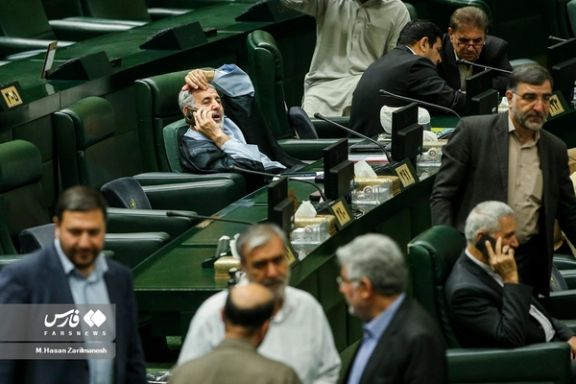
A parliament session on May 9, 2023

A prominent politician in Iran says none of the country's political factions can do anything to ensure a high turnout in the upcoming parliamentary election.

Mohammad Ali Abtahi, former reformist President Mohammad Khatami's chief of staff told Rouydad24 website on Wednesday that "if the people do not feel that it is a free election, they will not take part in it." 

"My understanding is that the Guardian Council is not going to soften its policy on the disqualification [of reform-minded candidates]. It is not likely that those who have gone out of their way to create a unified political system will come short of their hardliner policies."

Other Iranian media outlets such as Khabar Online have also pointed out during recent days that ten months before the vote in March 2024, there is no election mood in Iran unlike previous rounds when campaigns started at least a year before the elections. In the meantime, many Iranian officials including Supreme Leader Ali Khamenei have expressed concern about a likely low-turnout next March. 

Mohammad Ali Abtahi, the chief of staff of former reformist President Mohammad Khatami (undated)
100%
Mohammad Ali Abtahi, the chief of staff of former reformist President Mohammad Khatami

Khamenei told Iranian officials in late March that a high-turnout election will make the country powerful and will stop international pressures on the Islamic Republic. He called for a "healthy election" as he was aware of criticisms of the way the latest Iranian elections were held in 2020 and 2021 presumably under his supervision. 

Many politicians, particularly reformist figures such as Abtahi and Mohsen Mirdamadi, the leader of banned reformist party Mosharekat have said that the regime in Iran has lost its social capital, a polite word for legitimacy, as a result of the disputed presidential election of 2009 and the protests that have rocked Iran since 2017. 

Abtahi added that those who currently hold the power in Iran are not interested in increasing the turnout in the upcoming elections, as only a low turnout can ensure their victory.

Meanwhile, lawmaker Gholamreza Nouri Ghezeljeh told Khabar Online website on Wednesday that the current ultraconservative-dominated parliament is working hard in extraordinary sessions to pass an amendment to Iran's Election Law to serve the hardliners by giving even more power to the conservative-dominated Guardian Council to disqualify any candidate who does not belong to the ultraconservative camp. 

Lawmaker Gholamreza Nouri Ghezeljeh (undated)
100%
Lawmaker Gholamreza Nouri Ghezeljeh

Ghezeljeh characterized the new legislation as "a law against the republican system," however, he said that hardliners are working hard to enact the legislation before the upcoming elections. 

On Tuesday, prominent conservative politician Mohammad Javad Bahonar had said that the Majles should not be involved in changing the Election Law, as the incumbent lawmakers tend to manipulate the legislation to ensure their own re-election. 

Ghezeljeh said that in the draft amendment the Guardian Council has been given the power to disqualify even those who get elected. He said such a legislation will weaken the parliament altogether. 

Some Iranian politicians have also expressed concern about the next presidential election which usually takes place in the year after the Majles election. 

Former lawmaker Gholam AIi Jafarzadeh Imenabadi (undated)
100%
Former lawmaker Gholam AIi Jafarzadeh Imenabadi

Former lawmaker Gholam AIi Jafarzadeh Imenabadi said in an interview on Wednesday that President Ebrahim Raisi's chances for re-election is limited. "He can score only if they put him in front of an empty goal post," he said. 

Imanabadi reiterated that "In a competitive election neither Raisi nor 90 percent of current lawmakers have any chance to get re-elected."



Most Viewed

Iran negotiators ordered to return after internal rift over Islamabad talks
1
EXCLUSIVE

Iran negotiators ordered to return after internal rift over Islamabad talks

2
ANALYSIS

US blockade enters murky phase as tankers spoof signals and buyers hesitate

3
ANALYSIS

Why the $100 billion Hormuz toll revenue is a myth

4

US tightens financial squeeze on Iran, warns banks over oil money flows

5
ANALYSIS

US blockade targets Iran oil boom amid regional disruption

Banner
Banner

Spotlight

  • Hardliners push Hormuz ‘red line’ as US blockade tests Iran’s leverage
    INSIGHT

    Hardliners push Hormuz ‘red line’ as US blockade tests Iran’s leverage

  • Ideology may be fading in Iran, but not in Kashmir's ‘Mini Iran'
    INSIGHT

    Ideology may be fading in Iran, but not in Kashmir's ‘Mini Iran'

  • War damage amounts to $3,000 per Iranian, with blockade set to add to losses
    INSIGHT

    War damage amounts to $3,000 per Iranian, with blockade set to add to losses

  • Why the $100 billion Hormuz toll revenue is a myth
    ANALYSIS

    Why the $100 billion Hormuz toll revenue is a myth

  • US blockade targets Iran oil boom amid regional disruption
    ANALYSIS

    US blockade targets Iran oil boom amid regional disruption

  • Iran's digital economy battered by prolonged blackout
    INSIGHT

    Iran's digital economy battered by prolonged blackout

•
•
•

More Stories

Saudi Diplomacy Brings Assad And Zelenskyy To Arab Summit

May 19, 2023, 17:25 GMT+1
•
Iran International Newsroom

Saudi Arabia was the center of regional and world attention on Friday, as it invited both the Syrian and Ukrainian presidents to the Arab summit it was hosting.

In an unexpected move, Volodymyr Zelenskyy attended the summit of the Arab League to canvas support for his people, while Saudi Crown Prince Mohammed bin Salman expressed his readiness to mediate in the war between Moscow and Kyiv.

"We reaffirm the kingdom's readiness to continue mediating efforts between Russia and Ukraine, and to support all international efforts aimed at resolving the crisis politically in a way that contributes to achieving security," the Saudi Crown Prince said in his opening speech.

Saudi Arabia's Crown Prince Mohammed bin Salman shakes hands with Syria's President Bashar al-Assad ahead of the Arab League Summit in Jeddah, Saudi Arabia, May 19, 2023.
100%
Saudi Arabia's Crown Prince Mohammed bin Salman shakes hands with Syria's President Bashar al-Assad ahead of the Arab League Summit in Jeddah, Saudi Arabia, May 19, 2023.

At the same time, Syrian President Bashar al-Assad was given a warm welcome at the summit, winning a hug from Saudi Arabia's Crown Prince at a meeting of leaders who had shunned him for years, in a policy shift opposed by the US and other Western powers.

However, having Assad, a Russian and Iranian ally and Zelenskyy at the same summit was a diplomatic achievement by Saudi Arabia that reinforces it image as the main player in the Middle East and increasingly a key presence on the world stage.

The government in Tehran has so far not reacted to Riyadh’s move inviting Zelenskyy to the summit, although there was negative coverage by IRGC-linked Fars news agency.

Saudi Crown Prince Mohammed bin Salman shakes hands with Ukrainian President Volodymyr Zelenskiy, ahead of the Arab League summit, in Jeddah, Saudi Arabia, May 19, 2023.
100%
Saudi Crown Prince Mohammed bin Salman shakes hands with Ukrainian President Volodymyr Zelenskiy, ahead of the Arab League summit, in Jeddah, Saudi Arabia, May 19, 2023.

Iran has supported Russia’s invasion of Ukraine by supplying kamikaze drones and other weapons to Moscow and signing several economic agreements with Moscow just this week.

Although Tehran initially welcomed Saudi Arabia’s decision to restore ties with Assad, Iranian media began mentioning that Damascus owes tens of billions of dollars to Iran for its economic and military support since the start of the Syrian civil war in 2011. If rich Arab countries, led by Saudi Arabia, succeed in winning over Assad, Iran will be the biggest loser, finding its decade-long effort to expand influence in the Levant as a failure.

Arab Leaders pose for a family photo ahead of the Arab League Summit in Jeddah, Saudi Arabia, May 19, 2023.
100%
Arab Leaders pose for a group photo ahead of the Arab League Summit in Jeddah, Saudi Arabia, May 19, 2023.

"We hope Syria's return to the Arab League leads to the end of its crisis," Crown Prince Mohammed said in his remarks, 12 years after Arab states suspended Syria as the country descended into a civil war that has killed more than 350,000 people.

Oil powerhouse Saudi Arabia, once heavily influenced by the United States, has taken the diplomatic lead in the Arab world in the past year, re-establishing ties with Iran, welcoming Syria back to the fold, and mediating in the Sudan conflict.

Washington has objected to any steps towards normalization with Assad, saying there must first be progress towards a political solution to the conflict.

"The Americans are dismayed. We (Persian Gulf states) are people living in this region, we're trying to solve our problems as much as we can with the tools available to us in our hands," an Arab source close to government circles told Reuters.

The Saudi Syrian rapprochement followed a Chinese-brokered deal between Riyadh and Tehran in March to restore relations after a seven-year hiatus.

In 2018, the Qatari emir said the region could not tolerate "a war criminal" like Assad. Qatar hosted an Arab summit a decade ago at which the Syrian opposition sat in Syria's seat. Many regarded Assad as a war criminal for bombing and gassing his own people during the civil war.

With reporting by Reuters


IRGC Chief Commander Says US Has Yet To Receive ‘Final Blow’

May 19, 2023, 13:58 GMT+1
•
Iran International Newsroom

The United States will be forced to leave the Middle East and Iran’s “last blow” is yet to come, chief commander of the Revolutionary Guard (IRGC) said Thursday.

Speaking at a ceremony in memory of IRGC ‘martyrs’, Hossein Salami mentioned the targeted killing of Qassem Soleimani in Baghdad in 2020 in a US drone strike and said Iran already landed its first blow, by firing missiles at bases in Iraq hosting US troops, days after the killing.

“They received the first slap, and the second will be their gradual withdrawal from the region, but the last slap is yet to come,” he said.

Soleimani was the commander of IRGC’s extraterritorial Quds Force, who was the mastermind of the Iranian regime’s strategy of building a proxy network in the Middle East, made up of armed militias, Shiite groups, and the Syrian government.

Former commander of IRGC’s extraterritorial Quds Force Qassem Soleimani (left), IRGC Commander-in-Chief Hossein Salami (2nd left) IRGC Aerospace Force commander Amir Ali Hajizadeh (3rd left) and Chief of Staff for the Armed Forces of the Islamic Republic of Iran Mohammad Bagheri (May 2019)
100%
Former commander of IRGC’s extraterritorial Quds Force Qassem Soleimani (left), IRGC Commander-in-Chief Hossein Salami (2nd left) IRGC Aerospace Force commander Amir Ali Hajizadeh (3rd left) and Chief of Staff for the Armed Forces of the Islamic Republic of Iran Mohammad Bagheri (May 2019)

Soleimani invested heavily in post-Saddam Iraqi chaos, arming Iran’s proxies and instructing them to launch attacks against US forces in the country. As these attacks intensified in late 2019, former US President Donald Trump ordered his killing, which was a heavy blow to the regime.

Salami went on to highlight attacks against Israel. “These days fire is raining down on Israelis from Gaza, but the Zionists are unable to do anything and are powerless, and America has also left the region.”

Salami’s statement comes as the US and Israel are in close cooperation in intelligence and military matters, conducting large joint military drills. 

The US and Israel conducted their largest-ever joint military exercises in January, with thousands of troops, dozens of aircraft, and naval vessels in and around Israel.

The drills, dubbed Juniper Oak 2023 was widely seen as a message to Iran, although US officials said the live-fire exercise did not include mock-ups of Iranian targets, but American strategic bombers did take part.

Salami also warned that “no one can prevent our maritime trade, and if this happens, we will settle accounts anywhere in the world.”

It is not clear what Salami was referring to, but the US Navy and its European allies have interdicted several shipments of weapons and explosive from Iranian ports headed to Yemen in recent months. Iran also breaks US oil export sanctions by shipping cargos on “ghost tankers” that usually transfer the crude to other tankers on high seas to conceal their origin.

IRGC leaders have intensified their rhetoric since March and openly indicted that they are supporting the Palestinian Hamas and Islamic Jihad in rocket attacks against Israel.

The pressure of economic sanctions has crippled Iran’s economy, but the regime continues to expand its nuclear program, with high levels of uranium enrichment. Already, the UN nuclear watchdog and governments say that Tehran has accumulated enough enriched uranium to build two or more bombs.

Israel has repeatedly warned that it will not tolerate a nuclear-armed Iran in the region.

The Biden administration, despite holding indirect nuclear talks with Tehran, says that all options are on the table, indicating the US might assist Israel in a possible attack to prevent Iran from becoming a nuclear power.

However, Republicans in the US Congress criticize the Biden team for not having a new policy regarding Iran after nuclear talks reached an impasse last September.

20 Million Iranians Lack Basic Necessities – Official

May 19, 2023, 12:11 GMT+1

About 20 million Iranian citizens lack the basic necessities to survive, a leading official has revealed.

Ali Agha-Mohammadi, a member of Iran’s Expediency Discernment Council, said Thursday that about 19,700,000 Iranians do not have access to adequate housing, education, healthcare, food and clothing.

He criticized the officials who try to cover up the shortcomings with quick fixes and haphazard measures. 

The Expediency Discernment Council is an administrative assembly whose members are appointed by the Supreme Leader.

The figure disclosed by former deputy vice president Agha-Mohammadi equates to more than 1 in 5 of Iran’s total population of almost 88 million.

Earlier this year, the Islamic Republic’s Ministry of Cooperatives, Labor, and Social Welfare said that one-third of the country’s population is now living in extreme poverty, with the proportion having almost doubled from 2020 to 2021.

According to the ministry, the minimum monthly income needed to stay above the poverty line for a family of four in Tehran in 2022 was estimated at 147,000,000 rials (about $500 at the time) but the average nationwide is estimated to have been about 77,000,000 (about $250).

Iranian officials have set the minimum monthly salary for the current year at about 82 million rials, or about $160 at today’s exchange rate. This is one of the lowest minimum wages in the world.

Ecoiran quoted a central bank source on Wednesday as saying that inflation in the first Iranian month of the year (March 21-April 20) rose by 68.7 compared to the same period last year. Just in that one-month prices jumped 5.2 percent, with the previous month witnessing another substantial hike of 6.6 percent.


In Absence Of Official Stats, Media In Iran Say Inflation Is At 70%

May 19, 2023, 07:08 GMT+1
•
Mardo Soghom

A news website in Iran has warned that high inflation was detrimental in the fall of the Roman Empire, as the government conceals data to hide galloping prices.

Fararu website, considered to be moderate in Iran’s government-controlled media environment, wrote on Thursday that as Roman emperors reduced the silver content of their Denario coins, the foundations of the empire began to crumble.

Meanwhile, another website, Ecoiran quoted a central bank source on Wednesday as saying that inflation in the first Iranian month of the year (March 21-April 20) rose by 68.7 compared to the same period last year. Just in that one-month prices jumped 5.2 percent, with the previous month witnessing another substantial hike of 6.6 percent.

If true, this would represent a nearly 20-percent jump compared to the inflation rate last reported by the government in early 2023.

The Central Bank of Iran and the Statistical Center of Iran have not released figures on point-to-point inflation for the past two months, comparing prices to the same months in the past year.

The period in question coincides with persisting low exchange rates for the Iranian currency, rial, which has nearly halved in value since mid-2022. 

One year ago, the rial was trading at around 300,000 to the dollar, while in early May it dropped to as low as 550,000.

A woman shopping in Tehran with Iranian currency in hand (file photo)
100%
A woman shopping in Tehran with Iranian currency in hand

Rial’s huge drop tells the story of inflation in Iran. The country has to import a large part of its food, animal feed, medicines, raw materials and finished goods it needs. As the local currency loses value, imports become more expensive and higher prices have to be passed on to consumers.

The alarming comparison with the Roman Empire is not too far-fetched, as Iran faces a more immediate danger of rebellion by ever-impoverished masses. 

Although large-scale anti-regime protests in the fall of 2022 were driven by social and political oppression, but the current economic crisis was also making hopeless young people restive. Also, labor unrest began to rise in 2023, as workers’ real incomes declined.

It is important to note that price inflation is highest in the food sector, which even last year was estimated to have been between 70-100 percent. Reports began to emerge as early as 2021 that Iranians were cutting down on consumption of meat and dairy products. Recent reports have spoken of lower-income families cutting down on nutritious food and unable to afford many types of fruits and vegetables.

Iran has been suffering from lack of economic growth for more than a decade as international sanctions reduced its oil export revenues that were vital for financing an inefficient government and its more inefficient control of the economy.

But the regime has insisted to stick to its controversial nuclear program that brought about the sanctions in the first place. A brief respite came in 2016-2017, when the JCPOA accord with world powers lifted UN-imposed sanctions, but former US President Donald Trump withdrew from the deal and imposed unilateral sanctions in 2018.

Inflation soon began to surpass 20 percent and the rial started to nosedive, eventually losing value by 12-fold. 

Even politicians loyal to the regime have begun harshly criticizing President Ebrahim Raisi’s government for its inability to address the crisis, but almost no insiders openly say that the decision to resolve the nuclear dispute lies with the Iran’s anti-West ruler Ali Khamenei.

Iran’s high inflation rate is just behind other a few other troubled economies in the world, such as Venezuela, Sudan, Argentina and Zimbabwe.

Israel Accuses Iran Of Efforts to Disrupt Jerusalem Day Flag March

May 19, 2023, 00:04 GMT+1

On the eve of Jerusalem Day Flag on Thursday and Friday, Israeli police accused Iran of trying to disrupt a traditional march by creating “wild” incitement.

Police chief Kobi Shabtai warned against Iran-backed terror group incitement, saying “terrorist elements motivated by Iran — through Hezbollah, Hamas and Islamic Jihad — have been spreading false information on social media about the route of the flag parade…. in the capital of Israel, Jerusalem.”

“The goal of those terrorist elements is clear — it is to create wild incitement to terrorism against the thousands of Israelis who will come to celebrate Jerusalem Day at a number of events,” he said.

More than 3,000 police officers will be deployed across the city for the Jerusalem Day Flag March, which is anticipated to attract tens of thousands of mostly Orthodox Jewish nationalists.

The event marks Israel's unification of East and West Jerusalem during the 1967 Six Day War, but has gained notoriety over the years due to hate speech and violence by some Jewish participants.

On Wednesday, Hamas officials threatened an unspecified response if the march went ahead.

“The Zionist Flag March will not pass, and the response will inevitably come,” said senior Hamas official Salah al-Bardawil in a statement.

Israel has warned Hamas that if it fires rockets, it will respond.

Iranian proxies in Gaza, Lebanon and Syria have all recently attacked Israel with rockets as tensions simmered during the month of Ramadan.




