• العربية
  • فارسی
Brand
  • Iran Insight
  • Politics
  • Economy
  • Analysis
  • Special Report
  • Opinion
  • Podcast
  • Iran Insight
  • Politics
  • Economy
  • Analysis
  • Special Report
  • Opinion
  • Podcast
  • Theme
  • Language
    • العربية
    • فارسی
  • Iran Insight
  • Politics
  • Economy
  • Analysis
  • Special Report
  • Opinion
  • Podcast
All rights reserved for Volant Media UK Limited
volant media logo

Exclusive: Iran Importing Phosphates From Syria To Extract Uranium
Iran International Newsroom
May 3, 2023, 21:30 GMT+1Updated: 17:34 GMT+1
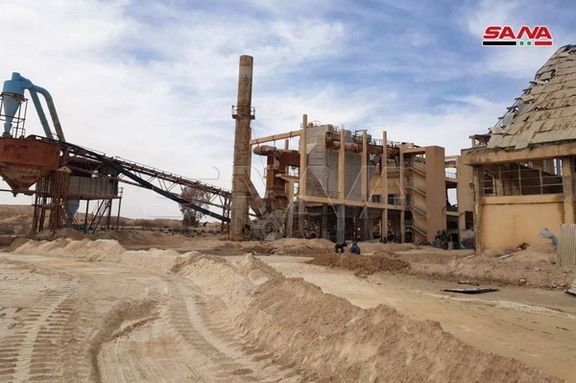
A view from Khunayfis mine in Homs Governorate, Syria, from which Iran will import hundreds of thousands of tons of phosphate to produce uranium

While President Ebrahim Raisi is in Syria, classified information obtained shows Tehran is procuring uranium from phosphate mines in Syria to make yellowcake.

According to the secret documents received by Iran International, the Atomic Energy Organization of Iran (AEOI) had asked the government to let the agency import 800,000 tons of phosphate from the mines under the Islamic Republic’s control in Syria without paying the share of the administration.

One of the documents is a letter issued in January by Mojtaba Hosseinipour, a deputy at the president’s office, addressing Minister of Economic and Financial Affairs Ehsan Khandozi and Reza Fatemi Amin, the former Minister of Industry, Mines and Business who was sacked this week, as well as former head of Iran's Planning and Budget Organization Masoud Mirkazemi and Mohammad Dehghan, Raisi’s deputy in legal matters.

In the letter, the office of the president has asked the officials to decide whether or not they can give the green light to the nuclear agency for “the annual purchase of phosphates from Syria without paying the government’s share.”

In 2017, Tehran and Damascus signed a memorandum of understanding to cooperate in a phosphate mine in Syria’s Al-Sharqiya. Syria is among the world’s largest exporters of the rock phosphate, a raw material used in the production of phosphatic fertilizers. The main use of phosphate is production of fertilizers, but the rock is also an unconventional source to extract uranium, explained in another document attached to the letter.

While EU sanctions on Syria do not explicitly prohibit phosphate imports, they do ban deals with the Syrian minister of oil and mineral resources, who is in charge of phosphates. Cheap Syrian phosphate exports to Europe have boomed in recent years, The Guardian reported in January 2022, noting that European farmers are dependent on phosphate fertilizers. Anyhow, it seems that the Islamic Republic has found another way around sanctions to advance its nuclear program.

Another letter included in the bundle of documents is by the head of Iran’s atomic agency, Mohammad Eslami, who asked Raisi’s first deputy Mohammad Mokhber to allow the purchase of the product from Syria.

A sample of the documents revealing Iran is importing phosphates for uranium extraction
100%
A sample of the documents revealing Iran is importing phosphates for uranium extraction

“In order to supply part of the uranium needed for the country's nuclear industry, this organization (AEOI) is mulling a project to extract uranium from Syria’s phosphate mines, the exploitation of which is at the disposal of the Islamic Republic,” Eslami wrote.

“Due to the high grade of uranium in the phosphate soil of these mines, the extraction of the element and the preparation of yellowcake from it is technically more feasible than the extraction of uranium from low-grade radioactive mines of Iran,” he added, requesting the cabinet to give the go-ahead for the project without paying the government.

Yellowcake is used in the preparation of uranium fuel for nuclear reactors, for which it is smelted into purified uranium dioxide for use in fuel rods for pressurized heavy-water reactors and other systems that use natural unenriched uranium. It has both civilian use as well as application for weapons but it should be processed further. Highly enriched uranium can be blended down with uranium containing low levels of U-235 to produce low-enriched uranium -- less than 5% U-235 -- fuel for power reactors. Further processing can yield weapons-grade uranium with U-235 levels usually above 90%, suitable for nuclear weapons.

In an appendix attached to the letter, the nuclear agency said that there are two main sources for extracting uranium, but the Islamic Republic is barred from using the conventional sources under international sanctions.

It has been forced to resort to unconventional sources in which uranium is extracted as a byproduct, such as is the case for phosphate soil.Khunayfis mine in Homs Governorate with 300 million tons of phosphates is the better choice among the mines under contract with Iran because it has a higher amount of uranium, according to the document.

The presidents of Iran and Syria on Wednesday signed a long-term strategic cooperation agreement, including a memorandum of understanding on oil industry cooperation.

The signing came during a visit by Raisi to Damascus for talks with his Syrian counterpart Bashar al-Assad, in the first such visit by an Iranian head of state since war broke out in Syria in 2011. Tehran is helping Syria rebuild its roads, airports, power stations and ports — potentially benefiting the Revolutionary Guards, which own the biggest construction firms in Iran.

In March, the E3, made up of France, Germany and the UK, issued a tough statement addressing IAEA Board of Governors, demanding immediate response to Iran’s 84-percent uranium enrichment.

While the US responded to the IAEA chief’s visit to Tehran with a cautious approach, waiting to see what the outcomes would be, the E3 said the enrichment at up to 83.7% U-235 is an “extremely grave escalation” which comes against the highly concerning backdrop of continued accumulation of high enriched uranium up to 60% and Iran continuing to expand its enrichment capabilities.


Most Viewed

State media slam Araghchi's Hormuz tweet, say it let Trump claim victory
1

State media slam Araghchi's Hormuz tweet, say it let Trump claim victory

2

Iran International says it won’t be silenced after London arson attack

3
INSIGHT

How Tehran bends its own red lines to boost state rallies

4
VOICES FROM IRAN

Hope and anger in Iran as fragile ceasefire persists

5

Iran halts petrochemical exports to supply domestic market

Banner
Banner

Spotlight

  • Too early to tell who is winning Iran war, experts say
    PODCAST

    Too early to tell who is winning Iran war, experts say

  • How Tehran bends its own red lines to boost state rallies
    INSIGHT

    How Tehran bends its own red lines to boost state rallies

  • Iran blackout cripples freelancer, small business incomes
    VOICES FROM IRAN

    Iran blackout cripples freelancer, small business incomes

  • Ideology may be fading in Iran, but not in Kashmir's ‘Mini Iran'
    INSIGHT

    Ideology may be fading in Iran, but not in Kashmir's ‘Mini Iran'

  • US blockade enters murky phase as tankers spoof signals and buyers hesitate
    ANALYSIS

    US blockade enters murky phase as tankers spoof signals and buyers hesitate

  • Why the $100 billion Hormuz toll revenue is a myth
    ANALYSIS

    Why the $100 billion Hormuz toll revenue is a myth

•
•
•

More Stories

EU Censures Terrorist Attacks On Israel

May 3, 2023, 13:51 GMT+1

The European Union has slammed recent rocket and terrorist attacks against Israel, reiterating the country’s right to defend itself.

However, the EU’s Foreign Policy Chief, Josep Borrell, stressed that “any response must be proportionate and in line with international law”.

As Israeli Prime Minister Benjamin Netanyahu's government seeks to improve ties with the European body, Foreign Minister Eli Cohen met with Borrell in Brussels on Tuesday.

The EU’s Spanish diplomat urged Israel to refrain from “measures that could heighten the already high level of tension and jeopardize the very possibility of a future just and sustainable peace based on the two-state solution.”

During his visit, Cohen also discussed Iranian attempts to target Jews and Israelis on European soil with EU Parliament President Roberta Metsola.

According to the Times of Israel, they discussed the importance of the EU listing the Iranian Revolutionary Guard Corps as a terrorist group and banning all business with it.

In January, the European Parliament called on the 27-state body to list the Revolutionary Guards as a terrorist entity, blaming it for the repression of domestic protests and the supply of drones to Russia.

However, Borrell claimed the EU cannot list Iran's IRGC as a terrorist entity until a European court has determined that they are.

“European countries understand today more than ever the danger from Iran, and see eye-to-eye with Israel regarding the need to confront terror that comes from and is funded by the Iranian regime,” Cohen stated after the meeting with Metsola.


Iran Seizes Second Oil Tanker In A Week In Persian Gulf

May 3, 2023, 12:46 GMT+1

Iran has seized a second oil tanker in a week on Wednesday in Persian Gulf waters, the US Navy said, the latest escalation in a series of attacks on commercial vessels since 2019.

The Bahrain-based US Fifth Fleet said the Panama-flagged oil tanker Niovi was seized by Iran's Islamic Revolutionary Guard Corps Navy (IRGCN) at 6:20 a.m. (0220 GMT) while passing through the narrow Strait of Hormuz.

The incident comes after Iran on Thursday seized a Marshall Islands-flagged oil tanker in the Gulf of Oman called the Advantage Sweet. That tanker is being held by Iranian authorities in Bandar Abbas, the Marshall Islands flag registry said on Tuesday.

Maritime security firm Ambrey has said it believed the Advantage Sweet's seizure by Iran was in response to a recent seizure via a court order by the United States of an oil cargo aboard the Marshall Islands tanker Suez Rajan.

The Niovi oil tanker had been travelling from Dubai toward the UAE's Fujairah port when it was forced by IRGC boats to change course towards Iranian territorial waters, the Navy said.

The Niovi last reported its position at 0231 GMT on Wednesday off the coast of Oman in the Strait of Hormuz with Fujairah as its destination, Refinitiv ship tracking data showed.

According to the International Maritime Organization shipping database, the Niovi's owner is Grand Financing Co, and the ship is managed by Greece-based Smart Tankers.

"Heightened military activity and geopolitical tensions in these regions continue to pose serious threats to commercial vessels," the Marshall Islands flag registry said in an advisory on Tuesday.

"Associated with these threats is the potential for miscalculation or misidentification, which could lead to aggressive actions."

Since 2019, there have been a series of attacks on shipping in the strategic Persian Gulf waters at times of tension between the United States and Iran.

Indirect talks between Tehran and Washington to revive Iran's 2015 nuclear pact with world powers have stalled since September over a range of issues, including the Islamic Republic's violent crackdown on popular protests, Tehran's sale of drones to Russia and acceleration of its nuclear program.

Reporting by Reuters

Hamas Pushed Iran Into Inviting Leader To Garner Financial Aid

May 2, 2023, 23:03 GMT+1
•
Iran International Newsroom

Iran International has learned that Palestinian militant group Hamas pressured the Islamic Republic into inviting its leader to Tehran hoping to get financial support.

According to our sources, the official invitation of Hamas leader Ismail Haniyeh was made following numerous requests because the Palestinian group is struggling with financial problems.

Haniyeh is expected to visit Iran in the near future, the Gaza-based terror group announced last Friday, April 28. Haniyeh's visit will be in relation to “political and field developments,” Hamas said, with Haniyeh expressing thanks and appreciation for the call, confirming his acceptance of the invitation and his intention to go to Tehran soon.

Iran International’s sources claimed that Hamas’ assets have been confiscated in several countries and currently the channels through which the group could receive aid in cryptocurrencies such as Bitcoin are also blocked. Therefore, the group sees the Islamic Republic as among its few sources of income.

Palestinian group Hamas' top leader Ismail Haniyeh talks after meeting with Lebanon's President Michel Aoun, in Baabda, Lebanon June 28, 2021
100%
Palestinian group Hamas' top leader Ismail Haniyeh talks after meeting with Lebanon's President Michel Aoun, in Baabda, Lebanon June 28, 2021

The sources added that although the Islamic Republic continues to provide financial aid to Hamas despite its own economic situation, Tehran is not satisfied with the performance of this group against Israel and is unlikely to give more aid to this group.

In December, Palestinian Arabic language daily newspaper Al-Quds cited informed sources in Lebanon as saying that the Islamic Republic had cut off its financial support for some Palestinian groups, without specifying which groups. General belief is that the Palestinian Islamic Jihad Movement, Hamas and the Popular Front for the Liberation of Palestine were the main recipients of financial aid from the Islamic Republic, among which Hamas and Islamic Jihad are known to be receiving the lion’s share of Tehran’s aid.

Hamas leader Ismail Haniyeh (L) and Iranian President Ebrahim Raisi at the latter's office on August 6, 2021
100%
Hamas leader Ismail Haniyeh (L) and Iranian President Ebrahim Raisi at the latter's office on August 6, 2021

According to Al-Quds sources, these groups depend on Iran's financial aid to pay the salaries of their leaders and members as well as the expenses for other activities. The Islamic Republic’s cutting off aid caused serious problems both in the Gaza Strip and outside the Palestinian territories, to the extent that in some cases, these groups and their leaders have not been able to pay their utility bills, the paper reported.

In March 2022, Haniyeh revealed that the Islamic Republic paid a total of $70 million to Hamas to help it develop missiles and defense systems.

During an interview with Al-Jazeera, Haniyeh said different countries help in financing the group, but Iran is the biggest donor. The head of Hamas political bureau added that thanks to the aid from Iran, his group managed to have a comprehensive defense strategy in its confrontation with the Israeli military in the Gaza Strip in 2021.

He was referring to the two-week outbreak of violence in May 2021 that was called operation “Sword of Jerusalem” by Hamas but dubbed operation “Guardian of the Walls” by Israel. Hamas reportedly fired more than 4,000 rockets and missiles at Israel, most of which were intercepted by the Israeli Iron Dome defense system.

Haniyeh added that Iran backs the Shiite groups within its framework of support for the “axis of resistance” in the region – a term used by Tehran for its aligned militia forces -- noting that Tehran also supports Sunni movements against Israel.

Following normalization of its ties with Iran and Syria, Saudi Arabia also invited a senior delegation of Hamas to the kingdom in April. With China's mediation, Saudi Arabia normalized ties with Iran on March 10 and returned its relations with Syria to the level before the Syrian war. The Saudi embassies in Iran and Syria are scheduled to reopen in the coming weeks.

The Hamas-affiliated al-Resalah newspaper wrote said at the time that Haniyeh, and the head of Hamas Diaspora Office Khaled Mashaal, who have been living in Qatar in the past years, traveled to Riyadh at the head of a high-level delegation. In recent years, relations between Hamas and Saudi Arabia have been tense, with the Kingdom detaining some members of the group, accusing them of supporting terrorism. The tensions mounted as Hamas drew closer to the Islamic Republic.

In December, Lebanese media reported that Hezbollah is also facing financial problems due to the situation in Iran, as it cannot import Iranian goods to sell at a discount to its supporters.

Israeli Foreign Minister Eli Cohen earlier in the year that “Iran is like a cancer. It finances Hamas, the Jihad, and Hezbollah.” Late in April, Iran’s Foreign Minister Hossein Amir-Abdollahian met with heads of two of the regime's terror proxies -- Hezbollah and Palestinian Islamic Jihad Movement -- during a visit to Lebanon.

IAEA Begins To Reinstall Cameras At Iran Nuclear Facilities: Grossi

May 2, 2023, 16:14 GMT+1

The International Atomic Energy Agency started re-installing the removed surveillance cameras in Iran.

After Western powers introduced a resolution in June 2022 to censure Iran over its nuclear program, Iran turned off a number of nuclear watchdog cameras.

In an interview with PBS NewsHour on Monday, IAEA Director-General Rafael Mariano Grossi said the agency is installing cameras and reconnecting some online monitoring systems.

The IAEA is responsible for monitoring and verifying Iran’s compliance with the 2015 nuclear deal, which limited the country’s nuclear activities in exchange for sanctions relief.

Iran has been gradually scaling back its commitments under the deal in response to the US withdrawal from the agreement and the re-imposition of sanctions.

The IAEA has been able to continue its monitoring of Iran’s nuclear program through other means, including satellite imagery, but the loss of the cameras raised concerns about the agency’s ability to detect any potential covert activities.

On March 4, 2023, Iran and the IAEA agreed to a new plan to allow the agency to reinstall certain surveillance equipment in the country.

As soon as the agreement was announced, the Atomic Energy Organization of Iran and IAEA offered different interpretations about what it would include, raising questions about its implementation.

Grossi did not indicate whether Iran would allow the agency to install an online enrichment monitor at Fordow where the agency detected 84 percent enriched uranium in January.

In addition, he did not address whether the IAEA would have access to the recordings made by the cameras or whether Tehran would turn over the data only if the JCPOA was restored.


Iranian American Jewish Federation Censures Letter By Israeli MPs

May 2, 2023, 12:41 GMT+1
•
Iran International Newsroom

A US Jewish federation has slammed a letter by Israeli MPs to advocate for the separation of Iran’s Azarbaijan region, as most of the signatories rescinded their signatures.

In a joint open letter to Israeli foreign Minister Eli Cohen on Sunday, the Iranian American Jewish Federation of New York and Los Angeles called the letter signed by 32 members of the parliament (Knesset) “ill-advised”.

They have underlined that the authors of the letter are clearly misguided in thinking that such advocacy “will deliver a hard blow” to the regime in Tehran, which has been putting pressure on Azerbaijan since its opening of an embassy in Israel in March. 

“This could further destabilize the region, create additional threats to Israel, and damage the current security structure to an irreversible and irreparable degree,” warned the federation, which claimed to support Iran’s territorial integrity.

The parliamentarians’ letter is further advocacy to deal a blow to Tehran and show support to its ally Azerbaijan but such meddling in the country’s foreign affairs has not been welcomed by Iranian Jews in the US. 

The letter claims: “Any attempt, by any entity, foreign or domestic, to sever portions of the country will compel the Iranian people to rally around the flag. Any such entity will be considered an enemy of the Iranian nation, not just its government.”

In another part of the letter, it has been noted that although Iran has several ethnic regions, each with its own small separatist movement, any attempt towards the country’s fragmentation could result in the creation of radical and hostile states.

The US group asserted that the misplaced concern is not a matter for comment from the state of Israel, urging Cohen to publicly announce his stance on the matter.

Later on Tuesday, Israeli Intelligence Minister Gila Gamliel tweeted in Hebrew and Persian that she had “convinced most of the Israeli parliamentarians to rescind their signature from the letter.”

“Fighting against a religious extremist regime is the common desire of many nations, and we must always continue this way," Gamliel said, sharing a document with signatures of about 20 lawmakers who said they “express their disapproval of the establishment of a state in part of the territory of Iran for the Azeri minority.”

Earlier, Prince Reza Pahlavi and diaspora political group Solidarity for a Free Iran also slammed the letter.

The diaspora political group (7th Aban Front in Persian) said the Knesset members’ letter regarding “the Azeri minority” in Iran is “a clear case of action against Iran's existence”. “Solidarity for a Free Iran considers this letter a hostile act against the Iranian nation and strongly condemns it,” the statement said, adding that “the letter of these Knesset members is in sheer contradiction with the statements made by Israeli government officials regarding friendship between the two nations of Iran and Israel during the recent visit of Prince Reza Pahlavi,” Solidarity for Free Iran said.

“The verbal assault on Iran’s territorial integrity by 32 members of the Israeli parliament is completely unacceptable and a service to the interests of the anti-Iranian Islamic Republic regime,” Pahlavi said.

Following Cohen's recent state visit to Azerbaijan, the Knesset members asked the Israeli government to “pressure Iran to stop oppressing the Azeri minority in northwest Iran” and called for separation of what they called South Azerbaijan from Iran.





