• العربية
  • فارسی
Brand
  • Iran Insight
  • Politics
  • Economy
  • Analysis
  • Special Report
  • Opinion
  • Podcast
  • Iran Insight
  • Politics
  • Economy
  • Analysis
  • Special Report
  • Opinion
  • Podcast
  • Theme
  • Language
    • العربية
    • فارسی
  • Iran Insight
  • Politics
  • Economy
  • Analysis
  • Special Report
  • Opinion
  • Podcast
All rights reserved for Volant Media UK Limited
volant media logo

Iranian Regime Forces Abuse, Torture, Kill Children During Protests: HRW
Iran International Newsroom
Apr 25, 2023, 16:21 GMT+1Updated: 17:42 GMT+1
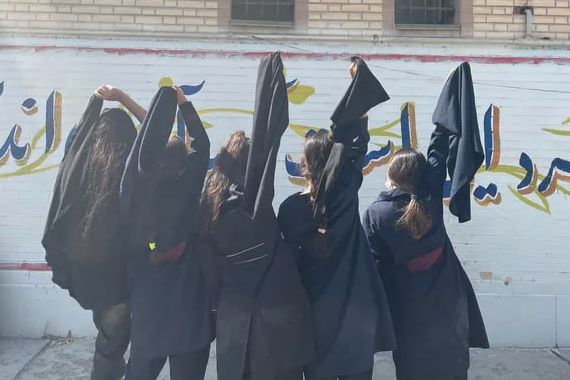
A group of schoolgirls removing their hijab in support of popular protests

In its latest report, Human Rights Watch claims Iranian security forces have systematically murdered, tortured, and sexually assaulted children during the nationwide protests.

The rights group claims judges have barred children's families from hiring lawyers of their choice to defend them, and found Iranian authorities have arrested, interrogated, and prosecuted children in violation of legal safeguards.

Released Tuesday, the report details eleven cases of child abuse between September 2022 and February 2023. Children have been arrested and detained by security forces without informing their families.

In some cases, the students released from detention are barred from returning to school, or their families' social welfare has been cut off, forcing them to go to work.

Tara Sepehri Far, a senior Iran researcher at Human Rights Watch said: “Over the past seven months, the authorities have not hesitated to extend the coercive power of the state to silence even children.”

Tara Sepehri Far, a senior Iran researcher at Human Rights Watch
100%
Tara Sepehri Far, a senior Iran researcher at Human Rights Watch

Detailing first hand accounts, one high school student said security forces set her clothing on fire, beat and whipped her, and pushed her onto a lit gas range during arrest. Another 17-year-old boy spoke of being brutally beaten and sexually assaulted.

According to the report, there have been numerous instances of torture, including the forcing of needles under a young boy's nails, the torture of two children to obtain information about their family’s whereabouts, and the torture of a 16-year-old who attempted suicide twice after being electrocuted, beaten, and sexually assaulted by interrogators.

Children injured by security forces have not been provided with medical care and their family members have been threatened to keep silent about the abuses.

Several rights groups, including Human Rights Watch, Amnesty International, and others, have documented widespread and violent repression of protests by the Iranian government, including the killing of children.

So far, well over 500 protesters -- including at least 69 children -- have been killed in regime crackdowns since the protests began in September, according to the Human Rights Activists' News Agency (HRANA).

Human Rights Watch called on the United Nations to act. In a statement, it said: “The United Nations Fact-Finding Mission on Iran should investigate these grave abuses against children as part of its broader reporting on the Iranian government’s serial human rights violations.”

Iranian law forbids prosecution and interrogation of children by anyone other than specialized children's prosecutors and youth courts. However, according to the report, a revolutionary court judge, a cleric, was co-appointed as a youth justice judge in one case involving 16 defendants, including three children.


Most Viewed

State media slam Araghchi's Hormuz tweet, say it let Trump claim victory
1

State media slam Araghchi's Hormuz tweet, say it let Trump claim victory

2

Iran International says it won’t be silenced after London arson attack

3
INSIGHT

How Tehran bends its own red lines to boost state rallies

4
OPINION

The Hormuz get out of jail card turned to a grave

5

Iran halts petrochemical exports to supply domestic market

Banner
Banner

Spotlight

  • Too early to tell who is winning Iran war, experts say
    PODCAST

    Too early to tell who is winning Iran war, experts say

  • How Tehran bends its own red lines to boost state rallies
    INSIGHT

    How Tehran bends its own red lines to boost state rallies

  • Iran blackout cripples freelancer, small business incomes
    VOICES FROM IRAN

    Iran blackout cripples freelancer, small business incomes

  • Ideology may be fading in Iran, but not in Kashmir's ‘Mini Iran'
    INSIGHT

    Ideology may be fading in Iran, but not in Kashmir's ‘Mini Iran'

  • US blockade enters murky phase as tankers spoof signals and buyers hesitate
    ANALYSIS

    US blockade enters murky phase as tankers spoof signals and buyers hesitate

  • Why the $100 billion Hormuz toll revenue is a myth
    ANALYSIS

    Why the $100 billion Hormuz toll revenue is a myth

•
•
•

More Stories

Iranian Hackers Gained Access To Election Results Website In 2020: US Military

Apr 25, 2023, 15:05 GMT+1

Iranian hackers gained access to a US government website set to report the 2020 elections results, according to US military officials.

The revelation was made by Major General William Hartman, head of US Cyber Command’s Cyber National Mission Force, who spoke for the first time of the incident, one of multiple attacks from foreign hackers during the presidential elections.

Speaking at the RSA cybersecurity conference in San Francisco, Hartman spoke of public concern that hackers may have rendered the website for displaying results unreachable or posted fake results, shaking public confidence.

However, he claimed that the Iranian group, known as Pioneer Kitten, was removed from the network before any damage was done to affect voting.

Hartman said the Iranian group was one of multiple foreign groups which had tried to disrupt the 2020 elections. In the same year, Iranian hackers faked emails supposedly from the militant far-right group, The Proud Boys, in order to threaten voters.

Six Iranians and a company called Emennet Pasargad were sanctioned by the United States in 2021 for interfering with the 2020 presidential election following the admission of the Biden administration that both Iran and Russia had interfered with the 2020 US presidential elections.

At the time, Alireza Miryousfi, the spokesperson of Iran's mission to the United Nations in New York, claimed on his Twitter page that "unlike America, Iran does not interfere in the elections of other countries."

Iran Lawmakers, Former President Criticize Government's Performance

Apr 25, 2023, 12:03 GMT+1
•
Iran International Newsroom

An Iranian lawmaker says the recent changes in the Raisi administration will not lead to any positive result as the president has not changed his approach.

Gholamreza Nouri Ghezeljeh added in an interview with Khabar Online in Tehran that although the highlight of the reshuffling was the removal of Agriculture Minister Javad Sadatinejad, several other ministers who needed to be replaced are still in the government because of problems in the dynamics between the parliament and the government.

Apart from changing some cabinet ministers, President Ebrahim Raisi also needs to remove some of the local officials and replace them with efficient executives, the lawmaker said. He charged that inefficiency is a shared characteristic by the parliament and the government – both dominated by hardliners loyal to Supreme Leader Ali Khamenei.

Ghezeljeh further added that the administration has a limited vision marked by factional interests, which prevents it from seeing the bigger picture and realizing the gravity of Iran's problems.

MP Gholamreza Nouri Ghezeljeh (undated)
100%
MP Gholamreza Nouri Ghezeljeh

Ghezeljeh pointed out that there are many capable political figures within the conservative camp, but the government has limited its choices to a few individuals. He insisted that the country's executive management has many problems and change is badly needed in the cabinet.

Apart from the economic crisis that is the government's biggest problem, the Raisi administration is facing another major issue which is holding parliamentary elections next March while ensuring a good turnout. Media reports and opinions say voters are deeply disappointed with the regime’s engineered elections and might see no point in turning out to vote.

Although Iranian media have interpreted a statement by Supreme Leader Ali Khamenei about the need for cooperation among the heads of the three branches of the government as an order to stop the impeachment motion to replace Industry Minister Reza Fatemi Amin, some of the members of the parliament have told Rouydad24 website that the impeachment will go ahead as planned.

 Industry Minister Reza Fatemi Amin (undated)
100%
Industry Minister Reza Fatemi Amin

The impeachment was called for by at least 40 lawmakers. Although lawmaker Kamal Hosseinpour told reporters that the motion has been stopped, others including Lotfollah Siahkali insist that the motion will go ahead, while 15 of those who had signed the motion have taken back their support for the impeachment.

Meanwhile, another lawmaker, Ahmad Rasoulijead told Rouiydad24 that according to regulations, lawmakers cannot take back their signature once an impeachment motion is handed over to the presidium. In another development as the spokesman for the Ministry of Industry has charged that some lawmakers had personal demands from the minister, Rasoulinejad called on Fatemi Amin to name those lawmakers.

MP Ahmad Rasoulijead  (undated)
100%
MP Ahmad Rasoulijead

Criticism of the government among the members of the parliament is not simply about impeachments and the ministers of Industry and agriculture. Jalal Mahmoudzadeh has harshly criticized the performance of Foreign Minister Hossein Amir-Abdollahian and said with a minister like him, “we cannot maintain ties even with small countries” that have less than one million population. He also criticized the Raisi administration for dividing the nation as insiders and outsiders, with regime insiders winning the lion's share of all the privileges the government can offer.

Meanwhile, mysteriously a two-year old video of former president Mahmoud Ahmadinejad emerged last week in which he criticizes compulsory hijab. He also criticizes hardliners who charged unveiled women advocate nudity and called for respect for women's choice of what the wear.

However, many social media users have dismissed Ahmadinejad's comment as one of his tactics to grab attention, citing his policies during his presidency. Although Ahmadinejad had since 2005 spoken in support of young Iranians choice of lifestyle and dress code, he never stopped hardliners and vigilante groups from attacking women when he was president.

Iran Indicts Three Activists Protesting To Chemical Attacks On Schools

Apr 25, 2023, 10:49 GMT+1

Three student activists in Iran have been summoned and indicted after protesting the serial poisoning of schoolgirls across the country.

Zia Nabavi, a former political prisoner, and student activist who was summoned to the Evin court together with two other activists, Fereshteh Tousi and Hasti Amiri, announced Monday that they have been accused of "propaganda against the state”.

The students from Tehran Allameh University held a gathering on March 7 to protest against the chemical attacks on students which began on November 30 in Qom.

Close to 300 schools and thousands of students have been targeted by chemical attacks with as yet, no clear answers from the government and no convictions made.

Nabavi is no stranger to the brutal regime’s crackdowns, having previously served nine years of a 10-year sentence on charges of "creating unease in the public mind" before being released in February 2018.

The attacks have mostly affected girls’ schools to quash the wave of anti-regime unrest which followed the death in custody of Mahsa Amini, with women leading the Woman, Life, Freedom revolutionary movement and rejecting the mandatory hijab.

Hundreds of girls have since been hospitalized with symptoms including respiratory distress, numbness in their limbs, heart palpitations, headaches, nausea, and vomiting.

Ordinary Iranians have been suspicious of the involvement of the regime itself, or religious extremists protected by the regime, calling the attacks “state terrorism,” although the regime has denied responsibility and even staged arrests of suspects after widespread protests.

Popular belief is that such large-scale and coordinated attacks cannot happen without the green light of regime authorities.

Iranians To Form Human Chains To Protect Schools From Gas Attacks

Apr 24, 2023, 23:23 GMT+1
•
Iran International Newsroom

As the government in Iran fails to stop recurring chemical attacks on girls’ schools, parents are moving to take protection into their own hands. 

Following increasing attacks in the past two weeks, photos emerged on social media of parents standing guard outside their daughters’ schools. 

Moreover, the Coordination Council of Iranian Teachers' Trade Associations issued a statement on Monday, stressing the necessity of forming grassroot groups to protect students. The council also called for the formation of a "human chain around schools.” 

Earlier on Monday, several schools in the Kurdish-majority city of Sanandaj were attacked by the mysterious gas for the second time in the past two weeks. 

Also on Monday, schools were attacked in the cities of Hamedan, Mehrshahr and Karaj, among others. An unknown number of girls were taken to hospital following these attacks. 

The council also said that two teachers were also hospitalized in the intensive care unit after one of the attacks in Karaj, near the capital Tehran. 

In the statement, the Council pointed out that the poisonings have been happening for over six months and despite haphazard denunciations authorities have taken no action to stop them.

A young woman lies in hospital after reports of poisoning at an unspecified location in Iran in this still image from video from March 2, 2023.
100%
A young woman lies in hospital after reports of poisoning at an unspecified location in Iran in this still image from video from March 2, 2023.

"While we are witnessing the continuation of these crimes, the suspicion of the government's support and orchestration of the attacks have become evident,” read the statement. 

“The country's police force is unable to ensure the safety of the children, but at the same time, it has devoted its efforts to threatening freedom-loving women, who resist pressure so as to have a choice on choosing their clothing," the council added. 

Urging students, their families, and teachers to join hands and set up groups to protect the schoolgirls, the council said, If the perpetrators of these catastrophic crimes are not identified, tried and punished, the teachers will inevitably hold classes in the street to save the lives of the students and will ask the popular groups to protect them with a human chain."

In the past few days, families of students staged several rounds of protest rallies urging officials to hold classes virtually rather than at schools to protect children from further attacks that began in November.

Critics of the regime say the attacks are part of a crackdown on protests, a claim denied by officials who have claimed the symptoms are the result of mass hysteria. Every now and then in the past six months, state media reported the arrest of perpetrators but never has the regime announced the identities of the detainees, or provided information about their motives, date of trial and the investigation. 

The only people whose arrests became certain were the people who released videos of the aftermath of the attacks. The Ministry of Islamic Guidance has sent a notice to the local media to censor the news related to the attacks.

Close to 300 schools were targeted in the past Iranian year ending on March 20 without any apparent serious effort by the government to identify and pursue the perpetrators, nor to explain to terrified parents and students what was happening.

Thousands of students have been affected, mostly girls, with hundreds hospitalized with symptoms including respiratory distress, numbness in their limbs, heart palpitations, headaches, nausea, and vomiting.

Woman Dies Of Heart Attack In Iran During Scuffle Over Hijab

Apr 24, 2023, 19:31 GMT+1
•
Maryam Sinaiee

A 59-year-old Iranian woman died of cardiac arrest in hospital Monday after a fight broke out when vigilantes assaulted a member of her family over hijab.

A video, posted on social media after the incident shows the woman, whose name has not been disclosed, on the ground and scuffles between people on the scene at the parking lot of Mahan Garden, a tourist attraction 25km from Kerman, capital of the Eastern Kerman Province. The woman died at a hospital later.

Social media users have reported that the deceased and her family members were visitors from the southern port city of Bandar Abbas.

The video was taken from inside a bus which carried the Revolutionary Guards (IRGC) affiliated Basij militia members and their families who were in Kerman to visit the grave of slain Qods Force Commander Qassem Soleimani.

Apparently, the Basij members ordered a member of the woman’s family to cover her hair, leading to an argument and a scuffle.

“Let her die!”, one of the Basij women on the bus exclaims when another one points out that the woman on the ground has died.

Scuffle between Basijis and people at Mahan Garden’s parking after a woman collapsed.

Ali Babaei, governor of Kerman, confirmed the death of the 59-year-old woman and injury of several others in the group fight, which he claimed had been “personal”. He added that those responsible for the incident were arrested by the police but did not offer further details.

A judiciary official, Yousef Sobhani, has said that an investigation has been launched into the incident and “any possible crime would be seriously dealt with.”

The footage was initially widely shared by hardliners on social media because it showed a few people attacking the Basijis and throwing stones at the bus but was later removed from most accounts as it appeared to have backfired.

In the past few weeks, hardliners have intensified their efforts to enforce veiling laws more forcefully to put a stop to women’s increasing defiance of the compulsory hijab. Since popular protests after Mahsa Amini died at the hands of the morality police in September, many women walk in the streets without hijab. The clerical regime is determined not to allow unveiled women to appear outside their homes and prevent more women from flouting hijab rules in as the hot summer season arrives.

Such efforts include encouragement of hardliners to take the matter into their own hands and carry out their religious duty of “calling to virtue and forbidding wrong”. This includes shutting businesses for their customers’ defiance of hijab, and “hijab warning” text messages sent by the police to nearly everyone who uses a mobile phone, including some men.

Warning ‘hijab-less’ women, however, in several cases has gone well beyond “verbal” and ended in violence.

Emergency responders attending to a woman who had a panic attack during a hijab fight at shopping arcade in Babol.

A video from the CCTV of a convenience store in Shandiz near the religious city of Mashhad went viral on social media in early April that showed a man dumping a large tub of yogurt on the head of a ‘hijab-less’ woman and her mother, after an argument as he demanded from her to cover her head.

Some of the people present on the scene came to the defense of the mother and daughter. The attacker was also a member of the Basij.

Another video that became viral on social media in mid-April showed a young woman having a panic attack at a shopping arcade in Babol in northern Iran. The incident happened as a fight broke out when Basij militia tried to arrest some shopkeepers over hijab and fired their guns into the air during the scuffle.

The police later denied that shots had been fired or the hijab incident had caused the young woman’s panic attack.

Hijab incidents are now becoming a daily occurrence. At Tehran University on Monday students staged a rally outside the campus security office after a fight broke out between them and guards who had used violence against female students over hijab. The security detained two female students but later released them.

Many say on social media that women will not allow to be bullied again into wearing the hijab.