• العربية
  • فارسی
Brand
  • Iran Insight
  • Politics
  • Economy
  • Analysis
  • Special Report
  • Opinion
  • Podcast
  • Iran Insight
  • Politics
  • Economy
  • Analysis
  • Special Report
  • Opinion
  • Podcast
  • Theme
  • Language
    • العربية
    • فارسی
  • Iran Insight
  • Politics
  • Economy
  • Analysis
  • Special Report
  • Opinion
  • Podcast
All rights reserved for Volant Media UK Limited
volant media logo

Iran Lawmakers, Former President Criticize Government's Performance
Iran International Newsroom
Apr 25, 2023, 12:03 GMT+1Updated: 18:06 GMT+1
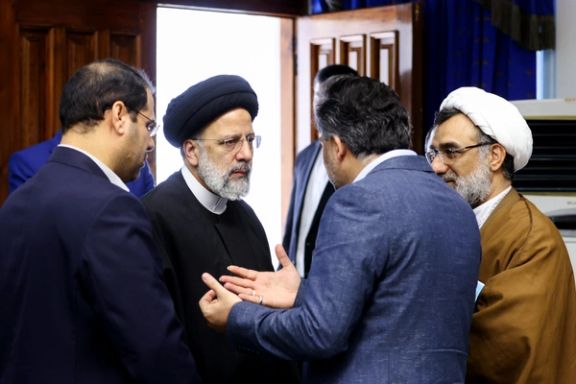
Iranian President Ebrahim Raisi after a cabinet meeting (April 2023)

An Iranian lawmaker says the recent changes in the Raisi administration will not lead to any positive result as the president has not changed his approach.

Gholamreza Nouri Ghezeljeh added in an interview with Khabar Online in Tehran that although the highlight of the reshuffling was the removal of Agriculture Minister Javad Sadatinejad, several other ministers who needed to be replaced are still in the government because of problems in the dynamics between the parliament and the government.

Apart from changing some cabinet ministers, President Ebrahim Raisi also needs to remove some of the local officials and replace them with efficient executives, the lawmaker said. He charged that inefficiency is a shared characteristic by the parliament and the government – both dominated by hardliners loyal to Supreme Leader Ali Khamenei.

Ghezeljeh further added that the administration has a limited vision marked by factional interests, which prevents it from seeing the bigger picture and realizing the gravity of Iran's problems.

MP Gholamreza Nouri Ghezeljeh (undated)
100%
MP Gholamreza Nouri Ghezeljeh

Ghezeljeh pointed out that there are many capable political figures within the conservative camp, but the government has limited its choices to a few individuals. He insisted that the country's executive management has many problems and change is badly needed in the cabinet.

Apart from the economic crisis that is the government's biggest problem, the Raisi administration is facing another major issue which is holding parliamentary elections next March while ensuring a good turnout. Media reports and opinions say voters are deeply disappointed with the regime’s engineered elections and might see no point in turning out to vote.

Although Iranian media have interpreted a statement by Supreme Leader Ali Khamenei about the need for cooperation among the heads of the three branches of the government as an order to stop the impeachment motion to replace Industry Minister Reza Fatemi Amin, some of the members of the parliament have told Rouydad24 website that the impeachment will go ahead as planned.

 Industry Minister Reza Fatemi Amin (undated)
100%
Industry Minister Reza Fatemi Amin

The impeachment was called for by at least 40 lawmakers. Although lawmaker Kamal Hosseinpour told reporters that the motion has been stopped, others including Lotfollah Siahkali insist that the motion will go ahead, while 15 of those who had signed the motion have taken back their support for the impeachment.

Meanwhile, another lawmaker, Ahmad Rasoulijead told Rouiydad24 that according to regulations, lawmakers cannot take back their signature once an impeachment motion is handed over to the presidium. In another development as the spokesman for the Ministry of Industry has charged that some lawmakers had personal demands from the minister, Rasoulinejad called on Fatemi Amin to name those lawmakers.

MP Ahmad Rasoulijead  (undated)
100%
MP Ahmad Rasoulijead

Criticism of the government among the members of the parliament is not simply about impeachments and the ministers of Industry and agriculture. Jalal Mahmoudzadeh has harshly criticized the performance of Foreign Minister Hossein Amir-Abdollahian and said with a minister like him, “we cannot maintain ties even with small countries” that have less than one million population. He also criticized the Raisi administration for dividing the nation as insiders and outsiders, with regime insiders winning the lion's share of all the privileges the government can offer.

Meanwhile, mysteriously a two-year old video of former president Mahmoud Ahmadinejad emerged last week in which he criticizes compulsory hijab. He also criticizes hardliners who charged unveiled women advocate nudity and called for respect for women's choice of what the wear.

However, many social media users have dismissed Ahmadinejad's comment as one of his tactics to grab attention, citing his policies during his presidency. Although Ahmadinejad had since 2005 spoken in support of young Iranians choice of lifestyle and dress code, he never stopped hardliners and vigilante groups from attacking women when he was president.


Most Viewed

State media slam Araghchi's Hormuz tweet, say it let Trump claim victory
1

State media slam Araghchi's Hormuz tweet, say it let Trump claim victory

2

Iran International says it won’t be silenced after London arson attack

3
INSIGHT

How Tehran bends its own red lines to boost state rallies

4
OPINION

The Hormuz get out of jail card turned to a grave

5

Iran halts petrochemical exports to supply domestic market

Banner
Banner

Spotlight

  • Too early to tell who is winning Iran war, experts say
    PODCAST

    Too early to tell who is winning Iran war, experts say

  • How Tehran bends its own red lines to boost state rallies
    INSIGHT

    How Tehran bends its own red lines to boost state rallies

  • Iran blackout cripples freelancer, small business incomes
    VOICES FROM IRAN

    Iran blackout cripples freelancer, small business incomes

  • Ideology may be fading in Iran, but not in Kashmir's ‘Mini Iran'
    INSIGHT

    Ideology may be fading in Iran, but not in Kashmir's ‘Mini Iran'

  • US blockade enters murky phase as tankers spoof signals and buyers hesitate
    ANALYSIS

    US blockade enters murky phase as tankers spoof signals and buyers hesitate

  • Why the $100 billion Hormuz toll revenue is a myth
    ANALYSIS

    Why the $100 billion Hormuz toll revenue is a myth

•
•
•

More Stories

Iran Indicts Three Activists Protesting To Chemical Attacks On Schools

Apr 25, 2023, 10:49 GMT+1

Three student activists in Iran have been summoned and indicted after protesting the serial poisoning of schoolgirls across the country.

Zia Nabavi, a former political prisoner, and student activist who was summoned to the Evin court together with two other activists, Fereshteh Tousi and Hasti Amiri, announced Monday that they have been accused of "propaganda against the state”.

The students from Tehran Allameh University held a gathering on March 7 to protest against the chemical attacks on students which began on November 30 in Qom.

Close to 300 schools and thousands of students have been targeted by chemical attacks with as yet, no clear answers from the government and no convictions made.

Nabavi is no stranger to the brutal regime’s crackdowns, having previously served nine years of a 10-year sentence on charges of "creating unease in the public mind" before being released in February 2018.

The attacks have mostly affected girls’ schools to quash the wave of anti-regime unrest which followed the death in custody of Mahsa Amini, with women leading the Woman, Life, Freedom revolutionary movement and rejecting the mandatory hijab.

Hundreds of girls have since been hospitalized with symptoms including respiratory distress, numbness in their limbs, heart palpitations, headaches, nausea, and vomiting.

Ordinary Iranians have been suspicious of the involvement of the regime itself, or religious extremists protected by the regime, calling the attacks “state terrorism,” although the regime has denied responsibility and even staged arrests of suspects after widespread protests.

Popular belief is that such large-scale and coordinated attacks cannot happen without the green light of regime authorities.

Iran Officials, Clerics Divided Over Compulsory Hijab Rules

Apr 25, 2023, 07:17 GMT+1
•
Iran International Newsroom

While thousands of women across Iran no longer wear the hijab, some regime officials are still in a state of denial and call for strict rules to control women.

In an interview with the IRGC-linked Fars news agency, Ali Khanmohammadi, the spokesman for the Headquarters To Promote Virtues and Prohibit Vice, the jargon for the morality police, called hijab defiance "a worrying situation and an onslaught on Islamic rules." He called on government institutions, meaning the police and the IRGC, to stop the behavior.

Khanmohammadi further warned that if the compulsory hijab rules are undermined, soon respect for other laws will also disappear.

The clerical regime has made hijab an existential issue for itself, trying to enforce it almost at any cost, including running the risk of renewed protests.

Ali Khanmohammadi, the spokesman for the Headquarters To Promote Virtues and Prohibit Vice (April 2023)
100%
Ali Khanmohammadi, the spokesman for the Headquarters To Promote Virtues and Prohibit Vice,

Former Deputy Judiciary Chief Mohammad Javad Larijani said recently that "the presence of a few unveiled women is not the social reality in Iran." Meanwhile he called the behavior of women who remove their headscarves "sedition," an offence that entails punishments as harsh as the death sentence in an Islamic society.

On the other hand, a prominent reformist cleric told Rouiydad24 website that the country's officials have given up dealing with major problems and all they do is intervention in the people's lifestyle and invading their privacy.

This comes while ultraconservative lawmaker Javad Karimi Qoddusi said on Sunday, that forceful methods that the morality police uses no longer work in Iran because people have become emboldened because of recent protests.

Critics say that some clerics including the Friday Imam of Qeshm island have gone out of their way and shut down people's shops for allowing unveiled women to shop. He said this is strictly against the religion and the law. He characterized such behavior as radical and a disgrace to the religion.

A few clerics have told the media that trying to force people to accept religious rules will discourage even the pious from following the religion. They warn that radical behaviors against unveiled women can lead to public insecurity while the government's main responsibility is to keep society and people secure.

Although many Iranians have seen videos that show the Friday Imam of Qeshm shutting down shops and harassing shopkeepers and shoppers in the island's malls, Gholamreza Hajebi has denied doing what is seen in videos, and accused his critics of distorting reality.

Iranian lawyer Nemat Ahmadi has likened the cleric's behavior of medieval Muslim rulers who did not have any respect for justice and punished whoever they did not like on the spot without asking questions first. He added that the least the Friday Imam of Qeshm can be charged with is undermining the principle of separation of the executive, legislative and judiciary bodies. However, the cleric cannot be associated with any one of the three bodies of the government.

The Friday Imam of Qeshm, Gholamreza Hajebi  (undated)
100%
The Friday Imam of Qeshm, Gholamreza Hajebi

Meanwhile, Iran's Supreme Leader Ali Khamenei has spoken differently about the government's reaction to the resistance against hijab in his speeches. While at times insisting on the enforcement of hijab, at other times he has said that even those who do not cover their hair are his daughters. However, security forces and their vigilante agents are under Khamenei’s control.

While many have warned that strict measures against women might lead to confrontation between various groups, in his latest Eid al-Fitr sermon on Saturday, Khamenei advised government officials to avoid creating confrontations between citizens.

Some have interpreted this as Khamenei’s signal to relax hijab rule, but so far all the signs point at the opposite direction.

Iranians To Form Human Chains To Protect Schools From Gas Attacks

Apr 24, 2023, 23:23 GMT+1
•
Iran International Newsroom

As the government in Iran fails to stop recurring chemical attacks on girls’ schools, parents are moving to take protection into their own hands. 

Following increasing attacks in the past two weeks, photos emerged on social media of parents standing guard outside their daughters’ schools. 

Moreover, the Coordination Council of Iranian Teachers' Trade Associations issued a statement on Monday, stressing the necessity of forming grassroot groups to protect students. The council also called for the formation of a "human chain around schools.” 

Earlier on Monday, several schools in the Kurdish-majority city of Sanandaj were attacked by the mysterious gas for the second time in the past two weeks. 

Also on Monday, schools were attacked in the cities of Hamedan, Mehrshahr and Karaj, among others. An unknown number of girls were taken to hospital following these attacks. 

The council also said that two teachers were also hospitalized in the intensive care unit after one of the attacks in Karaj, near the capital Tehran. 

In the statement, the Council pointed out that the poisonings have been happening for over six months and despite haphazard denunciations authorities have taken no action to stop them.

A young woman lies in hospital after reports of poisoning at an unspecified location in Iran in this still image from video from March 2, 2023.
100%
A young woman lies in hospital after reports of poisoning at an unspecified location in Iran in this still image from video from March 2, 2023.

"While we are witnessing the continuation of these crimes, the suspicion of the government's support and orchestration of the attacks have become evident,” read the statement. 

“The country's police force is unable to ensure the safety of the children, but at the same time, it has devoted its efforts to threatening freedom-loving women, who resist pressure so as to have a choice on choosing their clothing," the council added. 

Urging students, their families, and teachers to join hands and set up groups to protect the schoolgirls, the council said, If the perpetrators of these catastrophic crimes are not identified, tried and punished, the teachers will inevitably hold classes in the street to save the lives of the students and will ask the popular groups to protect them with a human chain."

In the past few days, families of students staged several rounds of protest rallies urging officials to hold classes virtually rather than at schools to protect children from further attacks that began in November.

Critics of the regime say the attacks are part of a crackdown on protests, a claim denied by officials who have claimed the symptoms are the result of mass hysteria. Every now and then in the past six months, state media reported the arrest of perpetrators but never has the regime announced the identities of the detainees, or provided information about their motives, date of trial and the investigation. 

The only people whose arrests became certain were the people who released videos of the aftermath of the attacks. The Ministry of Islamic Guidance has sent a notice to the local media to censor the news related to the attacks.

Close to 300 schools were targeted in the past Iranian year ending on March 20 without any apparent serious effort by the government to identify and pursue the perpetrators, nor to explain to terrified parents and students what was happening.

Thousands of students have been affected, mostly girls, with hundreds hospitalized with symptoms including respiratory distress, numbness in their limbs, heart palpitations, headaches, nausea, and vomiting.

Relatives Of Massacred Iranian Prisoners Push To Oust Professor From Ohio College

Apr 24, 2023, 17:23 GMT+1

Families of political prisoners executed in Iran’s in 1988 are meeting Ohio state legislators to push for the sacking of a college professor accused of being involved in the killings.

According to a statement released by relatives of the victims, they will meet with 10 state legislators to ask them to withhold state and federal funding to Oberlin College until Mohammad Jafar Mahallati, a former Iranian UN envoy who covered up the mass killings, is fired.

"On April 28 we will hold a protest at Oberlin College, and then we will participate in the Oberlin city rally to hail the courage of the Iranian people in standing up against the clerical regime," read the statement.

Mahallati, currently a professor of religion at Oberlin College, is accused of playing a role as an accomplice in the 1988 prison massacre.

The executions were carried out based on a fatwa by Iran's then-supreme leader, Ruhollah Khomeini, against the MEK which carried out a wave of bombings in Iran and struck an alliance with Saddam Hussein during the 1980-88 war.

The exact number of prisoners executed during the purge of prisoners is not known but according to Amnesty International, the Iranian authorities "forcibly disappeared" and "extrajudicially executed" around 5,000 between July and September 1988.

Mahallati maintains that he was unaware of the executions despite Amnesty International’s numerous urgent notices to Iran calling for an end to the killings which were widely reported by the media.

Iranian Lawmaker Warns Of Impending Medicine Shortage

Apr 24, 2023, 11:55 GMT+1

An Iranian lawmaker has warned about an impending medicine crisis following an inadequate budget allocation.

Homayoun Sameyah, a member of the Parliament's Health Commission, announced that the budget needed to procure medicine and medical equipment is 150 thousand billion tomans (nearly 3 billion USD), but the fund allocated by the government is less than half this figure.

“Our prediction is that in the coming months, the issue of medicine and medical equipment shortage will worsen,” he said on Monday.

Despite the warnings, Minister of Health Bahram Einollahi is underplaying the crisis, claiming that “most medicines are available, and there will be no problem regarding the supply of pharmaceuticals this year.”

Medicine shortages in more economically deprived areas of the country have already reached crisis point with medical staff at hospitals in the southeastern city of Zahedan citing shortages of IV fluid, insulin, and inhaler sprays.

In the last Iranian year, ending March 20, the medicine crisis intensified as people witnessed multifold increase in prices. The government scrapped an import subsidy for food and medications last year.

Although the national currency bounced back in the past month it is still down 50 percent compared to six months ago. The country imported around 100 million euros of medicines a month from Europe alone in 2022 and also large quantities from China and India.





