• العربية
  • فارسی
Brand
  • Iran Insight
  • Politics
  • Economy
  • Analysis
  • Special Report
  • Opinion
  • Podcast
  • Iran Insight
  • Politics
  • Economy
  • Analysis
  • Special Report
  • Opinion
  • Podcast
  • Theme
  • Language
    • العربية
    • فارسی
  • Iran Insight
  • Politics
  • Economy
  • Analysis
  • Special Report
  • Opinion
  • Podcast
All rights reserved for Volant Media UK Limited
volant media logo

Pundits In Iran See Top Conservatives Preparing For 2024 Vote
Iran International Newsroom
Apr 23, 2023, 12:42 GMT+1Updated: 17:23 GMT+1
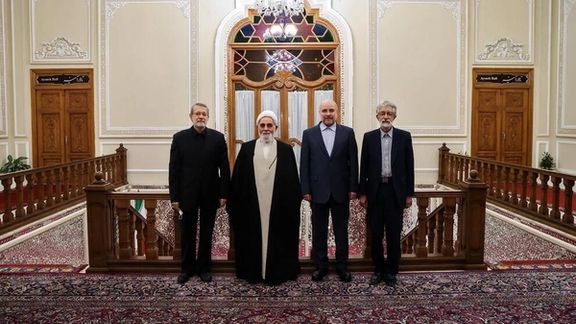
Former parliament speakers Ali Larijani (left), Ali Akbar Nategh-Nouri (2nd left), Gholam-Ali Haddad-Adel (right) and incumbent Mohammad-Bagher Ghalibaf during a meeting in April 2023

A meeting between four conservative heavyweights in Tehran has led to speculations about possible dealings ahead of the next parliamentary elections in March 2024.

The meeting which was a nocturnal fast-breaking party during the last week of Ramadan, was attended by the incumbent speaker of the Iranian parliament (Majles) Mohammad Bagher Ghalibaf, who calls himself a neo-con, and his predecessors, Ali Larijani, a moderate conservative politician, ultraconservative Gholam Ali Haddad Adel, whose political stances are aligned with the Paydari Party, and Ali Akbar Nateq-Nouri, another moderate conservative who was once very close to Supreme Leader Ali Khamenei and served as his chief inspector for several years until 2017.

The meeting was called for by Ghalibaf and was held in his office and is generally believed to have been about the outlook of the parliamentary elections and the challenges facing Iran's conservatives. Interestingly, all four men were presidential candidates in different years.

Some Iranian media including the moderate conservative Khabar Online suspect that the meeting was aimed at coming to some sort of arrangement between various conservative groups, in the absence of other political groups including the reformists who have been barred from taking part in elections in Iran at least since 2020.

Former parliament speakers Ali Larijani (left), Ali Akbar Nategh-Nouri (2nd left), Gholam-Ali Haddad-Adel (right) and incumbent Mohammad-Bagher Ghalibaf during a meeting in April 2023
100%
Former parliament speakers Ali Larijani (left), Ali Akbar Nategh-Nouri (2nd left), Gholam-Ali Haddad-Adel (right) and incumbent Mohammad-Bagher Ghalibaf during a meeting in April 2023

From among the four, Ali Larijani was the only one who told reporters that the meeting did not have any political agenda. Others remained silent.

The IRGC-linked newspaper Javan opined that the speculations about the meeting are the outcome of Iranian reformists' conspiracies. According to Javan, one of the leaders of the reformists has advised his likeminded politicians that "When your political rivals are moving toward some sort of accord, try to magnify their points of differences. Then, without any intervention just sit there and watch them fight and whenever there is a truce, you try to flare up the dispute.”

In the current round of the Majles, Ghalibaf has managed to garner support for his speakership from among the members of Paydari and the Conservatives Coalition Council, a group directly under the supervision of Haddad Adel who also has some influence in Paydari.

Haddad Adel on the other hand, who has helped Ghalibaf to win his role in the Majles, had pushed Ghalibaf aside in the 2017 Presidential election to pave the way for Raisi's victory, but Raisi lost that election to Hassan Rouhani. Nonetheless, the outcome of Haddad Adel's manoeuvres was creating the hegemony of hardliners in all three branches of the government.

The result for the country was the weakening of the Majles, which lost its supervisory power by being committed to support the hardliner government under any circumstances. Ghalibaf's attempts to stop impeachment motions to change cabinet ministers dramatically reduced the motivation of younger politicians to run for a Majles that no longer has a part in running the affairs of the state, Khabar Online wrote.

Former parliament speakers Ali Larijani (left), Ali Akbar Nategh-Nouri (2nd left), Gholam-Ali Haddad-Adel (3rd left) and incumbent Mohammad-Bagher Ghalibaf during a meeting in April 2023
100%
Former parliament speakers Ali Larijani (left), Ali Akbar Nategh-Nouri (2nd left), Gholam-Ali Haddad-Adel (3rd left) and incumbent Mohammad-Bagher Ghalibaf during a meeting in April 2023

Political observers’ take on the issue is that if the next Majles, like the current one, fails to remain independent of the government, this will eventually turn the voters away from any election.

Khabar Online even opined that although there is some sort of tactical alliance between Ghalibaf and Haddad Adel, both relatives of Khamenei, they are unlikely to garner support from Larijani and Nateq-Nouri.

To further undermine the significance of the meeting of the four former presidential candidates, Lawmaker Jalal Mahmoudzadeh told reporters sarcastically that some of those in Raisi's cabinet were also presidential candidates, and you see how they are running the country and what does the country's economy look like under their management.


Most Viewed

Ghalibaf defends Iran-US talks amid hardline backlash
1
INSIGHT

Ghalibaf defends Iran-US talks amid hardline backlash

2
INSIGHT

100 days after carnage: Iran economy reels from war, inflation, unemployment

3
INSIGHT

A nation in limbo: 100 days after the massacre, has the world moved on?

4
ANALYSIS

From instability to influence: Pakistan’s pivotal role in US-Iran diplomacy

5
ANALYSIS

100 days on: why Iran’s January protests spread across social classes

Banner
Banner

Spotlight

  • War-hit homeowners feel abandoned as Iran’s reconstruction aid fades

    War-hit homeowners feel abandoned as Iran’s reconstruction aid fades

  • 100 days on: the anatomy of Iran’s January crackdown
    INSIGHT

    100 days on: the anatomy of Iran’s January crackdown

  • Ghalibaf defends Iran-US talks amid hardline backlash
    INSIGHT

    Ghalibaf defends Iran-US talks amid hardline backlash

  • 100 days on: why Iran’s January protests spread across social classes
    ANALYSIS

    100 days on: why Iran’s January protests spread across social classes

  • From instability to influence: Pakistan’s pivotal role in US-Iran diplomacy
    ANALYSIS

    From instability to influence: Pakistan’s pivotal role in US-Iran diplomacy

  • A nation in limbo: 100 days after the massacre, has the world moved on?
    INSIGHT

    A nation in limbo: 100 days after the massacre, has the world moved on?

•
•
•

More Stories

Tehran Says Comments By Blinken Aimed At Promoting 'Iranophobia'

Apr 23, 2023, 08:53 GMT+1

Iran’s Foreign Ministry Spokesman Nasser Kanaani says a recent statement by US Secretary of State about Iran's military program is solely to promote "Iranophobia."

In a tweet on Thursday, Antony Blinken had said that Washington is firmly committed to disrupting Iran’s military procurement activities.

“We are designating entities from Iran and the People’s Republic of China involved in such destabilizing behavior,” he added.

Kanaani stated in a press release on Sunday that such remarks are “aimed at selling American weapons by fomenting the failed project of Iranophobia and creating division among regional countries.”

He claimed that Iran's military program is solely “defensive and deterrent” in nature and is not directed against any country that would not consider aggression against the Islamic Republic.

Iran has been supplying drones, rockets, missiles and other weapons to a host of militant proxy groups throughout the Middle East, and has sent hundreds of suicide drones to Russia that have been used against Ukraine.

On April 19, US Department of the Treasury’s Office of Foreign Assets Control (OFAC) designated six persons and one entity involved in Iran's acquisition of electronic components for its destabilizing military programs.

OFAC has issued multiple rounds of designations targeting Iran's UAV and missile programs, to include elements involved in production, procurement, and proliferation.

“Treasury will continue to enforce its sanctions against Iran’s military procurement efforts that contribute to regional insecurity and global instability,” Under Secretary of the Treasury for Terrorism and Financial Intelligence Brian E. Nelson said recently said.

An Iranian Doctor And His Wife Receive Long Sentences For Protesting

Apr 23, 2023, 07:55 GMT+1
•
Maryam Sinaiee

The ordeal of a doctor and his wife in Iran who evaded execution but received long sentences for simply participating in a protest has caught public attention.

Dr. Hamid Qarahassanlou (Ghara-Hasanlou), a fifty-four-year-old radiologist, and his wife Farzaneh were arrested in November in Karaj during protests in which a member of the Basij militia, Ruhollah Ajamian (27), was beaten to death by angry protesters but both have denied any involvement in the incident.

Qarahassanlou was initially sentenced to death and his wife to twenty-five years prison, but their sentences were later reduced due to a strong backlash on social media and lack of evidence of their involvement in a second trial.

Yazd and Mashhad, where Hamid and Farzaneh Qarahassanlou will serve their sentences respectively, are nearly 1,000, and 670 kilometers away from their hometown of Karaj.

A statement by the family released on social media Friday, after the announcement of the new sentences Tuesday, said even the footage of the incident made by security agents proves that the couple were not involved in the killing and were only present on the scene on the way home from a protest in Karaj, near Tehran, on November 3.

“He now has to be exiled [to a prison] in Yazd for fifteen years for not having saved the life of that Basiji in the fracas [of the moment] as a humane doctor,” the statement said while describing the very violent arrest of the couple which they say has hugely affected the couple’s teenage daughter.

Attack on a car belonging to security agents in Karaj on November 3, 2022
100%
Attack on a car belonging to security agents in Karaj on November 3, 2022

The large protest rally that turned very violent after security forces attacked protesters was held to commemorate a young girl, Hadis Najafi, who was shot to death by security forces forty days earlier.

“The crime [for which they were punished] was and is nothing other than participating in Hadis Najafi’s 40th day memorial,” the statement said.

Two young protesters, Mohammad Mehdi Karami (22) and Mohammad Hossein (39), were executed over Ajamian’s death in January after a hasty trial which human rights activists have called a travesty of justice.

All of the accused, including Qarahassanlou, were reportedly severely tortured to obtain “confessions” and the hardliner Judiciary assigned lawyers despite several prominent lawyers volunteering to defend them.

The lawyers assigned by the court did very little to defend the accused according to family members.

The convictions were not based on a criminal charge related to the murder per se, but they were charged with ‘moharebeh’, meaning “war against God”, a vague religious concept. The Islamic Republic applies the charge to people who might get into a confrontation with security forces during protests.

The first two hangings triggered strong international condemnations and hundreds of lawmakers in Europe and Australia began sponsoring Iranian detainees in danger of execution to generate publicity and impact their fate.

Twelve other protestors have been jailed for up to 15 years for the Basij agent’s death.

The couple were badly beaten during the arrest and later in detention. Qarahassanlou underwent surgery three times for several broken ribs and damaged lung and the family say he has partially lost his eyesight as a result of the beatings.

The couple who belong to the persecuted Sufi Gonabadi Order were known for active involvement in charitable efforts including building schools for underprivileged children.

Anti-Israel Rhetoric Intensifies In Iran As Some See Shadow Of War

Apr 23, 2023, 00:15 GMT+1
•
Iran International Newsroom

Politicians close to the core of the Iranian regime have increased their anti-Israel rhetoric as Tehran boasts of destabilizing its arch enemy by proxy attacks.

At the same time, Israeli officials are visibly angry at what they insist is Iranian orchestrated multi-front attacks, from Gaza, Lebanon and even Syria.

On April 15, the Spectator wrote about "The dangerous shadow war between Iran and Israel" and quoted regional affairs analyst Kim Ghattas as saying in her new book, The Black Wave, that the recent "Saudi-Iran peace deal might be based on the KSA's judgment that Israel will attack Iran sooner or later."

The Spectator, said Iran is likely to continue to use its proxy groups in the region against Israel and further quoted Ghattas as saying, "There is no change to Iran’s foreign policy, except for some cosmetic changes to allow the supreme leader some space and time to figure out how they’re going to ensure the survival of the Islamic Republic."

A Foreign Affairs report in February pointed out that "Israel has long made clear its penchant for applying military pressure to disrupt Iran’s nuclear advances and weapons exports—and, more recently, its drone technology program."

The publication added that "In the last few months, however, Israel’s appetite for risk seems to have increased." Israel's past weeks' attacks on Iranian targets in Syria seems to have proven the Foreign Affairs' argument.

Iran's Prince Reza Pahlavi with Israeli Prime Minister Benjamin Netanyahu on April 19, 2023
100%
Iran's Prince Reza Pahlavi with Israeli Prime Minister Benjamin Netanyahu on April 19, 2023

And last but not least, the Times of Israel quoted former Israeli National Security Adviser Yaacov Amidror as saying that "Israel must prepare for war with Iran without US help."The Times of Israel further quoted Amidror as saying that “We need to prepare for war. It’s possible that we will reach a point where we have to attack Iran even without American assistance.”

In Iran, in a message to his counterparts in Muslim countries, the Speaker of Parliament Mohammad Bagher Ghalibaf wrote on Friday, "The Islamic ummah [nation] can see the destruction of Israel thanks to their profound unity." In the message that was carried by IRGC-linked Fars News Agency, Ghalibaf reiterated that the liberation of Quds [Jerusalem] is one of the highest ideals of Muslims.

Meanwhile, the Friday Prayers Imam of Kangan, in southern Iran, Mahmoud Mahmoudi spoke about the recent visit to Israel by Prince Reza Pahlavi, the former Crown Prince of Iran, and said "The Iranian nation will send their message to Israel with the Resistance's missile, not by Reza Pahlavi."

The cleric was referring to Prince Reza's statement in which he said that his visit was aimed at carrying Iranian nation’s message to the people of Israel. Reports on social media and foreign-based Persian television channels indicate that the prince's visit to Israel was welcomed by Israeli officials and Iranian expats in Israel.

Mahmoudi referring to Iran's proxy groups in the region including the Lebanese Hizballah, claimed that "the resistance forces have opened the doors of hell to the Zionists who are now encircled by the resistance."

Earlier, on Thursday, the Friday Imam of Mashhad, firebrand cleric Ahmad Alamolhoda referred to possible Israeli attacks on Iran and threatened that, "If there is going to be any stupidity and aggression, all of the US bases in the region will be destroyed in the region."

In another development on the same day which marked the Army Day in Iran, President Ebrahim Raisi who reviewed the troop on the occasion, threatened Israel while watching obsolete US warplanes produced in the 1960s and 70s fly over the area by saying that "The smallest error by Israel, will lead to the destruction of Haifa and Tel Aviv."

A more than 50-year-old F-5 fighter of Iran's air force from the days of the monarchy
100%
A more than 50-year-old F-5 fighter of Iran's air force from the days of the monarchy

Iran Leader Urges Muslim Nations To Reinforce Palestinian Groups

Apr 22, 2023, 22:59 GMT+1

Iran’s Supreme Leader Ali Khamenei says the strategy of the Muslim world should be reinforcing the militant groups in the Palestinian territories.

Khamenei said in a Saturday meeting with regime officials and ambassadors of Muslim countries that Israel is gradually collapsing, and the Muslim nations must focus on supporting the militant elements in and around Israel.

While renewing his support for jihadists in Palestinian territories, Khamenei alleged that “The downfall [of Israel] which started a few years ago, has now accelerated and the Muslim world must take advantage of this great opportunity.”

Earlier, an Iranian IRGC Commander also hailed Palestinian terror groups, claiming 10,000 attacks have been perpetrated against Israelis this year.

Ramazan Sharif, the head of the Intifada and Quds Central Headquarters of the Islamic Propaganda Coordination Council, said earlier this month that the formation of a unified anti-Israeli front from South Lebanon and the Syrian Golan Heights to Gaza and the West Bank has challenged Israel more than ever.

Iranian proxies in Gaza, Lebanon and Syria have all recently attacked Israel with rockets as tensions simmered during the holy month of Ramadan.

Khamenei said in 2016 that Israel must be destroyed in 25 years and the government even set up a countdown clock in Tehran the following year.

Many Iranians mock the anti-Israel rhetoric and the ticking clock, but the regime is adamant in repeating its threat.

Iranians who have been periodically protesting against the regime since 2017, often chant slogans against spending Iran's national wealth to create and support proxy groups.

Opposition Figure’s Resignation From Coalition Opens Pandora’s Box

Apr 22, 2023, 20:05 GMT+1
•
Maryam Sinaiee

The resignation of Hamed Esmaeilion from the Alliance for Freedom and Democracy in Iran has sparked bitter arguments between monarchists and his supporters.

In a post entitled “Report to the People” Friday, Canada-based activist Esmaeilion announced that he has left the alliance. The council consisted of the exiled Prince Reza Pahlavi, Nobel peace prize laureate Shirin Ebadi , US-based author, journalist and women’s rights activist Masih Alinejad, actress and activist Nazanin Boniadi and Secretary General of the Kurdish Komala Party Abdullah Mohtadi and Esmaeilion.

Boniadi recently deactivated her social media accounts without any explanation and appears to have withdrawn from the alliance too. Alinejad, Mohtadi, and Ebadi have so far not commented on Esmaeilion’s resignation.

The alliance announced its existence in a February event at Georgetown University and issued its charter, the Mahsa Charter, in early March and its members said they had agreed on “minimal positions” that could create the most consensus among the opposition.

Esmaeilion said he joined the opposition in exile council hoping to help create a platform for dialogue and cooperation among various opposition factions but the lack of democracy and transparency in the council and the “domination” of one member over the others disillusioned him.

He claimed that he had tried to keep away from “conflicts, pressures and illogical demands” but was impeded by “pressure groups from the outside” who kept trying to impose their own views on the coalition by “undemocratic methods".

100%

Supporters of Esmaeilion, Alinejad, and Mohtadi have long been accusing the supporters of the exiled Prince of harassment on social media and efforts to defame them. Prince Reza Pahlavi has on some occasions advised his supporters to be more tolerant of others but the disputes and attacks on social media only got worse. They often accuse Prince Reza Pahlavi’s supporters of trying to present the him as the only legitimate leader of the opposition.

Supporters of the Prince who call themselves ‘constitutionalists’ are staunchly against establishing a republic of any form in Iran, particularly federalism, seek the revival of a constitutional monarchy and the Iranian Constitution of 1906. They allege that others, Esmaeilion and Alinejad in particular, have views that will lead to the loss of Iran's national integrity.

Constitutionalists have been particularly angry recently because they believe that Esmaeilion and possibly Alinejad have prevented the Prince from including some opposition figures close to him in the coalition– particularly London-based journalist Amir Taheri, the US-based Amir-Hossein Etemadi, a member of the Frashgard group, and Germany-based musician and activist Shahin Najafi.

"Imposing opinions is not democratic, and the consensus of a group’s members, not just one member, is a precondition of a democratic movement," Esmaeilion wrote without naming Prince Reza Pahlavi directly while further suggesting that there have been efforts to “eliminate” others and impose certain views on others.

He also opined that the opposition abroad should only help to empower the people of Iran, their networks and organizations and that he would personally continue helping young pro-democracy Iranians abroad to organize and work on “unrestricted internet and several other projects” with them.

His critics respond that the six-member council was self-appointed, and no one got elected to block others from joining.

Some social media users have also suggested that the reason for Esmaeilion’s departure from the alliance at this time could have been his opposition to the Prince’s recent visit to Israel.

“Timelines are filled with Esmaeilion’s worthless tweet exactly when articles and tweets must focus on the important and taboo-breaking Israel visit of the Iranian monarch, Prince Reza Pahlavi, and the impact of this visit today and after the reclamation of Iran [from the Islamic Republic]. Isn’t it interesting?” one of the Prince’s supporters tweeted.