• العربية
  • فارسی
Brand
  • Iran Insight
  • Politics
  • Economy
  • Analysis
  • Special Report
  • Opinion
  • Podcast
  • Iran Insight
  • Politics
  • Economy
  • Analysis
  • Special Report
  • Opinion
  • Podcast
  • Theme
  • Language
    • العربية
    • فارسی
  • Iran Insight
  • Politics
  • Economy
  • Analysis
  • Special Report
  • Opinion
  • Podcast
All rights reserved for Volant Media UK Limited
volant media logo

Iranian Lawyer Says Victims In Recent Protests File Lawsuits
Iran International Newsroom
Mar 30, 2023, 00:21 GMT+1Updated: 18:00 GMT+1
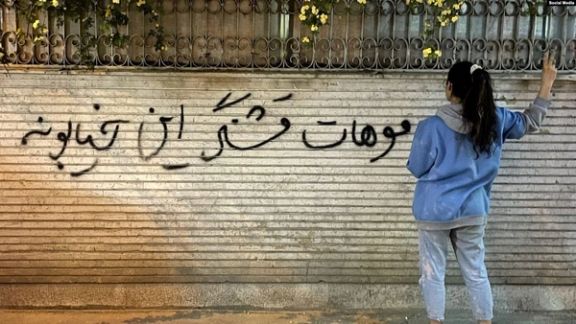
 An Iranian woman unveiling in public to protests against the mandatory hijab
An Iranian woman unveiling in public to protests against the mandatory hijab

An Iranian attorney says several victims of government brutality in the recent protests in Iran have filed legal complaints in several provinces of the country.

Payam Dorafshan told Emtedad News that these people filed a complaint after visiting a lawyer and presenting sufficient evidence.

According to attorney, Majid Khademi, Mir-Hesam Maleki, Reza Ezzati and Pouria Alipour are among the plaintiffs.

Explaining how these people were injured during the protests, Dorafshan said Majid Khademi had gone to the graveyard to offer condolences to the family of a victim, but "on his way back, he was shot from an unknown place and injured in one eye.”

Maleki went out to the street to move his car, but "he was shot in the face from a very close distance with a teargas launcher. Due to the severity of the injury, the bones of the upper and lower jaw and his teeth were completely crushed."

As Dorafshan stated, Maleki "has been undergoing various surgeries for months and has only been able to feed using a straw."

The Iranian lawyer also added that Reza Ezzati, who had gone to visit the grave of his relatives in a cemetery in Karaj west of Tehran, was "hit by many [bird]shots" on the way, and in addition to “eyes and face, even a few shots entered his body and heart.”

Ezzati "was forced to undergo heart surgery and currently one of his eyes has a severe vision defect while a large number of shots remain in his body."

Dorafshan has also asked other families of the deceased and injured to contact lawyers to file a lawsuit.

Two young women who lost an eye during Iran protests. Ghazal Ranjkesh (L) and Elahe Tavakolian
100%
Two young women who lost an eye during Iran protests. Ghazal Ranjkesh (L) and Elahe Tavakolian

During the recent protests, ignited by the death in custody of 22-year-old Mahsa Amini in September 2022, hundreds of people lost their lives and many more received permanent injuries. The authorities of the Islamic Republic not only failed to accept any responsibility, but put pressure on some of the victims' families who made statements against regime officials during funerals or on social networks.

Activist twitter and Instagram account '1500 Tasvir,' dedicated to news about protests in Iran, has recently published a large batch of harrowing photos and videos of people shot or killed by the regime. The regime’s security forces have been extensively using cartridges of shotshell loaded with numerous small balls or birdshots, or medium-sized buckshots as well as single large solid projectiles known as a slug to quash the nationwide protests.

Late in November 2022, dozens of ophthalmologists issued a joint letter warning against the use of shotgun ‘birdshots’ and other projectiles by Iran’s security forces that have blinded over 500 protesters since mid-September. According to them, a large number of victims were taken to medical centers hit by rubber bullets and metal pellets as well as paintball bullets in their eyes, leading to loss of eyesight in one or both eyes.

The Islamic Republic, which had been previously condemned for blinding protesters in the streets, intensified the use of guns, including military weapons against unarmed protesters. However, young Iranians who lost one or both eyes say they do not regret having protested against the regime.


Most Viewed

Iran International says it won’t be silenced after London arson attack
1

Iran International says it won’t be silenced after London arson attack

2
VOICES FROM IRAN

Hope and anger in Iran as fragile ceasefire persists

3

Iran halts petrochemical exports to supply domestic market

4
INSIGHT

How Tehran bends its own red lines to boost state rallies

5

US arrests Iranian national over alleged Basij-linked visa fraud

Banner
Banner

Spotlight

  • Hardliners push Hormuz ‘red line’ as US blockade tests Iran’s leverage
    INSIGHT

    Hardliners push Hormuz ‘red line’ as US blockade tests Iran’s leverage

  • Ideology may be fading in Iran, but not in Kashmir's ‘Mini Iran'
    INSIGHT

    Ideology may be fading in Iran, but not in Kashmir's ‘Mini Iran'

  • War damage amounts to $3,000 per Iranian, with blockade set to add to losses
    INSIGHT

    War damage amounts to $3,000 per Iranian, with blockade set to add to losses

  • Why the $100 billion Hormuz toll revenue is a myth
    ANALYSIS

    Why the $100 billion Hormuz toll revenue is a myth

  • US blockade targets Iran oil boom amid regional disruption
    ANALYSIS

    US blockade targets Iran oil boom amid regional disruption

  • Iran's digital economy battered by prolonged blackout
    INSIGHT

    Iran's digital economy battered by prolonged blackout

•
•
•

More Stories

Know The One Man Who May Bring Pain To Iran’s Guards

Mar 29, 2023, 12:27 GMT+1
•
Iran International Newsroom

After 35 days on hunger strike, a dual British-Iranian citizen's campaign calling on the UK government to designate the IRGC is finally gaining ground.

Vahid Beheshti has been battling the bitter winter outside the UK Foreign Office to raise awareness for the need to designate the Iranian terror group responsible for the deaths of hundreds of Iranian citizens since September.

He has got the attention of key political figures and has been joined by supporters hoping to force the UK government to take action on the brutal security forces.

On Monday, he met with the Minister of State for Security, Tom Tugendhat. Beheshti said, "He expressed his concerns for my health and emphasized that the Government's position is to proscribe the IRGC, but could not share the timescale in which this would happen."

His simple camp outside the Foreign Office has become a meeting place for activists, with others joining him.

His campaign has proven so successful that his name has been frequently mentioned during the sessions of the UK House of Commons. He has repeatedly urged UK lawmakers to hold official meetings with him instead of unofficial visits to his corner, to raise the profile of the issue to the highest echelons

Beheshti’s campaign is even reaching back home.

A boy in Iran holds a placard that urges Beheshti to break his hunger strike

As his body is getting weaker, temperatures at night dropping to freezing, his determination is growing stronger as he has vowed not to break the strike until the IRGC is listed as a terrorist organization.

The 46-year-old journalist is surviving on a daily diet of one cup of coffee, a few cubes of sugar, some salt and “plenty of water”.

“A policy of appeasement with Iran's Islamic Revolutionary Guard Corps has not worked in the last 44 years, and it will never work going forward,” Beheshti said last week, calling on Sunak, for “strong leadership” and to stand by his pledge to designate the group before his recent election.

Before embarking on his hunger strike, Beheshti held several meetings with British lawmakers, pleading with them for the proscription, but no action was made.

The tipping point came in February when Iran International was forced to close its London studios after repeated death threats from the regime.“The main point I highlight to British politicians is that their country’s principles are under threat today... I cannot understand why the British police, with all their power, cannot protect journalists against IRGC threats,” Beheshti said.

The Revolutionary Guard is the Islamic Republic’s leading military, intelligence and internal security juggernaut, responsible for cracking down on dissent inside Iran and managing the proxy militias throughout the region including the Houthis in Yemen which have caused devastation to the country.

Beheshti has been actively raising the voice of Iranians among the international community with his numerous interviews, speeches and video messages to global events on the uprising in Iran.

He says the designation is the first practical step toward further isolation of the Islamic Republic and the final overthrow of the regime.

Rallies against the IRGC have taken place globally including just last week in Brussels. The UK’s current list of 78 proscribed terrorist organizations includes Hamas, Hezbollah, and the Kurdistan Workers Party (PKK).

Several countries including the US, UK and EU have been cautious to designate the IRGC for fear it will further alienate the regime and in turn, limit negotiating capacity regarding its nuclear program.

In December, members of the UK House of Commons unanimously voted for a motion that urges the government to proscribe the IRGC but it has split the House.

Prominent Iranian opposition figures have repeatedly called on London to blacklist the Guards with exiled Prince Reza Pahlavi describing the move as to be akin to “pulling out the regime’s biggest tooth.”

Vahid Beheshti and stand-up comedian Omid Djalili on the 24th day of Beheshti's hunger strike (March 2023)
100%
Vahid Beheshti and stand-up comedian Omid Djalili on the 24th day of Beheshti's hunger strike

Federalism vs Centralism, Bone Of Contention Among Iran Activists

Mar 29, 2023, 07:20 GMT+1
•
Maryam Sinaiee

Whether the future government of Iran, after the Islamic Republic should be a federal or a centralized government is one of the most divisive issues among the activists.

Diaspora opposition groups and figures have held several gatherings and released various charters of solidarity and alliance in the past few months. Nearly unanimously, everyone says it is the Iranian people who should decide, through a referendum, the form of the future government in Iran.

The biggest diaspora alliance, the Alliance for Democracy and Freedom in Iran, which announced its existence in a February event at Georgetown University and issued its charter, the Mahsa Charter, in early March, advocates a secular-democratic system determined through a referendum but has not specified whether this could be a federal or a centralized government.

The alliance consists of the exiled Prince Reza Pahlavi, Nobel peace prize laureate Shirin Ebadi and Canada-based activist Hamed Esmaeilion, as well as US-based author, journalist and women’s rights activist Masih Alinejad, actress and activist Nazanin Boniadi and Secretary General of the Kurdish Komala Party Abdullah Mohtadi.

Iran-opposition (file)
100%

The six members of the alliance stress that for the time-being they have agreed on “minimal positions” that could create the most consensus among the opposition and that it could be further improved.

Many who support the diaspora opposition have already made up their minds whether they want a republic or the return of the Pahlavi monarchy which was ousted by the Islamic Revolution of 1979. The true weight of those favoring one or the other tendency is not known.

Prince Reza Pahlavi has said that he will accept whatever form of government Iranians choose and at least on one occasion in the past has said that he personally favors a republic.

But some opposition supporters known as ‘constitutionalists’ are staunchly against establishing a republic of any form in Iran, particularly federalism, seek the revival of a constitutional monarchy and the Iranian Constitution of 1906.

Among the members of the alliance, Mohtadi has been the most vocal advocate of ethnicity-linguistic-based federalism. “I would personally like the charter to more clearly move towards [recognition of] federalism,” he told Iran International on the sidelines of an opposition conference in Toronto, Canada, Sunday. At least two other members, Alinejad and Esmaeilion, also appear to be advocates of decentralization of the government or some type of federalism.

“Any kind of ethnicity-based federalism will be a fascistic regress in Iran and [cause] violation of basic human rights. Ethnic groups are intertwined and drawing lines between Iranian ethnic groups on the imaginary ground that they are racially different will lead to years of civil war. We are one nation, the Iranian nation,” one of the opponents of ethnicity-linguistic based federalism tweeted Tuesday.

Those favoring federalism, however, say economic, ethnic and religious inequality in a multi-ethnic and multilingual country like Iran requires recognition of ethnic differences and decentralization of the government. Many among them also demand recognition of other languages such as Kurdish, Turki, Balochi and Arabic as official languages and the right of non-Persian speakers to education in their mother tongues instead of Persian (Farsi).

Yet others advocate a non-ethnicity-linguistic-based form of federalism to avoid problems such as disputes over geographical boundaries of federal states in mixed ethnicity-linguistic areas of the country.

Many provinces in Iran have mixed ethnic or linguistic populations, such as West Azarbaijan or the oil-rich Khuzestan. Trying to create ethnically homogeneous provinces or states peacefully, would be next to impossible.

“Yes to political and no to ethnicity defined federalism. Yes to American and no to Yugoslavian [types of federalism],” @Ted_Mosbi1361 who is among Persian-language Twitter opposition influencers tweeted Friday. 

Jailed Rights Activist Slams Khamenei’s Prisoner Amnesty As A 'Deceptive Show'

Mar 28, 2023, 11:23 GMT+1

Iranian human rights defender, Narges Mohammadi, slammed the Supreme Leader’s latest prisoner amnesty as a sham to feign compassion to the Western world.

In a letter written to the UN Human Rights Council in Geneva from inside Tehran’s notorious Evin Prison following news that thousands of protesters are being released, she claims the latest announcement reflects a “politics of the Islamic Republic [which] is based on lies”.

It is not the first time such a show has taken place since the protests, which have seen over 500 protesters killed in brutal clampdowns by security forces and thousands more imprisoned. Four Iranians have received the death sentence for their part in protests which were sparked by the death in custody of Mahsa Amini in September.

Mohammadi has been imprisoned several times over the past two decades for her work fighting for human rights.

In her letter to the HRC, she said she is ready to testify against the authorities of the Islamic Republic regarding the torture, harassment and abuse of prisoners.

She was freed from Evin Prison in September 2020 after serving more than five years, during which time she often had no contact with her husband and children for long periods of time.

Last year, she was arrested again and sentenced to eight years in jail and 70 lashes by the Revolutionary Court on trumped-up political charges in a five-minute sham trial.

Iranian Twitterati Call Account Suspensions ‘Cyber-Terrorism’

Mar 28, 2023, 06:45 GMT+1
•
Maryam Sinaiee

Twitter’s recent suspension of hundreds of accounts has angered Iran's pro-monarchy Twitterati who believe they are being targeted by the Islamic Republic.

“Thousands of pro-democracy activists' Twitter accounts have been suspended en masse, indicating #cyberterrorism by an adversarial state and its proxies. We are investigating it. Would you care to join us in this effort, @elonmusk?” activist Shima Kalbasi tweeted Monday.

Kalbasi said it appears that the Twitter rules are being manipulated to benefit the Iranian regime and other actors. “I am reporting this issue to the FBI for further investigation,” she said in another tweet.

Sometimes Twitter asks the author to remove a tweet and serve a period of time in read-only mode before they can tweet again. In more serious cases, Twitter suspends the accounts of those “whose sole purpose is to violate” the platform’s policies. Such decisions can be appealed. Twitter also suspends accounts when other users mark its tweets as abusive.

@Sashtyani, one of the popular pro-monarchy accounts with over 62k followers, however, dismissed such “conspiracy theories” and said Twitter’s algorithms are responsible for the mass suspension of these like-minded accounts. It is possible that the suspended accounts followed too many of the fake accounts created by the Islamic Republic’s cyber-army, @Sashtyani argued.

This post claims Twitter has shown dual standards when it comes to the use of the same hashtag with the phrase “Death to” by two different users.

The Iranian regime has what it calls a “cyber army” with thousands of bots and agents who try to spread disinformation or report the accounts of dissidents. Both Twitter and Facebook have closed thousands of such accounts in the past once they concluded that they were government-driven actors.

Apparently, many of the tweets found abusive by Twitter contained the Persian word marg (death) in phrases such as “Death to …” against the Islamic Republic or various political groups.

“Twitter is now suspending accounts that say ‘Down with the 1979 riot’. Not sure why Elon Musk's Twitter is suspending the accounts that wish the fall (death) of that ‘riot’ and the radical Islamist regime it created. What is wrong with that wish?”, Saeed Ghasseminejad, a senior advisor at the Washington-based Foundation for Defense of Democracies (FDD) tweeted Sunday. He included an image of a message from Twitter to an account required to remove a tweet that read “Death to the 1979 riot”.

Another tweet addressed to Musk with the hashtag #FreedomOfSpeech asked if he has any thoughts on suspension of accounts that “express a desire for the downfall of the radical Islamist regime and the '79 riot in Iran?” 

Some Twitterati say tweets appearing to be abusive or threatening are probably being removed by artificial intelligence rather than persons who examine the content.

Tweeter sends a message to account holders when one or more of their tweets are marked as containing violent speech or threats.

Twitter prohibits “unwanted sexual conduct and graphic objectification that sexually objectifies an individual without their consent” as well as the “use of insults or profanity to target others”, “behavior that encourages others to harass or target specific individuals or groups with abusive behavior.”

Twitter also says tweets by an account that have been found in violation of Twitter safety policies will be downranked in replies, made ineligible for amplification in top search results and/or on timelines for users who don’t follow the Tweet author.

Women To Be Fined Up To $60,000 For Hijab: Iran Lawmaker

Mar 27, 2023, 16:13 GMT+1
•
Maryam Sinaiee

An ultra-hardliner has said that women could be fined as much as $60,000 for flouting hijab when a new law to enforce the Islamic dress code is passed by parliament.

Speaking to the press in his constituency in Yazd Province, Hojjat ol-Eslam Hossein Jalali said Sunday that punishments for flouting the hijab, according to the planned legislation, will include cash fines from 5m to 30b rials (around $100 to $60,000) and that other penalties may include revocation of drivers’ licenses and passports, or a ban on the use of the internet for celebrities and social media influencers and bloggers.

These penalties will apply to passengers who do not abide by the hijab rules while riding in vehicles, at restaurants, government organizations, schools and universities, airports and public transport terminals, in the cyberspace and to celebrities, and on the streets and other public arenas, Jalali added.

Hardliners have been looking for ways to strengthen the enforcement of hijab after their ‘morality police’ tactic of arresting women for “improper hijab” backfired with the death of Mahsa Amini last September, triggering nationwide popular protests.

Some Iranian women unveiling in public (March 2023)
100%
Some Iranian women unveiling in public

Detainees were usually released after paying rather smaller cash fines but could also face prison and lashes if they had a previous record. Activism against the compulsory hijab could also bear serious consequences including prosecution and imprisonment.

The morality police has largely disappeared from the streets since Amini’s death in September and the resulting protests as authorities feared enraging people.

Four decades after the Islamic Republic forced women to wear headscarves, long tunics and trousers, or the long black veil called chador, women are increasingly appearing in public, even in many smaller and more traditional areas of the country, in regular clothing such as colorful dresses and with no headscarf covering their hair.

Young girl skating and dancing ‘hijabless’ at a park in western Tehran recently.

Many women say on social media that there is no way they will go back to dressing according to the government mandated dress code.

The plan, Jalali said, was finalized after “300 meetings with the Supreme Council of Cultural Revolution and the National Security Council”. In December, amid nationwide protests, Jalali had said that thirty-seven different government organizations that were responsible for implementation of the existing hijab law had all received the relevant instructions to enforce it.

The government should submit the plan to the parliament in the form of a bill within the next couple of weeks, Jalali said of the envisaged plan which has been “brought to the attention of” the Supreme Leader Ali Khamenei and the Judiciary, implying their agreement with the new plan had been obtained.

Vida Movahed protesting against compulsory hijab in December 2017 at a busy streets in Tehran.

The new law, if passed, would exclude any “physical encounter” with women, Jalali said. He was apparently referring to plans to use CCTV cameras and facial recognition technology to identify women who flout the hijab, and use cash fines and social restrictions to punish them, instead of using the infamous morality police patrols on the street to issue warnings or make arrests.

The plans to eliminate physical confrontation were first revealed by the secretary of the Headquarters for Promoting Virtue and Preventing Vice, Mohammad-Saleh Hashemi-Golpayegani.

He said at the time that CCTV footage from public places such as streets and public transport and facial recognition software would be used to enforce the hijab.