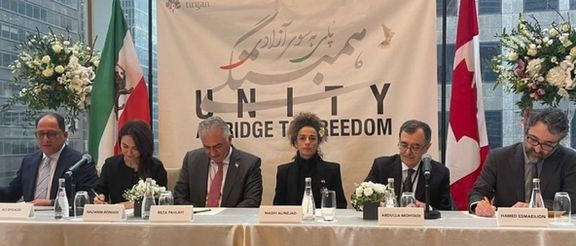
Prominent Iranian opposition figures at an event in Toronto, Canada, on March 25, 2023
Whether the future government of Iran, after the Islamic Republic should be a federal or a centralized government is one of the most divisive issues among the activists.
Diaspora opposition groups and figures have held several gatherings and released various charters of solidarity and alliance in the past few months. Nearly unanimously, everyone says it is the Iranian people who should decide, through a referendum, the form of the future government in Iran.
The biggest diaspora alliance, the Alliance for Democracy and Freedom in Iran, which announced its existence in a February event at Georgetown University and issued its charter, the Mahsa Charter, in early March, advocates a secular-democratic system determined through a referendum but has not specified whether this could be a federal or a centralized government.
The alliance consists of the exiled Prince Reza Pahlavi, Nobel peace prize laureate Shirin Ebadi and Canada-based activist Hamed Esmaeilion, as well as US-based author, journalist and women’s rights activist Masih Alinejad, actress and activist Nazanin Boniadi and Secretary General of the Kurdish Komala Party Abdullah Mohtadi.
The six members of the alliance stress that for the time-being they have agreed on “minimal positions” that could create the most consensus among the opposition and that it could be further improved.
Many who support the diaspora opposition have already made up their minds whether they want a republic or the return of the Pahlavi monarchy which was ousted by the Islamic Revolution of 1979. The true weight of those favoring one or the other tendency is not known.
Prince Reza Pahlavi has said that he will accept whatever form of government Iranians choose and at least on one occasion in the past has said that he personally favors a republic.
But some opposition supporters known as ‘constitutionalists’ are staunchly against establishing a republic of any form in Iran, particularly federalism, seek the revival of a constitutional monarchy and the Iranian Constitution of 1906.
Among the members of the alliance, Mohtadi has been the most vocal advocate of ethnicity-linguistic-based federalism. “I would personally like the charter to more clearly move towards [recognition of] federalism,” he told Iran International on the sidelines of an opposition conference in Toronto, Canada, Sunday. At least two other members, Alinejad and Esmaeilion, also appear to be advocates of decentralization of the government or some type of federalism.
“Any kind of ethnicity-based federalism will be a fascistic regress in Iran and [cause] violation of basic human rights. Ethnic groups are intertwined and drawing lines between Iranian ethnic groups on the imaginary ground that they are racially different will lead to years of civil war. We are one nation, the Iranian nation,” one of the opponents of ethnicity-linguistic based federalism tweeted Tuesday.
Those favoring federalism, however, say economic, ethnic and religious inequality in a multi-ethnic and multilingual country like Iran requires recognition of ethnic differences and decentralization of the government. Many among them also demand recognition of other languages such as Kurdish, Turki, Balochi and Arabic as official languages and the right of non-Persian speakers to education in their mother tongues instead of Persian (Farsi).
Yet others advocate a non-ethnicity-linguistic-based form of federalism to avoid problems such as disputes over geographical boundaries of federal states in mixed ethnicity-linguistic areas of the country.
Many provinces in Iran have mixed ethnic or linguistic populations, such as West Azarbaijan or the oil-rich Khuzestan. Trying to create ethnically homogeneous provinces or states peacefully, would be next to impossible.
“Yes to political and no to ethnicity defined federalism. Yes to American and no to Yugoslavian [types of federalism],” @Ted_Mosbi1361 who is among Persian-language Twitter opposition influencers tweeted Friday.
Iranians are emigrating from the country fleeing political and economic instability, with the UAE top of the list, a 600-page report issued in Tehran says.
Systematic corruption has also been a key factor for migration among the two groups of university students and graduates, and doctors and nurses. Sanctions and the falling national currency as well as inflation are the main factors affecting “businesspeople.”
In its latest annual outlook, Iran Migration Observatory says the UAE hosts the highest number of Iranians living abroad with over 450,000 Iranian-born residents, followed by the US, Canada, Germany, Turkey and the UK, as Iranians seek a better quality of life.
Although a report published in Iran cannot openly blame the political environment as a reason for migration, lack of social freedoms and the discriminatory nature of the authoritarian clerical political system also play a major role to drive young people out of the country.
A “lack of opportunities to be influential”, “feeling useless in the country”, and “lack of a promising prospect for the future” strengthen the motivation for migration and push people to actively plan for their emigration, the observatory said.
The number of Iranians living in Turkey has increased five-fold during the past seven years to stand at about 155,000. Based on international statistics, the report claims that more than two million Iranians are living abroad. However, the High Council of Iranian Affairs Abroad, an affiliate of the country’s Foreign Ministry, put the number at over four million people.
The report published in December covering 2022 also said that potential for growth and salaries were among other factors driving people out.
The risk of brain drain is also high as Iran fails to invest in key jobs of the future and technologies which surround that such as robotics, cloud computing and blockchain. The report called it “a chronic policy confusion,” and a crisis awaiting the human resources of the country.
Citing international databases, the document says Iran ranked 54th in terms of the number of migrants leaving the country. In terms of students going abroad to continue their studies, Iran ranked 17th.
Nationwide antigovernment protests since September and a further deterioration in economic conditions appear to have encourages more professionals to leave.
A scene of anti-regime protests in Tehran
Oman is also emerging as a new favorite destination. During the past year about 30,000 personnel of different medical professions, including doctors, nurses, and paramedical technicians, have applied for Certificates of Good Standing with intent to immigrate to Oman.
Iranian lawmakers have slammed the government's economic and other policies in interviews during Nowruz holidays as people complain about rising prices.
Ramezan Ali Sangdovini, representing Gorgan told Rouydad24 website that "Iran is overwhelmed by mismanagement." He added that "even those neighboring countries that are affected by wars are doing better than us."
Iran’s currency, rial, dropped to unprecedented lows right before the Nowruz, creating more chaos and despair for a population which has lost most of its purchasing power since 2018, because of US sanctions and a mismanaged economy.
Sangdovini stressed that "mismanagement is seriously endangering the integrity and authority of Iran's political system." He added: "Iran has no problem in resources and capital. All our problems are caused by mismanagement of resources.”
He reiterated that most of government managers are not fit for the positions they hold. Furthermore, the way they treat the people is less than perfect. Sangdovini said that the government cannot manage the falling national currency, rising prices and inflation rate.
He dismissed official comments about the "enemy's role in rising prices," and said the government is responsible. "The price of items such as dairy and gasoline is absolutely under the government's control. But it is not clear why the government refuses to keep the price of these items low."
Iranian lawmaker, Ramezan Ali Sangdovini
He warned the government that currently a large part of the population cannot afford to buy a kilo of meat. He added that the government has refused to send ministers to the parliament to answer lawmakers. The only solution for the Majles is to impeach the ministers," Sangdovini said.
Earlier, some lawmakers, including former nuclear chief Fereydoun Abbasi had said that the country's economic situation can only get worse, adding that the government lacks the will and authority to solve the problem.
Many politicians and commentators have been urging the regime to reach an agreement with the United States over its nuclear dispute and try to remove crippling sanctions, but so far talks with the West remain suspended.
Meanwhile, another lawmaker, Jalal Mahmoudzadeh told reportersthat the only way to sort out Iran's economic chaos is to summon President Ebrahim Raisi to the parliament. "Not only there has not been any progress in fixing the economic since Raisi took office in 2021, but the country has even lost ground in some areas as a result of the government's inefficiency."
He added that the parliament should deal with the matter and step in to sort out the problem once and for all. "We should summon Raisi to the Majles and question him and demand convincing answers from him; and if we are not convinced, then we should use the parliament's supervisory leverage," meaning to impeach the President. "He is the chief executive and should be accountable for the current situation," Mohammadzadeh said.
He reminded that when Raisi took office, he promised to control inflation and boost the national currency. He also promised to create four million jobs during the four years of his presidency. We see that not only none of these have happened, but Iranians lost 10 million jobs because of restrictions the government has imposed on access to the Internet. This comes while based on Raisi's promises, he should have created 1.5 million new jobs during this period.
Meanwhile, Mohammadzadeh warned lawmakers that if they fail to make Raisi accountable for his poor performance, their own electability will be at risk in the next parliamentary election in 2024.
Iranian human rights defender, Narges Mohammadi, slammed the Supreme Leader’s latest prisoner amnesty as a sham to feign compassion to the Western world.
In a letter written to the UN Human Rights Council in Geneva from inside Tehran’s notorious Evin Prison following news that thousands of protesters are being released, she claims the latest announcement reflects a “politics of the Islamic Republic [which] is based on lies”.
It is not the first time such a show has taken place since the protests, which have seen over 500 protesters killed in brutal clampdowns by security forces and thousands more imprisoned. Four Iranians have received the death sentence for their part in protests which were sparked by the death in custody of Mahsa Amini in September.
Mohammadi has been imprisoned several times over the past two decades for her work fighting for human rights.
In her letter to the HRC, she said she is ready to testify against the authorities of the Islamic Republic regarding the torture, harassment and abuse of prisoners.
She was freed from Evin Prison in September 2020 after serving more than five years, during which time she often had no contact with her husband and children for long periods of time.
Last year, she was arrested again and sentenced to eight years in jail and 70 lashes by the Revolutionary Court on trumped-up political charges in a five-minute sham trial.
Twitter’s recent suspension of hundreds of accounts has angered Iran's pro-monarchy Twitterati who believe they are being targeted by the Islamic Republic.
“Thousands of pro-democracy activists' Twitter accounts have been suspended en masse, indicating #cyberterrorism by an adversarial state and its proxies. We are investigating it. Would you care to join us in this effort, @elonmusk?” activist Shima Kalbasi tweetedMonday.
Kalbasi said it appears that the Twitter rules are being manipulated to benefit the Iranian regime and other actors. “I am reporting this issue to the FBI for further investigation,” she said in another tweet.
Sometimes Twitter asks the author to remove a tweet and serve a period of time in read-only mode before they can tweet again. In more serious cases, Twitter suspends the accounts of those “whose sole purpose is to violate” the platform’s policies. Such decisions can be appealed. Twitter also suspends accounts when other users mark its tweets as abusive.
@Sashtyani, one of the popular pro-monarchy accounts with over 62k followers, however, dismissed such “conspiracy theories” and said Twitter’s algorithms are responsible for the mass suspension of these like-minded accounts. It is possible that the suspended accounts followed too many of the fake accounts created by the Islamic Republic’s cyber-army, @Sashtyani argued.
This post claims Twitter has shown dual standards when it comes to the use of the same hashtag with the phrase “Death to” by two different users.
The Iranian regime has what it calls a “cyber army” with thousands of bots and agents who try to spread disinformation or report the accounts of dissidents. Both Twitter and Facebook have closed thousands of such accounts in the past once they concluded that they were government-driven actors.
Apparently, many of the tweets found abusive by Twitter contained the Persian word marg (death) in phrases such as “Death to …” against the Islamic Republic or various political groups.
“Twitter is now suspending accounts that say ‘Down with the 1979 riot’. Not sure why Elon Musk's Twitter is suspending the accounts that wish the fall (death) of that ‘riot’ and the radical Islamist regime it created. What is wrong with that wish?”, Saeed Ghasseminejad, a senior advisor at the Washington-based Foundation for Defense of Democracies (FDD) tweeted Sunday. He included an image of a message from Twitter to an account required to remove a tweet that read “Death to the 1979 riot”.
Another tweet addressed to Musk with the hashtag #FreedomOfSpeech asked if he has any thoughts on suspension of accounts that “express a desire for the downfall of the radical Islamist regime and the '79 riot in Iran?”
Some Twitterati say tweets appearing to be abusive or threatening are probably being removed by artificial intelligence rather than persons who examine the content.
Tweeter sends a message to account holders when one or more of their tweets are marked as containing violent speech or threats.
Twitter prohibits “unwanted sexual conduct and graphic objectification that sexually objectifies an individual without their consent” as well as the “use of insults or profanity to target others”, “behavior that encourages others to harass or target specific individuals or groups with abusive behavior.”
Twitter also says tweets by an account that have been found in violation of Twitter safety policies will be downranked in replies, made ineligible for amplification in top search results and/or on timelines for users who don’t follow the Tweet author.
Bodies of victims on the ground at the crash site near Tehran on January 8, 2020
Iran’s former presidential chief of staff says after the downing of a Ukrainian airliner in 2020, the President was not told it was shot down by IRGC missiles.
Mahmoud Vaezi told Mashreq news in Tehran on Monday that “the night when we were informed the Americans had killed Qassem Soleimani in Iraq it was a very tough time. Then the downing of the Ukrainian plane was so hard to bear.”
Flight PS 752 was hit with two surface-to-air missiles as it was taking off from Tehran on January 8, 2020, in the tense aftermath of Iran's missile attack on United States military bases in Iraq. The missile attack on US bases was in retaliation for the US killing of Iranian general Qassem Soleimani in Baghdad days earlier.
Vaezi went on to say that President Hassan Rouhani, Foreign Minister Mohammad Javad Zarif and other senior presidential aides were not initially told that the plane was shot down.
All 176 people onboard died in the incident, many dual-national Canadians, the Ukrainian pilots and crew, British citizens and others.
Iran first said that the crash was an accident but after video emerged showing projectiles hitting the plane and remarks by the United States and Canada that they had evidence of anti-aircraft missiles having been fired at the aircraft, the Revolutionary Guard (IRGC) admitted three days later that it was responsible for shooting down the airliner, resulting from “human error.”
Families of flight PS752 victims protesting in January 2022
“At that time, President Rouhani insisted on making a statement as soon as possible to tell the people everything,” he added, but before that “Rouhani, Foreign Minister Zarif and Roads Minister Mohammad Eslami did not know what had really happened.”
He went on to say that after news outlets abroad reported it was not an accident and the plane was shot down, the Rouhani administration followed up but they [the IRGC] denied, and “finally we found out the truth, but we were having a hard time.”
One day after the incident, President Rouhani’s spokesman denied that the airliner was shot down.
"All these reports are a psychological warfare against Iran...all those countries whose citizens were onboard the plane can send representatives and we urge Boeing to send its representative to join the process of investigating the black box," Ali Rabiei said in a statement.
However, Iran never allowed investigators to visit the country or interview any officials. After months of delay, Tehran passed on the flight data recorder to France for analysis, but no new information emerged. The issue was not how the plane had crashed but to find out who had issued the order to fire at the airplane.
In the three years since the tragedy, the families of the victims have explored multiple avenues to get answers from Iran, including taking the unusual step last year of filing a case in the International Criminal Court.
A sham trail of a few low-ranking military men was held in Tehran but victim families who attended a few court sessions dismissed the exercise as futile in uncovering the truth about which high-ranking officials were responsible.