• العربية
  • فارسی
Brand
  • Iran Insight
  • Politics
  • Economy
  • Analysis
  • Special Report
  • Opinion
  • Podcast
  • Iran Insight
  • Politics
  • Economy
  • Analysis
  • Special Report
  • Opinion
  • Podcast
  • Theme
  • Language
    • العربية
    • فارسی
  • Iran Insight
  • Politics
  • Economy
  • Analysis
  • Special Report
  • Opinion
  • Podcast
All rights reserved for Volant Media UK Limited
volant media logo

Know The One Man Who May Bring Pain To Iran’s Guards
Iran International Newsroom
Mar 29, 2023, 12:27 GMT+1Updated: 17:43 GMT+1
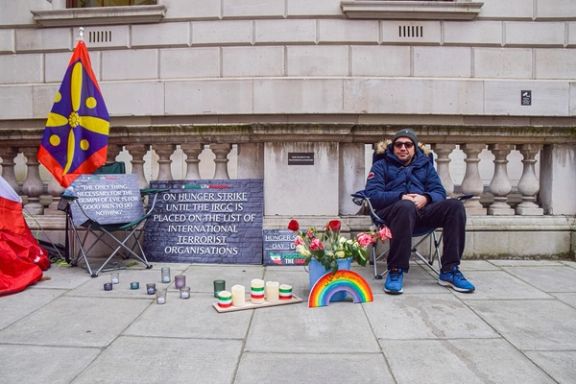
Iranian activist Vahid Beheshti, who has been on a hunger strike outside the UK Foreign Office in London since February 23 to push for the designation of the IRGC as a terrorist organization

After 35 days on hunger strike, a dual British-Iranian citizen's campaign calling on the UK government to designate the IRGC is finally gaining ground.

Vahid Beheshti has been battling the bitter winter outside the UK Foreign Office to raise awareness for the need to designate the Iranian terror group responsible for the deaths of hundreds of Iranian citizens since September.

He has got the attention of key political figures and has been joined by supporters hoping to force the UK government to take action on the brutal security forces.

On Monday, he met with the Minister of State for Security, Tom Tugendhat. Beheshti said, "He expressed his concerns for my health and emphasized that the Government's position is to proscribe the IRGC, but could not share the timescale in which this would happen."

His simple camp outside the Foreign Office has become a meeting place for activists, with others joining him.

His campaign has proven so successful that his name has been frequently mentioned during the sessions of the UK House of Commons. He has repeatedly urged UK lawmakers to hold official meetings with him instead of unofficial visits to his corner, to raise the profile of the issue to the highest echelons

Beheshti’s campaign is even reaching back home.

A boy in Iran holds a placard that urges Beheshti to break his hunger strike

As his body is getting weaker, temperatures at night dropping to freezing, his determination is growing stronger as he has vowed not to break the strike until the IRGC is listed as a terrorist organization.

The 46-year-old journalist is surviving on a daily diet of one cup of coffee, a few cubes of sugar, some salt and “plenty of water”.

“A policy of appeasement with Iran's Islamic Revolutionary Guard Corps has not worked in the last 44 years, and it will never work going forward,” Beheshti said last week, calling on Sunak, for “strong leadership” and to stand by his pledge to designate the group before his recent election.

Before embarking on his hunger strike, Beheshti held several meetings with British lawmakers, pleading with them for the proscription, but no action was made.

The tipping point came in February when Iran International was forced to close its London studios after repeated death threats from the regime.“The main point I highlight to British politicians is that their country’s principles are under threat today... I cannot understand why the British police, with all their power, cannot protect journalists against IRGC threats,” Beheshti said.

The Revolutionary Guard is the Islamic Republic’s leading military, intelligence and internal security juggernaut, responsible for cracking down on dissent inside Iran and managing the proxy militias throughout the region including the Houthis in Yemen which have caused devastation to the country.

Beheshti has been actively raising the voice of Iranians among the international community with his numerous interviews, speeches and video messages to global events on the uprising in Iran.

He says the designation is the first practical step toward further isolation of the Islamic Republic and the final overthrow of the regime.

Rallies against the IRGC have taken place globally including just last week in Brussels. The UK’s current list of 78 proscribed terrorist organizations includes Hamas, Hezbollah, and the Kurdistan Workers Party (PKK).

Several countries including the US, UK and EU have been cautious to designate the IRGC for fear it will further alienate the regime and in turn, limit negotiating capacity regarding its nuclear program.

In December, members of the UK House of Commons unanimously voted for a motion that urges the government to proscribe the IRGC but it has split the House.

Prominent Iranian opposition figures have repeatedly called on London to blacklist the Guards with exiled Prince Reza Pahlavi describing the move as to be akin to “pulling out the regime’s biggest tooth.”


Vahid Beheshti and stand-up comedian Omid Djalili on the 24th day of Beheshti's hunger strike (March 2023)
100%
Vahid Beheshti and stand-up comedian Omid Djalili on the 24th day of Beheshti's hunger strike

Most Viewed

US blockade enters murky phase as tankers spoof signals and buyers hesitate
1
ANALYSIS

US blockade enters murky phase as tankers spoof signals and buyers hesitate

2

US tightens financial squeeze on Iran, warns banks over oil money flows

3
INSIGHT

Ideology may be fading in Iran, but not in Kashmir's ‘Mini Iran'

4
INSIGHT

Hardliners push Hormuz ‘red line’ as US blockade tests Iran’s leverage

5
VOICES FROM IRAN

Hope and anger in Iran as fragile ceasefire persists

Banner
Banner

Spotlight

  • Hardliners push Hormuz ‘red line’ as US blockade tests Iran’s leverage
    INSIGHT

    Hardliners push Hormuz ‘red line’ as US blockade tests Iran’s leverage

  • Ideology may be fading in Iran, but not in Kashmir's ‘Mini Iran'
    INSIGHT

    Ideology may be fading in Iran, but not in Kashmir's ‘Mini Iran'

  • War damage amounts to $3,000 per Iranian, with blockade set to add to losses
    INSIGHT

    War damage amounts to $3,000 per Iranian, with blockade set to add to losses

  • Why the $100 billion Hormuz toll revenue is a myth
    ANALYSIS

    Why the $100 billion Hormuz toll revenue is a myth

  • US blockade targets Iran oil boom amid regional disruption
    ANALYSIS

    US blockade targets Iran oil boom amid regional disruption

  • Iran's digital economy battered by prolonged blackout
    INSIGHT

    Iran's digital economy battered by prolonged blackout

•
•
•

More Stories

Azerbaijan Investigating 'Terror Attack' After Lawmaker Wounded

Mar 29, 2023, 10:37 GMT+1

Azerbaijan's State Security Service said on Wednesday that it was investigating "a terror attack" after a lawmaker with strong anti-Iranian views was wounded in a gun attack at his home.

Fazil Mustafa, a member of the Azeri parliament, had been hospitalised after receiving wounds to his shoulder and thigh after being shot with a Kalashnikov assault rifle on Tuesday night, the security agency said in a statement.

His life was not at risk, it said, and a criminal investigation had been opened to identify the perpetrator.

Azeri news site haqqin.az quoted Mustafa, 57, as saying from hospital that he had been hit by two bullets while driving into his garage.

Mustafa was known in parliament as an outspoken critic of Iran, Azerbaijan's southern neighbour, with which Baku has often had strained relations. The State Security Service noted Mustafa's anti-Iran stance in its statement on the incident.

Relations between Azerbaijan and Iran, which has a large population of ethnic Azeris in its northwest, have been strained in recent months after Baku announced plans to open formal diplomatic ties with Israel.

In January, Azerbaijan closed its embassy in Tehran after what it called a "terrorist attack" that killed the embassy's head of security.


Report by Reuters

IRGC Urges Palestinians To Take Advantage Of Turmoil In Israel

Mar 29, 2023, 09:46 GMT+1

The spokesman of Iran’s Revolutionary Guard (IRGC) has called on the Palestinians to take advantage of recent protests in Israel to destabilize the country.

Brigadier General Ramezan Sharif said on Tuesday that “the occupied territories are the scene of confrontation of a movement within the Zionist regime that wants to stand against the totalitarianism of another wing.”

“This is a golden opportunity for the Palestinian fighters to take advantage of the situation,” he added.

The IRGC commander’s clear instigation of Palestinian youths comes as state media in Iran are also heralding that the domestic disagreements in Israel would lead to the “end of Zionism”.

Gen. Sharif told local media that Jerusalem's "liberation" is near, "thanks to the Palestinian struggle", and to Iran's Supreme Leader Ali Khamenei who "is the flag-bearer" of the fight against Israel. He also said that IRGC Gen. Qassem Soleimani played an important role in driving the "resistance". Soleimani was targeted and killed by the United States in Baghdad in January 2020.

The Islamic Republic officials have rejoiced by the political dispute over Prime Minister Benjamin Netanyahu's effort to overhaul the country's judicial system.

Hardliner media, mostly controlled by the IRGC began publishing daily articles about a "looming civil war" in Israel and predicting its demise in the near future.

On January 4, newly-appointed Justice Minister Yariv Levin announced plans to reform Israel's judiciary, including limiting the power of the Supreme Court, and granting the governing coalition a majority on the committee that appoints judges. Following the announcement, several organizations have staged mass protests for 12 weeks now.

Iran's Currency Drops After Initial Optimism Over Saudi Deal

Mar 29, 2023, 08:54 GMT+1

Iran’s currency has dropped by 20 percent since March 10 when an agreement was signed with Saudi Arabia to restore relations, injecting optimism into the economy.

The rial was trading above 530,000 to the US dollar, and 570,000 to the euro Wednesday, as most offices and businesses are closed due to long Nowruz holidays.

When Tehran and Riyadh announced the Chinese-brokered deal to restore diplomatic relations earlier in the month, the rial rose to 440,000 to the dollar, as the deal was seen as a step toward reducing Iran’s international isolation.

However, the initial euphoria in Tehran has given way to more realistic expectations, that the agreement might not have been a major foreign policy shift to impact the economy.

The fact remains that the government is facing a very large deficit, by some estimates more than 50 percent of its budget, without any immediate outlook for a major domestic or international breakthrough. More regime insiders are criticizing the government for lack of a plan to deal with the crisis and mismanagement of the economy.

Iran needs to resolve its disputes with the United States to end crippling oil export and international banking sanctions, as its oil-based economy faces a serious hard currency shortfall.

Talks to resolve differences on Iran’s galloping nuclear program ended in a deadlock last September, with Washington blaming Tehran for intransigence. Since the failure, the Biden Administration has been saying that reaching a nuclear deal is not its priority any longer.

Federalism vs Centralism, Bone Of Contention Among Iran Activists

Mar 29, 2023, 07:20 GMT+1
•
Maryam Sinaiee

Whether the future government of Iran, after the Islamic Republic should be a federal or a centralized government is one of the most divisive issues among the activists.

Diaspora opposition groups and figures have held several gatherings and released various charters of solidarity and alliance in the past few months. Nearly unanimously, everyone says it is the Iranian people who should decide, through a referendum, the form of the future government in Iran.

The biggest diaspora alliance, the Alliance for Democracy and Freedom in Iran, which announced its existence in a February event at Georgetown University and issued its charter, the Mahsa Charter, in early March, advocates a secular-democratic system determined through a referendum but has not specified whether this could be a federal or a centralized government.

The alliance consists of the exiled Prince Reza Pahlavi, Nobel peace prize laureate Shirin Ebadi and Canada-based activist Hamed Esmaeilion, as well as US-based author, journalist and women’s rights activist Masih Alinejad, actress and activist Nazanin Boniadi and Secretary General of the Kurdish Komala Party Abdullah Mohtadi.

Iran-opposition (file)
100%

The six members of the alliance stress that for the time-being they have agreed on “minimal positions” that could create the most consensus among the opposition and that it could be further improved.

Many who support the diaspora opposition have already made up their minds whether they want a republic or the return of the Pahlavi monarchy which was ousted by the Islamic Revolution of 1979. The true weight of those favoring one or the other tendency is not known.

Prince Reza Pahlavi has said that he will accept whatever form of government Iranians choose and at least on one occasion in the past has said that he personally favors a republic.

But some opposition supporters known as ‘constitutionalists’ are staunchly against establishing a republic of any form in Iran, particularly federalism, seek the revival of a constitutional monarchy and the Iranian Constitution of 1906.

Among the members of the alliance, Mohtadi has been the most vocal advocate of ethnicity-linguistic-based federalism. “I would personally like the charter to more clearly move towards [recognition of] federalism,” he told Iran International on the sidelines of an opposition conference in Toronto, Canada, Sunday. At least two other members, Alinejad and Esmaeilion, also appear to be advocates of decentralization of the government or some type of federalism.

“Any kind of ethnicity-based federalism will be a fascistic regress in Iran and [cause] violation of basic human rights. Ethnic groups are intertwined and drawing lines between Iranian ethnic groups on the imaginary ground that they are racially different will lead to years of civil war. We are one nation, the Iranian nation,” one of the opponents of ethnicity-linguistic based federalism tweeted Tuesday.

Those favoring federalism, however, say economic, ethnic and religious inequality in a multi-ethnic and multilingual country like Iran requires recognition of ethnic differences and decentralization of the government. Many among them also demand recognition of other languages such as Kurdish, Turki, Balochi and Arabic as official languages and the right of non-Persian speakers to education in their mother tongues instead of Persian (Farsi).

Yet others advocate a non-ethnicity-linguistic-based form of federalism to avoid problems such as disputes over geographical boundaries of federal states in mixed ethnicity-linguistic areas of the country.

Many provinces in Iran have mixed ethnic or linguistic populations, such as West Azarbaijan or the oil-rich Khuzestan. Trying to create ethnically homogeneous provinces or states peacefully, would be next to impossible.

“Yes to political and no to ethnicity defined federalism. Yes to American and no to Yugoslavian [types of federalism],” @Ted_Mosbi1361 who is among Persian-language Twitter opposition influencers tweeted Friday. 

US Senators Demand Forceful Response To Iranian Attacks In Region

Mar 28, 2023, 23:57 GMT+1
•
Iran International Newsroom

Amid heightened tensions between Iran’s proxy militia and US forces in Syria, some American senators criticized Biden administration's Middle East policy. 

In separate conversations with Iran International’s correspondent Arash Alaei on Tuesday, Senators Josh Hawley (R-MO), Marco Rubio (R-FL), and Tommy Tuberville (R-AL) blasted the administration’s policy – or lack thereof – about how to deal with the Islamic Republic’s destabilizing acts in the region. 

Senator Hawley said, “I don’t think this administration has a strategy” to counter the threats posed by Iran against the US forces in the region. “What they are doing is playing footsie with Iran, making nice with Iran, at precisely the time that we ought to be strengthening our allies and partners in the region to be able to counter Iran,” he added. 

US Senator Josh Hawley (R-MO) (undated)
100%
US Senator Josh Hawley (R-MO)

“I don’t think this administration understands at all the security challenges facing this country or national interests,” Hawley said. 

Despite attacks on US forces in Syria last week by Iran-backed militia, the White House said Monday that Washington will not back away from its deployment to Syria. Nevertheless, the New York Times reported Tuesday that the White House held off a retaliatory attack against the Iran-backed forces in Syria on Friday after a second attack on US bases.

“We’re going to do what we need to do swiftly and boldly to protect our people and our facilities in Syria,” White House National Security Council spokesperson John Kirby said on Monday. “We’re not going to be deterred from continuing to go after this network in Syria... We're not going to be deterred … by these attacks from these militant groups."

Senator Rubio also defended the retaliatory attacks as “appropriate response”, saying that “Iran and their proxy groups are actively operating in both Syria and Iraq, trying to kill Americans.”

US Senator Marco Rubio (R-FL) (undated)
100%
US Senator Marco Rubio (R-FL)

Senator Tuberville also voiced support for the US attacks, saying “I am glad we strike back... We did the right thing.” He added that the US should not allow Iran’s proxies to threaten the lives of Americans. 

After a US civilian contractor was killed and six other Americans were injured March 23 in northeast Syria by a drone attack of “Iranian origin,” two US F-15 E fighter jets launched airstrikes against militant sites linked to Iran’s Islamic Revolutionary Guards – the IRGC – later in the day. The retaliatory strikes and exchanges of fire killed 19 Syrian and pro-Iranian forces. That prompted the proxy forces to launch rocket and drone attacks on Friday, injuring another American, but, according the NYT quoted a senior US official as saying the Biden administration did not give the go ahead for a second retaliation, while the American warplanes were poised to conduct a second round of reprisal strikes late Friday. 

Also on Tuesday, Secretary of Defense Lloyd Austin told a Senate Armed Services Committee hearing on Capitol Hill that the US had only responded to four of 83 Iran-backed attacks on US troops in Iraq and Syria since Joe Biden took office in January 2021. 

He admitted that the Biden administration should have notified lawmakers earlier than it did about the deadly drone attack on American forces in Syria, after Republican lawmakers grilled him over an almost 13-hour delay between the time of the attack and when Congress was notified. 

Iran’s foreign ministry has condemned US retaliatory strikes on its proxy forces in Syria, labelling them as “terrorist aggression” against “civilian targets.”