• العربية
  • فارسی
Brand
  • Iran Insight
  • Politics
  • Economy
  • Analysis
  • Special Report
  • Opinion
  • Podcast
  • Iran Insight
  • Politics
  • Economy
  • Analysis
  • Special Report
  • Opinion
  • Podcast
  • Theme
  • Language
    • العربية
    • فارسی
  • Iran Insight
  • Politics
  • Economy
  • Analysis
  • Special Report
  • Opinion
  • Podcast
All rights reserved for Volant Media UK Limited
volant media logo

Iranian Media Upbeat About Tehran's Regional Détente
Iran International Newsroom
Mar 16, 2023, 19:18 GMT+0Updated: 17:37 GMT+1
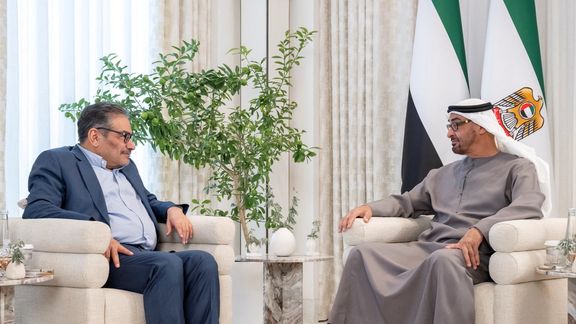
President of the United Arab Emirates Sheikh Mohamed bin Zayed Al Nahyan meets with Iran's top security official Ali Shamkhani, in Abu Dhabi, United Arab Emirates, March 16, 2023.

Iranian media appear to be upbeat about the possibility of further breakthroughs in Iran's relations with its Arab neighbors around the Persian Gulf.

Reformist daily Shargh wrote in a commentary headlined, "A season to end disputes" that reports have been coming in since mid-day March 10 when China brokered a deal between Tehran and Riyadh to resume diplomatic ties.

An Iranian parliamentary delegation met with Bahraini counterparts in Manama on Saturday, and Iranian Security Chief Ali Shamkhani visited the United Arab Emirates on Thursday. Manama severed its ties with Tehran one day after Saudi Arabia cut its diplomatic relations in 2016.

Russian sources observed that while the deal with Saudi Arabia was brokered by China as mediator, attempts to improve ties with Bahrain and the UAE are being made through bilateral negotiations.

Officials in Bahrain have attached high importance to restoring ties with Tehran which are likely to start by resuming flights between Tehran and Manama, Shargh newspaper in Tehran wrote. It quoted Iranian West Asia watcher Hossein Amiri as saying that "Saudi satellite countries" including Libya, Maldives, Egypt and Jordan might follow suit soon. The expert told Shargh that the moves signal a new chapter in Iran's foreign policy which is now focused on regional détente.

Saudi Minister of State and National Security Adviser Musaed bin Mohammed Al-Aiban, meets the Iranian Rear Admiral Ali Shamkhani, the secretary of the Supreme National Security Council, in Beijing, China, March 10, 2023.
100%
Saudi Minister of State and National Security Adviser Musaed bin Mohammed Al-Aiban, meets the Iranian Rear Admiral Ali Shamkhani, the secretary of the Supreme National Security Council, in Beijing, China, March 10, 2023.

Shargh also noted that an end to the war in Yemen is the beginning of an end to conflicts and tension in the region. In two weeks’ time, everyone in the region will remember the 9th anniversary of the war in Yemen. Iranian diplomat Ali Asghar Khaji told a visiting UN official in Tehran earlier this week that the Islamic Republic has always said that there is no military solution to the conflict in Yemen.

Mohammad Saleh Sadri, another expert on regional affairs, told Shargh that although all previous efforts to end the conflict in Yemen have failed, the agreement between Tehran and Riyadh has changed the situation. Nonetheless, he added that ending the war is no easy task.

Meanwhile, Arab media in London have pointed out that Egypt might be the first country outside the Persian Gulf region to begin to mend its ties with Tehran.

Another reformist daily, Etemad, wrote on Wednesday that Shamkhani hosted by UAE National Security Adviser Tahnoun bin Zayed Al Nahyan in Abu Dhabi, will also discuss the status of efforts to reach a nuclear deal with world powers as well as the issue of sanctions.

The UAE is usually one of the first points of reference for Iran to expand international trade.

However, it is not clear how Abu Dhabi might be able to help Iran with its troubled international trade as long as US sanctions remain in place, although according to some Iranian officials, at times, the UAE has gone out of its way to help Iran circumvent the sanctions.

Some officials in the UAE have said that Shamkhani's visit was planned long before the agreement with Saudi Arabia, but it was delayed as he went to China first to have the deal done.

Iran and the UAE have a long-standing issue over the ownership of three Persian Gulf islands, although the two side are usually reluctant to discuss it. Ironically it was brought up during President Xi Jinping’s visit Saudi Arabia in December and deeply annoyed some Iranians including state officials.

Another Etemad report suggested quoting Amwaj Media that the resumption of ties with Bahrain will be a priority for Manama as after the re-opening of the Saudi embassy in Tehran, possibly in May, Bahrain will be the only regional country without an embassy in Iran.

However, according to Amwaj Media, the two sides do not wish to do much propaganda about the resumption of their ties. The agency quoted an unnamed local official as saying "There is no serious unresolved problem between Bahrain and Iran."


Most Viewed

Iran negotiators ordered to return after internal rift over Islamabad talks
1
EXCLUSIVE

Iran negotiators ordered to return after internal rift over Islamabad talks

2
ANALYSIS

US blockade enters murky phase as tankers spoof signals and buyers hesitate

3
ANALYSIS

Why the $100 billion Hormuz toll revenue is a myth

4

US tightens financial squeeze on Iran, warns banks over oil money flows

5
ANALYSIS

US blockade targets Iran oil boom amid regional disruption

Banner
Banner

Spotlight

  • Hardliners push Hormuz ‘red line’ as US blockade tests Iran’s leverage
    INSIGHT

    Hardliners push Hormuz ‘red line’ as US blockade tests Iran’s leverage

  • Ideology may be fading in Iran, but not in Kashmir's ‘Mini Iran'
    INSIGHT

    Ideology may be fading in Iran, but not in Kashmir's ‘Mini Iran'

  • War damage amounts to $3,000 per Iranian, with blockade set to add to losses
    INSIGHT

    War damage amounts to $3,000 per Iranian, with blockade set to add to losses

  • Why the $100 billion Hormuz toll revenue is a myth
    ANALYSIS

    Why the $100 billion Hormuz toll revenue is a myth

  • US blockade targets Iran oil boom amid regional disruption
    ANALYSIS

    US blockade targets Iran oil boom amid regional disruption

  • Iran's digital economy battered by prolonged blackout
    INSIGHT

    Iran's digital economy battered by prolonged blackout

•
•
•

More Stories

Israeli Defence Minister Says Perpetrators Of Roadside Bombing Will 'Regret' Actions

Mar 16, 2023, 16:02 GMT+0

Israel’s Defense Minister vowed tough action in response to a roadside bombing suspected to have been planned by Iran-backed Hezbollah.

On a tour of the border between Israel and Lebanon on Thursday, Yoav Gallant said whoever carried out the attack “will regret” its actions. “We will find the right timing and appropriate manner to hit back,” he said.

An explosive device was detonated next to the Megiddo Junction on Monday, severely injuring an Israeli civilian. Soon after, following an extensive search and road blockades, the suspect was found and killed by Israel’s Yamam forces.

“The terrorist was found in possession of weapons, including an explosive belt ready to be activated and additional means. The assumption is that due to the neutralization, an additional terror attack was prevented,” the IDF spokesman’s office announced this week.

The spokesman’s unit said an initial inquiry suggests that the terrorist is presumed to have crossed into Israel from southern Lebanon, a Hezbollah stronghold, earlier this week.“The possibility of the involvement of the Hezbollah terrorist army is also under review,” it added.

According to Reuters, Hezbollah — Iran’s most powerful proxy which has frequently called for the end of the State of Israel — declined to comment on the allegations.

Israel and Lebanon do not have diplomatic relations and have relied on UN peacekeeping troops, The United Nations Interim Force in Lebanon, to act as a buffer between the two nations since 1978.

Leaked Document Reveals Infighting In Khamenei’s Family Business

Mar 16, 2023, 15:55 GMT+0
•
Iran International Newsroom

Hacktivist group Edalat-e Ali (Ali's Justice) has released documents revealing an embezzlement case related to a company managed by Iranian Supreme Leader’s brother. 

According to the document, Tehran's public and revolutionary prosecutor Ali Salehi has ordered the case not to be pursued after Ali Khamenei’s office pulled some strings. 

The complaint was originally filed about a year ago apparently by the office of the president of Sadra Islamic Philosophy Foundation, run by Mohammad Khamenei, one of the brothers of Iran’s ruler, against one of its affiliate companies, a food transportation company called Caravan Transportation. 

It is not clear why an institute financed by the government for research on Islamic philosophy owns a food transportation company, nor is it clear why the family business was thrown into shambles. 

Four senior members of the transportation company, including Mohammad Khamenei’s own son Ahmad Hosseini Khamenei and son-in-law Vahidreza Taleghani, are among those who were to be prosecuted for acquisition of property through illegal means, according to the leaked document. However, the case was buried upon an order by Salehi, seemingly because more people, including the plaintiff, Mohammad Khamenei, and his daughter Zohreh Hosseini could have been implicated in the case. 

The writer of the letter said that abuse of public property and bank cheques were proven and confessed in the case, but Salehi prevented the necessary follow-up. It was also revealed that a man, identified as Mohsen Afrasiabi, had tried to contact the prosecutor’s office, claiming that he had messages from the Supreme Leader himself and his brother Mohammad. 

Political analyst Ali-Hossein Ghazizadeh told Iran International that the case is only a small example of the corruption by the family of the Supreme Leader, who is considered “sacred” by his zealous followers. 

Late last year, the former chief of Iran's state television, who used to be a regime insider before his row with the IRGC’s intelligence organizations and Khamenei’s son, revealed harrowing facts about systematic corruption in the Iranian government. 

Mohammad Sarafraz, who resigned his post as head of IRIB (Islamic Republic of Iran Broadcasting) in May 2016 due to interventions in his organization's financial operations by Khamenei's son Mojtaba and former IRGC intelligence Chief Hossein Taeb, was one of the closest persons to Khamenei until then. The Supreme Leader later appointed Sarafraz as a member of the Supreme Council of Cyberspace. But Sarafraz says he resigned this post also, although Khamenei never accepted his resignation.

The former chief of Iran’s state Radio and TV, Mohammad Sarafraz (undated)
100%
The former chief of Iran’s state Radio and TV, Mohammad Sarafraz

In an interview conducted by one of his former aides and published on You Tube, Sarafraz said that Iranian intelligence officers can even tell judges at the court what they should decide when ruling on various cases.

Sarafraz accused the government and the banking system of systematic corruption that has led to vast income gaps among Iranians. He said most of this corruption exists in companies that enjoy the benefits of private firms but are in fact controlled by the government when they are paying taxes or reporting their financial status. These companies, he said, leave no room for competition from real private businesses.

Eighty percent of Iran’s economy is directly or indirectly controlled by the government or semi-official companies. A privatization drive that began 15 years ago mainly turned into setting up quasi-governmental firms controlled by powerful insiders who block competition and use public funds to stay afloat.

Soleimani 'Architect Of Peace' With Saudi Arabia, Says Spokesman

Mar 16, 2023, 14:00 GMT+0

Iran’s foreign ministry spokesman Nasser Kanaani claimed Thursday that IRGC’s Qassem Soleimani was the architect of restoring ties with Saudi Arabia.

Posting a tweet, Kanaani did not explain Soleimani’s role in an agreement last week to restore diplomatic relations between Tehran and Riyadh. Soleimani was killed more than three years ago in an air strike in Baghdad, ordered by former US President Donald Trump.

“General Soleimani not only was a hero in fighting terrorism and enhancing security in the region, he was also a general and an architect of peace, reconciliation and brotherhood among Muslim nations and countries,” Kanaani wrote in his tweet.

One day after the Tehran-Riyadh agreement was announced in Beijing on March 10, some media controlled by Iranian hardliners began saying that that the deal was the result of Iran’s military power in the region, implying that Saudi Arabia had no choice but to mend fences with the Islamic Republic.

Kanaani's tweet can be interpreted as a reference to Soleimani's military role in destabilizing the region.

As commander of IRGC's extraterritorial Quds Force, Soleimani was in fact Tehran’s military and intelligence operative in the Middle East and the architect of creating militant proxy forces in Iraq, Yemen, Syria, Afghanistan and reinforcing the Lebanese Hezbollah.

A devastating missile and drone attack on Saudi oil installations in September 2019 was ascribed to Iran or its Yemeni allies, the Houthis. It was said at the time that Soleimani was one of the main architects of the attack that eluded Saudi and American radars and air defenses.

Hardliner Iranian Cleric Says Soaring Prices A US Conspiracy

Mar 16, 2023, 12:52 GMT+0

Firebrand Iranian cleric Ahmad Khatami claims the massive rise of prices in Iran is the result of a plot hatched by the United States.

The hardliner cleric and Friday prayer Imam in Tehran said that high prices are the result of an "economic war” waged by the US, referring to the heavy sanctions Iran is currently living under.

Although economic sanctions imposed by Washington have a major impact on Iran's economy, many among local media and politicians also blame government mismanagement and the centrally controlled economy plagued by corruption.

“I clearly announce that this high level of inflation is a conspiracy and economic war staged by the US, so the authorities should put in more effort to deal with the unbridled prices,” he said.

Khatami went as far as making a strange claim that “American think tanks have organized 200 conspiracies to overthrow the Islamic Republic.” Accusing American research outfits of conspiring against the regime has been a recent theme in sermons by hardliner clerics.

Iran has been struggling with above-40-percent inflation since 2019 when the United States imposed sanctions.

Last May the government eliminated an annual food import subsidy of at least $10 billion, which immediately led to steep price increases. This was followed by a fall in the value of the national currency.

Food prices continue to climb as the national currency declined by 50 percent in the past six months. According to the Statistical Center of Iran (SCI), in some months, food and beverage inflation hit 87 percent.

The ongoing Woman Life Freedom protests and the collapse of the JCPOA talks, have also worsened the country’s economy to levels not seen in recent history.

State Department Says Success Of Iran Policy Was Uniting Allies

Mar 16, 2023, 12:24 GMT+0
•
Iran International Newsroom

US State Department’s outgoing spokesperson Ned Price says the major success of the administration regarding Iran has been forging unity with allies.

Asked by Iran International’s correspondent how he judges US policy on Iran after no diplomatic successes in two years, Price argued that Iran poses “a number of challenges, and we’ve always been clear-eyed that those challenges are difficult – they are complex; they cross into many different realms.”

Price claimed, “when you take a look at each one of those realms, you have seen us work with allies and partners in ways that meaningfully protect our interests and promote our interests.”

However, since President Joe Biden signaled his readiness in 2020 to revive the Obama-era nuclear deal with Iran, known as the JCPOA, the Islamic Republic has dangerously increased the level of its uranium enrichment, first to 20 and then to 60-percent purity starting in early 2021.

It also increased oil shipments to China despite US sanctions and continued its meddling in the Middle East. Tehran has also refused to fully cooperate with the International Atomic Energy Agency (IAEA) and in fact has substantially reduced the UN watchdog’s monitoring capacity at its nuclear installations.

The Biden administration also agreed to hold indirect talks with Iran to revive the JCPOA, with Russia playing a major role until its attack on Ukraine last year. Talks lasting 18 months came to a deadlock in September 2022, as Iran stonewalled while it was shipping kamikaze drones to Russia.

US envoy for Iran Robert Malley meeting Russia's representative in nuclear talks Mikhail Ulyanov in Vienna on December 29, 2021
100%
US envoy for Iran Robert Malley meeting Russia's representative in nuclear talks Mikhail Ulyanov in Vienna, just weeks before the invasion of Ukraine, on December 29, 2021

Price also admitted that Iran did not conduct honest negotiations. The “Iranian regime has not been true to its word when it said early on in this administration that it sought a mutual return to compliance with the JCPOA. It has consistently proven itself unable or unwilling to do so,” Price said.

“When it comes to Iran’s nuclear program, of course this is one of those core challenges. But I think when you look at where we are now as opposed to where we had been or where the previous administration had been, we are now united with our European allies,” Price said, highlighting the only area of success in two years.

Former President Donald Trump’s unilateral style in foreign policy had annoyed the Europeans, who often just tolerated his moves but were clearly unhappy. But the same cannot be said about US allies in the region, where both Israel and the block led by Saudi Arabia agreed with Trump’s policy of ‘maximum pressure’ against Tehran.

With the latest move by Saudi Arabia to re-establish diplomatic ties with Iran under Chinese guarantees, clearly shows regional allies are not sure about the Biden administration’s ability to handle Iran.

Secretary of State Antony Blinken speaking to reporters in Ethiopia Wednesday tried to put a positive spin on the development, saying, “anything that can help reduce tensions, avoid conflict, and curb in any way dangerous or destabilizing actions by Iran is a good thing… And to the extent that China facilitated conclusion of this agreement to restore diplomatic relations, that’s a good thing.”

This will be seen by many as an admission that China is able to provide security to Saudi Arabia while the United States has somehow left a void.

As China, Russia and Iran began naval drills in the region less than a week after the Chinese-brokered deal, one administration critic tweeted, “Wondering if we’ll hear from more anonymous US officials saying, ‘ultimately, this a good thing’.”





