• العربية
  • فارسی
Brand
  • Iran Insight
  • Politics
  • Economy
  • Analysis
  • Special Report
  • Opinion
  • Podcast
  • Iran Insight
  • Politics
  • Economy
  • Analysis
  • Special Report
  • Opinion
  • Podcast
  • Theme
  • Language
    • العربية
    • فارسی
  • Iran Insight
  • Politics
  • Economy
  • Analysis
  • Special Report
  • Opinion
  • Podcast
All rights reserved for Volant Media UK Limited
volant media logo

Leaked Document Reveals Infighting In Khamenei’s Family Business
Iran International Newsroom
Mar 16, 2023, 15:55 GMT+0Updated: 17:31 GMT+1
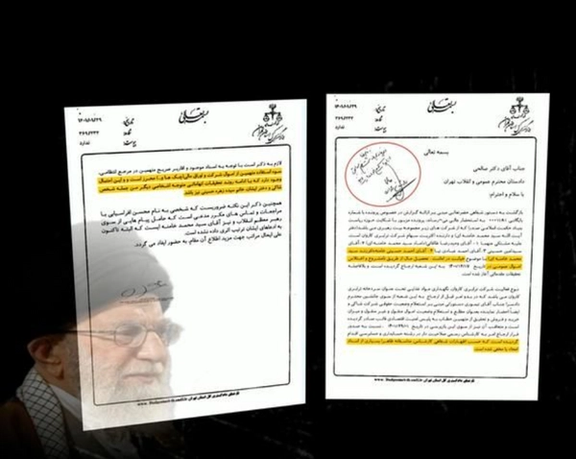
Photo of the documents leaked by hacktivist group Edalat-e Ali revealing an embezzlement case related to Iran’s ruler Ali Khamenei’s brother and his family

Hacktivist group Edalat-e Ali (Ali's Justice) has released documents revealing an embezzlement case related to a company managed by Iranian Supreme Leader’s brother. 

According to the document, Tehran's public and revolutionary prosecutor Ali Salehi has ordered the case not to be pursued after Ali Khamenei’s office pulled some strings. 

The complaint was originally filed about a year ago apparently by the office of the president of Sadra Islamic Philosophy Foundation, run by Mohammad Khamenei, one of the brothers of Iran’s ruler, against one of its affiliate companies, a food transportation company called Caravan Transportation. 

It is not clear why an institute financed by the government for research on Islamic philosophy owns a food transportation company, nor is it clear why the family business was thrown into shambles. 

Four senior members of the transportation company, including Mohammad Khamenei’s own son Ahmad Hosseini Khamenei and son-in-law Vahidreza Taleghani, are among those who were to be prosecuted for acquisition of property through illegal means, according to the leaked document. However, the case was buried upon an order by Salehi, seemingly because more people, including the plaintiff, Mohammad Khamenei, and his daughter Zohreh Hosseini could have been implicated in the case. 

The writer of the letter said that abuse of public property and bank cheques were proven and confessed in the case, but Salehi prevented the necessary follow-up. It was also revealed that a man, identified as Mohsen Afrasiabi, had tried to contact the prosecutor’s office, claiming that he had messages from the Supreme Leader himself and his brother Mohammad. 

Political analyst Ali-Hossein Ghazizadeh told Iran International that the case is only a small example of the corruption by the family of the Supreme Leader, who is considered “sacred” by his zealous followers. 

Late last year, the former chief of Iran's state television, who used to be a regime insider before his row with the IRGC’s intelligence organizations and Khamenei’s son, revealed harrowing facts about systematic corruption in the Iranian government. 

Mohammad Sarafraz, who resigned his post as head of IRIB (Islamic Republic of Iran Broadcasting) in May 2016 due to interventions in his organization's financial operations by Khamenei's son Mojtaba and former IRGC intelligence Chief Hossein Taeb, was one of the closest persons to Khamenei until then. The Supreme Leader later appointed Sarafraz as a member of the Supreme Council of Cyberspace. But Sarafraz says he resigned this post also, although Khamenei never accepted his resignation.

The former chief of Iran’s state Radio and TV, Mohammad Sarafraz (undated)
100%
The former chief of Iran’s state Radio and TV, Mohammad Sarafraz

In an interview conducted by one of his former aides and published on You Tube, Sarafraz said that Iranian intelligence officers can even tell judges at the court what they should decide when ruling on various cases.

Sarafraz accused the government and the banking system of systematic corruption that has led to vast income gaps among Iranians. He said most of this corruption exists in companies that enjoy the benefits of private firms but are in fact controlled by the government when they are paying taxes or reporting their financial status. These companies, he said, leave no room for competition from real private businesses.

Eighty percent of Iran’s economy is directly or indirectly controlled by the government or semi-official companies. A privatization drive that began 15 years ago mainly turned into setting up quasi-governmental firms controlled by powerful insiders who block competition and use public funds to stay afloat.


Most Viewed

Iran negotiators ordered to return after internal rift over Islamabad talks
1
EXCLUSIVE

Iran negotiators ordered to return after internal rift over Islamabad talks

2
ANALYSIS

US blockade enters murky phase as tankers spoof signals and buyers hesitate

3
ANALYSIS

Why the $100 billion Hormuz toll revenue is a myth

4

US tightens financial squeeze on Iran, warns banks over oil money flows

5
ANALYSIS

US blockade targets Iran oil boom amid regional disruption

Banner
Banner

Spotlight

  • Hardliners push Hormuz ‘red line’ as US blockade tests Iran’s leverage
    INSIGHT

    Hardliners push Hormuz ‘red line’ as US blockade tests Iran’s leverage

  • Ideology may be fading in Iran, but not in Kashmir's ‘Mini Iran'
    INSIGHT

    Ideology may be fading in Iran, but not in Kashmir's ‘Mini Iran'

  • War damage amounts to $3,000 per Iranian, with blockade set to add to losses
    INSIGHT

    War damage amounts to $3,000 per Iranian, with blockade set to add to losses

  • Why the $100 billion Hormuz toll revenue is a myth
    ANALYSIS

    Why the $100 billion Hormuz toll revenue is a myth

  • US blockade targets Iran oil boom amid regional disruption
    ANALYSIS

    US blockade targets Iran oil boom amid regional disruption

  • Iran's digital economy battered by prolonged blackout
    INSIGHT

    Iran's digital economy battered by prolonged blackout

•
•
•

More Stories

Soleimani 'Architect Of Peace' With Saudi Arabia, Says Spokesman

Mar 16, 2023, 14:00 GMT+0

Iran’s foreign ministry spokesman Nasser Kanaani claimed Thursday that IRGC’s Qassem Soleimani was the architect of restoring ties with Saudi Arabia.

Posting a tweet, Kanaani did not explain Soleimani’s role in an agreement last week to restore diplomatic relations between Tehran and Riyadh. Soleimani was killed more than three years ago in an air strike in Baghdad, ordered by former US President Donald Trump.

“General Soleimani not only was a hero in fighting terrorism and enhancing security in the region, he was also a general and an architect of peace, reconciliation and brotherhood among Muslim nations and countries,” Kanaani wrote in his tweet.

One day after the Tehran-Riyadh agreement was announced in Beijing on March 10, some media controlled by Iranian hardliners began saying that that the deal was the result of Iran’s military power in the region, implying that Saudi Arabia had no choice but to mend fences with the Islamic Republic.

Kanaani's tweet can be interpreted as a reference to Soleimani's military role in destabilizing the region.

As commander of IRGC's extraterritorial Quds Force, Soleimani was in fact Tehran’s military and intelligence operative in the Middle East and the architect of creating militant proxy forces in Iraq, Yemen, Syria, Afghanistan and reinforcing the Lebanese Hezbollah.

A devastating missile and drone attack on Saudi oil installations in September 2019 was ascribed to Iran or its Yemeni allies, the Houthis. It was said at the time that Soleimani was one of the main architects of the attack that eluded Saudi and American radars and air defenses.

Hardliner Iranian Cleric Says Soaring Prices A US Conspiracy

Mar 16, 2023, 12:52 GMT+0

Firebrand Iranian cleric Ahmad Khatami claims the massive rise of prices in Iran is the result of a plot hatched by the United States.

The hardliner cleric and Friday prayer Imam in Tehran said that high prices are the result of an "economic war” waged by the US, referring to the heavy sanctions Iran is currently living under.

Although economic sanctions imposed by Washington have a major impact on Iran's economy, many among local media and politicians also blame government mismanagement and the centrally controlled economy plagued by corruption.

“I clearly announce that this high level of inflation is a conspiracy and economic war staged by the US, so the authorities should put in more effort to deal with the unbridled prices,” he said.

Khatami went as far as making a strange claim that “American think tanks have organized 200 conspiracies to overthrow the Islamic Republic.” Accusing American research outfits of conspiring against the regime has been a recent theme in sermons by hardliner clerics.

Iran has been struggling with above-40-percent inflation since 2019 when the United States imposed sanctions.

Last May the government eliminated an annual food import subsidy of at least $10 billion, which immediately led to steep price increases. This was followed by a fall in the value of the national currency.

Food prices continue to climb as the national currency declined by 50 percent in the past six months. According to the Statistical Center of Iran (SCI), in some months, food and beverage inflation hit 87 percent.

The ongoing Woman Life Freedom protests and the collapse of the JCPOA talks, have also worsened the country’s economy to levels not seen in recent history.

State Department Says Success Of Iran Policy Was Uniting Allies

Mar 16, 2023, 12:24 GMT+0
•
Iran International Newsroom

US State Department’s outgoing spokesperson Ned Price says the major success of the administration regarding Iran has been forging unity with allies.

Asked by Iran International’s correspondent how he judges US policy on Iran after no diplomatic successes in two years, Price argued that Iran poses “a number of challenges, and we’ve always been clear-eyed that those challenges are difficult – they are complex; they cross into many different realms.”

Price claimed, “when you take a look at each one of those realms, you have seen us work with allies and partners in ways that meaningfully protect our interests and promote our interests.”

However, since President Joe Biden signaled his readiness in 2020 to revive the Obama-era nuclear deal with Iran, known as the JCPOA, the Islamic Republic has dangerously increased the level of its uranium enrichment, first to 20 and then to 60-percent purity starting in early 2021.

It also increased oil shipments to China despite US sanctions and continued its meddling in the Middle East. Tehran has also refused to fully cooperate with the International Atomic Energy Agency (IAEA) and in fact has substantially reduced the UN watchdog’s monitoring capacity at its nuclear installations.

The Biden administration also agreed to hold indirect talks with Iran to revive the JCPOA, with Russia playing a major role until its attack on Ukraine last year. Talks lasting 18 months came to a deadlock in September 2022, as Iran stonewalled while it was shipping kamikaze drones to Russia.

US envoy for Iran Robert Malley meeting Russia's representative in nuclear talks Mikhail Ulyanov in Vienna on December 29, 2021
100%
US envoy for Iran Robert Malley meeting Russia's representative in nuclear talks Mikhail Ulyanov in Vienna, just weeks before the invasion of Ukraine, on December 29, 2021

Price also admitted that Iran did not conduct honest negotiations. The “Iranian regime has not been true to its word when it said early on in this administration that it sought a mutual return to compliance with the JCPOA. It has consistently proven itself unable or unwilling to do so,” Price said.

“When it comes to Iran’s nuclear program, of course this is one of those core challenges. But I think when you look at where we are now as opposed to where we had been or where the previous administration had been, we are now united with our European allies,” Price said, highlighting the only area of success in two years.

Former President Donald Trump’s unilateral style in foreign policy had annoyed the Europeans, who often just tolerated his moves but were clearly unhappy. But the same cannot be said about US allies in the region, where both Israel and the block led by Saudi Arabia agreed with Trump’s policy of ‘maximum pressure’ against Tehran.

With the latest move by Saudi Arabia to re-establish diplomatic ties with Iran under Chinese guarantees, clearly shows regional allies are not sure about the Biden administration’s ability to handle Iran.

Secretary of State Antony Blinken speaking to reporters in Ethiopia Wednesday tried to put a positive spin on the development, saying, “anything that can help reduce tensions, avoid conflict, and curb in any way dangerous or destabilizing actions by Iran is a good thing… And to the extent that China facilitated conclusion of this agreement to restore diplomatic relations, that’s a good thing.”

This will be seen by many as an admission that China is able to provide security to Saudi Arabia while the United States has somehow left a void.

As China, Russia and Iran began naval drills in the region less than a week after the Chinese-brokered deal, one administration critic tweeted, “Wondering if we’ll hear from more anonymous US officials saying, ‘ultimately, this a good thing’.”

Iranian Top Security On Visit To UAE To Mend Ties

Mar 16, 2023, 09:34 GMT+0

A high-level Iranian delegation to Abu Dhabi led by Ali Shamkhani from Iran's Supreme National Security Council (SNSC) hopes to mend ties with its Persian Gulf neighbour.

It is part of wider regional efforts from the regime to bridge tensions between Iran and its rivals, including Saudi Arabia, with whom it agreed to resume diplomatic relations last week.

The visit to the United Arab Emirates also shows the UAE leadership’s desire to take regional peace forward without the hands of the US.

In an unexpected move, the UAE resumed diplomatic relations and returned its ambassador to Iran just last year after ties soured following the storming of the Saudi embassy in Tehran in 2016.

Before the visit on Thursday, Shamkhani said the region will be strengthened by deepening local ties, though.

According to ISNA news agency, he is accompanied by the governor of the central bank and other high ranking intelligence and foreign ministry officials.

Crippled by biting sanctions and a revolution which has plunged Iran into the worst recession in decades, has forced the hardline Iranian leaders to mend ties with neighboring countries in the hope for the revival of the 2015 nuclear deal known as the JCPOA.

Iran Renews Oppressive Measures As Hijab Crackdown Continues

Mar 16, 2023, 09:01 GMT+0
•
Iran International Newsroom

The country’s parliament is planning a raft of new repressive measures in further crackdowns on hijab rebels, including increased surveillance and cutting access to social services.

Bijan Nobaveh, Tehran's representative and a deputy at the cultural committee, admitted that as protests show no signs of abating, more repressive measures are ahead, with the approval of the administration and judiciary.

Increased state-wide surveillance will add further oppression to the country’s suffering population. “Identification of women without hijab in public spaces will be done through surveillance cameras, and punishment will be done according to the prepared tables [guidelines],” he said, though this is widely done already.

Women seen in public without their Islamic headscarf, required under regime law, have been seen multiple times being beaten by brutal security forces.

Further crackdowns to communications are set to come too, after months of internet shutdowns have blighted the country, including millions of women working from home who are now forced back into poverty. New punishments tabled include blocking mobile phones and internet of women who appear in public without hijab.

The announcement this week also reiterated threats against owners and operators of shops, malls and tourist attractions who do not confront women without headscarves. The Islamic Republic has closed down several businesses in the heavily touristic cities of Esfahan (Isfahan) and Kashan as well as in the capital Tehran in recent days, demanding management not allow access for uncovered women.

It is not yet clear how much money the regime, which is already bankrupt, is going to spend on the necessary technologies for such measures.

The new crackdowns come as no surprise. Before the unrest which began in September, triggered by the death in morality police custody of Mahsa Amini, there has long been talk of using cameras to identify women flouting the mandatory hijab rules, part of efforts by President Ebrahim Raisi’s hardliner administration to intensify pressures on women in society throughout the year.

In December, another member of parliament’s cultural committee, Hossein Jalali, said that hijab enforcement will never be abolished, ensuring that “veils will be back on women’s heads within two weeks.” Confirming that the regime is making some changes in enforcing hijab rules, he added that “it is possible that women who do not observe hijab would be informed via SMS, asking them to respect the law. After notifying them, we enter the warning stage... and in the third stage, the bank account of the person who unveiled may be blocked."

Iranian women appearing in public without headscarves has become a common sight across the country. Celebrities keep publishing photos and videos of themselves defying the regime and scuffles with security forces are still seen across social media on a daily basis.

While some politicians have demanded an end to compulsory hijab and laws that legalize discrimination against women, there are many others who have been talking about new methods and punishments to enforce hijab.

A young woman on a street in Iran-hijab (undated)
100%


Supreme Leader Ali Khamenei delivered an ambivalent speech about hijab in January, saying hijab is an inevitable duty for all Muslim women, but no Iranian woman should be labeled as non-religious if she fails to fully honor the Islamic dress code.

The Islamic Republic faces a dilemma. Allowing people to wear whatever they desire in public means the utmost failure of the regime's ideology, while enforcing hijab with strict punitive measures can only lead to further resentment in society.

Protests seems to have resulted in police being unable to confront the large number of women unveiling in public with its usual ferocity and the regime’s hardliners are worried that warmer weather in spring and summer would lead to more women defying the country’s strict hijab rules.

Firebrand Cleric Ahmad Alamolhoda -- who is President Ebrahim Raisi's father-in-law -- said earlier in the month that “the regime is no longer powerful enough to stand against women who defy compulsory hijab,”. Imam Mohammad-Nabi Mousavifard also said in February that the authorities should approve new laws to deal with women who do not observe hijab “otherwise women will come to the street naked this summer”.

On Tuesday evening, hours after the parliament session on enforcing the hijab, thousands of young Iranians took to the streets in several cities, dancing with their hair flowing freely and burning headscarves and photos of Khamenei. They came out to mark the ancient Iranian annual fire festival and used the occasion to vent their anger at security forces.