• العربية
  • فارسی
Brand
  • Iran Insight
  • Politics
  • Economy
  • Analysis
  • Special Report
  • Opinion
  • Podcast
  • Iran Insight
  • Politics
  • Economy
  • Analysis
  • Special Report
  • Opinion
  • Podcast
  • Theme
  • Language
    • العربية
    • فارسی
  • Iran Insight
  • Politics
  • Economy
  • Analysis
  • Special Report
  • Opinion
  • Podcast
All rights reserved for Volant Media UK Limited
volant media logo

Plainclothes Agents In Iran Roam Freely, Angering Citizens

Maryam Sinaiee
Maryam Sinaiee

Iran International

Mar 5, 2023, 18:07 GMT+0Updated: 17:36 GMT+1
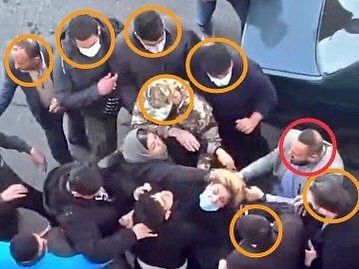
Plainclothes agents during the arrest of a mother whose daughter was poisoned in attacks on girls’ schools

The public is demanding answers after distraught parents of poisoned schoolgirls in Iran were brutally attacked by plainclothes security forces in recent days.

After public outrage and criticism even by some regime loyalists, four men accused of viciously beating a woman in Tehransar were arrested.

Video footage of the attack on the mother outside a girls’ school near the capital Tehran on Wednesday went viral, with demands for answers flooding social media.

The police have denied any involvement in the incident which saw several men surrounding and assaulting the woman who was apparently accusing the government of responsibility for the attacks. One of the men who dragged the woman by the hair has been identified as a Basij militia official by social media users.

It is often difficult to differentiate plainclothes agents from Basij militiamen or members of the public. Plainclothes forces who could be affiliated with any of the many intelligence and military organizations have often been seen working in tandem with pro-government vigilantes, beating and arresting protesters, and even destroying people’s vehicles and breaking shop windows.

Another video posted on social media on Saturday shows plainclothes forces violently arresting two schoolgirls in Karaj, forcing them into a car before driving them away.

While speculation grows as to the perpetrators of the poisonings in the girls’ schools, which began in the religious city of Qom in November and has now reached scores of schools around the country, even ministers have pointed the finger towards the government.

Last week, deputy education minister Younes Panahi said that "It was found that some people wanted all schools, especially girls' schools, to be closed," confirming fears that the regime is cracking down on girls who have been at the forefront of the Women, Life, Freedom movement since September.

"It has been revealed that the chemical compounds used to poison students are not war chemicals, and the poisoned students do not need aggressive treatment, and a large percentage of the chemical agents used are treatable," he told a press conference.

The five months of protests, sparked by the death in custody of Mahsa Amini in September, arrested by the morality police for not wearing her headscarf appropriately, has been supported nationally by schools, images being shared of girls burning pictures of the Supreme Leader, burning headscarves and cutting their hair.

Parents have staged rallies outside education departments in several Iranian cities in protest of the authorities’ failure to address the poisoning attacks. A number of the protesters were reportedly arrested by security forces.

Investigations to find the attacker of the woman outside the school is difficult due to the existence of numerous and parallel organizations, Mohsen Borhani, a criminologist and professor of law at Tehran University said in a tweet after the police’s claim that the man beating the woman outside the school was not one of theirs: “Woe to the nation who does not know which organization is responsible for beating it up!”

In another tweet, Borhani told the authorities that had they not prevented people from taking videos during protests, or forcing owners of CCTVs to delete their footage of the protest, hundreds responsible for attacks similar to the one on the woman outside the Tehransar school would have been identified. He added that authorities did not truly wish to prevent such acts of aggression against the public.

During recent unrest, protesters often noticed certain clothing items and accessories such as baseball caps or crossbody sling bags and shirt tails draped over their trousers or even two watches, one on each wrist, to allow them recognize each other from others on the scene. In one case a protester reported that plainclothes forces were all wearing red t-shirts that day.

In an interview with the Iranian Labour News Agency (ILNA) on January 8, interior Minister Ahmad Vahidi denied that there were any plainclothes forces on the ground and claimed all security forces dealing with protesters were uniformed.

However, protesters claimed plainclothes forces who often moved in groups of four, riding on two motorbikes and carrying teasers and walkie-talkies, even openly carried weapons. In one of the videos from a university in Tehran in November, a plainclothes agent is seen drawing a gun from his sling bag and taking a shot.

Most Viewed

Iran International says it won’t be silenced after London arson attack
1

Iran International says it won’t be silenced after London arson attack

2
INSIGHT

Hardliners push Hormuz ‘red line’ as US blockade tests Iran’s leverage

3
VOICES FROM IRAN

Hope and anger in Iran as fragile ceasefire persists

4

US sanctions oil network tied to Iranian tycoon Shamkhani

5

Iran halts petrochemical exports to supply domestic market

Banner
Banner

Spotlight

  • Hardliners push Hormuz ‘red line’ as US blockade tests Iran’s leverage
    INSIGHT

    Hardliners push Hormuz ‘red line’ as US blockade tests Iran’s leverage

  • Ideology may be fading in Iran, but not in Kashmir's ‘Mini Iran'
    INSIGHT

    Ideology may be fading in Iran, but not in Kashmir's ‘Mini Iran'

  • War damage amounts to $3,000 per Iranian, with blockade set to add to losses
    INSIGHT

    War damage amounts to $3,000 per Iranian, with blockade set to add to losses

  • Why the $100 billion Hormuz toll revenue is a myth
    ANALYSIS

    Why the $100 billion Hormuz toll revenue is a myth

  • US blockade targets Iran oil boom amid regional disruption
    ANALYSIS

    US blockade targets Iran oil boom amid regional disruption

  • Iran's digital economy battered by prolonged blackout
    INSIGHT

    Iran's digital economy battered by prolonged blackout

Tweet unavailable

•
•
•

More Stories

Chemical Attacks On Schoolgirls Surge As Islamic Republic Denies Foul Play

Mar 5, 2023, 14:43 GMT+0
•
Iran International Newsroom

About 80 more schools were targeted by chemical attacks on Sunday with dozens of girls hospitalized, as the international community demands answers to the mysterious poisonings.

The poisonings, targeting girls' schools since November, have been ramped up this week with hundreds more girls falling sick across Iran.

Social media videos surfaced on Sunday show that students were poisoned in many cities, including Fouladshahr and some other cities in Esfahan (Isfahan) province, Karaj and Fardis in Alborz province, Tabriz, Yazd, Hamedan, Shiraz, Ramhormoz and Mahshahr in Khuzestan province, Qazvin, Gonbad-e Kavus in Golestan, and the capital Tehran. Only In the city of Yazd, at least eight schools were attacked on Sunday.

On Saturday alone, schools in 33 cities were targeted by the same gas that has already affected around 1,500 students in recent weeks.

The scale of the intentional poisoning of female students -- which started in the religious city of Qom and spread further throughout the country and reached schools in small towns and villages -- has stepped up in recent weeks, becoming a daily occurrence.

State media is trying to downplay the seriousness of the incidents, with some officials such as former MP Jamileh Kadivar calling the attacks “mass hysteria.”

Many, such as Dr. Mohammadreza Hashemian, a doctor in the special care department of Masih Daneshvari Hospital, fear the poisonings are being led by regime authorities. He said that the gases used to poison the students are a combination of different chemicals, which it is "not possible for ordinary people" to access.

With women and girls having been at the forefront of protests, burning headscarves and cutting their hair in defiance of the regime, it is believed that the attacks are a coordinated effort to deter the young students from supporting ongoing unrest, triggered by the death of the young woman, Mahsa Amini. Her death in morality police custody after being arrested for the inappropriate use of her headscarf, has triggered national protest since September.

The patterns of the school attacks are similar to chemical attacks committed by radical Islamists in Chechnya and the Taliban in Afghanistan.

The regime’s Health Minister Bahram Eynollahi admitted that the girls have suffered "mild poison" attacks, while Interior Minister Abdolreza Rahmani Fazli said on Saturday, "In field studies, suspicious samples have been found, which are being investigated... to identify the causes of the students' illness, and the results will be published as soon as possible."

Outraged by the Islamic Republic’s inaction and reluctance to identify and arrest those behind the attacks, many parents, students and other activists have held demonstrations outside the buildings of the Education Ministry across the country, but security forces attacked the gatherings and arrested some of the parents and students.

In a gathering of parents outside an Education Ministry building in Tehran, people chanted "Basij, Guards, you are our Daesh," likening the Revolutionary Guards and other security forces to the Islamic State group. Comparing the Islamic Republic with the Taliban, protesters also chanted "Death to the Taliban, whether in Iran or Afghanistan".

Also on Sunday, a group of about 420 Iranian political and civil activists issued a statement to media, describing the poisoning of students as a "criminal act" that has caused "national concern".

On Friday, the United Nations human rights office in Geneva called for a transparent investigation into the attacks. Countries including the US and Germany have also voiced concern.

Nobel Peace Prize winner and human rights lawyer Shirin Ebadi says there is no doubt about the role of the regime in the mass poisoning attacks. Iran's exiled queen Farah Pahlavi also condemned the attacks, saying the Islamic Republic is showing parts of "its impure nature to the world." 

Exiled prince Reza Pahlavi also tweeted, “Iranian girls are being poisoned at schools across Iran. I urge the international community to bring pressure on the regime and demand access for investigations on-the-ground in Iran. Khamenei and his regime must be stopped.”

Canada-based activist Hamed Esmaeilion, whose daughter and wife were killed by the IRGC, also decried the school attacks, calling on the international community and democratic governments not to remain silent. “Will you finally stand with the people of Iran and expel the Islamic Republic Ambassadors?” he asked.

Diaspora Urge International Community To Investigate Iran Poisonings

Mar 5, 2023, 10:18 GMT+0

Thousands of Iranians in major cities around the world have staged demonstrations against the Islamic regime and called for global attention to the country's brutal crackdown on protesters, including scores of chemical attacks on girls' schools.

In Vancouver, Canada, hundreds came out to demonstrate and call for global attention to chemical attacks on girls' schools around the country. A group of representatives of conservative parties and the New Democratic Party of Canada were also present at the demonstration.

In Toronto and Montreal similar protests were held seeing hundreds protest on a cold and snowy day in solidarity to condemn the poisoning of schoolgirls which began in the religious city of Qom in November.

In the US, Iranians living in San Diego, California, showed their solidarity with fellow countrymen by holding demonstrations and demanding an end to torture and oppression in Iran. Demonstrators also displayed a photo of Pirouz, the lost Iranian cheetah which died of kidney failure last week, three of the country's last of the endangered species.

Iranians living in Sydney, Munich, Hamburg, and Copenhagen held similar rallies.

Three months into the serial poisoning of students which have affected scores of girls' schools, it is believed over 1,000 students have been targeted with unknown numbers hospitalized around the country. No culprits have yet been found nor any answers as to the chemical agents being used.

Iran Offers Denials, Accusations, Excuses About Gas Attacks

Mar 5, 2023, 03:35 GMT+0
•
Iran International Newsroom

More than three months after gas attacks began on girls' schools in Iran, the Ministry of Education has not shown any serious reaction to the shocking events.

According to Khabar Online news website in Tehran, at least 1,200 girls have been poisoned by the attacks just in Qom and Boroujerd. Other chemical attacks have also occurred in Tehran, Karaj, Kermanshah and Ardabil.

Khabar Online wrote on Saturday that the education ministry's silence is questionable as it has been quick to react to students singing a funny folk song at a school in Ghaem Shahr (Shahi) in February. The reaction in that case started from firing the teacher and forcing her to apologize on Instagram for "failing to take care of pupils."

The report said that explanations offered so far by officials are generally excuses made usually in the form of news fabrication. The only official reaction by Education Minister Yousef Nouri was dismissing the news of the attacks as "rumors".

Most other Iranian politicians either flatly denied the reports or like President Ebrahim Raisi blamed "the enemies" for the attacks. Many others who usually pass off-hand judgement on almost every development blaming intelligence agencies of the United States or Israel have followed Raisi.

Media linked to the government, including the Tehran Municipality's Hamshahri, implicated opposition leaders such as Prince Reza Pahlavi, women's right activist Masih Alinejad and National Council of Resistance leader Maryam Rajavi and published their pictures as "culprits." Obviously, a few hardliner loyalists believe such accusations in Iran.

But blaming “enemies” also begs the question of where more than a dozen intelligence agencies are when foreign agents can roam around throwing chemical gases into schools.

Meanwhile, the minister implicitly asked the media to push the news of the chemical attacks under the carpet so that the ministry could make up for the educational backlog resulting from the pandemic.

Some hardliners such as the Islamic Coalition Party member Ahmad Karimi-Esfahani flately denied the reports and videos about the gas attacks. He said that those reports were fabricated by "the enemies." The politician further claimed that "it has not been proven yet that anyone has been poisoned" and that "the attacks exist only on social media." This comes while the government has been sending tens of ambulance buses to the schools that were attack and videos of students at hospital are going viral on social media and foreign-based Persian media.

Earlier, vigilante leader Hossein Allahkaram told reporters in Tehran that the news of the attacks were "part of a plot to destabilize and disintegrate Iran and keep the Women, Life Freedom movement going."

Karimi-Esfahani also claimed that disseminating the news of the poisonings were part of "a plot hatched by the enemies." He also claimed that a deputy education minister's statement about "the attacks being launched by a group who opposes the idea of girls going to school was later denied."

Some former Iranian officials such as former Culture Minister Ataollah Mohajerani claimed on social media that the advocates of Women, Life Freedom Movement have deliberately poisoned the students. More shameless accusations are levelled by officials who claimed "the students have poisoned themselves!"

Reformist media in Iran, however, characterized the attacks as "organized crime" and urged the officials to offer convincing explanations rather than levelling fictitious accusations.

Chemical Attacks Continue On Students In Iran As Regime Blames The West

Mar 4, 2023, 15:10 GMT+0
•
Iran International Newsroom

Chemical attacks on girl's schools in Iran continued on Saturday with reports saying students in at least 16 elementary and high schools were poisoned.

A large number of students have been taken to hospital and based on published reports, the type of toxic substances used in the attacks has been identified.

The wave of intentional poisoning of female students, which started in November in the religious city of Qom, spread further throughout the country and reached schools in small towns and villages on Saturday.

Reports say female students of elementary and high schools in Tehran, Qom, Pakdasht, Karaj, Urmia, Zanjan, Hamedan, Safadasht, Shahriyar, and Rasht were taken to hospitals after being poisoned.

Tasnim News Agency, affiliated to the Revolutionary Guards, reported that at least 30 students at a school in Urmia in the northwest were transferred to medical centers in the city.

Attacks on schools in the past days were not only limited to female students, and reports also said that a group of male students were poisoned on Saturday following a chemical attack on a primary school in Karaj in the vicinity of Tehran.

Three months into the serial poisoning of students, not only the perpetrators of the chemical attacks have not been identified, but the attacks have spread to more cities.

Morteza Khatami, Vice-Chairman of the Parliament's Health and Treatment Commission, claimed on Saturday that students are poisoned by a combination of several types of gases.

It was previously announced that N2 gas was the cause of poisonings, but Khatami stated “N2 gas does not explain the symptoms and clinical manifestations, but other gases have symptoms that justify the numbness of the body.”

Nausea, vomiting, cough, shortness of breath, etc. are the symptoms Khatami mentioned adding that "according to clinical evidence, the students who were poisoned had unstable and short-term poisonings, but their tests were normal."

In the past days, many parents and some political and religious figures, including Sunni Imam of Zahedan,Mowlavi Abdolhamid have called the “deliberate” poisoning of female students to be a government project to take revenge on them for participating in the nationwide uprising after the death in custody of Mahsa Amini in September.

Security forces attacking parents outside schools in Tehran

Some others believe the aim of such attacks was to make girls and women stay at home, depriving them from education and any other social activity.

However, the Islamic Republic authorities and the state media are trying to blame their opponents for the biological terror of schoolgirls.

Kayhan hardline newspaper, in its report on Saturday, called the serial poisonings "a new phase of the hybrid war by the West and its Iranian allies against the Islamic Republic.”

Meanwhile, a group of protesting citizens and parents of poisoned students gathered in front of the education department in various cities including Tehran, Esfahan, Kermanshah and Ardebil on Saturday. Condemning the poisoning of female students, they chanted slogans against Iran’s ruler Ali Khamenei and senior government officials.

Reports say following the protests, dozens of people were arrested in different cities, and many were beaten by security forces and regime plainclothes mercenaries.

The families of some students in Tehran gathered outside the education ministry’s headquarters in protest and chanted the slogan like "Death to the Taliban, whether in Iran or Afghanistan".

The country's interior minister, Ahmad Vahidi, an ex-IRGC top officer wanted by Interpol for his part in the bombing of a Jewish community center in Buenos Aires in 1994, has been tasked with leading the investigation, though has so far denied any foul play.

Iranian-Born Doctors Urge Red Cross To Act On School Poisonings

Mar 4, 2023, 12:16 GMT+0

Iranian-born physicians in the West have appealed to International Federation of Red Cross and Red Crescent to intervene in widespread school poisonings in Iran and prevent mass casualty.

In their letter, published on Friday, the physicians living in North America and Europe wrote that young Iranian girls need the help of international assistance in the face of serial chemical attacks on their schools.

“As physicians, we view this crisis in Iran as a potential mass casualty scenario requiring urgent intervention by international disaster management organizations. We further consider these poisonings as premeditated attacks on Iran’s youth using substances that are applied in chemical warfare,” reads the letter signed by the 18 physicians.

Hundreds of female students in dozens of schools in many cities across Iran have been poisoned in the last three months by intentional gas attacks, which were not taken seriously by the government.

In all the cases, the students and their families attributed the poisoning to the inhalation of a poisonous gases.

Last week, a member of Iranian parliament said about 1,200 female students have been the target of attacks in three months.

After the MP’s remarks, several other cases of similar attacks reported on Monday, Tuesday, Wednesday and Saturday in several cities simultaneously. On Wednesday, according to some reports, 50 schools were attacked.

Videos published on social media show that dozens of students from schools were taken to hospitals in serious condition; some of them almost unconscious.

In one case the security forces attacked a concerned mother, severely beating her and pulling her hair.