• العربية
  • فارسی
Brand
  • Iran Insight
  • Politics
  • Economy
  • Analysis
  • Special Report
  • Opinion
  • Podcast
  • Iran Insight
  • Politics
  • Economy
  • Analysis
  • Special Report
  • Opinion
  • Podcast
  • Theme
  • Language
    • العربية
    • فارسی
  • Iran Insight
  • Politics
  • Economy
  • Analysis
  • Special Report
  • Opinion
  • Podcast
All rights reserved for Volant Media UK Limited
volant media logo

Chemical Attacks Continue On Students In Iran As Regime Blames The West
Iran International Newsroom
Mar 4, 2023, 15:10 GMT+0Updated: 17:38 GMT+1
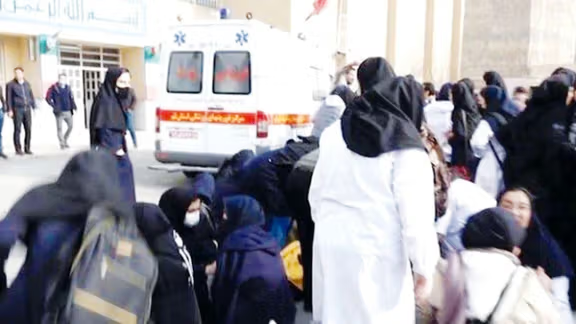
A scene outside a girls' school in Iran on March 3, 2023

Chemical attacks on girl's schools in Iran continued on Saturday with reports saying students in at least 16 elementary and high schools were poisoned.

A large number of students have been taken to hospital and based on published reports, the type of toxic substances used in the attacks has been identified.

The wave of intentional poisoning of female students, which started in November in the religious city of Qom, spread further throughout the country and reached schools in small towns and villages on Saturday.

Reports say female students of elementary and high schools in Tehran, Qom, Pakdasht, Karaj, Urmia, Zanjan, Hamedan, Safadasht, Shahriyar, and Rasht were taken to hospitals after being poisoned.

Tasnim News Agency, affiliated to the Revolutionary Guards, reported that at least 30 students at a school in Urmia in the northwest were transferred to medical centers in the city.

Attacks on schools in the past days were not only limited to female students, and reports also said that a group of male students were poisoned on Saturday following a chemical attack on a primary school in Karaj in the vicinity of Tehran.

Three months into the serial poisoning of students, not only the perpetrators of the chemical attacks have not been identified, but the attacks have spread to more cities.

Morteza Khatami, Vice-Chairman of the Parliament's Health and Treatment Commission, claimed on Saturday that students are poisoned by a combination of several types of gases.

It was previously announced that N2 gas was the cause of poisonings, but Khatami stated “N2 gas does not explain the symptoms and clinical manifestations, but other gases have symptoms that justify the numbness of the body.”

Nausea, vomiting, cough, shortness of breath, etc. are the symptoms Khatami mentioned adding that "according to clinical evidence, the students who were poisoned had unstable and short-term poisonings, but their tests were normal."

In the past days, many parents and some political and religious figures, including Sunni Imam of Zahedan,Mowlavi Abdolhamid have called the “deliberate” poisoning of female students to be a government project to take revenge on them for participating in the nationwide uprising after the death in custody of Mahsa Amini in September.

Security forces attacking parents outside schools in Tehran

Some others believe the aim of such attacks was to make girls and women stay at home, depriving them from education and any other social activity.

However, the Islamic Republic authorities and the state media are trying to blame their opponents for the biological terror of schoolgirls.

Kayhan hardline newspaper, in its report on Saturday, called the serial poisonings "a new phase of the hybrid war by the West and its Iranian allies against the Islamic Republic.”

Meanwhile, a group of protesting citizens and parents of poisoned students gathered in front of the education department in various cities including Tehran, Esfahan, Kermanshah and Ardebil on Saturday. Condemning the poisoning of female students, they chanted slogans against Iran’s ruler Ali Khamenei and senior government officials.

Reports say following the protests, dozens of people were arrested in different cities, and many were beaten by security forces and regime plainclothes mercenaries.

The families of some students in Tehran gathered outside the education ministry’s headquarters in protest and chanted the slogan like "Death to the Taliban, whether in Iran or Afghanistan".

The country's interior minister, Ahmad Vahidi, an ex-IRGC top officer wanted by Interpol for his part in the bombing of a Jewish community center in Buenos Aires in 1994, has been tasked with leading the investigation, though has so far denied any foul play.

Most Viewed

Iran International says it won’t be silenced after London arson attack
1

Iran International says it won’t be silenced after London arson attack

2
VOICES FROM IRAN

Hope and anger in Iran as fragile ceasefire persists

3

Iran halts petrochemical exports to supply domestic market

4
INSIGHT

How Tehran bends its own red lines to boost state rallies

5

US arrests Iranian national over alleged Basij-linked visa fraud

Banner
Banner

Spotlight

  • Too early to tell who is winning Iran war, experts say
    PODCAST

    Too early to tell who is winning Iran war, experts say

  • How Tehran bends its own red lines to boost state rallies
    INSIGHT

    How Tehran bends its own red lines to boost state rallies

  • Iran blackout cripples freelancer, small business incomes
    VOICES FROM IRAN

    Iran blackout cripples freelancer, small business incomes

  • Ideology may be fading in Iran, but not in Kashmir's ‘Mini Iran'
    INSIGHT

    Ideology may be fading in Iran, but not in Kashmir's ‘Mini Iran'

  • US blockade enters murky phase as tankers spoof signals and buyers hesitate
    ANALYSIS

    US blockade enters murky phase as tankers spoof signals and buyers hesitate

  • Why the $100 billion Hormuz toll revenue is a myth
    ANALYSIS

    Why the $100 billion Hormuz toll revenue is a myth

•
•
•

More Stories

Opposition Figure Mousavi In Iran Hospitalized For Influenza

Mar 4, 2023, 13:40 GMT+0

Iranian opposition figure Mir-Hossein Mousavi (81) who has been under house arrest for 13 years has been hospitalized for a severe case of influenza.

Mousavi became ill recently and according to people close to him did not receive timely medical care in his house, where he is imprisoned along with his wife Zahra Rahnavard.

The official government news website IRNA claimed Friday that Mousavi became ill because of not following health guidelines and meeting with many people.

However, since he published a statement in early February demanding a referendum to change the political system, his house arrest had become more strict and he could have only met his daughters and the guards.

Mousavi was put under house arrest in 2011 when he was running as a reformist candidate and challenged the highly suspicious presidential re-election of Mahmoud Ahmadinejad in 2009.

Kalameh, a website based abroad, which carries news about Reformists in Iran including Mr. Mousavi, reported that he suffers from high fever and general weakness and has been transferred to hospital.

Mousavi’s call for a referendum was seen as a significant development since it was the first major break of a Reformist leader from the policy of defending the Islamic Republic and only asking for reforms.

Mousavi’s move enraged hardliners loyal to Iran’s ruler Ali Khamenei, some of whom have wished for his death after hearing the news about his illness.

Morteza Panahian, a well-known hardliner wished “success for the virus” and said that Mousavi’s death is 12 years overdue.

His supporters say that the delay in proper medical attention was intentional on the part of the government.

Iranian-Born Doctors Urge Red Cross To Act On School Poisonings

Mar 4, 2023, 12:16 GMT+0

Iranian-born physicians in the West have appealed to International Federation of Red Cross and Red Crescent to intervene in widespread school poisonings in Iran and prevent mass casualty.

In their letter, published on Friday, the physicians living in North America and Europe wrote that young Iranian girls need the help of international assistance in the face of serial chemical attacks on their schools.

“As physicians, we view this crisis in Iran as a potential mass casualty scenario requiring urgent intervention by international disaster management organizations. We further consider these poisonings as premeditated attacks on Iran’s youth using substances that are applied in chemical warfare,” reads the letter signed by the 18 physicians.

Hundreds of female students in dozens of schools in many cities across Iran have been poisoned in the last three months by intentional gas attacks, which were not taken seriously by the government.

In all the cases, the students and their families attributed the poisoning to the inhalation of a poisonous gases.

Last week, a member of Iranian parliament said about 1,200 female students have been the target of attacks in three months.

After the MP’s remarks, several other cases of similar attacks reported on Monday, Tuesday, Wednesday and Saturday in several cities simultaneously. On Wednesday, according to some reports, 50 schools were attacked.

Videos published on social media show that dozens of students from schools were taken to hospitals in serious condition; some of them almost unconscious.

In one case the security forces attacked a concerned mother, severely beating her and pulling her hair.

Two-Year-Old Killed In Iran As Police Open Fire At Family Car

Mar 4, 2023, 10:50 GMT+0

A two-year-old child was killed on Friday after Iranian special forces opened fire at the car carrying him and his family in the central city of Esfahan.

The "1500 Images" Twitter account reported that “Last night [Friday], a mother and father with two young children were traveling in a car when a truck belonging to the special unit swiveled in front of them. The driver of the car (a family friend) thought the truck driver was sleepy, so he decided to go around the truck. But the special forces opened fire at them and killed the child by shooting him in the head.”

"Bazaar Civil Protest" Telegram channel identified the child as Amirali Musa-Kazemi, adding that he was killed as his family and several friends were on a recreational trip to Esfahan.

According to the report, the special unit's vehicle was a "truck unlike police cars" and the forces in it fired at the car without warning them to pull over.

It remains unclear why the special police unit opened fire at a car carrying ordinary citizens and children.

It is stated in the report that Amir-Ali's body was not handed over to his family under the pretext of handing it over to them in Tehran. The cause of death was registered as "unintentional murder".

Police officials are yet to react to the report.

This is not the first time children are killed by regime forces’ direct fire in private cars.

In the most controversial case, Kian Pirfalak, a 9-year-old child from Izeh in the south, was killed by the direct fire of government forces during nationwide protests on November 16.

Belgium’s Top Court Issues Decree To Swap Iranian Diplomat

Mar 4, 2023, 06:58 GMT+0
•
Iran International Newsroom

Belgium's Constitutional Court has rejected a request to annul a prisoner exchange treaty with the Islamic Republic that can lead to the release of an Iranian diplomat. 

The constitutional court said in a press release Friday that "The Court rejects the action for annulment," a decree that could lead to Iranian diplomat Assadollah Assadi, convicted of terrorism, being swapped for Belgian aid worker Olivier Vandecasteele, held hostage in Iran. 

“The Court rejects the appeal against the law assenting to the Belgian-Iranian treaty, but the victims of a convicted person must be informed of his transfer so as to be able to submit this for the review of the legality by a judge,” read the statement. 

The court added that “This balancing act must be made in a concrete case and on a case-by-case basis, and must be open for judicial review. It is up to the competent judge (in principle the Court of first instance), with respect for the separation of powers, to review the legality of the decision of the Government authorizing the transfer of a person detained in Belgium towards a foreign State of which it is a national.”

Iranian former diplomat Assadollah Assadi (file photo)
100%
Iranian former diplomat Assadollah Assadi

The temporary ban on the extradition of the convicted diplomat was announced by the Brussels Court of Appeal late in July following numerous complaints after the Belgian Parliament ratified a controversial prisoner swap treaty with Iran on July 20. The Iranian exiled opposition group Mujahedin-e Khalq Organization (MEK) mounted a fierce campaign against the deal, challenging the possible extradition. "The court has now declared the plaintiffs' question unfounded," said lawyer Khloë Georgiev, who represents Vandecasteele. In June, Belgian MPs ratified a deal to allow the exchange. At the time, Prime Minister Alexander De Croo argued that it was the only way to get Vandeesteele back home safely.

The Islamic Republic’s judiciary sentenced Vandecasteele, who was detained in 2022, to 40 years in prison and 74 lashes for alleged “spying and cooperation with the United States, money laundering and smuggling $500,000 out of Iran.” Vandecasteele, 41, has served in various international humanitarian organizations since at least 2006, including, Médecins du Monde, Norwegian Refugee Council (NRC), and Relief International. He worked in Iran for humanitarian organizations for more than six years and left the country. Later, he was lured back by “a girlfriend” and was detained in February 2022. A spokesman for Vandecasteele’s family said in December that he should serve up to 28 years in prison. 

In a statement released late in February, Amnesty International said Iranian authorities are subjecting Vandecasteele to enforced disappearance, torture and other ill-treatment, urging all states whose nationals are or have been detained at any point in Iran to promptly examine whether the deprivation of liberty amounts to an act of hostage-taking, and if so, take all appropriate measures to ensure accountability. Currently, at least 16 foreign citizens, most of whom dual nationals, are detained in the prisons of the Islamic Republic.

Assadi, 50, a former attaché at the Iranian embassy in Austria, was convicted of plotting to bomb a gathering of the MEK near Paris on June 30, 2018. The only Iranian diplomat ever brought to trial in Europe for direct involvement in terrorism was arrested in Germany, where he did not enjoy diplomatic immunity, while he was on holiday. German authorities later extradited Assadi to Belgium.

Some Belgian lawmakers voiced concern that the prisoner exchange treaty might lead to "hostage diplomacy" and put other Belgians at risk of detention.

The Islamic Republic’s Foreign Minister Hossein Amir-Abdollahian (left) and Belgian Foreign Minister Hadja Lahbib met on the sidelines of the 52nd session of the UN Human Rights Council at its headquarters in Geneva on February 27, 2023.
100%
The Islamic Republic’s Foreign Minister Hossein Amir-Abdollahian (left) and Belgian Foreign Minister Hadja Lahbib met on the sidelines of the 52nd session of the UN Human Rights Council at its headquarters in Geneva on February 27, 2023.

On Monday, February 27, Belgian Foreign Minister Hadja Lahbib held a meeting with the Islamic Republic’s Foreign Minister Hossein Amir-Abdollahian hours before tens of participants at the UN Human Rights Council walked out when Akir-Abdollahian spoke at the 52nd session of the body at UHRC’s headquarters in Geneva.

The meeting between the Belgian and Iranian ministers drew heavy criticism by many activists and officials, including Belgian lawmaker Darya Safai, who pointed out that “The Belgian government goes along with hostage diplomacy.” Lahbib herself tweeted about the release of Vandecasteele, who was probably the main reason for the meeting.


Islamic Republic Blames ‘Enemies’ For Chemical Attacks On Schoolgirls

Mar 3, 2023, 23:36 GMT+0
•
Iran International Newsroom

Faced with international outcry for inaction over the chemical gas attacks on school and university girls, the Islamic Republic authorities have started to blame them on “enemies.”

Iranian President Ebrahim Raisi on Friday described the wave of poisonings of hundreds of schoolgirls around the country as part of a psychological war by the enemies meant “to instill stress and anxiety among students and parents, creating chaos.” He did not say who those enemies are but in the Islamic Republic jargon, the ‘enemies’ usually mean as the United States and Israel, and recently every entity and individual who has expressed support for the current wave of antiregime protests.

“One day, the enemies instigate street riots and another day they try to create problems in the field of education and schools because despite all the plots, people across the country came to the scene and defeated the enemy,” he said, and then referred to state-sponsored demonstrations in February to mark the 44th anniversary of the regime as a victory. 

Iran's Foreign Minister Hossein Amir-Abdollahian (file photo)
100%
Iran's Foreign Minister Hossein Amir-Abdollahian

Foreign Minister Hossein Amir-Abdollahian on Friday also hit out at Western governments. “The interventionist reaction of some Western authorities to the question of the suspected poisoning of dear Iranian female students is the continuation of the enemy's hybrid war,” he wrote in a Twitter post.

He claimed that “the relevant institutions of the country are following up seriously and meticulously examining its dimensions. The great nation of Iran knows crocodile tears very well!” He made the remarks as the authorities have not yet allowed media or parents to view the content of surveillance cameras around the schools, which were attacked. 

The so-far unexplained poisonous gas attacks at about 60 schools and girl dormitories in one-third of the country’s provinces began November 30 when the first case of poisoning among schoolgirls was reported in the religious city of Qom. Around 1,000 students have become ill with the mysteriously dispersed, unidentified fumes so far. The country's interior minister, Ahmad Vahidi, an ex-IRGC top officer wanted by Interpol for his part in the bombing of a Jewish community center in Buenos Aires in 1994, has been tasked with leading the investigation, though he has so far denied fowl play.

Many suspect the schools have been targeted by religious groups opposed to girls' education. The authorities have also denied reports that the death of 11-year-old Fatemeh Rezaei was linked to the poisonings. 

Iran's Foreign Ministry spokesman Nasser Kanaani urged other countries not to comment on the issues in Iran and described the calls for investigations by right groups and officials as “interventions and dramatic” statements.

Meanwhile, even religious leaders – both Shiites who are among the inner circles of the regime and Sunnis such as Mowlavi Abdolhamid -- have spoken out against government’s inadequate reaction to the poisonings.

Tasnim news agency, affiliated with the Revolutionary Guards, cited Reza Karimi Saleh, the deputy governor of Pardis suburb where one of the attacks happened as saying that a fuel tanker driver was arrested because he was next to a school and had also been spotted in two other cities. "Guards at a parking lot where the fuel tanker was parked also suffered from poisoning."

Many have started questioning the efficiency of the intelligence agencies, which are very fast in identifying protesters and arresting them, while others say those responsible for the gas attacks are not identified because the regime already knows they are insiders.

Ravina Shamdasani, spokesperson for the UN High Commissioner for Human Rights  (file photo)
100%
Ravina Shamdasani, spokesperson for the UN High Commissioner for Human Rights

In Geneva, the United Nations human rights office on Friday called for a transparent investigation into the attacks. Ravina Shamdasani, spokesperson for the UN High Commissioner for Human Rights said on Friday that "We're very concerned about these allegations that girls are being deliberately targeted under what appear to be mysterious circumstances.” She said that the findings of a government investigation should be made public, and the perpetrators brought to justice.