• العربية
  • فارسی
Brand
  • Iran Insight
  • Politics
  • Economy
  • Analysis
  • Special Report
  • Opinion
  • Podcast
  • Iran Insight
  • Politics
  • Economy
  • Analysis
  • Special Report
  • Opinion
  • Podcast
  • Theme
  • Language
    • العربية
    • فارسی
  • Iran Insight
  • Politics
  • Economy
  • Analysis
  • Special Report
  • Opinion
  • Podcast
All rights reserved for Volant Media UK Limited
volant media logo

Diaspora Urge International Community To Investigate Iran Poisonings

Mar 5, 2023, 10:18 GMT+0
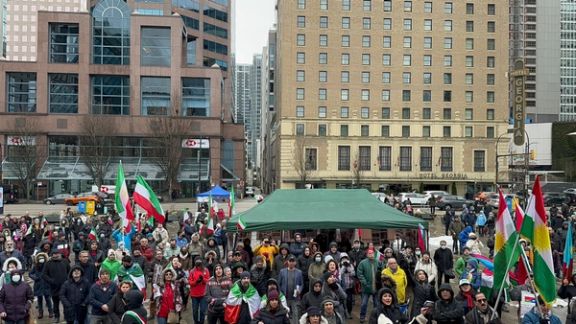
A protest rally by Iranian diaspora

Thousands of Iranians in major cities around the world have staged demonstrations against the Islamic regime and called for global attention to the country's brutal crackdown on protesters, including scores of chemical attacks on girls' schools.

In Vancouver, Canada, hundreds came out to demonstrate and call for global attention to chemical attacks on girls' schools around the country. A group of representatives of conservative parties and the New Democratic Party of Canada were also present at the demonstration.

In Toronto and Montreal similar protests were held seeing hundreds protest on a cold and snowy day in solidarity to condemn the poisoning of schoolgirls which began in the religious city of Qom in November.

In the US, Iranians living in San Diego, California, showed their solidarity with fellow countrymen by holding demonstrations and demanding an end to torture and oppression in Iran. Demonstrators also displayed a photo of Pirouz, the lost Iranian cheetah which died of kidney failure last week, three of the country's last of the endangered species.

Iranians living in Sydney, Munich, Hamburg, and Copenhagen held similar rallies.

Three months into the serial poisoning of students which have affected scores of girls' schools, it is believed over 1,000 students have been targeted with unknown numbers hospitalized around the country. No culprits have yet been found nor any answers as to the chemical agents being used.

Most Viewed

Hardliners push Hormuz ‘red line’ as US blockade tests Iran’s leverage
1
INSIGHT

Hardliners push Hormuz ‘red line’ as US blockade tests Iran’s leverage

2

Iran International says it won’t be silenced after London arson attack

3
VOICES FROM IRAN

Hope and anger in Iran as fragile ceasefire persists

4

US sanctions oil network tied to Iranian tycoon Shamkhani

5

Iran halts petrochemical exports to supply domestic market

Banner
Banner

Spotlight

  • Hardliners push Hormuz ‘red line’ as US blockade tests Iran’s leverage
    INSIGHT

    Hardliners push Hormuz ‘red line’ as US blockade tests Iran’s leverage

  • Ideology may be fading in Iran, but not in Kashmir's ‘Mini Iran'
    INSIGHT

    Ideology may be fading in Iran, but not in Kashmir's ‘Mini Iran'

  • War damage amounts to $3,000 per Iranian, with blockade set to add to losses
    INSIGHT

    War damage amounts to $3,000 per Iranian, with blockade set to add to losses

  • Why the $100 billion Hormuz toll revenue is a myth
    ANALYSIS

    Why the $100 billion Hormuz toll revenue is a myth

  • US blockade targets Iran oil boom amid regional disruption
    ANALYSIS

    US blockade targets Iran oil boom amid regional disruption

  • Iran's digital economy battered by prolonged blackout
    INSIGHT

    Iran's digital economy battered by prolonged blackout

•
•
•

More Stories

Former Supporter Says Khamenei Behind Poison Attacks

Mar 5, 2023, 08:59 GMT+0

An Islamic revolutionary turned regime critic, has accused Ali Khamenei of the poison attacks on girls' schools which have left hundreds of students sick and numerous hospitalized.

Abolfazl Qadiani (Ghadyani) said the scores of incidents around the country since November, are a "revenge" against the Women, Life, Freedom movement, at the forefront of which have been schoolgirls and students.

In a statement, Qadiani said of Khamenei: "In his false belief, by suppressing the street gatherings, he found an opportunity to take revenge to appease his evil spirit. So, he has targeted the physical and mental health and safety of the brave pioneers of the movement.”

Qadiani belonged to a leftist, revolutionary group that was supporting Khamenei until the disputed presidential election of 2009, when the Supreme Leader backed the questionable reelection of Mahmoud Ahmadinejad. Qadiani, with many others, protested the results, was jailed and became an opposition figure.

“Khamenei is the same criminal who took revenge on the Americans by throwing some firecrackers in Ain al-Asad, but on that ominous day, with two rockets, he deliberately killed the innocent passengers of the Ukrainian plane in order to use their noble lives and bodies as a human shield for himself,” he said this week.

Qadiani was referring to the downing of a Ukrainian International Airlines flight taking off from Tehran in January 2020, hours after Iran had fired missiles at US bases in Iraq. The IRGC brought the passenger plane down by two missiles and all 176 onboard died.

Interior Minister Ahmad Vahidi, an ex IRGC commander wanted by Interpol for his part in the bombing of a Jewish community center in Buenos Aires in 1994, has been assigned to lead the investigation. No arrests have so far been made.

Iran Offers Denials, Accusations, Excuses About Gas Attacks

Mar 5, 2023, 03:35 GMT+0
•
Iran International Newsroom

More than three months after gas attacks began on girls' schools in Iran, the Ministry of Education has not shown any serious reaction to the shocking events.

According to Khabar Online news website in Tehran, at least 1,200 girls have been poisoned by the attacks just in Qom and Boroujerd. Other chemical attacks have also occurred in Tehran, Karaj, Kermanshah and Ardabil.

Khabar Online wrote on Saturday that the education ministry's silence is questionable as it has been quick to react to students singing a funny folk song at a school in Ghaem Shahr (Shahi) in February. The reaction in that case started from firing the teacher and forcing her to apologize on Instagram for "failing to take care of pupils."

The report said that explanations offered so far by officials are generally excuses made usually in the form of news fabrication. The only official reaction by Education Minister Yousef Nouri was dismissing the news of the attacks as "rumors".

Most other Iranian politicians either flatly denied the reports or like President Ebrahim Raisi blamed "the enemies" for the attacks. Many others who usually pass off-hand judgement on almost every development blaming intelligence agencies of the United States or Israel have followed Raisi.

Media linked to the government, including the Tehran Municipality's Hamshahri, implicated opposition leaders such as Prince Reza Pahlavi, women's right activist Masih Alinejad and National Council of Resistance leader Maryam Rajavi and published their pictures as "culprits." Obviously, a few hardliner loyalists believe such accusations in Iran.

But blaming “enemies” also begs the question of where more than a dozen intelligence agencies are when foreign agents can roam around throwing chemical gases into schools.

Meanwhile, the minister implicitly asked the media to push the news of the chemical attacks under the carpet so that the ministry could make up for the educational backlog resulting from the pandemic.

Some hardliners such as the Islamic Coalition Party member Ahmad Karimi-Esfahani flately denied the reports and videos about the gas attacks. He said that those reports were fabricated by "the enemies." The politician further claimed that "it has not been proven yet that anyone has been poisoned" and that "the attacks exist only on social media." This comes while the government has been sending tens of ambulance buses to the schools that were attack and videos of students at hospital are going viral on social media and foreign-based Persian media.

Earlier, vigilante leader Hossein Allahkaram told reporters in Tehran that the news of the attacks were "part of a plot to destabilize and disintegrate Iran and keep the Women, Life Freedom movement going."

Karimi-Esfahani also claimed that disseminating the news of the poisonings were part of "a plot hatched by the enemies." He also claimed that a deputy education minister's statement about "the attacks being launched by a group who opposes the idea of girls going to school was later denied."

Some former Iranian officials such as former Culture Minister Ataollah Mohajerani claimed on social media that the advocates of Women, Life Freedom Movement have deliberately poisoned the students. More shameless accusations are levelled by officials who claimed "the students have poisoned themselves!"

Reformist media in Iran, however, characterized the attacks as "organized crime" and urged the officials to offer convincing explanations rather than levelling fictitious accusations.

Iran Says Large Lithium Deposit Discovered In West

Mar 4, 2023, 19:39 GMT+0

An Iranian official says huge deposits of lithium have been discovered for the first time in the country’s western province of Hamadan.

"For the first time in Iran, a lithium reserve has been discovered in Qahavand in Hamedan province", Iran's state television quoted Mohammad Hadi Ahmadi, an industry ministry official.

The reserve is believed to hold 8.5 million tons of lithium, according to the director-general of the ministry's operating department Ebrahim Ali Molabeigi.

“The discovery of this mine took four years and the investor is ready to invest in it and this mine will be launched in the next two years.”

Iran is one of the few countries that has access to adequate amounts of reserves of rare elements and precious metals, and the discovery of the first lithium reserve in Hamedan promises the discovery of other reserves in this province, the ministry official told IRNA.

According to a United States Geological Survey (USGS) report published in 2022, a total of 89 million tons of lithium have been identified worldwide. Australia, Chile, Argentina and China are the main producers.

Lithium is an essential element for the manufacturing of batteries of electric vehicles. Given the scale of the threat posed by Climate Change, it crucially allows the functioning of the cars without the emission of Carbon dioxide. It is also dubbed as the "oil of the 21st century".

This white metal is also an essential component of rechargeable batteries used in cell phones and other electronic devices.

Iraqi Premier Says Baghdad Not A Messenger For Tehran And Washington

Mar 4, 2023, 15:58 GMT+0

The Iraqi prime minister says Baghdad is not the messenger between Tehran and Washington, but it has its own initiatives in this regard.

In an interview with the Saudi Al-Arabiya network on Friday, Iraqi Prime Minister Mohammad Shia Al-Sudani emphasized that Iraq does not accept any aggression on its borders.

He said that Baghdad officially condemned the actions of Iran and Turkey against its territory and borders, and the security forces of the federal government of Iraq, in cooperation with the Kurdish authorities in the north, control the borders with Iran and Turkey.

The Iraqi prime minister said opposition to other countries from within Iraq should be “peaceful and unarmed.”

“We will not allow any side to bring Iraq into war and conflicts that are against our national interests,” he added.

Al-Sudani further stressed that Iraq is not a messenger between Iran and the United States, but it has an initiative to bring the two sides closer.

Earlier, Iraqi Foreign Minister Fuad Hussein said in an interview with Al-Sharq that the tensions between Iran and the United States affect Iraq either directly or indirectly because Baghdad has good relations with both sides.

He said Baghdad is not the backyard of any country and Iraq's position in this regard is clear.

The Iraqi foreign minister further underlined that the lack of tensions between regional countries benefits Iraq and if Tehran and Washington cannot resolve their differences, Baghdad can manage the crisis between the two.

Chemical Attacks Continue On Students In Iran As Regime Blames The West

Mar 4, 2023, 15:10 GMT+0
•
Iran International Newsroom

Chemical attacks on girl's schools in Iran continued on Saturday with reports saying students in at least 16 elementary and high schools were poisoned.

A large number of students have been taken to hospital and based on published reports, the type of toxic substances used in the attacks has been identified.

The wave of intentional poisoning of female students, which started in November in the religious city of Qom, spread further throughout the country and reached schools in small towns and villages on Saturday.

Reports say female students of elementary and high schools in Tehran, Qom, Pakdasht, Karaj, Urmia, Zanjan, Hamedan, Safadasht, Shahriyar, and Rasht were taken to hospitals after being poisoned.

Tasnim News Agency, affiliated to the Revolutionary Guards, reported that at least 30 students at a school in Urmia in the northwest were transferred to medical centers in the city.

Attacks on schools in the past days were not only limited to female students, and reports also said that a group of male students were poisoned on Saturday following a chemical attack on a primary school in Karaj in the vicinity of Tehran.

Three months into the serial poisoning of students, not only the perpetrators of the chemical attacks have not been identified, but the attacks have spread to more cities.

Morteza Khatami, Vice-Chairman of the Parliament's Health and Treatment Commission, claimed on Saturday that students are poisoned by a combination of several types of gases.

It was previously announced that N2 gas was the cause of poisonings, but Khatami stated “N2 gas does not explain the symptoms and clinical manifestations, but other gases have symptoms that justify the numbness of the body.”

Nausea, vomiting, cough, shortness of breath, etc. are the symptoms Khatami mentioned adding that "according to clinical evidence, the students who were poisoned had unstable and short-term poisonings, but their tests were normal."

In the past days, many parents and some political and religious figures, including Sunni Imam of Zahedan,Mowlavi Abdolhamid have called the “deliberate” poisoning of female students to be a government project to take revenge on them for participating in the nationwide uprising after the death in custody of Mahsa Amini in September.

Security forces attacking parents outside schools in Tehran

Some others believe the aim of such attacks was to make girls and women stay at home, depriving them from education and any other social activity.

However, the Islamic Republic authorities and the state media are trying to blame their opponents for the biological terror of schoolgirls.

Kayhan hardline newspaper, in its report on Saturday, called the serial poisonings "a new phase of the hybrid war by the West and its Iranian allies against the Islamic Republic.”

Meanwhile, a group of protesting citizens and parents of poisoned students gathered in front of the education department in various cities including Tehran, Esfahan, Kermanshah and Ardebil on Saturday. Condemning the poisoning of female students, they chanted slogans against Iran’s ruler Ali Khamenei and senior government officials.

Reports say following the protests, dozens of people were arrested in different cities, and many were beaten by security forces and regime plainclothes mercenaries.

The families of some students in Tehran gathered outside the education ministry’s headquarters in protest and chanted the slogan like "Death to the Taliban, whether in Iran or Afghanistan".

The country's interior minister, Ahmad Vahidi, an ex-IRGC top officer wanted by Interpol for his part in the bombing of a Jewish community center in Buenos Aires in 1994, has been tasked with leading the investigation, though has so far denied any foul play.