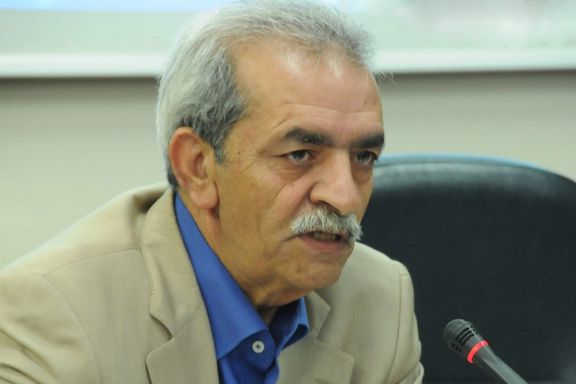
The current chairman of the Iran Chamber of Commerce, Gholam-Hossein Shafei
Over 40 percent of candidates running for chambers of commerce in Iran who are somewhat independent of the government were disqualified by a supervisory body.
Disqualifications have been so widespread that the actual elections of chambers of commerce, industries, mines and agriculture often referred to as “private sector’s parliament”, had to be postponed from February 29 to March 10 to allow investigation of candidates’ complaints.
Mehdi Karbasian, a former deputy minister of industries, mines and trade, who represents several high-profile companies, and Masoud Khansari, the incumbent chairman of Tehran Chamber of Commerce, the most influential chamber in the country, are among the candidates who have been disqualified.
In a commentaryentitled “Butchering Chamber of Commerce Election [Candidates] Following Increase of Businessmen’s Criticism of Raisi Government”, Aftab News website on Saturday said disqualified candidates believe due to profuse criticisms of the government policies by businessmen and chambers, the ministry of industries, mines and trade has decided to take control and only allow its own supporters to take the key positions.
Iran’s economic crisis has deepened in recent months as the national currency has lost more than half of its value and hyper-inflation is feared in the next few months. Prominent businessmen holding positions in chambers of commerce have urged the government to change its foreign policy and end US economic sanctions.
Head of Tehran Chamber of Commerce, Industries, Mines and Agriculture Masoud Khansari
The vetting was based on a recent regulation that required candidates to have at least two consecutive years of membership in chambers of commerce, to have paid insurance for a minimum of twenty employees during the past year, to have had a minimum annual turnover of 150 billion rials, and to have also been awarded for exports by the Trade Development Organization.
The boards in every city where the chamber of commerce elections were to be held consist of representatives of the Chamber of Commerce of Iran and the ministry of industries, mines and trade.
One of the barred candidates who did not want to be named, told Aftab News that that disqualifications were more a result of the candidates’ political leanings than the new regulations. “The ministry of industries, mines and trade and the government are trying hard to shift the control of the chambers, particularly the chambers of Iran and Tehran, to a certain political faction,” he said.
Aftab News which is believed to be close to former President Hassan Rouhani and the Moderation and Development Party, said most of the disqualified candidates have reformist affiliations.
The reformist Etemad newspaper wrote last week that those who are currently key members of the chambers were very unlikely to be allowed to run again. The newspaper predicted that the elections of the “private sector parliament” would be engineered to shift the control to government supporters.
The current chairman of the Iran Chamber of Commerce, Gholam-Hossein Shafei and some other high profile former members did not nominate themselves to run.
Chambers of commerce often produce economic reports that the government finds embarrassing while some prominent members such as Shafei have been vocal critics of the government’s lack of communication with representatives of the private sector over its economic policies.
Referring to the current foreign exchange rate crisis Saturday, a member of Tehran Chamber of Commerce, Ahmadreza Farshchian, described the past four years as the most difficult years for the private sector since the end of the Iran-Iraq War (1980-1988).
Workers on strike at Esfahan Steel Company on early hours of February 26, 2023
Iran witnessed another wave of daily protests and strikes Sunday, as its currency sank leaving ordinary people to wonder how they can afford minimum necessities.
Groups of pensioners and workers from the bakery union, steel companies and sugar factories among others continued their strikes, that started during the week as bad news about rising prices daily jolted ordinary people.
Bakers held a gathering in Tehran, while workers of Haft-Tappeh Sugarcane complex in the southwestern Khuzestan province, the Esfahan Steel Company in central Iran, and workers in several southern cities, where most of oil and gas companies are located, were on strike.
The steel company’s strike, which started Saturday, went through the night while security forces used water cannons to disperse the protesting workers, but they gathered again and stopped the work of more sectors, as well as the night shift in the sprawling complex, a protester told Iran Interntional. According to him, parts of the Esfahan Steel Company are closed, and the governor of the city has visited the steel mill. He added that no cameras are allowed in the company and the place is swarming with security forces. The company, called Zob Ahan in Persian, is directly controlled by the country’s Ministry of Industries and Mines, and is Iran's third largest steel producer and is the largest factory producing steel for construction.
A section of Esfahan Steel Company
Some of the retirees of the company also gathered in front of the company’s pensioners fund building on Sunday to protest against their conditions. In videos released to social media of the rally in provincial capital Ahvaz, people are heard chanting slogans such as “Leave Syria, solve our problems!”
In some other cities of the oil-rich province such as Shush, Shushtar, and Dezful as well as the central city of Kerman, pensioners held rallies and chanted slogans.
Even the veterans of the Iraq-Iran war held a gathering on Sunday and asked for their overdue pensions.
On an accelerating freefall in recent days, the rial lost value on Sunday to touch over 600,000 against the US dollar but bounced back a little to retreat again. The rial’s plunge to 575,000 Saturday exacerbated chaos in several of Iran's major markets and brought many businesses to near standstill.
The government’s official rate of over 420,000 for the dollar on Saturday meant very little. Availability of foreign currency at that rate is very limited, which drives buyers to the black market, leading to speculations that the Central Bank of Iran injected a vast amount on Sunday to slow the devaluation.
However, the government is also incapable of major changes in the market as is itself strapped for cash, sending Foreign Minister Hossein Amir-Abdollahian to neighboring countries to find ways for funneling foreign currency through them.
An informed Iraqi source told Iran International on Thursday that the recent trip by Amir-Abdollahian to Baghdad was focused on ways to retain the flow of foreign currency from the neighboring country. Washington has imposed new restrictions on dollar transfers to Iraq as the Arab country’s banking officials believe there is widespread money laundering sending funds to Iran and Syria.
According to Iran International sources, the IRGC’s Quds (Qods) force is laundering money for the regime with cooperation from the Islamic Republic’s embassy and several cover companies to take revenues from oil and gas exports back to Iran. The laundering network is managed under the supervision of Hamed Abdollahi, the commander of the Quds Force Unit 400 of the IRGC, which directs terrorist operations abroad. Some of the members of his family and a former IRGC official Mahmoud Hassani-Zadeh work in the operations.
Earlier in the month, Iran International obtained information that the Islamic Republic is suffering from heavy financial losses because such a large amount of its money is blocked in Iraq by US banking sanctions.
The rial fell from 35,000 to more than 600,000 against the US dollar in exactly five years. This led to very high inflation, officially at more than 50 percent, which has impoverished tens of millions of Iranians. An Iranian economist says the role of US sanctions in causing economic chaos in Iran has been significant.
Amirali Hajizadeh, the head of the Revolutionary Guards aerospace force
Washington has warned Tehran saying it would respond to any attacks after a top IRGC commander claimed the Islamic Republic intends to kill former US officials.
In an emailed statement to Al Arabiya English, the US State Department warned the clerical regime that “any attempt to harm US citizens, including those who served in the past, would be met with a strong response.”
Amirali Hajizadeh, the head of the Revolutionary Guards aerospace force, on Saturday spoke of Iran's often repeated threat to avenge the US killing of Qassem Soleimani, Tehran’s top military and intelligence operator in the Middle East, saying "We are looking to kill (former US President Donald) Trump."
"God willing, we are looking to kill Trump. (Former Secretary of State Mike) Pompeo ... and military commanders who issued the order (to kill Soleimani) should be killed," Hajizadeh said in the televised interview.
A US State Department spokesperson also reiterated Washington’s commitment to work with its allies and partners to deter and respond to any attacks carried out by Iran.
“Iran would test our resolve to protect our citizens at great peril. As the Administration has consistently made clear, the United States will protect and defend its citizens. This includes those serving the United States now and those who served in the past,” a State Department spokesperson said.
File photo of an Iranian man passing in front of a board that shows exchange rates against rial
An Iranian economist says the role of US sanctions in causing economic chaos in Iran has been significant, as the national currency continued its free fall on Sunday.
Iranian government officials, experts and the regime’s opponents have long argued that economic sanctions imposed by the Trump administration since 2018 inflicted a serious blow to Iran’s weak economy, but few have ventured to quantify the impact.
What is clear now is that Iran’s oil-dependent currency, the rial, fell from 35,000 to more than 600,000 against the US dollar in exactly five years. This led to very high inflation, officially at more than 50 percent, which has impoverished tens of millions of Iranians. But how much of the bad news was the result of sanctions and how much was the outcome of a natural trend in Iran’s state-controlled and inefficient economy.
Masoud Nili, an economist in Tehran believes that the impact of sanctions on the fall of the rial has been significant and serious. In a television program reported by Roouydad24 news website. Nili said that if the United States had not withdrawn from the JCPOA nuclear deal and imposed sanctions, the rial would be probably trading at 100,000 against the US dollar, instead of 600,000 and counting.
The economist based his estimate on trends since at least 2000 and concluded that the rial would have lost value in the past 5 years, but at a manageable pace.
Iranian economist Masoud Nili
Iran’s currency was trading at 70 to the dollar right before the 1979 revolution but in the 44 years since the establishment of the Islamic Republic it has steadily declined and now is headed toward a 10,000-fold fall in value.
But in Nili’s estimate, without the ‘Trump’s sanctions’ the Islamic Republic would have faced rial’s natural fall and not a catastrophic decline that it cannot control now.
The economist had a similar appraisal of the rate of inflation. Looking at trends in more than two decades he argued that the average annual inflation rate was around 16 percent, except in the past five years. The latest official figures put the inflation rate at more than 50 percent for January 2023, although there are no independent estimates.
Nili argued that the difference between the 16 percent average since the year 2000 and the current inflation rate is because of US sanctions.
But that difference is exactly what made the current situation an hyper-crisis instead of a weak economy limping along with the steady income from oil exports.
The Biden administration that assumed office criticizing the its predecessor’s decision to withdraw from the 2015 nuclear accord, also argued that sanctions have been ineffective and Tehran has expanded its nuclear program instead of making any concessions.
Critics on the other hand argued that sanctions take time to leave a serious impact and those imposed on Iran would have hardly worked in just two years from 2018-2020.
As the Biden administration entered talks with Tehran in April 2020 to revive the JCPOA, it did not suspend Trump’s sanctions and Iran struggled to sell oil and engage in in international trade. After depleting its foreign currency reserves, the economic situation began to quickly deteriorate, especially as optimism disappeared in the latter part of 2022 in the absence of a new nuclear deal with the US.
Two days after explosions and gunfire in Karaj near Tehran that government media described as military drills, Iran's minister of intelligence called it a "fake operation by the enemy".
Esmail Khatib said that "The enemies faked an operation in Karaj so that they could use it to gain prestige for themselves, but such fake news and propaganda will have a short life."
He did not clearly say if there was an attack and what was targeted, although there was visual evidence of explosions and anti-aircraft fire.
On Thursday night, residents in the area reported on social media that first a series of explosions were heard, and then anti-aircraft guns began firing into the air.
One of the videos shared by the citizens showed anti-aircraft tracer rounds soaring into the sky as an explosion could also be seen on the ground. There was no prior public notification of planned military exercises.
However, the official government news website IRNA citing an informed source, described the event as military drills by the IRGC near Karaj, during which targets were attacked by anti-aircraft systems.
A military installation in the central province of Esfahan was recently attacked by unknown drones and the Islamic Republic claimed Israel was behind the attack; however, the Israeli authorities did not comment on the matter.
Regarding the Esfahan attack, Khatib said “a team was arrested in Esfahan, and despite the training they received, it failed to carry out its operation.”
It is not clear who conducted the opinion survey or when, but the interesting aspect of what has appeared in the media is that it was conducted by some kind of government outlet.
The research also concluded that the government's interference in social and cultural matters such as women's dress code and lifestyle will increase people’s distrust in the government.
Meanwhile, like many other assessments about the implications of the Iranian protests during the past months, the research concluded that the death in custody of the young woman Mahsa Amini in mid-September was simply a trigger for the protests and long-standing grievances were the main reason for the unrest that still continues.
Based on the findings of the research, people's dissatisfaction and their disappointment with the government has made it necessary to bring about essential reforms to end the protest movement.
According to the findings, although a majority of Iranians want a new system of governance, this does not necessarily mean that they simply want a change of the presidential administration.
Despair and disillusionment in the Iranian society are not exclusively about the way authorities run the economy or manipulate elections, but they are also about unfair treatment of people in occupational environments that hinder their progress at work.
The study suggested that the government should follow democratic reforms after mending its broken relationship with the people by paying respect to their wisdom and courage and not attributing the protests to foreign governments or delaying to meet the people's demands as protests recede.
The Netherlands-based Gamaan institute conducted an online survey in December 2022, with tens of thousands of respondents from Iran and abroad. The study revealed very similar attitudes between those in the country and abroad. “In response to the question “Islamic Republic: Yes or No?” 81% of respondents inside the country responded “No” to the Islamic Republic, 15% responded “Yes,” and 4% were not sure. Of the Iranian respondents abroad, 99% responded “No,” opting against the Islamic Republic,” GAMAAN reported.
In a follow-up question for those who answered “No”, the survey asked about their preferred democratic and secular alternative political system. Of those, 28% inside Iran and 32% outside Iran would prefer a presidential republic, 12% inside Iran and 29% outside Iran would prefer a parliamentary republic, and 22% inside Iran and 25% outside Iran would prefer a constitutional monarchy.
According to the National Security Monitor magazine, experts among the government's supporters and critics equally believed that the protests took place against a backdrop of systematic injustice, unfair treatment of the elites and intellectuals, widespread wrongdoing at various levels of governance, and violating the freedoms of citizens and their dignity by the government.
Meanwhile, the study suggested democratic reforms that would lead to boosting people's participation in elections and facilitating online communication with the people. The study said that some Iranian officials' hardline stances about censoring the Internet, social media and works of literature and art showed that not only they do not believe in people's rights, but they judge a majority of Iranians as immature individuals who would easily be influenced by foreigners' propaganda. Such a treatment will ruin the remnants of the regime's credibility and legitimacy, the study warned.