• العربية
  • فارسی
Brand
  • Iran Insight
  • Politics
  • Economy
  • Analysis
  • Special Report
  • Opinion
  • Podcast
  • Iran Insight
  • Politics
  • Economy
  • Analysis
  • Special Report
  • Opinion
  • Podcast
  • Theme
  • Language
    • العربية
    • فارسی
  • Iran Insight
  • Politics
  • Economy
  • Analysis
  • Special Report
  • Opinion
  • Podcast
All rights reserved for Volant Media UK Limited
volant media logo

Economist In Iran Says Big Chunk Of Crisis Due To US Sanctions
Iran International Newsroom
Feb 26, 2023, 13:02 GMT+0Updated: 18:15 GMT+1
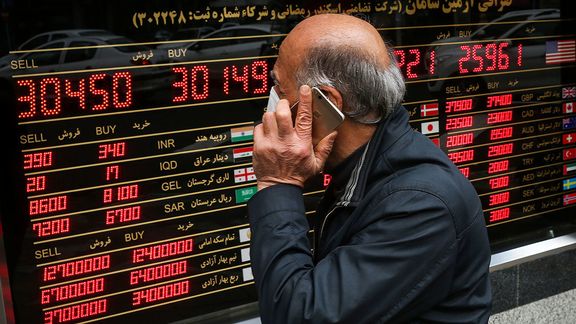
File photo of an Iranian man passing in front of a board that shows exchange rates against rial

An Iranian economist says the role of US sanctions in causing economic chaos in Iran has been significant, as the national currency continued its free fall on Sunday.

Iranian government officials, experts and the regime’s opponents have long argued that economic sanctions imposed by the Trump administration since 2018 inflicted a serious blow to Iran’s weak economy, but few have ventured to quantify the impact.

What is clear now is that Iran’s oil-dependent currency, the rial, fell from 35,000 to more than 600,000 against the US dollar in exactly five years. This led to very high inflation, officially at more than 50 percent, which has impoverished tens of millions of Iranians. But how much of the bad news was the result of sanctions and how much was the outcome of a natural trend in Iran’s state-controlled and inefficient economy.

Masoud Nili, an economist in Tehran believes that the impact of sanctions on the fall of the rial has been significant and serious. In a television program reported by Roouydad24 news website. Nili said that if the United States had not withdrawn from the JCPOA nuclear deal and imposed sanctions, the rial would be probably trading at 100,000 against the US dollar, instead of 600,000 and counting.

The economist based his estimate on trends since at least 2000 and concluded that the rial would have lost value in the past 5 years, but at a manageable pace.

Iranian economist Masoud Nili (file photo)
100%
Iranian economist Masoud Nili

Iran’s currency was trading at 70 to the dollar right before the 1979 revolution but in the 44 years since the establishment of the Islamic Republic it has steadily declined and now is headed toward a 10,000-fold fall in value.

But in Nili’s estimate, without the ‘Trump’s sanctions’ the Islamic Republic would have faced rial’s natural fall and not a catastrophic decline that it cannot control now.

The economist had a similar appraisal of the rate of inflation. Looking at trends in more than two decades he argued that the average annual inflation rate was around 16 percent, except in the past five years. The latest official figures put the inflation rate at more than 50 percent for January 2023, although there are no independent estimates.

Nili argued that the difference between the 16 percent average since the year 2000 and the current inflation rate is because of US sanctions.

But that difference is exactly what made the current situation an hyper-crisis instead of a weak economy limping along with the steady income from oil exports.

The Biden administration that assumed office criticizing the its predecessor’s decision to withdraw from the 2015 nuclear accord, also argued that sanctions have been ineffective and Tehran has expanded its nuclear program instead of making any concessions.

Critics on the other hand argued that sanctions take time to leave a serious impact and those imposed on Iran would have hardly worked in just two years from 2018-2020.

As the Biden administration entered talks with Tehran in April 2020 to revive the JCPOA, it did not suspend Trump’s sanctions and Iran struggled to sell oil and engage in in international trade. After depleting its foreign currency reserves, the economic situation began to quickly deteriorate, especially as optimism disappeared in the latter part of 2022 in the absence of a new nuclear deal with the US.


Most Viewed

Iran negotiators ordered to return after internal rift over Islamabad talks
1
EXCLUSIVE

Iran negotiators ordered to return after internal rift over Islamabad talks

2
ANALYSIS

US blockade enters murky phase as tankers spoof signals and buyers hesitate

3
ANALYSIS

Why the $100 billion Hormuz toll revenue is a myth

4

US tightens financial squeeze on Iran, warns banks over oil money flows

5
ANALYSIS

US blockade targets Iran oil boom amid regional disruption

Banner
Banner

Spotlight

  • Hardliners push Hormuz ‘red line’ as US blockade tests Iran’s leverage
    INSIGHT

    Hardliners push Hormuz ‘red line’ as US blockade tests Iran’s leverage

  • Ideology may be fading in Iran, but not in Kashmir's ‘Mini Iran'
    INSIGHT

    Ideology may be fading in Iran, but not in Kashmir's ‘Mini Iran'

  • War damage amounts to $3,000 per Iranian, with blockade set to add to losses
    INSIGHT

    War damage amounts to $3,000 per Iranian, with blockade set to add to losses

  • Why the $100 billion Hormuz toll revenue is a myth
    ANALYSIS

    Why the $100 billion Hormuz toll revenue is a myth

  • US blockade targets Iran oil boom amid regional disruption
    ANALYSIS

    US blockade targets Iran oil boom amid regional disruption

  • Iran's digital economy battered by prolonged blackout
    INSIGHT

    Iran's digital economy battered by prolonged blackout

•
•
•

More Stories

Study Shows A Majority Of Iranians Want A Change In Governance

Feb 26, 2023, 09:55 GMT+0
•
Iran International Newsroom

The findings of a research conducted by an Iranian government body indicate that "a majority of Iranians want a new system of governance in Iran."

Moderate news website Aftab News on February 24 quoted a report from the January issue of "National Security Monitor" magazine which also said: "A small percentage of Iranians believe in harsh treatment of bad-hijab women.”

It is not clear who conducted the opinion survey or when, but the interesting aspect of what has appeared in the media is that it was conducted by some kind of government outlet.

The research also concluded that the government's interference in social and cultural matters such as women's dress code and lifestyle will increase people’s distrust in the government.

Meanwhile, like many other assessments about the implications of the Iranian protests during the past months, the research concluded that the death in custody of the young woman Mahsa Amini in mid-September was simply a trigger for the protests and long-standing grievances were the main reason for the unrest that still continues.

Based on the findings of the research, people's dissatisfaction and their disappointment with the government has made it necessary to bring about essential reforms to end the protest movement.

According to the findings, although a majority of Iranians want a new system of governance, this does not necessarily mean that they simply want a change of the presidential administration.

Despair and disillusionment in the Iranian society are not exclusively about the way authorities run the economy or manipulate elections, but they are also about unfair treatment of people in occupational environments that hinder their progress at work.

The study suggested that the government should follow democratic reforms after mending its broken relationship with the people by paying respect to their wisdom and courage and not attributing the protests to foreign governments or delaying to meet the people's demands as protests recede.

The Netherlands-based Gamaan institute conducted an online survey in December 2022, with tens of thousands of respondents from Iran and abroad. The study revealed very similar attitudes between those in the country and abroad. “In response to the question “Islamic Republic: Yes or No?” 81% of respondents inside the country responded “No” to the Islamic Republic, 15% responded “Yes,” and 4% were not sure. Of the Iranian respondents abroad, 99% responded “No,” opting against the Islamic Republic,” GAMAAN reported.

In a follow-up question for those who answered “No”, the survey asked about their preferred democratic and secular alternative political system. Of those, 28% inside Iran and 32% outside Iran would prefer a presidential republic, 12% inside Iran and 29% outside Iran would prefer a parliamentary republic, and 22% inside Iran and 25% outside Iran would prefer a constitutional monarchy.

According to the National Security Monitor magazine, experts among the government's supporters and critics equally believed that the protests took place against a backdrop of systematic injustice, unfair treatment of the elites and intellectuals, widespread wrongdoing at various levels of governance, and violating the freedoms of citizens and their dignity by the government.

Meanwhile, the study suggested democratic reforms that would lead to boosting people's participation in elections and facilitating online communication with the people. The study said that some Iranian officials' hardline stances about censoring the Internet, social media and works of literature and art showed that not only they do not believe in people's rights, but they judge a majority of Iranians as immature individuals who would easily be influenced by foreigners' propaganda. Such a treatment will ruin the remnants of the regime's credibility and legitimacy, the study warned.

Iran’s Exiled Prince Urges UK To Proscribe The IRGC

Feb 26, 2023, 09:11 GMT+0

Iran’s exiled Prince Reza Pahlavi has called on Britain to designate Iran’s IRGC as a terrorist group, saying it would be akin to “pulling out the regime’s biggest tooth.”

Speaking to The Sunday Telegraph during a brief trip to London on Saturday, he argued that when it comes to proscribing the IRGC, Europe is being slow to act because it underestimates the importance of such a move.

Designating the IRGC would mean “more pressure in paralyzing the regime that is depending on this instrument of coercion at home and abroad to do the sinister deeds whether it is Syria or Lebanon, or in Iran itself,” the prince noted.

The United States has already listed the IRGC as a Foreign Terrorist Organization, but debate in Europe continues over such a move.

He said that for the first time since the Iranian revolution in 1979 the factors are in place for the Islamic Republic to be ousted. “I think the alignment of stars is now there. The opportunity is right in front of us,” he underlined.

Not only have the “reformists of yesteryear” from within Iran now come around to the idea of total regime change, but the West has also warmed to the idea, he stressed.

“A lot of people question what can come after, rightfully so,” he said. “But I think that Iran has all the ingredients and tools to fill the void in terms of the intelligentsia, in terms of positions that they can immediately fill for transitional governance, specialists [in] the economy, environment, transitional justice as well as constitutional law.”

Rumors Of Government Reshuffle Circulate As Iran Faces Turmoil

Feb 26, 2023, 02:15 GMT+0
•
Iran International Newsroom

Reports from Iran indicate that political power within the Raisi administration is likely to change hands between two leading hardline conservative groups.

The reports quote rumors circulating on the popular messaging application Telegram as saying that Mostazafan Foundation Chief Parviz Fattah, a member of the ultraconservative Paydari Party is likely to replace Vice President Mohammad Mokhber who has been under attack for the rapidly falling national currency in the past week.

In a closed-door session of the parliament Saturday morning, Mokhber reportedly refused provide a convincing answer for the rial’s fall and told the lawmakers: "That is how it is. Take it or leave it!"

Conservative news website Nameh News, which reported the possibility of a change at the top level of the Raisi administration on Saturday, said that Vice President for Economic Affairs Mohsen Rezaei is also likely to be replaced by Zahedi Vafa, another Paydari member.

Political observers have been saying recently that no routine change in the combination of the cabinet can save the administration, particularly because all of these hardliner conservative groups are equally inefficient and unpopular. Nonetheless, rumors in Tehran indicate that the new arrivals will strengthen the position of Planning and Budget Organization Chief Massoud Mirkazemi and his efforts to contain the current chaos.

Mohammad Mokhber, president Raisi's top economic aide. Undated
100%
Mohammad Mokhber, president Raisi's top economic aide

President Ebrahim Raisi recently promised during a public meeting with Iran’s ruler Ali Khamenei that the rial will be strengthened. Since then, during the past week the rate of exchange for the US dollar has risen from over 450,000 rials to more than 570,000.

At the same time, while the government is under pressure for the failure or rather lack of an economic policy, an editorial in the reformist daily Sharq predicted that according to political observers in Tehran, as street protests seems to have receded, Iran is likely to face a new wave of unrest because of the inevitable rise in prices as the rial falls.

According to Shargh newspaper, while social protests in the Iranian year 1401 [2022-23] led to major unrest, in 1402 [2023-24] economic matters are likely to create political turmoil. Shargh wrote that this possibility is so strong that even some government institutions have expressed concern about the likelihood.

Meanwhile, political analyst Ghasem Mohebali told Rouydad24 website in an interview that "We are facing a government whose style of management is based on wishful thinking and chanting slogans, mindless of the fact that time is over for that kind of management." Mohebali added: "This is a system that has all the political power and financial resources at its disposal and does not need the people for being elected another round."

"The government thinks that by spreading 'good news' about developments such as a probable visit by the Sultan of Oman, it can lower the rates of exchange, but it does not realize that this wishful thinking does not solve any problem," Mohebali added. He said the government is in a situation that it cannot step back from its positions and at the same time it cannot continue its current policies.

In another development, lawmaker Shiva Ghassemipour said: "although the economic situation was not ideal before Raisi, people's livelihood has become increasingly more difficult under the Raisi administration." Pointing out the political and economic impasse, she said that "It would have not possibly made much of a difference even if someone other Raisi was steering the administration."

Iran's Rial Continues To Fall - iPhone At One Billion

Feb 25, 2023, 21:48 GMT+0
•
Maryam Sinaiee

The rial’s plunge to 575,000 against the US dollar Saturday exacerbated chaos in several of Iran's major markets and brought many businesses to near standstill.

The government’s official rate of 417,500 for the dollar on Saturday meant very little. Availability of foreign currency at that rate is very limited which drives buyers to the curbside black market.

Fluctuations in the foreign currency exchange rates have immediate effect on the prices of several other commodities including gold, jewelry, and vehicles -- which many Iranians buy for investment or to preserve the value of their savings -- as well as electronic devices such as computers and smart phones and even home appliances.

The property market usually reflects the changes in exchange rates after a period of around 30 days but buyers and sellers both appear very apprehensive as the rial has been rapidly falling daily for about a week. No one can be certain how far the currency will fall and is not sure about any business decision.

The deep plunge of the rial has also affected many businesses where pricing is not as obviously reflective of foreign currency rates, as is the case with mobile phones and cars.

The price of mobile phones, for instance, rose sharply Saturday with many retailers preferring to hold on to their stock in anticipation of further fall of the rial. According to Etemad newspaper, an iPhone 13 Pro Max which sold for one billion rials ten days ago was priced at 1.2 billion on Thursday when the dollar traded around 560,000 on the street. The price of other brands and models such as Samsung phones has also risen accordingly.

Mohammad Mokhber, Iran's economy czar. Undated
100%
Mohammad Mokhber, Iran's economy czar

Some textile retailers and goldsmiths in the Grand Bazaar of Tehran, for instance, closed their shops Saturday afternoon as the rial continued to fall. In such circumstances, retailers as well as wholesalers are too reluctant to sell for the fear of not being able to replenish their stock with the ‘worthless’ money they earn.

The country is also suffering from an inflation rate of well over 50 percent.

The parliament held an extraordinary, closed session with First Vice President Mohammad Mokhber Saturday morning regarding rials fall and the chaos it has created for businesses.

Once again, Mokhber insisted that the problems which already existed when the administration of President Ebrahim Raisi took over in August 2021 are “gradually diminishing” and that the foreign currency market “will soon be stabilized” while the governor of the Central Bank of Iran (CBI), Mohammadreza Farzin, told lawmakers that only the rates announced by the bank’s new portal were “real”.

Many, however, believe that the rial’s depreciation will continue as long as the Islamic Republic does not reach an agreement with world powers over its nuclear program that can lift sanctions, and stop provoking the international community with rash remarks and statements.

Economy Minister Ehsan Khandouzi tried to convince the parliament that “hidden hands” were responsible for the chaos in the market and that these “saboteurs have been identified.” Security, intelligence, and judiciary bodies will soon deal with these people, he said.

The Islamic republic has resorted at times of similar to hanging individuals whom it accused of “corruption on earth” through their economic activities including destabilizing the foreign currency and gold markets at. Officials also usually accuse foreign governments and “enemies” whenever upheavals in the markets cause popular discontent.

In November 2018, Vahid Mazloumin, who came to be known in the media as “The Sultan of Gold Bullions” and another businessman Mohammad-Esmail Ghasemi were hanged in Tehran after being convicted of “creating a network to destabilize the country’s economic, foreign currency, and financial systems by conducting illegal transactions and large-scale smuggling of foreign currency and gold bullions.”

International Financial Watchdog Keeps Iran On Black List

Feb 25, 2023, 19:39 GMT+0

The international financial watchdog FATF has kept Iran and North Korea on its back list during its latest meeting that ended on Friday.

The Paris-based Financial Action Task Force is an inter-state organization that leads global action to tackle money laundering, terrorist and proliferation financing. Its recommendations impact decisions by governments and private sector firms in making banking and investment decisions.

Iran and North Korea are the only two countries on FATF’s black list, and all member states are urged to apply enhanced due diligence in dealing with them.

Experts say that even if sanctions imposed by Western countries on Iran are lifted, Tehran must adhere to FATF standards in banking and financial controls to be considered a safe business partner by international actors.

Most important are measures to prevent money laundering and financing of terrorism.

Although FATF’s decision comes as no surprise given Tehran’s refusal to accept its demands, it coincides with unprecedented financial and economic chaos in Iran in recent days.

Iran’s previous government submitted legislation to parliament in 2017 to adopt laws to implement FATF’s standards, but the hardliners have since prevented the final approval of the laws.

Opponents argue that if Iran accedes to FATF demands it will not be able to provide financial help to allied groups in the region that are part of Tehran’s “axis of resistance”.

These groups, such as the Lebanese Hezbollah and some Palestinian militant organizations, are designated as terrorist by some countries and act as proxy forces to help the Islamic Republic spread its influence in other countries.