• العربية
  • فارسی
Brand
  • Iran Insight
  • Politics
  • Economy
  • Analysis
  • Special Report
  • Opinion
  • Podcast
  • Iran Insight
  • Politics
  • Economy
  • Analysis
  • Special Report
  • Opinion
  • Podcast
  • Theme
  • Language
    • العربية
    • فارسی
  • Iran Insight
  • Politics
  • Economy
  • Analysis
  • Special Report
  • Opinion
  • Podcast
All rights reserved for Volant Media UK Limited
volant media logo

Rumors Of Government Reshuffle Circulate As Iran Faces Turmoil
Iran International Newsroom
Feb 26, 2023, 02:15 GMT+0Updated: 17:25 GMT+1
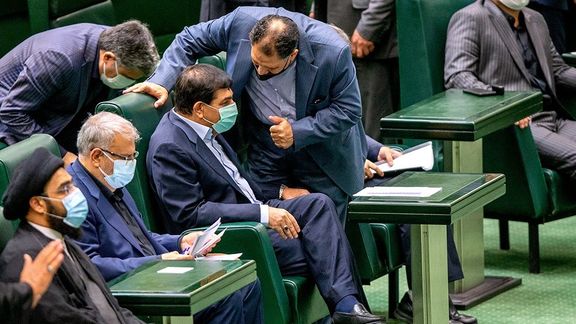
An undated photo of Iranian ministers at a parliamentary session

Reports from Iran indicate that political power within the Raisi administration is likely to change hands between two leading hardline conservative groups.

The reports quote rumors circulating on the popular messaging application Telegram as saying that Mostazafan Foundation Chief Parviz Fattah, a member of the ultraconservative Paydari Party is likely to replace Vice President Mohammad Mokhber who has been under attack for the rapidly falling national currency in the past week.

In a closed-door session of the parliament Saturday morning, Mokhber reportedly refused provide a convincing answer for the rial’s fall and told the lawmakers: "That is how it is. Take it or leave it!"

Conservative news website Nameh News, which reported the possibility of a change at the top level of the Raisi administration on Saturday, said that Vice President for Economic Affairs Mohsen Rezaei is also likely to be replaced by Zahedi Vafa, another Paydari member.

Political observers have been saying recently that no routine change in the combination of the cabinet can save the administration, particularly because all of these hardliner conservative groups are equally inefficient and unpopular. Nonetheless, rumors in Tehran indicate that the new arrivals will strengthen the position of Planning and Budget Organization Chief Massoud Mirkazemi and his efforts to contain the current chaos.

Mohammad Mokhber, president Raisi's top economic aide. Undated
100%
Mohammad Mokhber, president Raisi's top economic aide

President Ebrahim Raisi recently promised during a public meeting with Iran’s ruler Ali Khamenei that the rial will be strengthened. Since then, during the past week the rate of exchange for the US dollar has risen from over 450,000 rials to more than 570,000.

At the same time, while the government is under pressure for the failure or rather lack of an economic policy, an editorial in the reformist daily Sharq predicted that according to political observers in Tehran, as street protests seems to have receded, Iran is likely to face a new wave of unrest because of the inevitable rise in prices as the rial falls.

According to Shargh newspaper, while social protests in the Iranian year 1401 [2022-23] led to major unrest, in 1402 [2023-24] economic matters are likely to create political turmoil. Shargh wrote that this possibility is so strong that even some government institutions have expressed concern about the likelihood.

Meanwhile, political analyst Ghasem Mohebali told Rouydad24 website in an interview that "We are facing a government whose style of management is based on wishful thinking and chanting slogans, mindless of the fact that time is over for that kind of management." Mohebali added: "This is a system that has all the political power and financial resources at its disposal and does not need the people for being elected another round."

"The government thinks that by spreading 'good news' about developments such as a probable visit by the Sultan of Oman, it can lower the rates of exchange, but it does not realize that this wishful thinking does not solve any problem," Mohebali added. He said the government is in a situation that it cannot step back from its positions and at the same time it cannot continue its current policies.

In another development, lawmaker Shiva Ghassemipour said: "although the economic situation was not ideal before Raisi, people's livelihood has become increasingly more difficult under the Raisi administration." Pointing out the political and economic impasse, she said that "It would have not possibly made much of a difference even if someone other Raisi was steering the administration."


Most Viewed

100 days after carnage: Iran economy reels from war, inflation, unemployment
1
INSIGHT

100 days after carnage: Iran economy reels from war, inflation, unemployment

2
INSIGHT

Ghalibaf defends Iran-US talks amid hardline backlash

3
EXCLUSIVE

Iranian assaulted in London amid concern over threats to regime critics

4

IRGC fires at Indian vessel in Hormuz

5
INSIGHT

A nation in limbo: 100 days after the massacre, has the world moved on?

Banner
Banner

Spotlight

  • War-hit homeowners feel abandoned as Iran’s reconstruction aid fades

    War-hit homeowners feel abandoned as Iran’s reconstruction aid fades

  • 100 days on: the anatomy of Iran’s January crackdown
    INSIGHT

    100 days on: the anatomy of Iran’s January crackdown

  • Ghalibaf defends Iran-US talks amid hardline backlash
    INSIGHT

    Ghalibaf defends Iran-US talks amid hardline backlash

  • 100 days on: why Iran’s January protests spread across social classes
    ANALYSIS

    100 days on: why Iran’s January protests spread across social classes

  • From instability to influence: Pakistan’s pivotal role in US-Iran diplomacy
    ANALYSIS

    From instability to influence: Pakistan’s pivotal role in US-Iran diplomacy

  • A nation in limbo: 100 days after the massacre, has the world moved on?
    INSIGHT

    A nation in limbo: 100 days after the massacre, has the world moved on?

•
•
•

More Stories

Iran's Rial Continues To Fall - iPhone At One Billion

Feb 25, 2023, 21:48 GMT+0
•
Maryam Sinaiee

The rial’s plunge to 575,000 against the US dollar Saturday exacerbated chaos in several of Iran's major markets and brought many businesses to near standstill.

The government’s official rate of 417,500 for the dollar on Saturday meant very little. Availability of foreign currency at that rate is very limited which drives buyers to the curbside black market.

Fluctuations in the foreign currency exchange rates have immediate effect on the prices of several other commodities including gold, jewelry, and vehicles -- which many Iranians buy for investment or to preserve the value of their savings -- as well as electronic devices such as computers and smart phones and even home appliances.

The property market usually reflects the changes in exchange rates after a period of around 30 days but buyers and sellers both appear very apprehensive as the rial has been rapidly falling daily for about a week. No one can be certain how far the currency will fall and is not sure about any business decision.

The deep plunge of the rial has also affected many businesses where pricing is not as obviously reflective of foreign currency rates, as is the case with mobile phones and cars.

The price of mobile phones, for instance, rose sharply Saturday with many retailers preferring to hold on to their stock in anticipation of further fall of the rial. According to Etemad newspaper, an iPhone 13 Pro Max which sold for one billion rials ten days ago was priced at 1.2 billion on Thursday when the dollar traded around 560,000 on the street. The price of other brands and models such as Samsung phones has also risen accordingly.

Mohammad Mokhber, Iran's economy czar. Undated
100%
Mohammad Mokhber, Iran's economy czar

Some textile retailers and goldsmiths in the Grand Bazaar of Tehran, for instance, closed their shops Saturday afternoon as the rial continued to fall. In such circumstances, retailers as well as wholesalers are too reluctant to sell for the fear of not being able to replenish their stock with the ‘worthless’ money they earn.

The country is also suffering from an inflation rate of well over 50 percent.

The parliament held an extraordinary, closed session with First Vice President Mohammad Mokhber Saturday morning regarding rials fall and the chaos it has created for businesses.

Once again, Mokhber insisted that the problems which already existed when the administration of President Ebrahim Raisi took over in August 2021 are “gradually diminishing” and that the foreign currency market “will soon be stabilized” while the governor of the Central Bank of Iran (CBI), Mohammadreza Farzin, told lawmakers that only the rates announced by the bank’s new portal were “real”.

Many, however, believe that the rial’s depreciation will continue as long as the Islamic Republic does not reach an agreement with world powers over its nuclear program that can lift sanctions, and stop provoking the international community with rash remarks and statements.

Economy Minister Ehsan Khandouzi tried to convince the parliament that “hidden hands” were responsible for the chaos in the market and that these “saboteurs have been identified.” Security, intelligence, and judiciary bodies will soon deal with these people, he said.

The Islamic republic has resorted at times of similar to hanging individuals whom it accused of “corruption on earth” through their economic activities including destabilizing the foreign currency and gold markets at. Officials also usually accuse foreign governments and “enemies” whenever upheavals in the markets cause popular discontent.

In November 2018, Vahid Mazloumin, who came to be known in the media as “The Sultan of Gold Bullions” and another businessman Mohammad-Esmail Ghasemi were hanged in Tehran after being convicted of “creating a network to destabilize the country’s economic, foreign currency, and financial systems by conducting illegal transactions and large-scale smuggling of foreign currency and gold bullions.”

International Financial Watchdog Keeps Iran On Black List

Feb 25, 2023, 19:39 GMT+0

The international financial watchdog FATF has kept Iran and North Korea on its back list during its latest meeting that ended on Friday.

The Paris-based Financial Action Task Force is an inter-state organization that leads global action to tackle money laundering, terrorist and proliferation financing. Its recommendations impact decisions by governments and private sector firms in making banking and investment decisions.

Iran and North Korea are the only two countries on FATF’s black list, and all member states are urged to apply enhanced due diligence in dealing with them.

Experts say that even if sanctions imposed by Western countries on Iran are lifted, Tehran must adhere to FATF standards in banking and financial controls to be considered a safe business partner by international actors.

Most important are measures to prevent money laundering and financing of terrorism.

Although FATF’s decision comes as no surprise given Tehran’s refusal to accept its demands, it coincides with unprecedented financial and economic chaos in Iran in recent days.

Iran’s previous government submitted legislation to parliament in 2017 to adopt laws to implement FATF’s standards, but the hardliners have since prevented the final approval of the laws.

Opponents argue that if Iran accedes to FATF demands it will not be able to provide financial help to allied groups in the region that are part of Tehran’s “axis of resistance”.

These groups, such as the Lebanese Hezbollah and some Palestinian militant organizations, are designated as terrorist by some countries and act as proxy forces to help the Islamic Republic spread its influence in other countries.

Iran Mulls Plans To Give Tourists 'Unrestricted' Internet

Feb 25, 2023, 17:08 GMT+0
•
Maryam Sinaiee

Iran’s ministry of communications has backtracked, possibly temporarily, from a plan to provide unrestricted internet access to foreign visitors to encourage tourism.

In an interview Thursday with Miras-e Arya, a government-run news website dedicated to cultural heritage and tourism news, the communications minister, Isa Zare’i, said blocking of WhatsApp and Instagram in Iran has created “a little difficulty” for foreign tourists and that his ministry was planning to design special sim cards for them to use to be able to have better and easier access to such platforms.

Many on social media reacted angrily to the minister’s remarks and said the Iranian people had an equal right to have free access to social media platforms and websites that they wish to use.

“It’s true that a tourist, anywhere in the world, must be shown respect by the host country but it is racial discrimination and apartheid if special sim cards are provided to tourist to have specially tailored internet access when the people of that country are deprived of it,” one of the critics tweeted.

Another tweeter user pointed out that issuing such sim cards would encourage a black market.

In a statement Friday, the ministry said the reason for the plan was that foreigners visiting Iran for a short time must be allowed to connect with family and friends through their favored platforms, which are banned in Iran by law, and claimed Iranians are increasingly immigrating to unfiltered domestically-developed platforms.

The ministry went on to say there had been requests to provide limited-time tourist sim cards, which would expire when they leave the country, to provide them with access to certain filtered platforms to resolve their communications problems. “[Issuing] tourist sim cards is only a proposal and no decision has been taken about it yet,” the statement said.

The Twitter account of the government portal, PadDolat, has now removed the tweet which quoted the minister’s original remarks.

Iran has been censoring the internet and blocked most major social media platforms such as Facebook, Twitter, and YouTube for years. Amid recent protests, Instagram, the only freely accessible application which millions including small businesses and farmers used to promote and sell their commodities, was also blocked.

Social media users in Iran have largely shunned domestically developed social media applications such as Wisgoon and Nazdika, designed to replace Instagram, and Rubika, a messaging application, for various reasons including their quality and lack of privacy.

Experts have warned that domestic apps are very vulnerable to government intrusion and there are serious safety and privacy concerns including the fear that security services could be able to spy on people through them.

For years, many in Iran have relied on VPNs and anti-filtering software to navigate through government censorship and blocked social media and websites. The use of VPNs surged drastically following the recent nationwide protests. Farhikhtegan newspaper recently reported that based on a survey, 42 percent of all Iranians regularly use Telegram, and 38 percent WhatsApp and Instagram. All these platforms are only accessible if users install anti-filtering software or VPNs on their phones and computers for which they need to pay subscription fees of up to 2 million rials (around $4) per month.

Former Communications Minister Mohammad-Javad Azari-Jahromi has estimated that the market for VPNs is worth around 160,000 billion rials a year.

Iran has also been struggling with the mass cancellation of previously planned visits to Iran since protest erupted across the country in September following the death in custody of the 22-year-old Mahsa Amini who was arrested for not wearing her hijab “properly”. In November, the head of the Hoteliers Association, Jamshid Hamzehzadeh, said as much as 85 percent of all tours to Iran had been cancelled.

Canada Censures Iranian Regime For Threatening Journalists

Feb 25, 2023, 15:42 GMT+0

Canada has strongly condemned threats by the Iran's regime against journalists inside and outside the country, stressing that it supports the right to freedom of expression.

The foreign ministry told Iran International in a statement on Friday that “Ottawa stands for the right of everyone to hold opinions without interference and the right to freedom of expression and peaceful assembly, as enshrined in the Universal Declaration of Human Rights and the International Covenant on Civil and Political Rights.”

It also slammed the Iranian regime's gross and systematic violations of human rights and intimidation of its own people.

“We stand with the people of Iran, who call for change based on equality, respect and justice.”

The statement stressed that journalists, activists and media workers are the cornerstone of fair, strong and vibrant societies and must be free to do their work without fear of reprisals, political interference or intimidation.

“Any violence and intimidation against journalists or activists is completely unacceptable and must be condemned.”

Iran International was warned by British authorities in November that its journalists were under threat from Iranian agents and London’s Metropolitan Police took measures to strengthen security around the network’s office in the area.

On February 18, the network announced that following the advice of UK anti-terrorism officials it decided to temporarily move its studio operations to the US.

The decision solicited worldwide condemnations of Iran’s malign activities and specially threats against journalists.

Issue Of Education In Minority Languages In Iran Creates Controversy

Feb 25, 2023, 13:28 GMT+0
•
Maryam Sinaiee

Demands for education to be taught not only in Persian but also in the mother tongue of the many communities within Iran, has gone viral on social media.

Sparked by International Mother Language Day, February 21, some speakers of Iran’s many languages including Turki, Kurdish, Balochi and Arabic, are demanding access to education in their native languages.

Heated discussions have flooded social media, especially among the opposition, with allegations of separatism for the government's policy to enforce only Persian language education.

Proponents of education in mother language argue that teaching only in Persian is detrimental to the development of many children whose mother language is different. Some suggest it can cause psychological pressures on young children when they begin their education, hindering their progress.

Asma Balouch is a Baluchi activist
100%
Asma Balouch is a Baluchi activist

In a paper presented to the Second Development and Educational Equality Conference in 2016, prominent economist Mohsen Renani said over 65 percent of the children who had to repeat the first and second years of school were from nine provinces where the first language is not Persian.

“By forcing education in Persian, we reduce the speed of mental and personal development of around half of the country’s population and deprive them of opportunities in favor of Persian-speaking children,” Renani wrote. In the absence of any official data, Renani estimated the total population of non-Persian speakers between 42 to 49 percent of all Iranians.

Article 15 of the Constitution of the Islamic Republic recognizes Persian as the “official language and script of Iran, the lingua franca of its people.” However, it also recognizes the the use of “regional and tribal languages in the press and mass media, as well as for teaching of their literature in schools.”

Some of the programs of the state broadcaster’s local stations are broadcast in other languages including Turki and Kurdish, Arabic and Gilaki but none of the many languages of Iran are allowed to be taught in schools, whether public or private, despite the Constitution. Learning classical Arabic, however, is compulsory after primary education on religious grounds.

Authorities often shut down cultural and literary societies formed to promote other languages and teachers such as Zahra Mohammadi, a Kurdish language teacher, are often prosecuted on charges of acting against national security. Mohammadi who was serving a five-year sentence was recently released from prison.

The regime is particularly strict about the teaching of languages that are spoken in peripheral areas of the country such as Kurdish and Turki and accuses those who promote these languages of separatism.

Restrictions do not only affect teaching of other languages and publication in those languages. Names can only be chosen from a list of approved Persian and Arabic (religious) names. Mahsa Amini, whose death in custody sparked the recent months of unrest, was named Jina by her family but her birth certificate had to be issued as Mahsa.

A survey by Gamaan Institute a year ago found that 85% of respondents considered Farsi (Persian) as the most appropriate official or common language for Iran and 65% agree that schools should teach native languages in addition to Farsi while 19% of respondents disapproved of this option. On the other hand, 61% disagreed with the statement “I prefer my child to receive higher education in their native language rather than in Farsi”, while 18% agreed.

The survey was carried out between February 17-27, 2022. Over 20,000 respondents over the age of 19 participated in this study. The final sample used in the report consisted of 16,850 Iranians living inside Iran.