• العربية
  • فارسی
Brand
  • Iran Insight
  • Politics
  • Economy
  • Analysis
  • Special Report
  • Opinion
  • Podcast
  • Iran Insight
  • Politics
  • Economy
  • Analysis
  • Special Report
  • Opinion
  • Podcast
  • Theme
  • Language
    • العربية
    • فارسی
  • Iran Insight
  • Politics
  • Economy
  • Analysis
  • Special Report
  • Opinion
  • Podcast
All rights reserved for Volant Media UK Limited
volant media logo

Talk Of Reform In Iran Signifies Quest To Reclaim Lost Legitimacy
Iran International Newsroom
Feb 5, 2023, 09:30 GMT+0Updated: 17:40 GMT+1
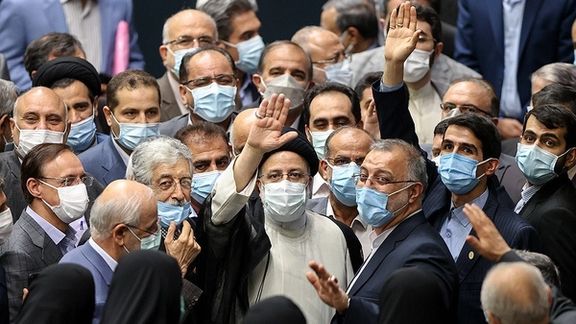
President Ebrahim Raisi among hardliner majority members in parliament. August 2021

Amid a legitimacy crisis for Iran’s regime there are signs that reformist figures are being allowed to speak out possibly as a safety valve to save the system.

As parliamentary elections next year are on the horizon, the regime will have a hard time to have any sort of vote resembling at least a limited choice, unless it allows some reformists to run for seats.

Some conservatives acknowledge the need for essential reforms in the country's political system, and the core of the regime under Supreme Leader Ali Khamenei might consider ending the isolation it has imposed on reformists.

Influential conservative politician and a member of the Expediency Council Mohammad Reza Bahonar is one of the conservatives who has pointed out the need for reforms. Bahonar said in a recent interview: "We need a second Republic," meaning that a Constitutional Assembly should be formed to determine new boundaries for the government's authority and the people's rights.

There are indications that the regime might tolerate reform-minded candidates in the upcoming elections. Members of the press have pointed out more frequent public appearances by former President Hassan Rouhani. He recently met with a like-minded press corps of moderate and reformist journalists and media owners. Meanwhile, he has been speaking out about political issues.

Mir-Hossein Mousavi under house arrest since 2011
100%
Reformist Mir-Hossein Mousavi under house arrest since 2011

In one of his latest political remarks, Rouhani said that "a minority government cannot solve the country's problems." His characterization of Raisi's all conservative administration and the ultraconservative parliament as a "minority government" was reminiscent of his well-known art of tact and dry sense of humor.

There are other reform-minded contestants too for the next election. They are politicians such as Mostafa Tajzadeh who is in jail, and former Prime Minister Mir-Hossein Mousavi who has been under house arrest since 2011. However, if Khamenei is going to allow reform-minded politicians to run for key positions, he is highly unlikely to settle for anyone known to be more of a reformist than moderate conservative Hassan Rouhani.

On Saturday, February 4, Tajzadeh issued a long statement calling for constitutional reforms, i.e, preserving and beautifying the Islamic Republic.

Mostafa Tajzadeh, a former deputy minister, arrested in July 2022
100%
Mostafa Tajzadeh, a former deputy minister, arrested in July 2022

On the same day, Mousavi also introduced his version of a call for constitutional change, which could be summarized as holding a free and fair referendum on changing the constitution or writing a new one, if necessary, forming a constitutional assembly, holding another referendum on the assembly's ratification, establishing a political order based on rule of law and the people's will. Mousavi’s call was clearly more radical, as he declared that the regime cannot be reformed.

These developments coincide with some conservatives also emphasizing the need for reform moves to boost the regime’s legitimacy.

Conservative politician Bahonar, asking for reforms said that protests have not really ended, and warned that after the protests recede, the regime should not forget about the people's grievances and demands, although “we tend to forget about their complaints as soon as the situation calms down."

He said, as the country gets closer to a parliamentary and an Assembly of Experts election next year, “we need to remember that an election without the presence of our rivals would be meaningless.”

He called the recent protest "a hybrid war against the Islamic Republic" waged by Europe, the United States and international media and political forums. He also acknowledged the role of Iranian expats and celebrities in the protests. Nevertheless, he ignored hundreds of thousands of Iranians who took to the streets for over five months.

Bahonar said that foreigners were prompted by recent low-turnout elections to believe that the Islamic Republic has lost its “social capital.” He added that even those who take part in pro-regime demonstrations have many complaints about the performance of the President and other state officials. He further suggested that dialogue should be maintained between the people and the government and elections should be competitive.

He also pointed out that conservatives' political rivals should not be barred from elections as it was the case in parliamentary and presidential elections in 2020 and 2021. He also criticized the regime for weakening political parties over the years.

Most Viewed

State media slam Araghchi's Hormuz tweet, say it let Trump claim victory
1

State media slam Araghchi's Hormuz tweet, say it let Trump claim victory

2

Iran International says it won’t be silenced after London arson attack

3
INSIGHT

How Tehran bends its own red lines to boost state rallies

4
VOICES FROM IRAN

Hope and anger in Iran as fragile ceasefire persists

5

Iran halts petrochemical exports to supply domestic market

Banner
Banner

Spotlight

  • Too early to tell who is winning Iran war, experts say
    PODCAST

    Too early to tell who is winning Iran war, experts say

  • How Tehran bends its own red lines to boost state rallies
    INSIGHT

    How Tehran bends its own red lines to boost state rallies

  • Iran blackout cripples freelancer, small business incomes
    VOICES FROM IRAN

    Iran blackout cripples freelancer, small business incomes

  • Ideology may be fading in Iran, but not in Kashmir's ‘Mini Iran'
    INSIGHT

    Ideology may be fading in Iran, but not in Kashmir's ‘Mini Iran'

  • US blockade enters murky phase as tankers spoof signals and buyers hesitate
    ANALYSIS

    US blockade enters murky phase as tankers spoof signals and buyers hesitate

  • Why the $100 billion Hormuz toll revenue is a myth
    ANALYSIS

    Why the $100 billion Hormuz toll revenue is a myth

•
•
•

More Stories

Iran’s Security Forces ‘Systematically’ Targeting Protesters’ Faces

Feb 4, 2023, 22:18 GMT+0
•
Iran International Newsroom

A new report by a human rights group has confirmed earlier speculations that the Islamic Republic security forces have been systematically targeting protesters’ eyes. 

Norway-based Iran Human Rights on Friday documented over 20 cases of people being blinded in one eye as a result of fire from the security agents during protests, adding that initial data indicates that young women were disproportionately represented among people who had sustained such wounds. 

“Considering the volume of reports about protesters being shot in the head and face by security forces in most Iranian cities, leading to many, including a significant number of young women, being blinded, Iran Human Rights considers the inhumane and unlawful act to have been systematically carried out by the Islamic Republic to crush protests,” the rights group said. 

IHR Director Mahmood Amiry-Moghaddam said, “Exposing the magnitude of the crimes and documenting evidence are crucial steps towards justice that require all citizens' cooperation. Islamic Republic leader Ali Khamenei and the repressive forces under his command must know that they will be held accountable for all their crimes.”

The group claimed that Iran Human Rights researchers have collected and verified information related to many citizens who have lost their sight in one or both eyes as a result of being shot with shotguns or paintball guns in the nationwide protests in the past months. The report also provided a list of cases independently verified by their researchers, noting that the real number is much higher.

The group added that they made their compiled list available to international organizations and the UN fact-finding mission. In their list, they provided photos, names, and other details such as when and where the protesters were targeted in the eye. 

A combo photo of some of the protesters whose eyes were injured by security forces (file)
100%
A combo photo of some of the protesters whose eyes were injured by security forces

The report was released less than a week after the commander of Iranian special police units, Hassan Karami, denied “deliberate” shooting at sensitive parts of the protestors' bodies such as their eyes and heads. He claimed that "the performance of the special unit has shown it is not their intention to deal unprofessionally with people," noting, "I have so much confidence in the ability of the special forces that I have said many times if anyone can prove that even one person was killed due to a mistake by our staff, I will offer them a reward."

While the suppression of the nationwide protests against the Islamic Republic has so far left more than 500 citizens dead and thousands injured, Karami claimed, "The special unit forces have the ability and expertise to restore peace with the least cost and damage."

In November, over 370 ophthalmologists said that a large number of protesters have been taken to medical centers hit by rubber bullets and metal pellets as well as paintball bullets fired at them at close range during the protests, leading to the loss of eyesight in one or both eyes. They warned against the use of shotgun ‘birdshots’ and other projectiles by the security forces that have blinded over 500 protesters since mid-September.

In a November 19 report, The New York Times cited ophthalmologists of three hospitals in the capital Tehran – namely Farabi, Rasoul Akram and Labbafinezhad -- and several doctors in Kordestan province, as saying that about 580 protesters suffered serious eye injuries during the regime’s crackdown.

The full scope of numerous eye injuries has been largely concealed due to the internet blackout in Iran, but medical evidence given to the NYT by doctors, protesters, family members of patients and rights groups revealed that ophthalmology wards in hospitals were overwhelmed with eye injury victims late last year. The range of injuries included mutilated retinas, severed optic nerves and punctured irises.

Sunni Leader In Iran Slams Government Policies Amid New Restrictions

Feb 4, 2023, 18:55 GMT+0
•
Iran International Newsroom

Iran’s most prominent Sunni leader Mawlana Abdolhamid has criticized the government for not allowing criticism, while officials are planning more hijab enforcement.

In his Friday Prayer sermon in Zahedan, Abdolhamid called for freedom of speech and suggested that the Islamic Republic government should begin to include qualified secular individuals in its institutions.

The Sunni leader has become an outspoken critic of the Islamic Republic since nationwide protests broke out last September, and specially after security forces killed more than 80 civilians in the city on September 30.

Criticizing brutality in Iranian prisons, Abdolhamid said that inmates should not feel that they have been imprisoned by the enemy. "All Muslims and followers of other faiths should be treated fairly and equally in prisons. Wardens should not insult or attack the inmates," Abdolhamid stressed.

The call for fair treatment of inmates was made while photos of a political prisoner, Farhad Meysami has gone viral on social media and even found their way to more controlled traditional media. Meysami who has been in jail for five nearly years for doing nothing other than opposing the death sentence, supporting women who removed their scarves in public in 2018, and calling for the release of other political prisoners, is seen in these pictures with his ribs and bones alarmingly visible under his skin with almost no fat and flesh.

Abdolhamid also called for press freedom in Iran and said that journalists should be free to speak about the realities and highlight weaknesses. Meanwhile, he warned government officials that "there is no value in ruling over people who do not want you." In another part of his sermon, Abdolhamid called on the government to release Sunni leaders Mawlana Abdolmajid, Mawlana Gorgij and the Mamustas (Sunni clerics in Kurdistan) from jail. He said these men of God wish well for the society. So, they should not be intimidated or threatened.

The Sunni leader’s critical comments came one day after Shiite cleric Mousa Ghazanfarabadi, the head of the Iranian parliament's Judiciary Committee called for harsher treatment of those who undermine the compulsory hijab rule.

Ghazanfarabadi suggested that those women who undermine compulsory hijab should first receive a text message on their phone and then they should be fined in case they continue to ignore the hijab, and they will be deprived of all social services until they pay the fine.

He also suggested that bad-hijab women should be identified using face detection technology in the streets. Once they are identified, their ID cards will be confiscated, and they will be deprived of social services including using the banking system. He said the parliament is adamant to implement this plan once it is finalized and becomes a law.

However, he insisted that the new system of dealing with bad-hijab women does not include any physical confrontation.

The protests began when Mahsa Amini, a 22-year-old woman was fatally wounded in the custody of the ‘hijab police’ in September. During widespread street protests officials were careful not to speak about enforcing the veiling rule, but now they feel they have crushed the movement.

All this is happening against a backdrop of general dissatisfaction about the deteriorating economic situation. In one of the latest cases of unhappiness about the government's performance, Deputy Commander of the Iranian Army, Habibollah Sayyari said that the budget allocated to the army for the coming year is not enough to confront the many threats Iran is facing in the region.

Iran Expels More Dissident University Professors

Feb 4, 2023, 17:41 GMT+0

Iranian media report that nine professors of Tehran Azad University have been forced into early retirement because of expressing critical views against the Islamic Republic.

Moderate news website Rouydad 24 has quoted Susan Safaverdi, one of the professors as saying that they were expelled because they were not “revolutionary”.

She further noted that she and the eight others, who are expelled on the pretext of reaching the retirement age, have been repeatedly accused of being “anti-establishment”.

Safaverdi also pointed out that the head of the faculty has repeatedly emphasized only those who support the country’s 83-year-ol ruler Ali Khamenei, should teach at the faculty.

Safaverdi is the wife of Mohammad Ali Ramin, deputy minister of culture and a presidential advisor in Mahmoud Ahmadinejad's cabinet.

In addition to the forced retirement of these nine professors, the Islamic Republic is trying to put more pressure on other university professors who support anti-regime protests.

In Khorasan Razavi province in the northeast, Mahshid Gohari, professor of literature at Ferdowsi University of Mashhad, announced on her Instagram page that after seven years of teaching, the university has expelled her.

Javad Atefeh, a playwright, director and theater instructor, announced on his Instagram page, "For reasons that I am sure you know", he was not offered to teach in universities for the next semester.

Court cases have also been filed against many university professors and they have been arrested or summoned.

Opposition Figure In Iran Calls For Fundamental Change, New Constitution

Feb 4, 2023, 14:50 GMT+0
•
Mardo Soghom

A prominent opposition figure says Iran needs a “fundamental change” based on “Woman, Life, Freedom” and constitutional change, in a statement released on Saturday.

Mir-Hossein Mousavi, who was a presidential candidate in 2009 and has been under house arrest since 2011, referring to government violence against protesters, said that such events have “demonstrated major truths for the nation.” The rulers of the Islamic Republic are not willing “to take the smallest step to meet the demands of the people.”

But what was noteworthy in Mousavi’s message, dubbed “To save Iran,” is his conclusion that the people have given up hope for reforms.

The leader of the Green Movement, born from large popular protests in 2009, is known as a staunch reformist, or someone who believes the Islamic Republic can be reformed to become a more democratic and tolerant polity.

But Mousavi’s statement seems to reject reform as a viable alternative, urging fundamental change, a new constitution and a constitutional assembly.

Although he does not openly call for regime change, but his demands, if implemented could lead to a new and democratic political system.

Mousavi in his statement has implicitly repeated what exiled Prince Reza Pahlavi has been saying for years, and other opposition activists have echoed in the past five months – transition from the Islamic Republic.

Mousavi and his wife voting in the 2009 presidential election
100%
Mousavi and his wife voting in the 2009 presidential election

“Iran and the Iranians need a fundamental change, that takes its main features from the pure movement of ‘Woman, Life, Freedom.’ Mousavi said. These three words are “the seeds of a bright future, free of oppression, poverty, humiliation and discrimination.”

This represents an important turning point when an opposition figure from inside Iran demands a new constitution, implicitly rejecting the current leadership altogether.

However, Mousavi carries a heavy political baggage that has dented his popularity. When protests began in 2009 against the highly suspicious victory of Mahmoud Ahmadinejad in presidential elections that year, millions of Iranians poured into streets. They saw Mousavi who was the opposing candidate, as their leader, but he refrained from criticizing Supreme Leader Ali Khamenei who was ultimately responsible for engineering the vote count and the subsequent suppression of protesters. Mousavi came across as someone who did not want to challenge the Islamic Republic.

He also served as prime minister in the 1980s, when the government killed thousands of people in prisons. His critics say that Mousavi has not apologized or explained why he remained silent at the time.

Nevertheless, Mousavi puts forth three demands in his statement. First, a free and untainted referendum about the necessity to change or write a new constitution. Second, in case of a positive vote by the people, to form a constitutional assembly composed of the “real representatives of the nation” through a free and fair election. Third, a second referendum to approve the draft constitution to establish a regime based on rule of law, in conformity with human rights and the will of the people.

Mousavi acknowledged that his three demands require further clarifications, as for example who would implement the changes needed, but he appealed to sense of unity and cooperation “to save Iran”.

Iranians have been hotly debating the need to form an opposition council to manage the protest movement and plan for transition to a new form of government. So far, there are no signs that prominent activists abroad are about to untie and establish a framework of coordination. Inside the country no such move is possible because of repression, but many people seem willing to support a council formed abroad.

Opposition Growing To Iran's Liquidation Of Public Assets

Feb 4, 2023, 09:06 GMT+0
•
Maryam Sinaiee

Many in Iran oppose a plan to hastily liquidate public assets with no supervision or clear process, as many fear it could massively increase corruption.

The so-called ‘privatization’ plan announced earlier this week to be carried out over the next two years is meant to augment the country’s budget. It involves the liquidation of billions of dollars of assets belonging to the government and its affiliated entities including banks under the supervision of a seven-man team with extraordinary powers and immunity from prosecution.

The country’s ruler Ali Khamenei has approved the plan, which is not a real privatization scheme. Well-connected and powerful buyers who are often secretive funds and endowments run by powerful officials are lined up to gobble up the prize.

First Vice President Mohammad Mokhber who is one of the members of the supervision team claimed Thursday that the “immunity” of the team has been misunderstood. “Immunity applies to decisions, not infringement of the law,” he said. His explanation, however, has done very little to reassure the public.

First Vice President Mohammad Mokhber (file photo)
100%
First Vice President Mohammad Mokhber

Many former officials and the media have expressed deep concerns over the plan. Mohammad Reza Salehi, a logistics chief of former President Hassan Rouhani’s office, in a speech at a meeting of former officials earlier this week argued that the so-called privatization would give rise to massive corruption, degenerate the regime from within and eventually cause its collapse. 

Reza Gheibi, an economic journalist told Iran International that the liquidation of assets would not help the government to overcome the economic crisis it is grappling with. “In the best-case scenario, it may balance some of the budget deficit,” he said, adding that transferring these assets to individuals and entities and companies connected with Khamenei’s office, who would be the likely beneficiaries, would give them control over the economy.

The new owners will use these assets to preserve the regime but if the regime is toppled, they will form a class of oligarchs with the power to control the economy, Gheibi said. “It’s a win-win game for the leader’s office and those close to its circle of power.”

In a tweet Wednesday, Iran's exiled prince, Reza Pahlavi, accused Khamenei of plundering the country’s national wealth “greedily” with the so-called privatization plan. “Plunderers should be aware that legal immunity will not help them, and the plundered assets of the Iranian nation should [one day] be restored to the treasury of the nation,” he wrote.

Right before the ‘privatization’ was announced, Mokhber misleadingly claimed that the former royal family had “stolen” the crown jewels when the Shah and his family left before the Islamic Revolution in 1979. The monarchy’s crowns and other crown jewels have been held in the Treasury of National Jewels in Tehran in the past four decades but have not been seen by the public for two years and his accusation worried many that these had been sold or stolen.

Minister of cultural heritage Ezzatollah Zarghami (file photo)
100%
Minister of cultural heritage Ezzatollah Zarghami

The claim, however, was disproved when minister of cultural heritage Ezzatollah Zarghami, published photos of his visit to the treasury with the crowns on display.

In a speech Thursday, head of the Mostazafan Foundation (Bonyad Mostazafan), Parviz Fattah, referred to other invaluable properties of the royals , including expensive art, a 500,000-piece stamp collection, bejeweled swords and daggers, and a unique vehicle collection including a gold-adorned vehicles belonging the to the Shah’s father, King Reza Pahlavi. Fattah’s mention of these assets, which have also remained in Iran, has worried some over the possibility that these invaluable national assets are also going under the hammer under the plan.